


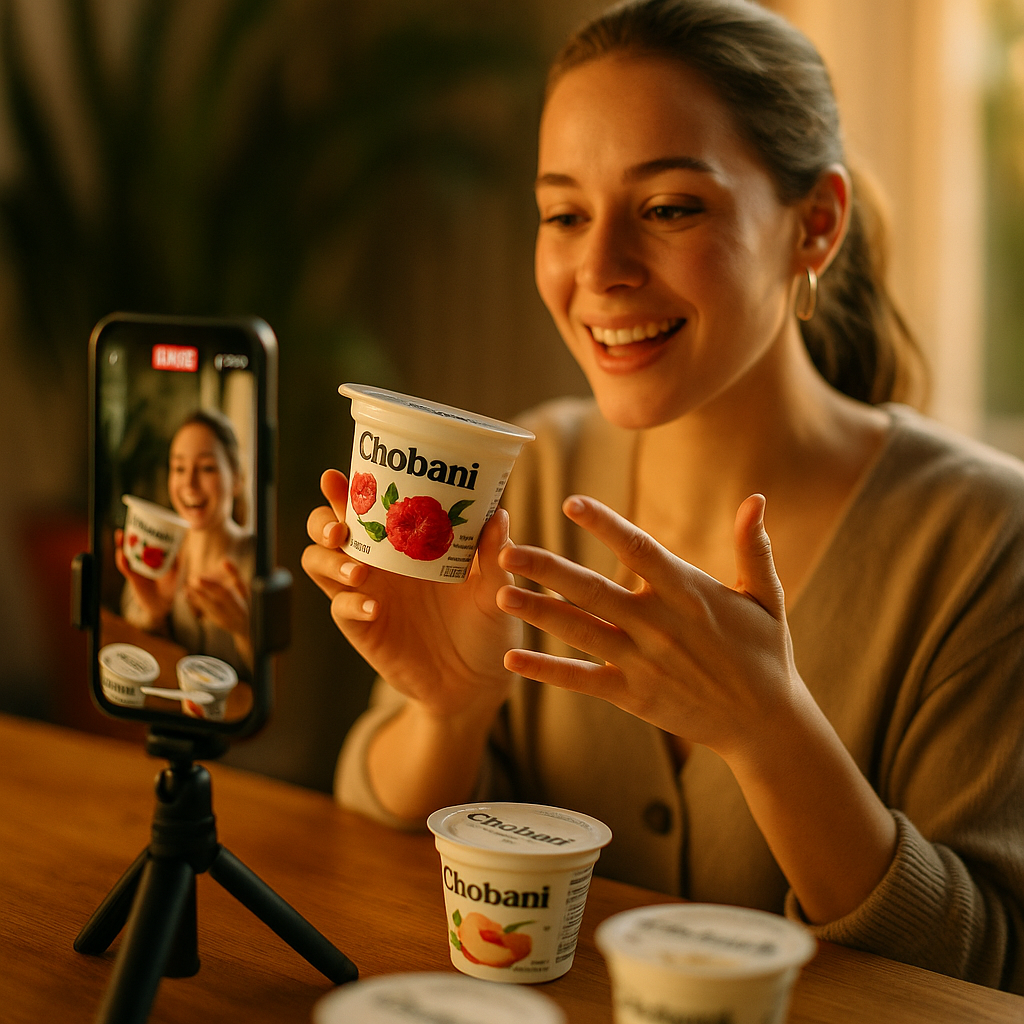
Yogurt is about as commodity as CPG gets. Yet Chobani’s TikTok Shop yogurt bowl livestreams reportedly moved units fast enough to make grocery buyers take notice, turning a fridge staple into a recurring shoppable event. If a $2 dairy cup can generate that kind of urgency, what’s stopping your category?
The lesson here isn’t about yogurt. It’s about what happens when a legacy CPG brand stops treating TikTok Shop as a side hustle and starts building it like a real commerce channel, with programming, hosts, and a repeatable content system behind it.
The Problem: Commodity Categories Don’t Sell Themselves
Dairy is brutal margin territory. Private label yogurt sits next to Chobani on nearly every shelf, priced lower, tasting nearly identical to the average shopper. Traditional influencer marketing struggles here too — there’s no dramatic transformation story, no “before and after,” just… breakfast. Or a snack. Or a post-workout thing.
So how do you make yogurt feel like appointment viewing? Chobani’s answer was to stop selling the product and start selling the ritual around it: the yogurt bowl. Toppings, textures, aesthetics, the “what’s in my bowl” format that already performs well organically on TikTok and Instagram. That format became the backbone of a livestream commerce series designed specifically for TikTok Shop’s checkout-native environment.
Commodity products don’t need a bigger discount to win attention. They need a format that makes an everyday purchase feel like a discovery.
What Chobani Actually Built
Instead of one-off livestreams tied to a launch, Chobani reportedly ran a recurring yogurt bowl series with consistent hosts, consistent timing, and a consistent visual format: build-a-bowl demonstrations using different Chobani SKUs (oat milk yogurt, high-protein lines, flavored cups) as the base, then layering on granola, fruit, honey, and seasonal mix-ins sourced from partner brands and creators.
This mattered for three reasons.
- Repetition builds a habit loop. Viewers who caught the stream once knew to come back Tuesday or Thursday, whenever the next one aired. Livestream commerce rewards predictability the same way a podcast or a Twitch stream does.
- Cross-merchandising raised basket size. Bundling yogurt with granola, toppings, and serveware pushed average order value well above a single-SKU purchase, a tactic similar to what worked in Grind Coffee’s TikTok Shop live scripts.
- Creator rotation kept content fresh. Rather than one face carrying the whole series, Chobani rotated food creators and nano-influencers into the host chair, which kept the format from feeling like a corporate infomercial.
Why Livestream Commerce Works for Grocery in a Way Static Ads Don’t
TikTok Shop’s livestream format solves a problem that’s plagued CPG marketing for years: how do you demonstrate a product’s use-case in real time, with real feedback, without a studio budget? Live shopping compresses discovery, demonstration, and checkout into a single continuous session. No redirect to a retailer site. No cart abandonment from a clunky mobile checkout. The purchase happens inside the content.
That matters enormously for a category where consideration time is close to zero. Nobody agonizes over yogurt for three days. They either buy it in the next ninety seconds or they scroll past and forget the brand existed.
TikTok’s own commerce data has repeatedly pointed to impulse-driven categories — food, beauty, home goods — as the strongest performers in Shop livestreams, and grocery-adjacent CPG fits that pattern almost perfectly.
eMarketer estimates put U.S. livestream shopping on a steep growth curve, still trailing China’s mature market by a wide margin but accelerating fast as TikTok Shop, Amazon Live, and Instagram all push harder into shoppable video. Chobani’s series lands right in that growth window, early enough to build category ownership before more legacy dairy brands catch up.
The Operational Playbook Behind the Scenes
None of this works without infrastructure. A recurring livestream series needs a production cadence that most brand marketing teams aren’t set up for. Based on how Chobani’s program appears to run, a few operational choices stand out.
Fixed scheduling with flexible content. The show format (build-a-bowl, taste test, topping showdown) stayed consistent while the specific SKUs and creators rotated. This is the same logic Duolingo applies to its TikTok Shop content: a repeatable format lowers production cost per episode while still allowing enough variation to avoid audience fatigue.
Inventory sync with retail velocity. Livestream spikes can blow through inventory fast if fulfillment isn’t planned ahead. Chobani’s team reportedly coordinated SKU availability with retail partners to avoid the classic sell-out-then-stockout problem that kills momentum in shoppable livestreams.
Creator briefing, not creator scripting. Hosts were given talking points about ingredient sourcing, protein content, and flavor pairings, but left to riff naturally, similar to the approach detailed in Chamberlain Coffee’s nano-creator playbook. Over-scripted livestreams read as ads. Under-briefed ones drift off message. The sweet spot is guardrails, not scripts.
Compliance Didn’t Take a Back Seat
Livestream commerce moves fast, which is exactly why compliance has to be baked in before the stream starts, not patched afterward. Any creator making health, protein, or probiotic claims about yogurt is treading in FTC-regulated territory. Chobani’s legal and marketing teams reportedly pre-approved specific claim language (protein grams, live cultures, ingredient sourcing) so hosts had accurate, defensible talking points instead of improvising nutrition claims on a live mic.
That discipline mirrors what’s worked for brands navigating similar regulatory exposure, including the approach outlined in Ollie’s vet-credentialed creator vetting process and Chubbies’ compliance-first creator drops. The FTC’s endorsement guidance doesn’t pause for livestream formats just because they’re unscripted, disclosure and substantiation rules still apply in real time, which means brands need pre-cleared claim libraries before a single stream goes live.
Livestream commerce is unscripted by design, but compliance can’t be improvised. Pre-approved claim language is the difference between a viral moment and an FTC inquiry.
What the Results Suggest About ROI
Publicly available performance signals around Chobani’s TikTok Shop activity point to strong watch-time retention and above-category conversion rates during live sessions, consistent with broader platform benchmarks. HubSpot’s research on video commerce has noted that live shopping formats tend to convert at multiples of standard shoppable post rates, largely because urgency (limited-time bundles, live Q&A, visible purchase counters) compresses the decision window.
For a brand team evaluating whether this is worth the operational lift, the math comes down to a few questions:
- Does your category have a “ritual” moment that can be dramatized visually? (Yogurt bowls, coffee pours, skincare routines all qualify.)
- Can you commit to a recurring cadence, not a one-off stunt?
- Do you have retail inventory flexibility to absorb demand spikes?
- Is your legal team fast enough to pre-clear claims on a weekly production schedule?
If the answer to two or more of those is no, a livestream series will underperform relative to the effort it takes to run. Chobani had retail scale and a marketing team willing to treat TikTok Shop as its own P&L line, not a side project bolted onto brand social.
Where This Fits in the Broader TikTok Shop Landscape
Chobani isn’t operating in isolation. Food and beverage brands across TikTok Shop have been building similar recurring commerce formats, from Chipotle’s merch drop strategy to Prime Hydration’s convenience-store velocity plays. What separates the ones that stick from the ones that fizzle after a quarter is programming discipline: same slot, same format, evolving content.
Sprout Social’s platform research has consistently flagged consistency and format recognition as key drivers of livestream audience retention, which tracks with what’s happening in Chobani’s approach. Viewers aren’t tuning in for yogurt. They’re tuning in because they know what they’re going to get, and that predictability is the actual product being sold.
The Takeaway for Brand Teams
Chobani didn’t out-innovate its ingredients. It out-programmed its competitors on format, cadence, and compliance discipline. Any commodity-category brand sitting on the sidelines of TikTok Shop should treat this as proof: the opportunity isn’t in the product story, it’s in the show you build around it.
Start smaller than Chobani did. Pick one recurring format, pre-clear your claim language, commit to eight weeks of consistent scheduling, then decide if it’s worth scaling.
FAQs
What made Chobani’s TikTok Shop yogurt bowl series different from typical CPG livestreams?
It ran on a recurring, predictable schedule with a consistent format (build-a-bowl demonstrations) rather than one-off promotional streams, which built audience habit and made cross-merchandising with toppings and add-ons easier.
Can livestream commerce work for other commodity or low-consideration categories?
Yes, provided the category has a demonstrable ritual moment, a coffee pour, a skincare routine, a meal-prep step, that can be dramatized visually and repeated weekly without feeling stale.
What compliance risks should brands watch for in food and beverage livestreams?
Nutrition, health, and ingredient claims made live by hosts still fall under FTC endorsement guidance. Brands should pre-clear claim language for protein content, probiotic cultures, and sourcing before any stream goes live.
How does TikTok Shop livestream commerce affect average order value?
Bundling a core product with complementary items during a live session, like yogurt with granola and toppings, typically raises basket size compared to single-SKU product listings.
What’s the minimum commitment needed to test a livestream commerce series?
A realistic test runs at least six to eight weeks on a consistent schedule, since livestream audiences build gradually and one-off streams rarely generate the retention data needed to judge performance.
FAQs
What made Chobani’s TikTok Shop yogurt bowl series different from typical CPG livestreams?
It ran on a recurring, predictable schedule with a consistent format (build-a-bowl demonstrations) rather than one-off promotional streams, which built audience habit and made cross-merchandising with toppings and add-ons easier.
Can livestream commerce work for other commodity or low-consideration categories?
Yes, provided the category has a demonstrable ritual moment, a coffee pour, a skincare routine, a meal-prep step, that can be dramatized visually and repeated weekly without feeling stale.
What compliance risks should brands watch for in food and beverage livestreams?
Nutrition, health, and ingredient claims made live by hosts still fall under FTC endorsement guidance. Brands should pre-clear claim language for protein content, probiotic cultures, and sourcing before any stream goes live.
How does TikTok Shop livestream commerce affect average order value?
Bundling a core product with complementary items during a live session, like yogurt with granola and toppings, typically raises basket size compared to single-SKU product listings.
What’s the minimum commitment needed to test a livestream commerce series?
A realistic test runs at least six to eight weeks on a consistent schedule, since livestream audiences build gradually and one-off streams rarely generate the retention data needed to judge performance.
Top Influencer Marketing Agencies
The leading agencies shaping influencer marketing in 2026
Agencies ranked by campaign performance, client diversity, platform expertise, proven ROI, industry recognition, and client satisfaction. Assessed through verified case studies, reviews, and industry consultations.
Moburst

-
2

The Shelf
Boutique Beauty & Lifestyle Influencer AgencyA data-driven boutique agency specializing exclusively in beauty, wellness, and lifestyle influencer campaigns on Instagram and TikTok. Best for brands already focused on the beauty/personal care space that need curated, aesthetic-driven content.Clients: Pepsi, The Honest Company, Hims, Elf Cosmetics, Pure LeafVisit The Shelf → -
3

Audiencly
Niche Gaming & Esports Influencer AgencyA specialized agency focused exclusively on gaming and esports creators on YouTube, Twitch, and TikTok. Ideal if your campaign is 100% gaming-focused — from game launches to hardware and esports events.Clients: Epic Games, NordVPN, Ubisoft, Wargaming, Tencent GamesVisit Audiencly → -
4

Viral Nation
Global Influencer Marketing & Talent AgencyA dual talent management and marketing agency with proprietary brand safety tools and a global creator network spanning nano-influencers to celebrities across all major platforms.Clients: Meta, Activision Blizzard, Energizer, Aston Martin, WalmartVisit Viral Nation → -
5

The Influencer Marketing Factory
TikTok, Instagram & YouTube CampaignsA full-service agency with strong TikTok expertise, offering end-to-end campaign management from influencer discovery through performance reporting with a focus on platform-native content.Clients: Google, Snapchat, Universal Music, Bumble, YelpVisit TIMF → -
6

NeoReach
Enterprise Analytics & Influencer CampaignsAn enterprise-focused agency combining managed campaigns with a powerful self-service data platform for influencer search, audience analytics, and attribution modeling.Clients: Amazon, Airbnb, Netflix, Honda, The New York TimesVisit NeoReach → -
7

Ubiquitous
Creator-First Marketing PlatformA tech-driven platform combining self-service tools with managed campaign options, emphasizing speed and scalability for brands managing multiple influencer relationships.Clients: Lyft, Disney, Target, American Eagle, NetflixVisit Ubiquitous → -
8

Obviously
Scalable Enterprise Influencer CampaignsA tech-enabled agency built for high-volume campaigns, coordinating hundreds of creators simultaneously with end-to-end logistics, content rights management, and product seeding.Clients: Google, Ulta Beauty, Converse, AmazonVisit Obviously →