


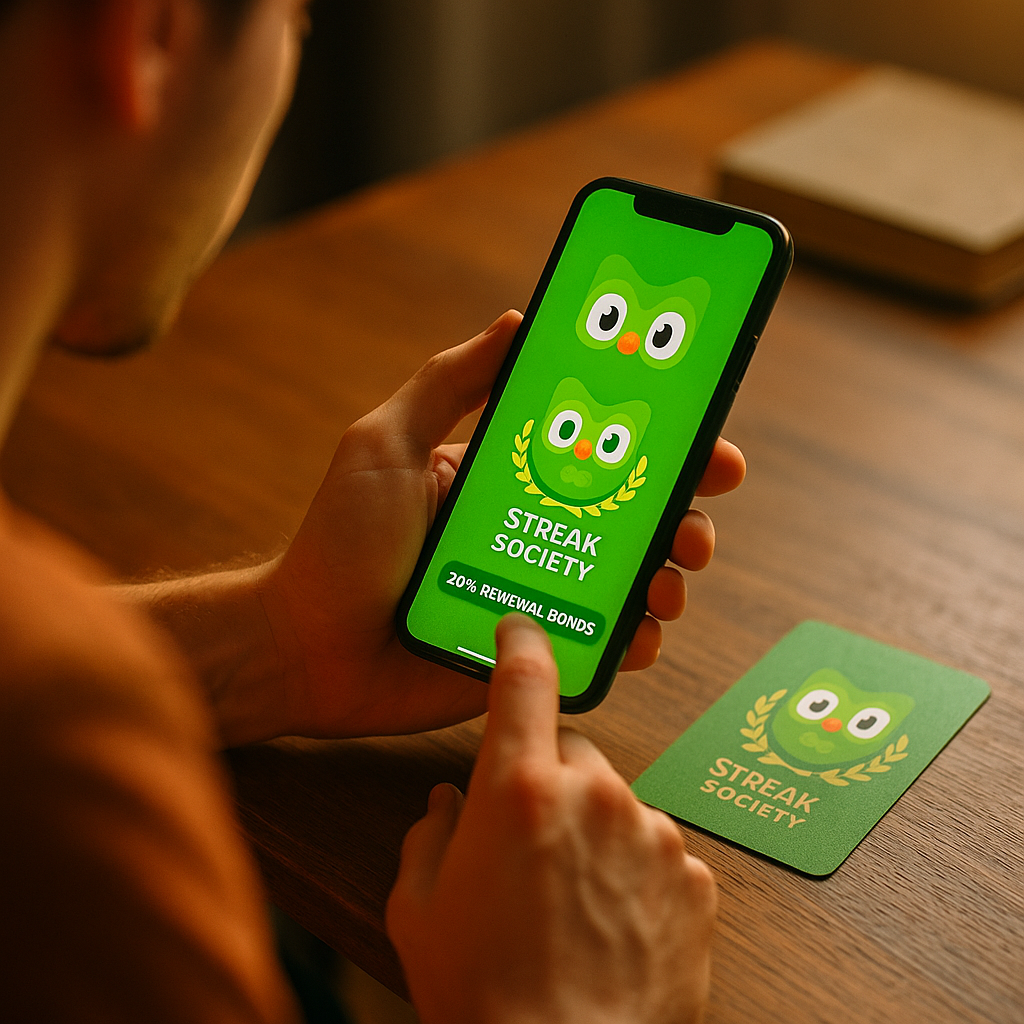
A 20% lift in paid subscription renewals isn’t a rounding error. It’s the kind of number that gets a CFO’s attention in a board meeting. That’s what Duolingo reportedly achieved after rolling out its Streak Society loyalty tier and letting creators, not press releases, break the news. This Duolingo Streak Society case study breaks down exactly how a loyalty perk turned into a retention engine, and what B2B marketers can lift from it.
Why a Language App’s Loyalty Tier Matters to Every Subscription Brand
Duolingo has never marketed like a typical edtech company. Its TikTok owl has already been dissected in Duolingo’s owl playbook and its trend-jacking system covered extensively across the creator economy press. But Streak Society represents something different: a shift from top-of-funnel comedy to bottom-of-funnel retention economics.
Subscription businesses live and die by renewal rates. Acquiring a Super Duolingo subscriber costs money, ad spend, creator fees, app store optimization. Losing that subscriber at renewal erases the entire investment. So when a company known for viral awareness plays applies the same creator-first instincts to retention, it’s worth studying closely.
A 20% renewal lift isn’t a brand awareness metric. It’s a direct revenue signal, and that’s precisely why this case study matters more than another viral TikTok skit.
What Is Streak Society, Exactly?
Streak Society is Duolingo’s loyalty layer for users who maintain long learning streaks, rewarding consistency with exclusive perks: badges, early feature access, special in-app cosmetics, and status signaling within the app’s social features. It’s less a “rewards program” in the airline-miles sense and more a gamified status tier that taps into the same psychology driving the streak mechanic itself, loss aversion and habit reinforcement.
The mechanic isn’t new to gaming or fitness apps. What’s notable is how Duolingo announced it. Instead of an in-app modal or a corporate blog post, the company handed the reveal to its existing creator bench, the same TikTok and YouTube personalities who’d already built audience trust through the brand’s chaotic, meme-heavy content strategy documented in the owl’s trend-jacking system.
The Announcement Strategy: Creators as the Product Launch Channel
Here’s the part most brands get wrong. They build a great loyalty feature, then bury the announcement in an email newsletter nobody opens. Duolingo did the opposite. It treated the Streak Society launch like a product drop, not a feature update.
- Creators who’d built long-running “Duolingo streak” content series got early access before public rollout.
- Announcement videos were framed as personal milestones (“I finally unlocked this after a 400-day streak”) rather than sponsored placements.
- Content leaned into FOMO, positioning Streak Society as something earned, not purchased, which reframed the paid subscription as a gateway to status rather than just an ad-free experience.
This matters because subscription fatigue is real. eMarketer research has repeatedly flagged rising churn concerns across consumer subscription apps as users audit recurring charges. A feature that turns a subscription into an identity marker, rather than a utility, gives users an emotional reason to keep paying beyond pure functionality.
Breaking Down the 20% Renewal Lift
The reported 20% lift in paid subscription renewals didn’t come from a single video going viral. It came from a compounding effect across three levers working together.
1. Perceived Exclusivity Reduced Price Sensitivity
When creators frame a perk as earned status rather than a purchased add-on, users mentally decouple the renewal decision from price. They’re not asking “is this worth $12.99 a month?” They’re asking “do I want to lose my Streak Society badge?” That’s a fundamentally different psychological transaction, and it’s the same loss-aversion trigger that makes the streak counter itself so sticky.
2. Creator Trust Shortened the Consideration Cycle
Users who’d followed a specific creator’s Duolingo journey for months already trusted that creator’s take on whether the paid tier was worth it. That trust transfer meant less time spent second-guessing the renewal, and less exposure to churn-triggering moments like a surprise charge notification.
3. Timing Aligned With Natural Renewal Windows
Duolingo reportedly synced creator content drops with subscription renewal cycles, not random calendar dates. That’s an operational detail easy to overlook, but it’s the difference between content that entertains and content that converts at the exact moment a user is deciding whether to keep paying.
The real lesson isn’t “make a loyalty program.” It’s “make the loyalty program’s announcement do the retention work that your pricing page can’t.”
How This Compares to Duolingo’s Broader Creator Playbook
Duolingo’s top-of-funnel work is well documented. Its TikTok localization strategy shows how the brand adapts humor across markets while keeping the owl consistent. Its YouTube long-form strategy demonstrates a parallel channel built for depth rather than chaos. Streak Society sits at the intersection of both: it needed short-form virality to spread awareness fast, but it also needed longer creator narratives (the “my 500-day streak story” genre) to build the emotional weight that makes exclusivity feel earned.
What’s different here is funnel stage. Most influencer marketing case studies, including plenty covered on this site, focus on acquisition: driving trial signups, store traffic, or first purchase. Think Chobani’s TikTok Shop engine or Prime Hydration’s convenience store velocity. Streak Society is a retention play, arguably the harder problem, because you’re marketing to people who already pay you and could easily stop.
The Operational Playbook for B2B and Brand Marketers
You don’t run a language app. You might run a SaaS platform, a subscription box, a membership community, or a B2C app with a freemium-to-paid funnel. Here’s what transfers.
- Give loyal creators early access before public launch. Early access converts creators into authentic first-users rather than paid narrators. Their genuine reaction is the asset, not the script.
- Frame perks as status, not discounts. A 10% discount is forgettable. A badge that signals “I’m a top-tier user” taps into identity, which drives stronger retention than price incentives alone, according to loyalty research from HubSpot’s customer retention resources.
- Sync creator content calendars with renewal cycles. Don’t just plan for launch-day buzz. Map creator drops against subscription billing dates, trial-expiration windows, and re-engagement email sequences.
- Track renewal lift, not just impressions. Vanity metrics like views don’t prove ROI. Tie creator content to cohort-level renewal data, similar to how L’Oréal Luxe’s attribution graph connects creator touchpoints to purchase behavior.
- Choose creators with tenure, not just reach. A creator with an 18-month posting history about your product carries more retention-driving credibility than a one-off influencer with bigger follower counts.
Risk and Compliance Considerations
Retention-focused creator campaigns still fall under the same disclosure rules as awareness campaigns. If creators receive early access, free premium tiers, or compensation to promote Streak Society-style features, that’s a material connection requiring clear disclosure under FTC endorsement guidelines. Brands operating internationally should also check regional equivalents; UK marketers, for instance, need to account for ICO guidance where data-driven personalization intersects with influencer promotion.
There’s a subtler risk too: authenticity decay. If every “earned status” video looks suspiciously well-produced, users notice. Duolingo’s advantage is years of built-up creator relationships and a brand voice that tolerates chaos. Brands trying to copy this without that foundation risk the perk feeling like a paid ad wearing a loyalty costume, which can backfire and increase skepticism rather than reduce it.
Measuring What Actually Matters
If you’re building a similar test, don’t stop at engagement metrics. Track:
- Renewal rate lift among users exposed to creator-led loyalty content versus a control group
- Time-to-churn delta for cohorts who engaged with creator content near their renewal date
- Net revenue retention, not just gross renewal counts
- Creator-attributed reactivations among lapsed subscribers
Platforms like Sprout Social and internal subscription analytics tools can help you build the attribution bridge between a creator post and a renewal decision, though most brands will need custom cohort tagging to get it right.
Next Step
If your subscription product has any kind of streak, tier, or milestone mechanic, stop treating the announcement as an in-app notification. Hand it to two or three long-tenured creators, sync the drop to your renewal window, and measure churn delta, not just views, over the following billing cycle.
FAQs
What is Duolingo’s Streak Society?
Streak Society is a loyalty tier within Duolingo that rewards long-term learning streaks with exclusive perks, badges, and status features designed to reinforce habit and subscription retention.
How did creator-led announcements drive a 20% renewal lift?
Creators framed the loyalty perk as earned status rather than a paid upgrade, reducing price sensitivity and building trust that shortened users’ renewal decision cycle, especially when content was timed to actual billing dates.
Can this strategy work outside of consumer apps?
Yes. Any subscription business, SaaS, membership, or media platform, can apply the same principles: early creator access, status-based framing over discounts, and syncing content drops to renewal windows.
What disclosure rules apply to retention-focused creator campaigns?
The same FTC endorsement guidelines that apply to acquisition campaigns apply here. Any compensation, free access, or material connection between the brand and creator must be clearly disclosed.
How is this different from Duolingo’s TikTok comedy content?
Duolingo’s viral TikTok content drives top-of-funnel awareness, while Streak Society’s creator announcements target bottom-of-funnel retention, focusing on existing paid subscribers rather than new user acquisition.
Top Influencer Marketing Agencies
The leading agencies shaping influencer marketing in 2026
Agencies ranked by campaign performance, client diversity, platform expertise, proven ROI, industry recognition, and client satisfaction. Assessed through verified case studies, reviews, and industry consultations.
Moburst

-
2

The Shelf
Boutique Beauty & Lifestyle Influencer AgencyA data-driven boutique agency specializing exclusively in beauty, wellness, and lifestyle influencer campaigns on Instagram and TikTok. Best for brands already focused on the beauty/personal care space that need curated, aesthetic-driven content.Clients: Pepsi, The Honest Company, Hims, Elf Cosmetics, Pure LeafVisit The Shelf → -
3

Audiencly
Niche Gaming & Esports Influencer AgencyA specialized agency focused exclusively on gaming and esports creators on YouTube, Twitch, and TikTok. Ideal if your campaign is 100% gaming-focused — from game launches to hardware and esports events.Clients: Epic Games, NordVPN, Ubisoft, Wargaming, Tencent GamesVisit Audiencly → -
4

Viral Nation
Global Influencer Marketing & Talent AgencyA dual talent management and marketing agency with proprietary brand safety tools and a global creator network spanning nano-influencers to celebrities across all major platforms.Clients: Meta, Activision Blizzard, Energizer, Aston Martin, WalmartVisit Viral Nation → -
5

The Influencer Marketing Factory
TikTok, Instagram & YouTube CampaignsA full-service agency with strong TikTok expertise, offering end-to-end campaign management from influencer discovery through performance reporting with a focus on platform-native content.Clients: Google, Snapchat, Universal Music, Bumble, YelpVisit TIMF → -
6

NeoReach
Enterprise Analytics & Influencer CampaignsAn enterprise-focused agency combining managed campaigns with a powerful self-service data platform for influencer search, audience analytics, and attribution modeling.Clients: Amazon, Airbnb, Netflix, Honda, The New York TimesVisit NeoReach → -
7

Ubiquitous
Creator-First Marketing PlatformA tech-driven platform combining self-service tools with managed campaign options, emphasizing speed and scalability for brands managing multiple influencer relationships.Clients: Lyft, Disney, Target, American Eagle, NetflixVisit Ubiquitous → -
8

Obviously
Scalable Enterprise Influencer CampaignsA tech-enabled agency built for high-volume campaigns, coordinating hundreds of creators simultaneously with end-to-end logistics, content rights management, and product seeding.Clients: Google, Ulta Beauty, Converse, AmazonVisit Obviously →