


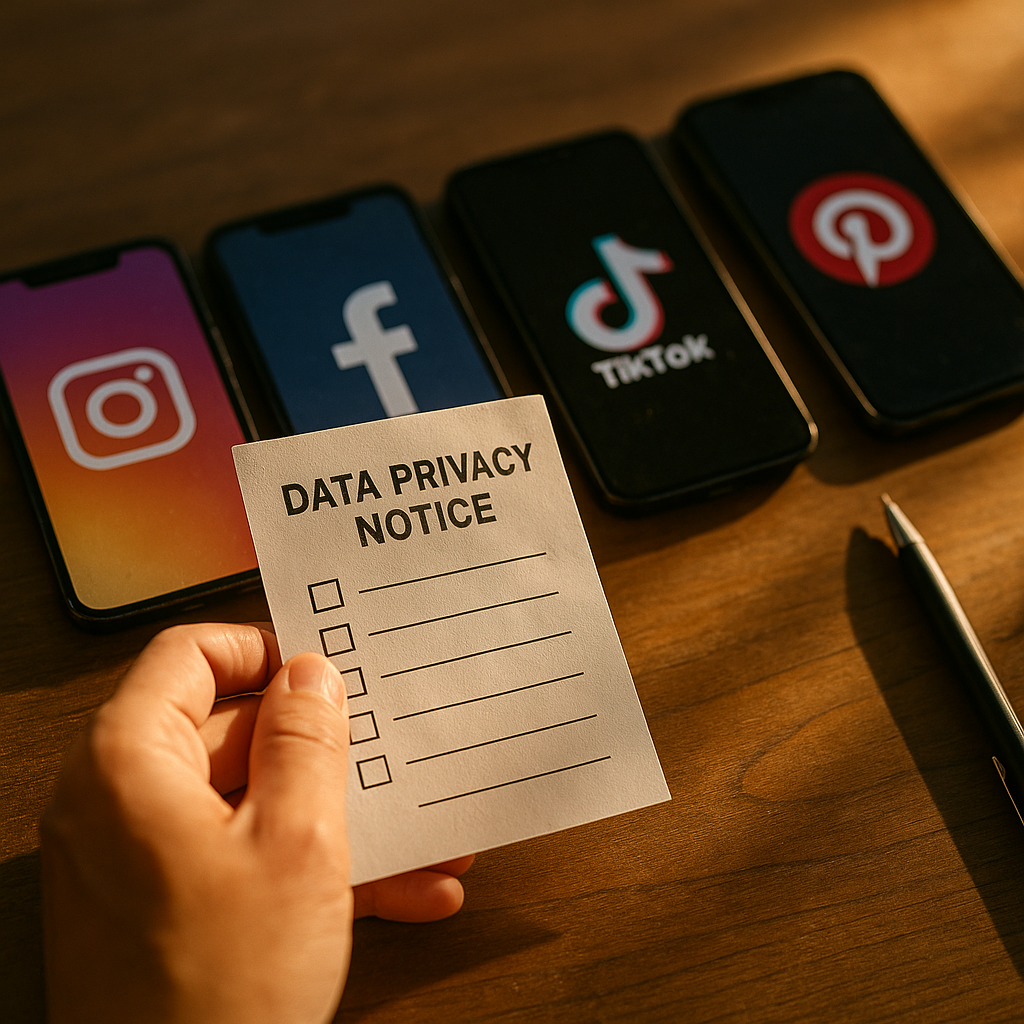
Four platforms, four data-collection regimes, one shopping cart. If your brand runs social commerce across TikTok Shop, Instagram Checkout, YouTube Shopping and LinkedIn lead gen, you’re managing at least four distinct data-privacy notice obligations simultaneously, and most legal teams are only tracking one or two. Regulators aren’t grading on a curve.
The FTC’s renewed interest in dark patterns and the EU’s Digital Services Act enforcement wave both converge on the same weak point: consent language buried in checkout flows nobody reads. Social commerce makes this worse because the “notice” isn’t just a privacy policy link anymore. It’s a checkbox, a pixel, a saved-card prompt, and a chatbot all collecting data in a single transaction.
Why One Privacy Policy Doesn’t Cut It Anymore
Most brands still treat data-privacy notices as a single, static document. Legal drafts it, it lives on the website footer, and everyone assumes it covers whatever happens on TikTok Shop or Instagram’s in-app checkout. It doesn’t.
Each platform layers its own data flows on top of your brand’s collection. TikTok Shop pulls purchase and browsing data into its own ads system. Instagram Checkout routes payment info through Meta’s infrastructure. YouTube Shopping ties into Google’s account graph. LinkedIn lead gen forms auto-fill from member profile data your brand never directly collected. Your privacy notice needs to disclose all of it, accurately, per surface.
A privacy notice that describes your website’s data practices but stays silent on in-app commerce flows is not a compliance gap — it’s a compliance void.
Regulators increasingly treat platform-specific data handling as material to consumer consent. The UK’s Information Commissioner’s Office has flagged embedded commerce and lead-gen tools as high-risk precisely because users don’t realize a third platform is processing their data mid-transaction.
TikTok Shop: The Fastest-Moving Target
TikTok Shop’s checkout collects shipping addresses, payment tokens, purchase history, and behavioral signals for its recommendation engine, often within the same session a user watches a creator video. Your notice needs to specify:
- Whether TikTok Shop data feeds back into your brand’s CRM or stays platform-side
- Retention periods for order and return data collected through TikTok’s checkout API
- Whether affiliate-linked purchases trigger data sharing with the creator or their agency
This last point matters more than most teams realize. If a creator’s affiliate link generates commission data tied to a specific buyer, that’s a data-sharing relationship requiring disclosure, not just an internal analytics footnote. Brands still catching up on TikTok’s shifting compliance posture should review the platform’s infrastructure restructuring and how it changes where data actually lives. It’s also worth pairing this with the broader affiliate vetting standard TikTok introduced, since vetting and data disclosure now travel together in enforcement actions.
TikTok’s ad platform documentation is the baseline reference here — check TikTok for Business for current data-processing terms before finalizing your notice language, because they change faster than most legal review cycles.
Instagram and the Meta Checkout Problem
Instagram Checkout (and the broader Meta Shops infrastructure) blends brand-owned data with Meta’s ad targeting stack. The tricky part: Meta’s own privacy disclosures cover its side of the transaction, but your brand’s notice still needs to explain what happens to the data once it’s in your systems.
Ask yourself: does your notice disclose that Instagram Checkout data may be used to build lookalike audiences? Does it explain retention for saved payment methods? If a customer requests deletion under CCPA or GDPR, do you know how to purge Meta-side records, or just your own database?
This is where a lot of teams get exposed. Meta’s conversion data is useful for optimization, but it’s not proof of anything in a regulatory sense, and brands that lean on it as a substitute for real consent documentation are building on sand. That’s the same logic explored in this breakdown of Meta conversion data limits — the data tells you what happened, not what customers agreed to.
Meta’s own developer and business documentation, available at business.meta.com, should be your reference point for what Meta itself discloses, so your notice fills the gaps rather than duplicating or contradicting it.
YouTube Shopping: Watch Data Meets Purchase Data
YouTube Shopping is newer to the social commerce mix, but it inherits Google’s entire account and watch-history infrastructure. That’s a lot of signal. A viewer who watches a haul video, clicks a product tag, and completes checkout has generated at least three distinct data points your notice needs to account for: viewing behavior, click-through intent, and transactional data.
The complication is that YouTube’s monetization shift toward watch-time and engagement metrics means brands are now tracking viewer behavior more granularly than ever, often blending it with purchase-intent signals for attribution. That dual-tracking reality is exactly why disclosure needs to cover both content engagement and commerce data together, not as separate footnotes. For a deeper look at how this affects disclosure obligations more broadly, see this dual disclosure checklist.
Google’s support documentation at support.google.com outlines current merchant and shopping data policies, but treat it as a floor, not a ceiling, for your own notice language.
LinkedIn’s Lead Gen Forms Are a Commerce Tool Too
It’s easy to forget LinkedIn belongs in this conversation. But LinkedIn Lead Gen Forms function as a commerce funnel for B2B brands, auto-populating fields from member profiles and feeding data straight into CRM and marketing automation systems. That’s a data flow requiring the same rigor as a TikTok Shop checkout.
LinkedIn’s recent removal of the EU consent checkbox from its ad forms caught a lot of legal teams flat-footed. If your brand hasn’t updated its consent language since that change, you’re likely out of step with current requirements. The fix isn’t complicated, but it does require rewriting form-level disclosures rather than relying on a blanket privacy policy link. Full detail on the specific language changes needed is in this consent checkbox fix guide, and a broader audit framework is available in this lead gen forms audit.
If your LinkedIn consent language hasn’t been touched since the checkbox removal, assume it’s already non-compliant. Platform-level defaults change faster than brand legal review cycles.
Building the Cross-Platform Checklist
Here’s the practical version. Rather than four separate notices, build one master data-privacy notice with platform-specific annexes. This keeps the core disclosure consistent while letting you update platform-specific language as TikTok, Meta, Google, and LinkedIn each shift their own policies (which happens more often than anyone wants).
Your checklist should cover:
- Data collected per platform — payment, behavioral, profile, and third-party affiliate data, itemized separately for each surface
- Retention periods — matched to each platform’s own data lifecycle, not a single blanket period
- Third-party sharing — including creators, affiliates, ad networks, and any retail media partners pulling sales-lift data
- Deletion and access rights — with a documented process for purging platform-side records, not just internal databases
- Consent mechanism per surface — checkbox, implied consent, or platform-native opt-in, clearly labeled as such
- Update cadence — a review trigger tied to platform policy changes, not just an annual calendar review
Brands running retail media alongside social commerce should also cross-check their sales-lift data agreements, since attribution data often crosses into the same consent territory. The retail media DPA guide and the related sales-lift claims checklist both connect directly to this notice-building work, since overlapping data processing agreements need to say the same thing your public notice says.
For creator-specific data flows, particularly around affiliate commissions and gifting programs where personal data moves between brand, platform, and creator, the creator data consent framework offers a parallel structure worth aligning your notice against.
What Happens If You Skip This
The FTC has made clear that vague or missing disclosures around data collection in commerce flows are enforcement-worthy on their own, independent of whether a deceptive claim was made. The EU’s DSA enforcement wave has similarly targeted platforms and brands for youth-targeting and consent failures in ad and commerce tools, a trend covered in this DSA enforcement analysis. Industry benchmarking from eMarketer continues to show social commerce spend climbing faster than compliance infrastructure, which is exactly the gap regulators are watching.
The operational risk isn’t abstract. A missing disclosure on one platform can trigger a review of your entire data practice, across all four. That’s the real cost of treating this as four separate checkboxes instead of one coordinated system.
Start this quarter: audit your current privacy notice against each platform’s actual data flow, not what you assume it collects, and build the annex structure before your next FTC or GDPR review finds the gap for you.
FAQs
Do brands need a separate privacy notice for each social commerce platform?
Not necessarily separate documents, but you do need platform-specific disclosure sections (annexes) within one master notice, since data collection, retention, and sharing differ meaningfully across TikTok Shop, Instagram Checkout, YouTube Shopping, and LinkedIn lead gen tools.
What’s the biggest compliance gap brands miss in social commerce privacy notices?
Failing to disclose third-party data sharing with creators and affiliates. When affiliate links generate commission data tied to specific buyers, that’s a disclosable data relationship, not just internal analytics.
How often should these notices be updated?
Whenever a platform changes its own data policy or consent mechanism, not on a fixed annual schedule. LinkedIn’s removal of the EU consent checkbox is a recent example of a platform-side change that immediately made existing brand notices outdated.
Does a “Paid Partnership” label satisfy data-privacy disclosure requirements?
No. Sponsorship labels address disclosure of paid relationships, not data collection and processing consent. These are separate compliance obligations, and conflating them is a common mistake, as detailed in this analysis of partnership label limits.
Who owns responsibility for platform-side data once a purchase completes?
Both the platform and the brand share responsibility, but the brand’s privacy notice must still explain what happens to platform-collected data once it enters brand systems, including deletion processes for platform-side records.
FAQs
Do brands need a separate privacy notice for each social commerce platform?
Not necessarily separate documents, but you do need platform-specific disclosure sections (annexes) within one master notice, since data collection, retention, and sharing differ meaningfully across TikTok Shop, Instagram Checkout, YouTube Shopping, and LinkedIn lead gen tools.
What’s the biggest compliance gap brands miss in social commerce privacy notices?
Failing to disclose third-party data sharing with creators and affiliates. When affiliate links generate commission data tied to specific buyers, that’s a disclosable data relationship, not just internal analytics.
How often should these notices be updated?
Whenever a platform changes its own data policy or consent mechanism, not on a fixed annual schedule. LinkedIn’s removal of the EU consent checkbox is a recent example of a platform-side change that immediately made existing brand notices outdated.
Does a “Paid Partnership” label satisfy data-privacy disclosure requirements?
No. Sponsorship labels address disclosure of paid relationships, not data collection and processing consent. These are separate compliance obligations, and conflating them is a common mistake.
Who owns responsibility for platform-side data once a purchase completes?
Both the platform and the brand share responsibility, but the brand’s privacy notice must still explain what happens to platform-collected data once it enters brand systems, including deletion processes for platform-side records.
Top Influencer Marketing Agencies
The leading agencies shaping influencer marketing in 2026
Agencies ranked by campaign performance, client diversity, platform expertise, proven ROI, industry recognition, and client satisfaction. Assessed through verified case studies, reviews, and industry consultations.
Moburst

-
2

The Shelf
Boutique Beauty & Lifestyle Influencer AgencyA data-driven boutique agency specializing exclusively in beauty, wellness, and lifestyle influencer campaigns on Instagram and TikTok. Best for brands already focused on the beauty/personal care space that need curated, aesthetic-driven content.Clients: Pepsi, The Honest Company, Hims, Elf Cosmetics, Pure LeafVisit The Shelf → -
3

Audiencly
Niche Gaming & Esports Influencer AgencyA specialized agency focused exclusively on gaming and esports creators on YouTube, Twitch, and TikTok. Ideal if your campaign is 100% gaming-focused — from game launches to hardware and esports events.Clients: Epic Games, NordVPN, Ubisoft, Wargaming, Tencent GamesVisit Audiencly → -
4

Viral Nation
Global Influencer Marketing & Talent AgencyA dual talent management and marketing agency with proprietary brand safety tools and a global creator network spanning nano-influencers to celebrities across all major platforms.Clients: Meta, Activision Blizzard, Energizer, Aston Martin, WalmartVisit Viral Nation → -
5

The Influencer Marketing Factory
TikTok, Instagram & YouTube CampaignsA full-service agency with strong TikTok expertise, offering end-to-end campaign management from influencer discovery through performance reporting with a focus on platform-native content.Clients: Google, Snapchat, Universal Music, Bumble, YelpVisit TIMF → -
6

NeoReach
Enterprise Analytics & Influencer CampaignsAn enterprise-focused agency combining managed campaigns with a powerful self-service data platform for influencer search, audience analytics, and attribution modeling.Clients: Amazon, Airbnb, Netflix, Honda, The New York TimesVisit NeoReach → -
7

Ubiquitous
Creator-First Marketing PlatformA tech-driven platform combining self-service tools with managed campaign options, emphasizing speed and scalability for brands managing multiple influencer relationships.Clients: Lyft, Disney, Target, American Eagle, NetflixVisit Ubiquitous → -
8

Obviously
Scalable Enterprise Influencer CampaignsA tech-enabled agency built for high-volume campaigns, coordinating hundreds of creators simultaneously with end-to-end logistics, content rights management, and product seeding.Clients: Google, Ulta Beauty, Converse, AmazonVisit Obviously →