


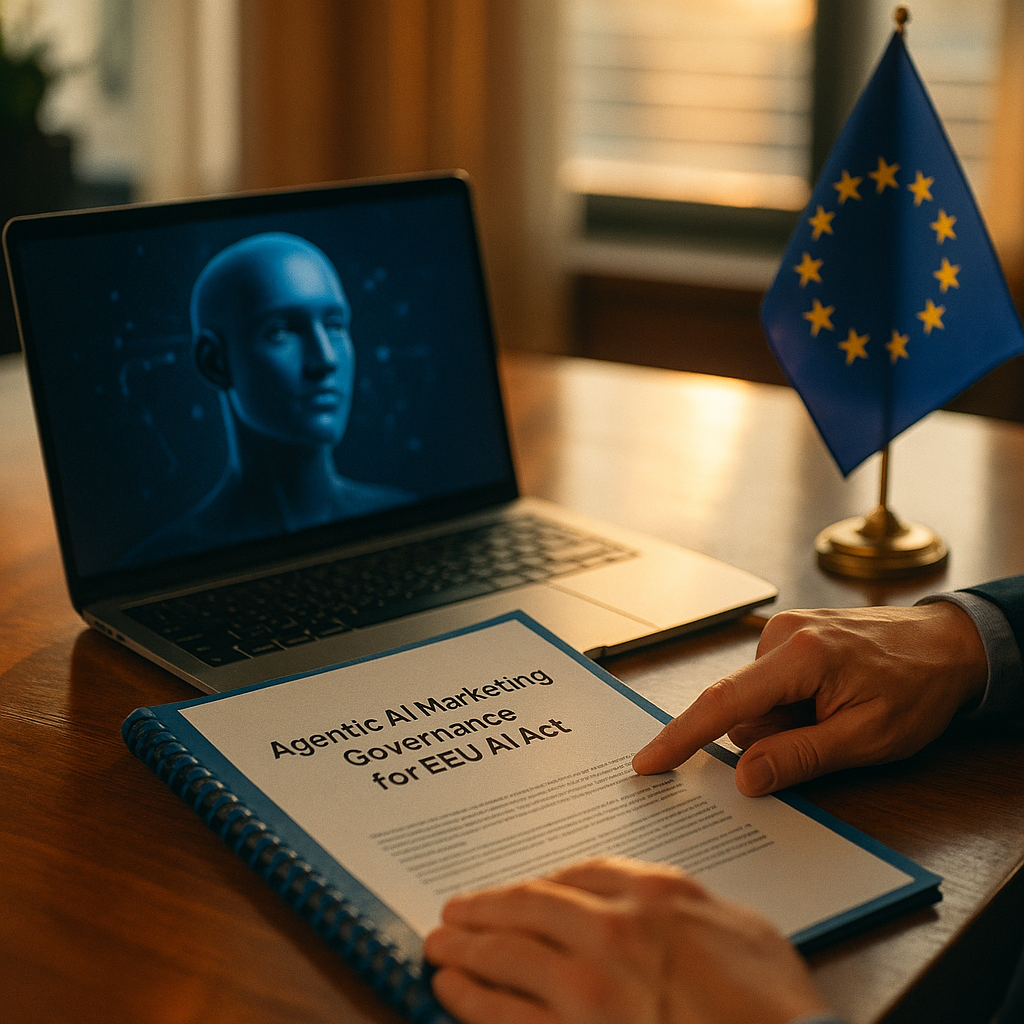
Roughly 40% of marketing organizations now run at least one autonomous AI agent that can execute campaigns without a human clicking “approve” first. That number will look quaint by next year. A governance charter for agentic AI marketing tools is no longer a compliance nice-to-have — it’s the difference between scaling fast and explaining yourself to a regulator.
Agentic AI is different from the chatbot-and-copy-generator era brands got comfortable with. These systems plan, execute, and adjust in real time: bidding on media, negotiating creator rates, generating and publishing ad variants, even flagging or approving influencer contracts. The moment a tool acts without a human in the loop, your risk profile changes. And the EU AI Act’s next enforcement phase is tightening exactly around that moment.
Why This Matters Now, Not Next Quarter
The EU AI Act’s phased rollout has already brought prohibited-practice bans and GPAI transparency obligations into force. The next milestone pushes deeper into high-risk system requirements, including many marketing and advertising use cases that touch profiling, targeting, or consumer-facing automated decisions. If your agentic tools influence pricing, ad delivery, or personalized offers based on inferred consumer traits, you’re closer to “high-risk” classification than your legal team may have told you.
This isn’t only a Brussels problem. Multinational brands run global campaign infrastructure, and regulatory spillover is real — the same pattern already playing out with state-level synthetic-performer laws colliding with platform AI labels in the US (see our breakdown of synthetic-performer disclosure rules). Build once for the strictest jurisdiction, or rebuild constantly. Most CMOs will pick the former once they see the cost comparison.
If your agentic AI tool can execute a media buy, alter ad copy, or select a creator without a documented human checkpoint, you likely already have an EU AI Act exposure — whether or not you sell into the EU.
What a Governance Charter Actually Is
Think of it less as a policy PDF and more as an operating contract between your marketing team, legal, and the machines doing the work. A governance charter defines:
- Which agentic functions require pre-action human sign-off versus post-action review
- Escalation thresholds — dollar amounts, audience size, or content sensitivity that trigger mandatory human review
- Audit logging requirements for every autonomous decision
- Named accountable owners for each agent category (media, creative, creator vetting, pricing)
- A revocation protocol — how fast you can kill an agent’s permissions if it misbehaves
Without this document, “human oversight” becomes whatever an engineer decided during a sprint planning meeting six months ago. That’s not governance. That’s an accident waiting for an audit.
The Three-Tier Oversight Model
Most mature programs are converging on a three-tier structure, and it maps cleanly onto EU AI Act risk logic even for companies outside EU jurisdiction.
Tier one: full autonomy, logged only. Low-stakes, reversible actions — A/B testing minor creative variants, adjusting bid caps within a pre-set band, scheduling posts. No human checkpoint needed, but every action gets timestamped and logged for later audit.
Tier two: human-in-the-loop before execution. Anything touching consumer profiling, lookalike audience expansion, creator selection involving minors or health/finance verticals, or spend above a defined threshold (many brands use $5,000–$10,000 per campaign action as the trigger). The agent drafts, a human approves.
Tier three: human-led, AI-assisted only. Legal disclosures, health and performance claims, anything with FTC substantiation exposure, contract terms with creators. AI can draft and suggest; it cannot finalize. This tier overlaps heavily with existing FTC disclosure obligations — see our guide on health claim disclaimers that survive FTC review for the substantiation standard your tier-three review needs to meet.
Setting the Actual Thresholds: Numbers, Not Vibes
Vague governance language — “significant decisions require review” — will not survive a regulator’s questions, and it won’t survive an internal audit either. Significant according to whom? Reviewed by whom, within what window?
Here’s a starting framework brands can adapt:
- Spend thresholds: Set per-agent daily and campaign caps. Anything above triggers mandatory human sign-off before execution, not after.
- Audience sensitivity thresholds: Any targeting touching minors, health conditions, financial vulnerability, or protected characteristics moves to tier two minimum, regardless of spend.
- Content risk thresholds: Claims involving efficacy, safety, or comparative performance always require human legal review — no exceptions, no autonomous publishing.
- Reversibility thresholds: If an action can’t be undone within 24 hours (a signed creator contract, a submitted ad to a slow-review platform), it needs upfront human approval.
- Data threshold: Any agent action that creates a new data processing purpose — say, using engagement data to infer purchase intent — needs a DPA review. Our sales-lift data processing addendum guide covers exactly this kind of scope creep.
None of these numbers are prescribed by the EU AI Act itself — the regulation sets risk categories, not dollar figures. That’s your job. But regulators and courts will ask whether your thresholds were reasonable and documented before an incident, not invented afterward as a defense.
Where Agentic Tools Are Already Creating Contract Gaps
Governance charters don’t live only in your MarTech stack. They need to reach into every creator and vendor contract where an AI agent might act on your behalf — negotiating usage rights, auto-renewing licenses, or triggering payment on performance milestones.
This is where a lot of brands get caught flat-footed. An agentic tool that automatically escalates a creator’s usage rights when a video goes viral sounds efficient, until nobody can say who approved the new terms. Our piece on usage-rights escalation clauses walks through the contract language needed before you let an agent auto-negotiate anything. Similarly, if your agentic system interacts with AI shopping assistants or automated commerce flows, revisit your indemnification language for AI shopping agents — liability doesn’t disappear because a bot signed off instead of a person.
The uncomfortable truth: most existing influencer and vendor contracts were written before agentic tools existed in their current form. They assume a human negotiates, a human approves, a human is liable. Retrofitting that assumption after deployment is far more expensive than building it into your governance charter now.
Building the Audit Trail Regulators Will Actually Want
The EU AI Act’s high-risk provisions lean heavily on documentation: risk assessments, technical documentation, logging, and human oversight records. If your agentic tools can’t produce a clean audit trail showing when a human reviewed a decision and why, you’re exposed regardless of how good your actual outcomes are.
Practical steps that hold up under scrutiny:
- Log every agent decision with a timestamp, the triggering condition, and the outcome (approved, escalated, blocked).
- Store human review decisions with the reviewer’s name and rationale, not just a checkbox.
- Run quarterly threshold reviews — thresholds set for a $2M media budget won’t hold when spend triples.
- Cross-reference agent decisions against disclosure compliance, similar to the transcript-level review used in sponsorship disclosure audits, which catches gaps automated systems miss.
Industry benchmarking from eMarketer and Statista shows AI-driven ad spend automation growing faster than governance headcount at most agencies — a gap that regulators, and plaintiffs’ attorneys, will eventually exploit.
Who Owns the Charter Internally?
This is where charters die in practice. Legal thinks marketing ops owns it. Marketing ops thinks it’s a legal document. Data science thinks it’s someone else’s compliance checklist. Pick one accountable executive — typically a CMO or Chief Marketing Operations lead — and give them named co-owners in legal and data privacy.
Quarterly review cadence works better than annual. Agentic tools evolve monthly; a charter reviewed once a year is functionally obsolete by month four. Treat it like a living risk register, not a static policy.
Next Step
Don’t wait for the EU AI Act’s enforcement calendar to force the issue. Draft your three-tier oversight thresholds this quarter, assign a single accountable owner, and run one live audit of your current agentic tools against those thresholds before your next campaign cycle launches.
Frequently Asked Questions
What is a governance charter for agentic AI marketing tools?
It’s an internal operating document that defines which AI-driven marketing actions require human approval, what thresholds trigger escalation, how decisions are logged, and who is accountable for each category of autonomous activity.
Does the EU AI Act apply to brands outside the EU?
Yes, if the brand’s marketing activities target or affect consumers located in the EU, the regulation’s extraterritorial scope can apply regardless of where the company is headquartered.
What counts as a “high-risk” agentic marketing use case?
Use cases involving consumer profiling, automated targeting based on inferred personal characteristics, pricing decisions, or systems that materially influence access to services can fall into high-risk categories under the Act’s framework.
How often should human-oversight thresholds be reviewed?
Quarterly at minimum. Agentic AI tools and their capabilities change faster than annual policy cycles can track, and spend or audience thresholds set too rigidly become outdated within months.
What’s the difference between human-in-the-loop and human-on-the-loop oversight?
Human-in-the-loop requires approval before an action executes. Human-on-the-loop allows the agent to act autonomously with a human monitoring and able to intervene or reverse afterward. High-risk actions generally require the former.
Can existing creator contracts cover agentic AI decisions?
Usually not without amendment. Most contracts assume human negotiation and approval, so brands need updated clauses addressing AI-driven usage rights escalation, liability, and disclosure obligations.
Top Influencer Marketing Agencies
The leading agencies shaping influencer marketing in 2026
Agencies ranked by campaign performance, client diversity, platform expertise, proven ROI, industry recognition, and client satisfaction. Assessed through verified case studies, reviews, and industry consultations.
Moburst

-
2

The Shelf
Boutique Beauty & Lifestyle Influencer AgencyA data-driven boutique agency specializing exclusively in beauty, wellness, and lifestyle influencer campaigns on Instagram and TikTok. Best for brands already focused on the beauty/personal care space that need curated, aesthetic-driven content.Clients: Pepsi, The Honest Company, Hims, Elf Cosmetics, Pure LeafVisit The Shelf → -
3

Audiencly
Niche Gaming & Esports Influencer AgencyA specialized agency focused exclusively on gaming and esports creators on YouTube, Twitch, and TikTok. Ideal if your campaign is 100% gaming-focused — from game launches to hardware and esports events.Clients: Epic Games, NordVPN, Ubisoft, Wargaming, Tencent GamesVisit Audiencly → -
4

Viral Nation
Global Influencer Marketing & Talent AgencyA dual talent management and marketing agency with proprietary brand safety tools and a global creator network spanning nano-influencers to celebrities across all major platforms.Clients: Meta, Activision Blizzard, Energizer, Aston Martin, WalmartVisit Viral Nation → -
5

The Influencer Marketing Factory
TikTok, Instagram & YouTube CampaignsA full-service agency with strong TikTok expertise, offering end-to-end campaign management from influencer discovery through performance reporting with a focus on platform-native content.Clients: Google, Snapchat, Universal Music, Bumble, YelpVisit TIMF → -
6

NeoReach
Enterprise Analytics & Influencer CampaignsAn enterprise-focused agency combining managed campaigns with a powerful self-service data platform for influencer search, audience analytics, and attribution modeling.Clients: Amazon, Airbnb, Netflix, Honda, The New York TimesVisit NeoReach → -
7

Ubiquitous
Creator-First Marketing PlatformA tech-driven platform combining self-service tools with managed campaign options, emphasizing speed and scalability for brands managing multiple influencer relationships.Clients: Lyft, Disney, Target, American Eagle, NetflixVisit Ubiquitous → -
8

Obviously
Scalable Enterprise Influencer CampaignsA tech-enabled agency built for high-volume campaigns, coordinating hundreds of creators simultaneously with end-to-end logistics, content rights management, and product seeding.Clients: Google, Ulta Beauty, Converse, AmazonVisit Obviously →