


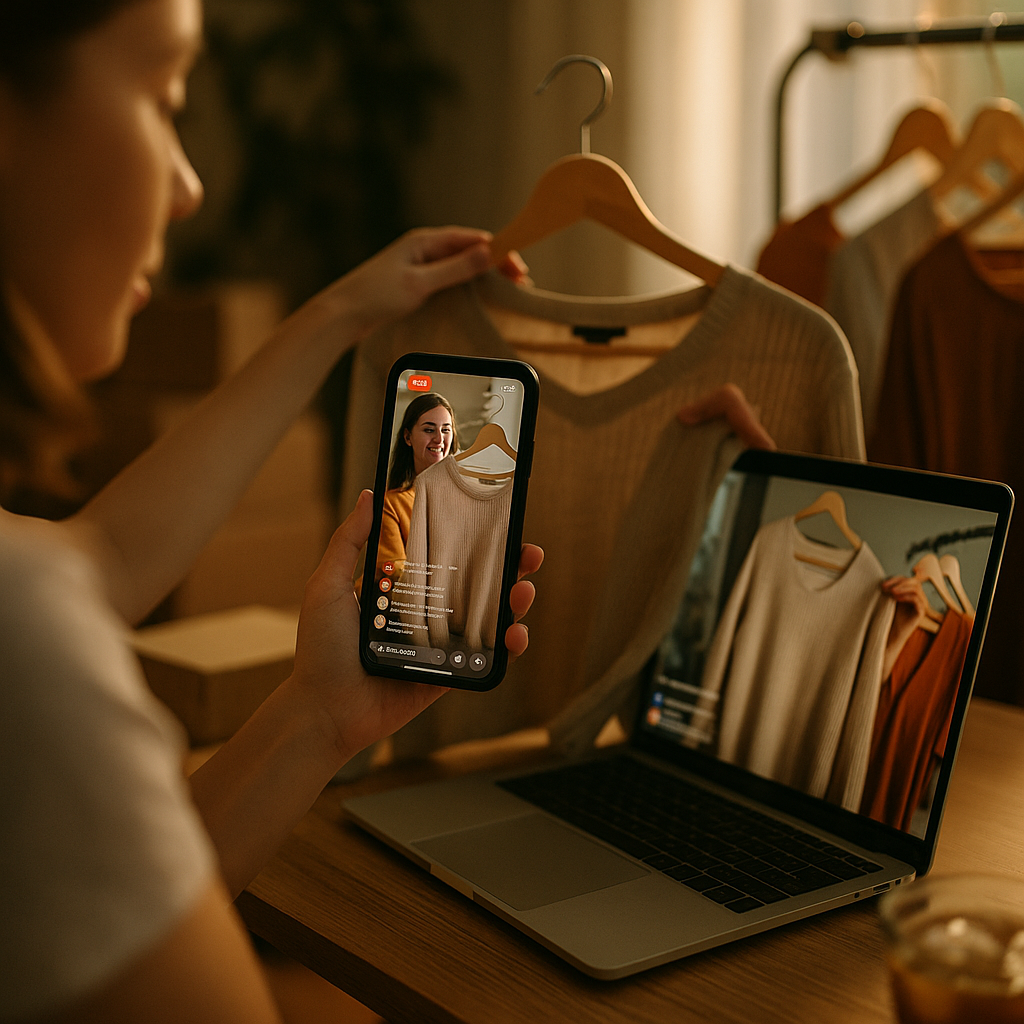
Nielsen pegs the average live-shopping conversion rate at roughly 30%, against a 2-3% conversion benchmark for standard ecommerce pages. That gap is why live-shopping and shoppable video are no longer treated as separate line items in the marketing budget. They’re colliding into a single commerce-first production model, and it’s forcing brands to tear apart the UGC operations they built for a discovery-first era.
If your creator program still separates “content creators” from “live sellers,” you’re already behind. The formats are merging. The teams should be too.
Why the Line Between UGC and Live Commerce Just Disappeared
Shoppable video used to mean a polished 30-second clip with a tappable product tag. Live-shopping meant a scheduled event, often clunky, often under-attended, treated as a novelty channel borrowed from QVC playbooks. Those two things ran on different calendars, different creative briefs, and usually different budgets.
That separation doesn’t hold anymore. TikTok Shop, Amazon Live, and Whatnot have all pushed toward hybrid formats where a single livestream gets clipped, repurposed, and re-injected into shoppable video feeds within hours. The livestream isn’t the endpoint. It’s the raw material.
This matters because it changes what “UGC” even means operationally. It’s no longer a static asset library of reviews and unboxings. It’s a live production pipeline that has to output commerce-ready clips continuously, not on a monthly content calendar. Brands that still brief creators for one-off video deliverables are leaving money on the table, because a single two-hour live session can generate a dozen usable shoppable clips if the operation is built to capture and cut it fast.
The brands winning this shift aren’t the ones with the biggest creator rosters. They’re the ones who rebuilt their content ops to treat every live session as a clip factory, not a one-time event.
The Operational Restructuring Nobody Budgeted For
Here’s the uncomfortable part for a lot of marketing orgs: this convergence isn’t a creative challenge. It’s an operations and staffing challenge. Live-shopping requires real-time production skills — camera switching, chat moderation, inventory sync, payment handling — that traditional UGC teams simply don’t have. Shoppable video requires fast-turn editing and tagging workflows that live-production teams often don’t have either.
So companies are merging the two functions, and it’s messy.
Whatnot and Amazon Live have both started hiring influencer managers whose compensation ties directly to CAC and LTV rather than views or engagement, a signal that live-commerce talent management is being pulled into performance marketing rather than left in brand/social silos. That’s a structural shift worth sitting with: the person negotiating creator deals is now judged on the same metrics as a paid media buyer. For more on how that compensation shift is playing out, see how live platforms are restructuring creator pay.
Practically, this means brands need to answer a few uncomfortable questions before scaling live-shopping programs:
- Who owns the real-time technical production — an agency, an in-house team, or the creator’s own crew?
- What’s the SLA for turning raw livestream footage into shoppable clips? Same day? Within the hour?
- Does your creator contract cover usage rights for clipped, re-edited, and re-published segments of a live session?
- Is your product catalog synced in real time so a creator never sells something that’s out of stock mid-stream?
Miss any of those and you either bottleneck your content output or expose the brand to compliance and inventory risk. Neither is cheap to fix after launch.
Platform Economics Are Forcing the Convergence, Not Just Trends
This isn’t happening because live-shopping is trendy. It’s happening because platforms have redesigned their commerce mechanics to reward exactly this kind of hybrid content. TikTok Shop’s affiliate model pays creators on performance, which means creators are incentivized to produce as much sellable content as possible, live and pre-recorded, and platforms are rewarding whichever format converts. That’s restructured how creator payouts work across the board, something we broke down in TikTok Shop’s affiliate payout model.
Amazon has taken a different route, leaning on creator newsletters to sustain live-shopping audiences between events rather than competing purely on payout size, a strategy detailed in Amazon Live’s newsletter-driven retention play.
Different mechanics, same underlying logic: platforms want continuous commerce content, not sporadic campaigns.
eMarketer estimates that live commerce and shoppable video spend in the US is climbing faster than traditional influencer campaign budgets, and the reason is straightforward. Attribution is cleaner. When a viewer taps a product during a livestream and checks out without leaving the app, you get a direct commerce signal instead of a vague engagement metric. That’s a much easier story to tell a CFO than “brand lift.”
Attribution Gets Easier, But Only If You Rebuild Measurement Around It
One underappreciated benefit of commerce-first formats: they solve part of the attribution headache that’s plagued influencer marketing for years. Live-shopping and in-feed shoppable video generate closed-loop purchase data because the transaction happens inside the platform. No more stitching together promo codes and vanity URLs to guess at conversion.
But that only helps if your measurement stack is built to ingest it. A lot of brands are still running influencer ROI through the same attribution models they used for display ads, models that were already breaking down as platforms shifted away from click-based tracking. We covered that shift in why clicks no longer drive attribution decisions, and the same logic applies here: live-commerce data needs to feed into broader mix modeling, not sit in a platform-specific dashboard nobody checks.
If you’re not already blending platform-native commerce metrics with marketing mix modeling, now’s the time. Live-shopping generates a firehose of granular data — watch time, add-to-cart moments, drop-off points mid-stream — that’s genuinely useful for optimizing creative and offers, but useless if it stays trapped in a single platform’s reporting UI. For a broader framework on filling attribution gaps, see how mix modeling fills attribution gaps.
Match the Format to the Category, Not the Hype Cycle
Not every product category benefits equally from this convergence. Beauty and fashion have obvious live-shopping fit: visual, impulse-driven, benefit from demonstration. Home goods and electronics are catching up, especially where creators can show product-in-use in ways static images can’t. B2B and considered-purchase categories? Live-shopping is mostly a bad fit, no matter how much a platform rep tries to sell you on it.
This is where a lot of brands waste budget — chasing the format because competitors are doing it, not because their category converts through it. There’s a real cost to running live-shopping production for a category that doesn’t move impulsively. You’re paying for real-time staffing and creator fees against a conversion rate that’ll never approach the beauty or apparel benchmarks.
We’ve written before about matching category to platform commerce model, and the same discipline applies to format selection within live and shoppable video specifically. Run a small pilot, measure conversion against your category baseline, and only scale the production build-out once you’ve got signal. Check the fuller framework in matching category to commerce model.
Live-shopping isn’t a universal upgrade to your creator strategy. It’s a category-specific tool that happens to be getting cheaper and easier to deploy — which means more brands will misuse it before they figure out where it actually works.
Compliance Risk Nobody’s Talking About Enough
Real-time commerce content raises the compliance stakes considerably. Pre-recorded shoppable video gets reviewed before it goes live. A live-shopping session doesn’t. Creators are making real-time claims about product benefits, pricing, and availability with no editorial buffer, and the FTC’s endorsement guidelines still apply in full force during live formats, disclosure requirements included.
If your legal and compliance teams haven’t been briefed on live-shopping-specific risk, that’s a gap to close before scaling. Review the FTC’s endorsement guidance with your creator management team, and build real-time moderation protocols rather than relying on post-hoc corrections. A false claim made during a live stream and clipped into a shoppable video afterward doesn’t just violate guidelines once. It replicates the violation across every platform where that clip circulates.
This is also a talent vetting issue. Creators who are excellent at scripted, pre-recorded UGC aren’t automatically good at live, unscripted commerce hosting. Test creators in live formats specifically before betting a major campaign on their performance.
What This Means for Team Structure Going Forward
The org chart implications are real. Brands are consolidating what used to be three separate functions — content production, influencer relations, and live commerce/events — into a single commerce content team. That team needs technical live-production capability, fast-turn editing capacity, creator relationship management, and real-time compliance oversight, often reporting into performance marketing rather than brand.
This mirrors a broader trend we’ve tracked in creator-economy hiring, where algorithm fluency and platform-native production skill are becoming baseline requirements rather than specialist add-ons. See why algorithm fluency is now a hiring filter for the leadership-level version of this shift.
If you’re building this team from scratch, prioritize hiring producers who’ve run live commerce before over generalist content marketers. The skill gap between “can write a good brief” and “can manage live inventory sync while moderating chat and cueing a creator” is bigger than it looks on paper.
Where to Start This Quarter
Pick one product category with genuine impulse-purchase behavior, run a live-shopping pilot with a single vetted creator, and build the clip-repurposing workflow before you scale spend — measure conversion against category baseline, not against vanity engagement, and only expand the team once the unit economics prove out.
Frequently Asked Questions
What’s the difference between shoppable video and live-shopping?
Shoppable video is pre-recorded content with embedded product tags or links that let viewers purchase without leaving the platform. Live-shopping happens in real time, typically with a creator or host demonstrating products and responding to viewer questions during the broadcast. The convergence brands are now managing involves clipping live sessions into shoppable video assets almost immediately after the stream ends.
How should brands measure ROI on live-shopping compared to traditional influencer content?
Live-shopping generates closed-loop purchase data directly within the platform, which makes conversion tracking more reliable than traditional influencer campaigns that rely on promo codes or external links. Brands should feed this data into broader marketing mix modeling rather than evaluating it in isolation, since platform-native dashboards rarely capture the full customer journey.
Which product categories perform best in live-shopping formats?
Beauty, fashion, and home goods tend to perform best because they benefit from visual demonstration and impulse-driven purchase behavior. Considered-purchase categories and most B2B products generally see weak conversion from live formats and are better served by traditional shoppable video or long-form content.
What compliance risks are unique to live-shopping?
Live-shopping removes the editorial review buffer that pre-recorded content has, meaning creators make real-time claims about pricing, availability, and product benefits without pre-approval. FTC endorsement and disclosure rules still apply, and any compliance issue in the live stream can replicate across clipped shoppable video afterward.
Do creators need different skills for live-shopping versus standard UGC content?
Yes. Live-shopping requires comfort with unscripted, real-time interaction, chat moderation, and selling under pressure, which differs significantly from the skills needed for polished, pre-recorded UGC. Brands should test creators specifically in live formats before committing major budget to them.
Frequently Asked Questions
What’s the difference between shoppable video and live-shopping?
Shoppable video is pre-recorded content with embedded product tags or links that let viewers purchase without leaving the platform. Live-shopping happens in real time, typically with a creator or host demonstrating products and responding to viewer questions during the broadcast. The convergence brands are now managing involves clipping live sessions into shoppable video assets almost immediately after the stream ends.
How should brands measure ROI on live-shopping compared to traditional influencer content?
Live-shopping generates closed-loop purchase data directly within the platform, which makes conversion tracking more reliable than traditional influencer campaigns that rely on promo codes or external links. Brands should feed this data into broader marketing mix modeling rather than evaluating it in isolation, since platform-native dashboards rarely capture the full customer journey.
Which product categories perform best in live-shopping formats?
Beauty, fashion, and home goods tend to perform best because they benefit from visual demonstration and impulse-driven purchase behavior. Considered-purchase categories and most B2B products generally see weak conversion from live formats and are better served by traditional shoppable video or long-form content.
What compliance risks are unique to live-shopping?
Live-shopping removes the editorial review buffer that pre-recorded content has, meaning creators make real-time claims about pricing, availability, and product benefits without pre-approval. FTC endorsement and disclosure rules still apply, and any compliance issue in the live stream can replicate across clipped shoppable video afterward.
Do creators need different skills for live-shopping versus standard UGC content?
Yes. Live-shopping requires comfort with unscripted, real-time interaction, chat moderation, and selling under pressure, which differs significantly from the skills needed for polished, pre-recorded UGC. Brands should test creators specifically in live formats before committing major budget to them.
Top Influencer Marketing Agencies
The leading agencies shaping influencer marketing in 2026
Agencies ranked by campaign performance, client diversity, platform expertise, proven ROI, industry recognition, and client satisfaction. Assessed through verified case studies, reviews, and industry consultations.
Moburst

-
2

The Shelf
Boutique Beauty & Lifestyle Influencer AgencyA data-driven boutique agency specializing exclusively in beauty, wellness, and lifestyle influencer campaigns on Instagram and TikTok. Best for brands already focused on the beauty/personal care space that need curated, aesthetic-driven content.Clients: Pepsi, The Honest Company, Hims, Elf Cosmetics, Pure LeafVisit The Shelf → -
3

Audiencly
Niche Gaming & Esports Influencer AgencyA specialized agency focused exclusively on gaming and esports creators on YouTube, Twitch, and TikTok. Ideal if your campaign is 100% gaming-focused — from game launches to hardware and esports events.Clients: Epic Games, NordVPN, Ubisoft, Wargaming, Tencent GamesVisit Audiencly → -
4

Viral Nation
Global Influencer Marketing & Talent AgencyA dual talent management and marketing agency with proprietary brand safety tools and a global creator network spanning nano-influencers to celebrities across all major platforms.Clients: Meta, Activision Blizzard, Energizer, Aston Martin, WalmartVisit Viral Nation → -
5

The Influencer Marketing Factory
TikTok, Instagram & YouTube CampaignsA full-service agency with strong TikTok expertise, offering end-to-end campaign management from influencer discovery through performance reporting with a focus on platform-native content.Clients: Google, Snapchat, Universal Music, Bumble, YelpVisit TIMF → -
6

NeoReach
Enterprise Analytics & Influencer CampaignsAn enterprise-focused agency combining managed campaigns with a powerful self-service data platform for influencer search, audience analytics, and attribution modeling.Clients: Amazon, Airbnb, Netflix, Honda, The New York TimesVisit NeoReach → -
7

Ubiquitous
Creator-First Marketing PlatformA tech-driven platform combining self-service tools with managed campaign options, emphasizing speed and scalability for brands managing multiple influencer relationships.Clients: Lyft, Disney, Target, American Eagle, NetflixVisit Ubiquitous → -
8

Obviously
Scalable Enterprise Influencer CampaignsA tech-enabled agency built for high-volume campaigns, coordinating hundreds of creators simultaneously with end-to-end logistics, content rights management, and product seeding.Clients: Google, Ulta Beauty, Converse, AmazonVisit Obviously →