


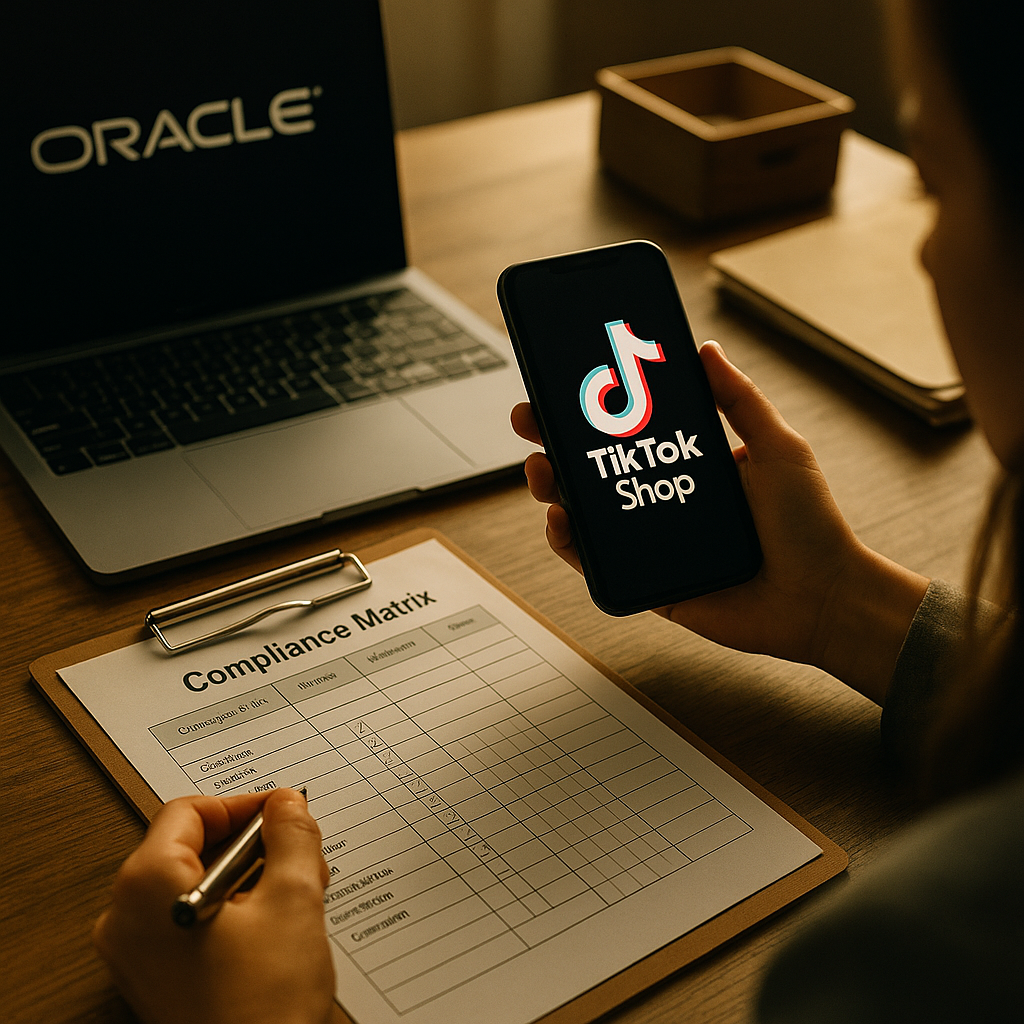
Oracle now holds the keys to nearly every U.S. TikTok Shop transaction, and most brand compliance teams still can’t answer a basic question: where does their creator campaign data actually live once a shopper checks out? That gap is the reason a TikTok Shop compliance matrix for data localization has gone from nice-to-have to non-negotiable. If you’re running influencer commerce across borders in 2026, guessing isn’t a strategy anymore.
The Oracle joint venture restructured how TikTok stores, processes, and — critically — transfers U.S. user and transaction data. But “Oracle now hosts it” is not the same as “Oracle now owns compliance for it.” Brands are still the party on the hook when a regulator asks who saw what data, when, and under which legal basis. That’s the crux of the problem this article solves.
Why the Oracle JV Changes the Compliance Math
Under the restructured arrangement, TikTok’s U.S. operations run through a joint venture involving Oracle as the infrastructure and security partner, with data stored on Oracle Cloud Infrastructure inside the United States. Oracle isn’t just a landlord here — it has an oversight role over the algorithm and data access, with U.S.-based personnel reviewing source code and data flows.
That sounds reassuring. It also creates a new compliance wrinkle: your brand’s creator commerce data, order records, and customer PII may now sit in a jurisdictionally distinct environment from the EU, UK, and APAC TikTok Shop instances your global team is running simultaneously.
If you operate TikTok Shop programs in the U.S., UK, EU, and Southeast Asia, you’re no longer dealing with one TikTok data regime. You’re dealing with at least four, each with different localization rules, different retention windows, and different breach notification clocks.
A single global “TikTok Shop compliance policy” no longer covers you. Each region’s data residency rule needs its own row in the matrix, or you’re auditing blind.
The Multi-Jurisdiction Problem, in Plain Numbers
Consider the scope. TikTok Shop is live in the U.S., UK, several EU markets, Indonesia, Vietnam, Malaysia, Thailand, and the Philippines, among others. Each of those markets enforces its own flavor of data localization:
- United States: Data now routed through the Oracle-hosted U.S. joint venture infrastructure, with algorithmic and data-access oversight from a U.S. security committee.
- European Union: GDPR governs cross-border transfer, with TikTok’s own European data centers (part of “Project Clover”) handling EU user data separately from the U.S. JV.
- United Kingdom: Post-Brexit adequacy rules under UK GDPR, enforced by the Information Commissioner’s Office, diverge subtly from EU requirements on transfer mechanisms.
- Indonesia: Requires local data storage for electronic system operators, tied to its Personal Data Protection Law.
- Vietnam: Decree 53 mandates local storage of certain user data categories for platforms above a user threshold.
None of these regimes talk to each other. A creator campaign that pulls purchase data from a U.S. shop, tags UK influencers, and reports results to an APAC regional team is touching at least three separate legal frameworks in a single workflow. That’s exactly the kind of cross-border complexity we’ve flagged before in livestream commerce compliance work across Asia-Pacific markets.
What a Cross-Border Compliance Matrix Actually Looks Like
Forget the 40-page policy memo nobody reads. A compliance matrix is an operational tool — a spreadsheet or database your legal, data, and marketing teams can actually query before launching a campaign. Build it with these columns, minimum:
- Market/jurisdiction (U.S., UK, EU member state, Indonesia, etc.)
- Data category (PII, transaction records, biometric/age-verification data, creator payout info)
- Storage location (Oracle Cloud U.S., TikTok EU data center, local APAC server)
- Legal basis for transfer (adequacy decision, standard contractual clauses, explicit consent)
- Retention window and deletion trigger
- Breach notification clock (72 hours under GDPR, varies elsewhere)
- Internal data owner (who signs off before a campaign touching this data category launches)
Populate this once, then treat it as a living document. Update it every time TikTok changes its data architecture — which, given the pace of regulatory pressure on the platform, has been roughly annual since 2023.
Where Brands Get This Wrong
Most compliance failures aren’t malicious. They’re operational blind spots. A few patterns show up repeatedly:
- Treating TikTok Shop as one platform instead of a patchwork of regional entities. The U.S. JV structure doesn’t automatically extend to how EU or APAC instances handle data.
- Assuming Oracle’s security oversight equals GDPR or PDPA compliance. It doesn’t. Oracle’s role is infrastructure security and algorithmic review, not a substitute for your own data processing agreements.
- No clear owner for cross-border data decisions. Marketing wants speed, legal wants certainty, and data localization sits in the gap between them.
- Ignoring creator-side data flows. Payout information, performance analytics, and audience demographics move across borders too — not just customer transaction data.
This last point matters more than people think. If you’re running affiliate or creator-code programs that span multiple TikTok Shop regions, you need to map where creator earnings data and audience insight data physically sit, not just customer checkout data. We covered a related angle on this in our piece on creator codes and personalized pricing rules, where the same “who owns this data” question keeps resurfacing.
Age Verification Data Adds Another Layer
TikTok Shop’s age verification requirements — already a minefield state by state in the U.S. — now intersect with the Oracle JV’s data handling. Age and identity verification data is arguably the most sensitive category in your matrix, because it touches minors’ data protection law on top of standard privacy regulation.
If your brand sells beauty, supplements, or age-restricted categories through TikTok Shop, this isn’t optional homework. Our breakdown of state-by-state age verification rules shows how fragmented U.S. enforcement already is before you even add international localization requirements on top.
Beauty and wellness brands in particular should be pairing this compliance matrix work with tighter data processing agreements — something we detailed in age verification and beauty DPA requirements.
If your compliance matrix doesn’t have a dedicated row for age-verification and minor data flows, you’re missing the category regulators care about most right now.
Operationalizing It: From Spreadsheet to Workflow
A matrix that lives in a shared drive and nobody checks before campaign launch is decorative, not functional. Here’s how operationally mature teams are wiring this into actual workflow:
- Pre-launch gate checks. Before any cross-border TikTok Shop campaign goes live, a designated data owner checks the matrix against the specific markets and data categories involved.
- Quarterly matrix reviews. TikTok’s data architecture shifts. Regulatory guidance shifts faster. A quarterly cadence keeps the matrix from going stale.
- Vendor and creator contract riders. Add explicit data localization language to creator agreements and any third-party analytics vendor contracts touching TikTok Shop data.
- Escalation paths. When a campaign touches a jurisdiction not yet mapped in the matrix, there needs to be a clear escalation route rather than a shrug-and-launch default.
This last point mirrors what we’ve argued in the context of advertising disputes more broadly — see our compliance escalation matrix framework, which applies the same “don’t wait for regulators to define your process” logic.
Where This Intersects with Broader Platform Risk
Data localization isn’t happening in isolation. It’s part of a broader tightening across platforms. Meta’s ongoing antitrust exposure, detailed in our coverage of the $1.4 trillion Meta trial risk, and TikTok’s own $400 million privacy settlement (covered in our piece on TikTok’s privacy settlement and ad targeting rules) both point to the same trend: platforms are under enough regulatory pressure that they’re pushing compliance risk downstream to brands.
That’s not paranoia. That’s the operating environment. According to eMarketer estimates, social commerce spend continues climbing double digits year over year, which means more brands are exposed to this exact cross-border data problem, not fewer.
Build the matrix now, while enforcement is still catching up to the technology. Waiting until a regulator sends a letter is the expensive way to learn your data map had gaps.
A Practical Starting Checklist
- Audit every market where your TikTok Shop campaigns currently run.
- Identify the data storage location for each — Oracle U.S. JV, EU data center, or local APAC server.
- Map legal transfer basis for every cross-border data flow, including creator payout and analytics data.
- Assign a named data owner per region, not just a department.
- Set a quarterly review trigger tied to platform policy updates and new regulatory guidance.
- Cross-reference age verification and minor data flows against current FTC guidance and applicable state law.
For teams managing this alongside personalized pricing disclosure obligations, it’s worth reviewing the crossover risks we outlined in FTC personalized pricing disclosure guidance, since data localization and pricing transparency increasingly draw from the same underlying data sets.
Next step: pull your current TikTok Shop market list, assign one owner to draft the first version of the matrix this quarter, and treat the Oracle JV’s next policy update as the trigger for your first review cycle — not an afterthought you discover during an audit.
FAQs
What is a cross-border compliance matrix for TikTok Shop?
It’s an operational document mapping where TikTok Shop data — customer, transaction, and creator data — is stored and processed across different jurisdictions, along with the legal basis for each cross-border transfer. Brands use it to check compliance risk before launching multi-market campaigns.
Does the Oracle joint venture make TikTok Shop GDPR compliant?
No. The Oracle joint venture governs U.S. data infrastructure and algorithmic oversight. It does not extend GDPR compliance to EU operations, which are handled through TikTok’s separate European data center arrangements under its own Project Clover initiative.
Which TikTok Shop data categories carry the highest compliance risk?
Age verification and minor-related data typically carry the highest regulatory scrutiny, followed by transaction and payment data, then creator payout and audience analytics data that moves across regional boundaries.
How often should brands update their compliance matrix?
Quarterly, at minimum, or immediately after any TikTok policy change affecting data architecture. Given how frequently platform data policies have shifted in recent years, a static annual review is too slow.
Who inside a brand should own the compliance matrix?
Ownership should sit jointly with legal/privacy and marketing operations, with a named individual accountable for sign-off before any campaign touches a new jurisdiction or data category.
Visible FAQ (HTML)
See FAQ section above.
Top Influencer Marketing Agencies
The leading agencies shaping influencer marketing in 2026
Agencies ranked by campaign performance, client diversity, platform expertise, proven ROI, industry recognition, and client satisfaction. Assessed through verified case studies, reviews, and industry consultations.
Moburst

-
2

The Shelf
Boutique Beauty & Lifestyle Influencer AgencyA data-driven boutique agency specializing exclusively in beauty, wellness, and lifestyle influencer campaigns on Instagram and TikTok. Best for brands already focused on the beauty/personal care space that need curated, aesthetic-driven content.Clients: Pepsi, The Honest Company, Hims, Elf Cosmetics, Pure LeafVisit The Shelf → -
3

Audiencly
Niche Gaming & Esports Influencer AgencyA specialized agency focused exclusively on gaming and esports creators on YouTube, Twitch, and TikTok. Ideal if your campaign is 100% gaming-focused — from game launches to hardware and esports events.Clients: Epic Games, NordVPN, Ubisoft, Wargaming, Tencent GamesVisit Audiencly → -
4

Viral Nation
Global Influencer Marketing & Talent AgencyA dual talent management and marketing agency with proprietary brand safety tools and a global creator network spanning nano-influencers to celebrities across all major platforms.Clients: Meta, Activision Blizzard, Energizer, Aston Martin, WalmartVisit Viral Nation → -
5

The Influencer Marketing Factory
TikTok, Instagram & YouTube CampaignsA full-service agency with strong TikTok expertise, offering end-to-end campaign management from influencer discovery through performance reporting with a focus on platform-native content.Clients: Google, Snapchat, Universal Music, Bumble, YelpVisit TIMF → -
6

NeoReach
Enterprise Analytics & Influencer CampaignsAn enterprise-focused agency combining managed campaigns with a powerful self-service data platform for influencer search, audience analytics, and attribution modeling.Clients: Amazon, Airbnb, Netflix, Honda, The New York TimesVisit NeoReach → -
7

Ubiquitous
Creator-First Marketing PlatformA tech-driven platform combining self-service tools with managed campaign options, emphasizing speed and scalability for brands managing multiple influencer relationships.Clients: Lyft, Disney, Target, American Eagle, NetflixVisit Ubiquitous → -
8

Obviously
Scalable Enterprise Influencer CampaignsA tech-enabled agency built for high-volume campaigns, coordinating hundreds of creators simultaneously with end-to-end logistics, content rights management, and product seeding.Clients: Google, Ulta Beauty, Converse, AmazonVisit Obviously →