


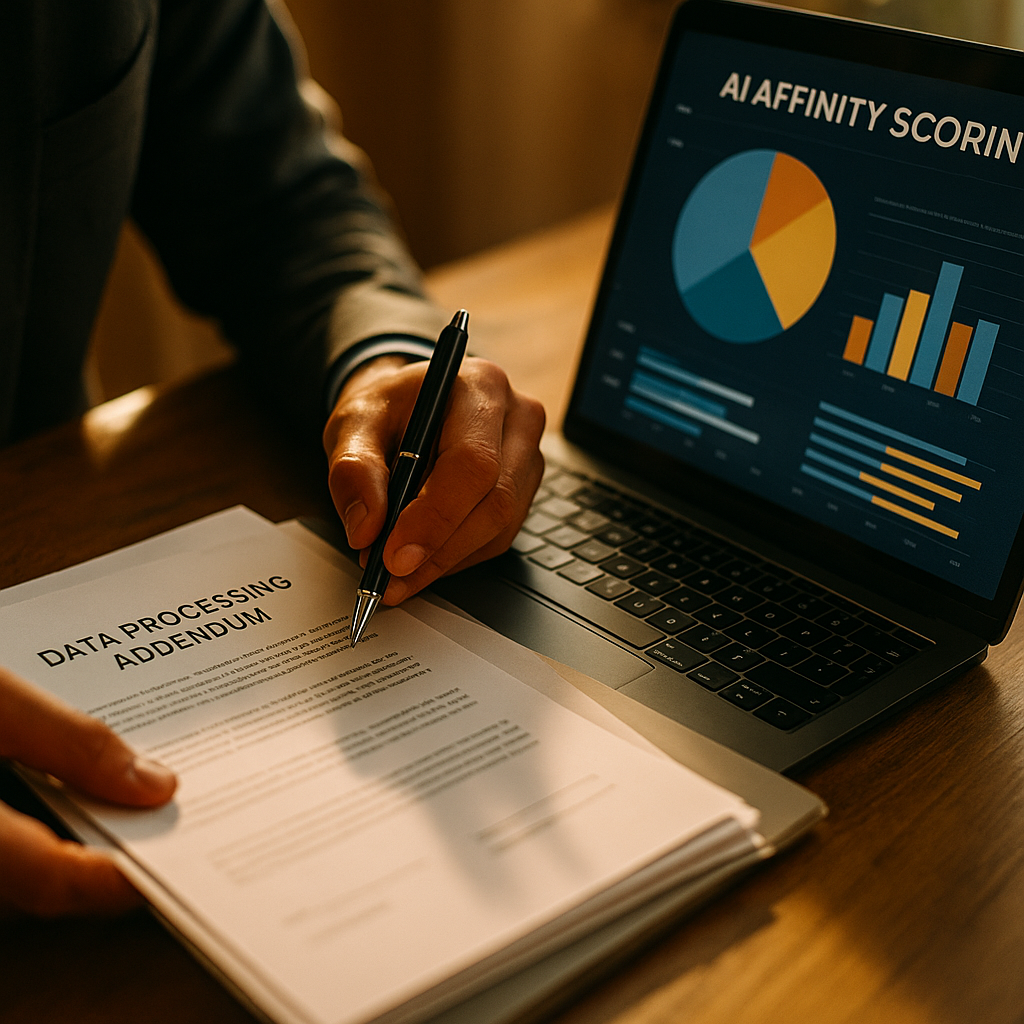
Here’s an uncomfortable question for your legal team: when an AI creator-matching platform scores “audience affinity” for a potential brand partnership, whose data is it actually processing, and under what legal basis? Most brands have no idea. A data processing addendum template built specifically for these tools isn’t optional paperwork anymore. It’s the thing standing between your influencer program and a regulator’s inbox.
Audience affinity scoring sounds harmless. It’s marketed as a matchmaking feature, pairing brands with creators whose followers “look like” the target customer. But under the hood, these platforms are ingesting follower demographics, engagement patterns, inferred interests, and sometimes location and purchase-intent signals, then running them through proprietary models to spit out a compatibility score. That’s personal data processing, full stop, and most brands have signed up for it without a proper DPA in place.
Why Affinity Scoring Is a Different Beast Than Standard Ad Tech
Traditional influencer platforms handled fairly static data: follower counts, past campaign performance, maybe some engagement rate benchmarks. Affinity scoring tools go deeper. They’re often pulling in aggregated audience data from the creator’s platform (via API access or the creator’s own dashboard export), layering it with third-party enrichment data, and generating an inference about how well that audience matches your customer profile.
That inference is itself a new piece of personal data, even if it’s derived rather than collected directly. Under FTC guidance and frameworks like GDPR, derived and inferred data typically carries the same obligations as directly collected data. If your vendor can’t explain in plain language how the affinity score is generated and what raw inputs feed it, you don’t have enough information to sign a compliant DPA, let alone represent to your own customers that you’re handling their data responsibly.
If a vendor can’t map its data flow on a single page, that’s your first red flag: you cannot draft an enforceable DPA for a system nobody can fully describe.
What Actually Belongs in the Template
A generic vendor DPA template, the kind procurement teams pull off the shelf for any SaaS tool, will not cover the specific risks of affinity scoring. Here’s what your template needs that a standard one doesn’t.
- Data inventory clause specific to scoring inputs. List every category of data the platform ingests to generate a score: demographic data, engagement metrics, inferred interest categories, location signals, and any third-party enrichment sources. Vague language like “audience data” is not acceptable.
- Purpose limitation tied to matching only. Explicitly restrict the vendor from repurposing affinity data for its own model training, resale, or cross-client benchmarking without separate written consent. This is where most vendor-drafted DPAs quietly leave the door open.
- Sub-processor disclosure for enrichment vendors. Affinity platforms rarely build everything in-house. They lean on third-party data brokers or social listening APIs. Your DPA needs a current sub-processor list and a notification requirement (30 days is reasonable) before adding new ones.
- Data retention and deletion timelines for scores, not just raw data. A score generated for a campaign that ended eight months ago shouldn’t still be sitting in a vendor’s database. Set a retention ceiling and require certified deletion.
- Audit rights that actually work in practice. Standard “right to audit” language is often unenforceable because it doesn’t specify frequency, scope, or who pays. Name a cadence (annual, at minimum) and clarify that you can request a SOC 2 report or equivalent in lieu of a full audit.
- Cross-border transfer mechanism. If the platform’s data science team or infrastructure sits outside your jurisdiction, you need Standard Contractual Clauses or an equivalent mechanism named explicitly, not just referenced vaguely.
None of this is exotic contract language. It’s standard DPA architecture applied to a use case that most legal teams haven’t thought through yet because “influencer marketing” still sounds like a creative function rather than a data operation.
The Consent Gap Nobody Wants to Talk About
Here’s the part that should worry brand and legal teams equally: whose consent covers the affinity scoring in the first place?
The creator agreed to the platform’s terms of service when they signed up. Their followers almost certainly did not agree to have their aggregated behavior scored against a brand’s target customer profile. Platforms typically lean on the argument that the data is aggregated and anonymized enough to fall outside individual consent requirements. That argument gets weaker every year as re-identification techniques improve and regulators sharpen their definitions of “anonymized.”
This is functionally the same consent architecture problem brands are already wrestling with in consent architecture for AI-driven ad targeting. The lesson transfers directly: don’t assume the platform’s terms of service are doing the legal work your brand needs done. Build a warranty clause into your DPA requiring the vendor to affirm that its data collection and scoring methodology has a valid legal basis in every jurisdiction where you operate, and require them to indemnify you if that turns out to be false.
A platform’s terms of service protect the platform. Your DPA is the only document that protects you.
Data Minimization: The Clause Everyone Skips
Brand teams love affinity scoring because more data supposedly means better matches. Legal teams should push back on that instinct, hard. The template should include a data minimization schedule that specifies exactly which data categories are necessary for the stated purpose (matching creators to campaigns) and excludes anything beyond that scope, like granular location tracking or purchase history enrichment that isn’t relevant to the matching function.
This isn’t just defensive lawyering. Regulators globally, and increasingly platforms themselves, are moving toward minimization as a default expectation rather than a nice-to-have. Influencers Time has covered this shift extensively in the context of checkout data minimization and platform-level verification requirements, and the same logic applies here. If your affinity-matching vendor resists a minimization clause, ask why. There’s usually a business model reason, and it’s usually about monetizing the data you’re not using.
Vendor Due Diligence Before You Even Draft the DPA
Before your legal team spends a week drafting redlines, run a shorter diagnostic. Ask the vendor these five questions directly:
- What specific data points feed the affinity score, and can you provide a data flow diagram?
- Do you train any proprietary models on aggregated client data across accounts, and if so, can brands opt out?
- Who are your current sub-processors, and how often does that list change?
- What is your data retention policy for scores versus raw inputs?
- Can you provide a current SOC 2 Type II report or equivalent third-party attestation?
If a vendor can’t answer these cleanly, that’s useful information too. It tells you the DPA negotiation is going to be an uphill climb, and you should factor that into your procurement timeline. According to eMarketer, spend on AI-powered creator discovery and matching tools has grown sharply as brands look to scale influencer programs without proportionally scaling headcount, which means more brands are onboarding these platforms faster than their legal review processes can keep up. Don’t let procurement speed outrun contract diligence.
Building the Template: A Practical Sequence
Rather than starting from a blank page, structure the drafting process in this order:
- Step one: Map the vendor’s actual data flow before writing a single clause. You cannot draft protections for data uses you haven’t identified.
- Step two: Adapt your organization’s existing master DPA template as the base, then layer in the affinity-specific clauses above. Don’t build from scratch. Reinventing the base structure wastes time and introduces inconsistency with your other vendor contracts.
- Step three: Route the draft through both privacy counsel and the marketing ops team that will actually use the platform day to day. Marketing ops often knows operational details, like how often campaigns pull fresh audience data, that materially affect retention clause drafting.
- Step four: Negotiate the sub-processor and audit clauses first. These are typically the sections vendors push back on hardest, and getting them settled early saves time on the rest of the redline.
- Step five: Set a review cadence. DPAs for AI-driven platforms shouldn’t be “sign and forget” documents. Annual review is a reasonable minimum given how fast these tools evolve their scoring methodologies.
This process mirrors what smart brands are already doing with broader AI governance frameworks. If your organization has already built an AI content labeling policy, the same cross-functional muscle (legal, marketing ops, and compliance working from a shared document) applies directly here.
Where This Intersects With Broader Compliance Risk
A weak DPA on your affinity-matching platform doesn’t stay contained to one vendor relationship. It becomes a liability that shows up during a broader compliance audit, especially if regulators start asking how brands vet the AI tools feeding their creator selection process. Given how much scrutiny AI-driven marketing decisions are already attracting from state and federal regulators, treating your affinity-matching DPA as a low-priority procurement checkbox is a bet most brands shouldn’t be making.
Consider this too: creator-matching decisions increasingly influence which creators get paid campaign work and which don’t. If your matching algorithm relies on flawed or non-compliant data processing, you’re not just carrying privacy risk. You’re potentially making biased or legally indefensible business decisions about which creators to work with, based on a black-box score you can’t fully explain if challenged.
Next step: Pull your current AI creator-matching vendor contract this week and check for a data flow diagram, a sub-processor list, and a defined retention period for affinity scores. If any of those three are missing, you don’t have a compliant DPA, you have a placeholder, and it needs to move to the top of your legal team’s queue before the next campaign cycle launches.
Frequently Asked Questions
What is a data processing addendum in the context of influencer marketing platforms?
A data processing addendum (DPA) is a legally binding contract attachment that defines how a vendor, such as an AI creator-matching platform, is allowed to collect, use, store, and share personal data on behalf of a brand. It sits alongside the master service agreement and specifies obligations around data security, sub-processors, retention, and deletion.
Why do audience affinity scoring tools require special DPA clauses?
These tools generate inferred personal data (the affinity score itself) from raw inputs like demographic and engagement data, often blended with third-party enrichment sources. Standard vendor DPAs rarely account for derived data, sub-processor enrichment chains, or purpose limitation specific to matching, which is why a tailored template is necessary.
Who is legally responsible if an affinity-matching vendor mishandles audience data?
Liability typically depends on the contract terms, but brands acting as data controllers generally retain significant responsibility even when a vendor (acting as processor) causes the breach. This is exactly why indemnification and warranty clauses in the DPA matter so much.
How often should brands review their DPA with AI creator-matching platforms?
An annual review is a reasonable baseline, though brands should also trigger a review whenever the vendor updates its scoring methodology, adds new sub-processors, or expands into new data categories.
Does audience affinity data count as sensitive personal information?
It depends on the inputs. If the scoring model incorporates inferred categories like health interests, religious affiliation, or political leanings, it can trigger heightened obligations under laws like GDPR or state privacy statutes, even though the platform may market the score as generic “interest” data.
FAQs
What is a data processing addendum in the context of influencer marketing platforms?
A data processing addendum (DPA) is a legally binding contract attachment that defines how a vendor, such as an AI creator-matching platform, is allowed to collect, use, store, and share personal data on behalf of a brand. It sits alongside the master service agreement and specifies obligations around data security, sub-processors, retention, and deletion.
Why do audience affinity scoring tools require special DPA clauses?
These tools generate inferred personal data (the affinity score itself) from raw inputs like demographic and engagement data, often blended with third-party enrichment sources. Standard vendor DPAs rarely account for derived data, sub-processor enrichment chains, or purpose limitation specific to matching, which is why a tailored template is necessary.
Who is legally responsible if an affinity-matching vendor mishandles audience data?
Liability typically depends on the contract terms, but brands acting as data controllers generally retain significant responsibility even when a vendor (acting as processor) causes the breach. This is exactly why indemnification and warranty clauses in the DPA matter so much.
How often should brands review their DPA with AI creator-matching platforms?
An annual review is a reasonable baseline, though brands should also trigger a review whenever the vendor updates its scoring methodology, adds new sub-processors, or expands into new data categories.
Does audience affinity data count as sensitive personal information?
It depends on the inputs. If the scoring model incorporates inferred categories like health interests, religious affiliation, or political leanings, it can trigger heightened obligations under laws like GDPR or state privacy statutes, even though the platform may market the score as generic “interest” data.
Top Influencer Marketing Agencies
The leading agencies shaping influencer marketing in 2026
Agencies ranked by campaign performance, client diversity, platform expertise, proven ROI, industry recognition, and client satisfaction. Assessed through verified case studies, reviews, and industry consultations.
Moburst

-
2

The Shelf
Boutique Beauty & Lifestyle Influencer AgencyA data-driven boutique agency specializing exclusively in beauty, wellness, and lifestyle influencer campaigns on Instagram and TikTok. Best for brands already focused on the beauty/personal care space that need curated, aesthetic-driven content.Clients: Pepsi, The Honest Company, Hims, Elf Cosmetics, Pure LeafVisit The Shelf → -
3

Audiencly
Niche Gaming & Esports Influencer AgencyA specialized agency focused exclusively on gaming and esports creators on YouTube, Twitch, and TikTok. Ideal if your campaign is 100% gaming-focused — from game launches to hardware and esports events.Clients: Epic Games, NordVPN, Ubisoft, Wargaming, Tencent GamesVisit Audiencly → -
4

Viral Nation
Global Influencer Marketing & Talent AgencyA dual talent management and marketing agency with proprietary brand safety tools and a global creator network spanning nano-influencers to celebrities across all major platforms.Clients: Meta, Activision Blizzard, Energizer, Aston Martin, WalmartVisit Viral Nation → -
5

The Influencer Marketing Factory
TikTok, Instagram & YouTube CampaignsA full-service agency with strong TikTok expertise, offering end-to-end campaign management from influencer discovery through performance reporting with a focus on platform-native content.Clients: Google, Snapchat, Universal Music, Bumble, YelpVisit TIMF → -
6

NeoReach
Enterprise Analytics & Influencer CampaignsAn enterprise-focused agency combining managed campaigns with a powerful self-service data platform for influencer search, audience analytics, and attribution modeling.Clients: Amazon, Airbnb, Netflix, Honda, The New York TimesVisit NeoReach → -
7

Ubiquitous
Creator-First Marketing PlatformA tech-driven platform combining self-service tools with managed campaign options, emphasizing speed and scalability for brands managing multiple influencer relationships.Clients: Lyft, Disney, Target, American Eagle, NetflixVisit Ubiquitous → -
8

Obviously
Scalable Enterprise Influencer CampaignsA tech-enabled agency built for high-volume campaigns, coordinating hundreds of creators simultaneously with end-to-end logistics, content rights management, and product seeding.Clients: Google, Ulta Beauty, Converse, AmazonVisit Obviously →