


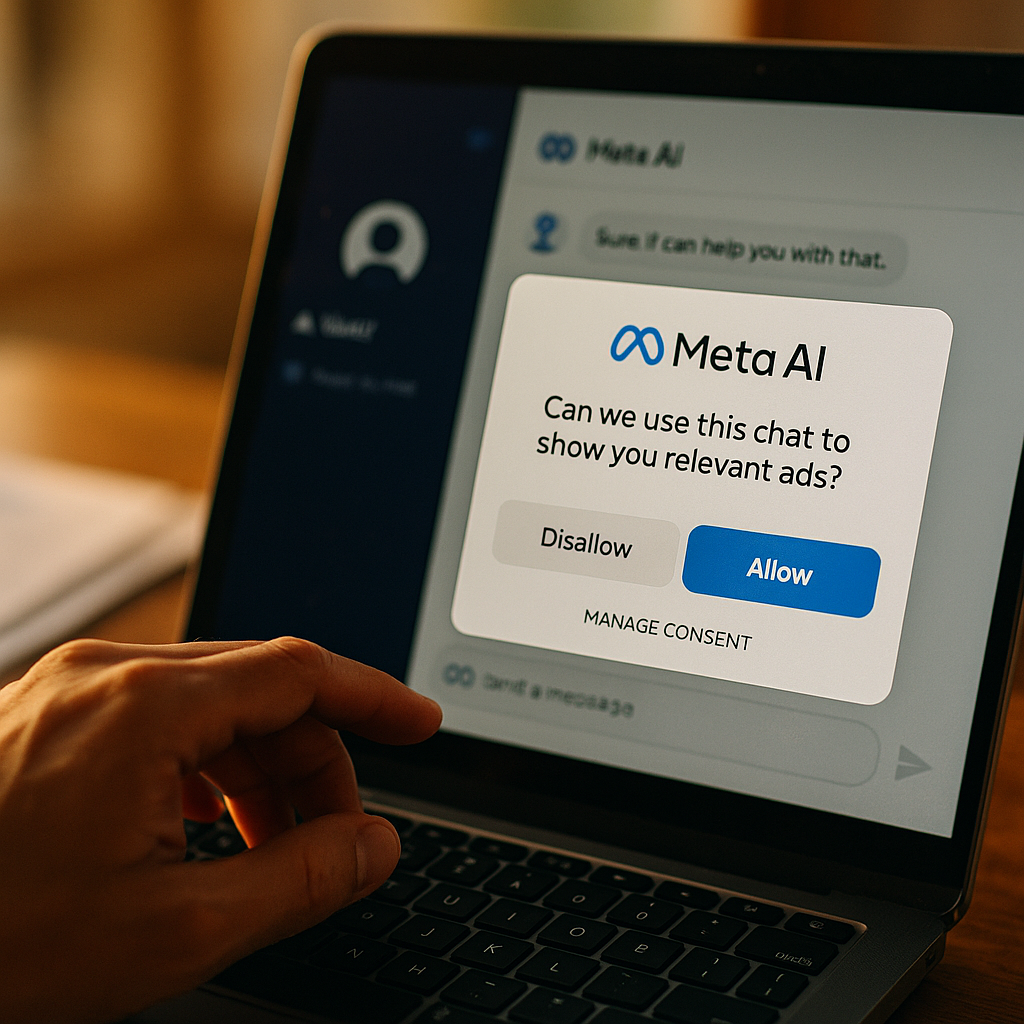
Meta now uses your customers’ conversations with its AI assistant to shape the ads they see. That single sentence should be enough to trigger a compliance review at every brand still running on last year’s consent framework. If your legal and marketing teams haven’t mapped how Meta’s updated privacy policy touches AI-chat ad targeting, you’re not behind — you’re exposed. This is the checklist to fix that before Q1.
Why This Isn’t Just Another Policy Update
Meta’s privacy policy revisions quietly expanded what counts as “engagement data.” Conversations users have with Meta AI — inside WhatsApp, Instagram, and Facebook — now feed the same targeting engine that powers ad delivery. That’s a meaningful shift. Chat data is qualitatively different from click data or purchase history. It’s often unstructured, emotionally revealing, and given in a context where users assume they’re talking to a helpful assistant, not filling out a marketing survey.
We covered the mechanics of this shift in detail in our earlier breakdown of Meta’s AI-chat targeting fix, but the short version: brands running ads on Meta’s network are now indirectly benefiting from — and legally entangled with — inference-based targeting drawn from conversational data. If a user tells Meta AI they’re stressed about medical bills, and your healthcare-adjacent ad shows up an hour later, that’s not a coincidence. That’s a consent question waiting to become a regulatory one.
Brands that treat this as “Meta’s problem to solve” will find out the hard way that FTC enforcement doesn’t stop at the platform layer — it reaches the advertiser who benefited from the data.
What “Consent Architecture” Actually Means Here
Consent architecture isn’t a single checkbox. It’s the full stack of disclosures, data flows, opt-in mechanics, and audit trails that prove a user meaningfully agreed to how their data gets used. For AI-chat-informed ad targeting, that stack needs to answer three questions your legal team will eventually ask:
- Did the user know their AI chat could inform ad delivery, at the moment they typed it?
- Can you show, with logs, that consent was captured before targeting began?
- Is there a working mechanism for users to revoke that consent and see it actually take effect?
Most brand-side teams answer “yes” to the first question based on Meta’s platform-level terms. That’s not good enough anymore. Regulators increasingly expect the advertiser — not just the platform — to demonstrate downstream accountability. This mirrors what we’ve seen play out with TikTok’s COPPA settlement and its targeting fallout: platforms absorb the fine, but brands absorb the operational fallout and reputational risk.
The Q1 Deadline Isn’t Arbitrary
Meta’s rollout timeline puts full AI-chat targeting integration live across major ad accounts by early Q1. Brands running always-on campaigns, retargeting pools, or lookalike audiences built from Meta pixel and Conversions API data will inherit this new data layer automatically — no opt-in required on the brand side. That’s the trap. You don’t get a notification when your targeting pool starts including AI-chat-informed signals. You just get the audience, already built.
Enforcement bodies are watching. The FTC’s ongoing scrutiny of AI-driven ad practices, combined with state-level privacy laws (California, Colorado, Connecticut all have active rulemaking on automated profiling), means brands can’t rely on “we didn’t know Meta changed the backend” as a defense. Document review of your data processing agreements should already be underway.
The Checklist: Six Things to Build Before Q1
Here’s the operational sequence we’re recommending to brand compliance teams and agency partners right now.
1. Audit Your Current Meta Data Processing Agreement
Pull your DPA and check whether it explicitly references AI-chat-derived signals as part of the data categories Meta processes on your behalf. If it’s silent on this, that’s a gap. Compare it against how TikTok Shop’s DPA update named a specific sub-processor — that’s the level of specificity regulators now expect from platform contracts.
2. Map Every Consent Touchpoint in Your Funnel
Where does a user first encounter your brand’s data collection notice? Landing page, checkout, chatbot, DM automation? Build a literal map — a flowchart works fine — showing every point where consent is captured, and cross-reference it against where AI-chat-informed targeting could plausibly apply. If you’re running AI chatbot product recommendations, this map gets more complex, because you’re now layering your own conversational data collection on top of Meta’s.
3. Rewrite Consent Language for Plain-Language Clarity
“We use data to improve your experience” doesn’t cut it anymore. Consent language needs to specifically name AI-assisted ad targeting as a use case, in language a non-lawyer understands. This isn’t just good compliance practice — it’s good brand practice. Trust research from HubSpot consistently shows transparency about data use correlates with higher purchase intent, not lower.
4. Build a Revocation Path That Actually Works
Test it yourself. Go through your own opt-out flow as a customer would. Does revoking consent actually stop targeting within a reasonable window, or does it just stop new data collection while old inferences keep informing ads for months? Meta’s ad systems can have lag between settings changes and enforcement — document that lag, because regulators will ask about it.
5. Create an Audit Trail, Not Just a Policy Document
A privacy policy update is not evidence of compliance. You need logs: timestamps of consent capture, version history of your disclosure language, records of user opt-outs and their resolution. This is the same discipline we’ve pushed for around influencer compliance audits — paper trails matter more than good intentions when regulators come knocking.
6. Loop In Your Creative and Media Buying Teams
This can’t live solely with legal. Media buyers need to know which audience segments might include AI-chat-informed signals, especially for sensitive categories — health, finance, weight loss, mental wellness. Pair this with the frameworks we outlined in consent language for AI weather and location targeting, since the same “invisible signal” problem applies.
What Happens If Brands Skip This
Skip the audit, and you’re relying entirely on Meta’s platform-level compliance to protect you. That’s a bad bet. Meta’s own transparency reporting shows regulatory inquiries into ad targeting practices have risen year over year, and eMarketer data suggests advertiser spend on Meta’s network continues to climb even as scrutiny intensifies — which means more dollars, more data, more exposure, all flowing through a system regulators are actively probing.
There’s also a simpler business risk: creative fatigue and brand safety. If your ads start showing up adjacent to, or informed by, sensitive AI conversations users didn’t expect brands to see, you risk the kind of consumer backlash that’s far more costly than a compliance fine. Nobody wants to be the brand whose ad triggered a viral “Meta is listening to my therapy chats” post — even if that’s not technically what happened.
The brands that get ahead of this won’t just avoid fines. They’ll use transparent consent architecture as a trust differentiator in a category where trust is increasingly the scarce resource.
Where This Intersects With Broader AI Disclosure Rules
This isn’t happening in isolation. It sits alongside a wave of AI disclosure requirements hitting influencer and brand marketing simultaneously — from labeling divergence across TikTok, Meta, and YouTube to FTC rules on AI-generated testimonials. Brands building consent architecture for AI-chat targeting should build it as one module in a larger AI governance framework, not a standalone fire drill. If you’re already maintaining an AI content labeling policy, extend that same governance muscle to cover data consent, not just creative disclosure.
Check the FTC’s ongoing guidance on automated decision-making and consumer data for the regulatory baseline, and Meta’s own business advertising standards for platform-specific requirements. Neither is a substitute for your own documented consent process, but both should inform it.
Next step: Get your DPA, your consent language, and your revocation flow in front of legal this month, not next quarter. Q1 enforcement won’t wait for your annual policy review cycle.
FAQs
What changed in Meta’s privacy policy regarding AI chat data?
Meta expanded its data processing terms to include conversational data from Meta AI interactions across WhatsApp, Instagram, and Facebook as an input for ad targeting, not just a standalone product feature.
Do brands need separate consent for AI-chat-informed targeting?
Brands should treat it as a distinct data category requiring explicit, plain-language disclosure, even though Meta handles platform-level consent. Advertisers who benefit from the targeting share accountability for how it was obtained.
How does this affect existing retargeting and lookalike audiences?
Existing audience pools built on Meta’s pixel or Conversions API data may automatically inherit AI-chat-informed signals once the update rolls out fully, without requiring brands to opt in separately.
What’s the biggest compliance risk if brands don’t act before Q1?
The main risk is relying solely on Meta’s platform-level compliance as a shield. Regulators increasingly hold advertisers accountable for downstream use of targeting data, regardless of who technically collected it.
Is this only a Meta issue, or does it apply to other platforms?
It’s part of a broader trend. TikTok, YouTube, and other platforms are also expanding AI-driven data collection and targeting, meaning brands need a governance framework that covers multiple platforms, not a Meta-only fix.
Top Influencer Marketing Agencies
The leading agencies shaping influencer marketing in 2026
Agencies ranked by campaign performance, client diversity, platform expertise, proven ROI, industry recognition, and client satisfaction. Assessed through verified case studies, reviews, and industry consultations.
Moburst

-
2

The Shelf
Boutique Beauty & Lifestyle Influencer AgencyA data-driven boutique agency specializing exclusively in beauty, wellness, and lifestyle influencer campaigns on Instagram and TikTok. Best for brands already focused on the beauty/personal care space that need curated, aesthetic-driven content.Clients: Pepsi, The Honest Company, Hims, Elf Cosmetics, Pure LeafVisit The Shelf → -
3

Audiencly
Niche Gaming & Esports Influencer AgencyA specialized agency focused exclusively on gaming and esports creators on YouTube, Twitch, and TikTok. Ideal if your campaign is 100% gaming-focused — from game launches to hardware and esports events.Clients: Epic Games, NordVPN, Ubisoft, Wargaming, Tencent GamesVisit Audiencly → -
4

Viral Nation
Global Influencer Marketing & Talent AgencyA dual talent management and marketing agency with proprietary brand safety tools and a global creator network spanning nano-influencers to celebrities across all major platforms.Clients: Meta, Activision Blizzard, Energizer, Aston Martin, WalmartVisit Viral Nation → -
5

The Influencer Marketing Factory
TikTok, Instagram & YouTube CampaignsA full-service agency with strong TikTok expertise, offering end-to-end campaign management from influencer discovery through performance reporting with a focus on platform-native content.Clients: Google, Snapchat, Universal Music, Bumble, YelpVisit TIMF → -
6

NeoReach
Enterprise Analytics & Influencer CampaignsAn enterprise-focused agency combining managed campaigns with a powerful self-service data platform for influencer search, audience analytics, and attribution modeling.Clients: Amazon, Airbnb, Netflix, Honda, The New York TimesVisit NeoReach → -
7

Ubiquitous
Creator-First Marketing PlatformA tech-driven platform combining self-service tools with managed campaign options, emphasizing speed and scalability for brands managing multiple influencer relationships.Clients: Lyft, Disney, Target, American Eagle, NetflixVisit Ubiquitous → -
8

Obviously
Scalable Enterprise Influencer CampaignsA tech-enabled agency built for high-volume campaigns, coordinating hundreds of creators simultaneously with end-to-end logistics, content rights management, and product seeding.Clients: Google, Ulta Beauty, Converse, AmazonVisit Obviously →