


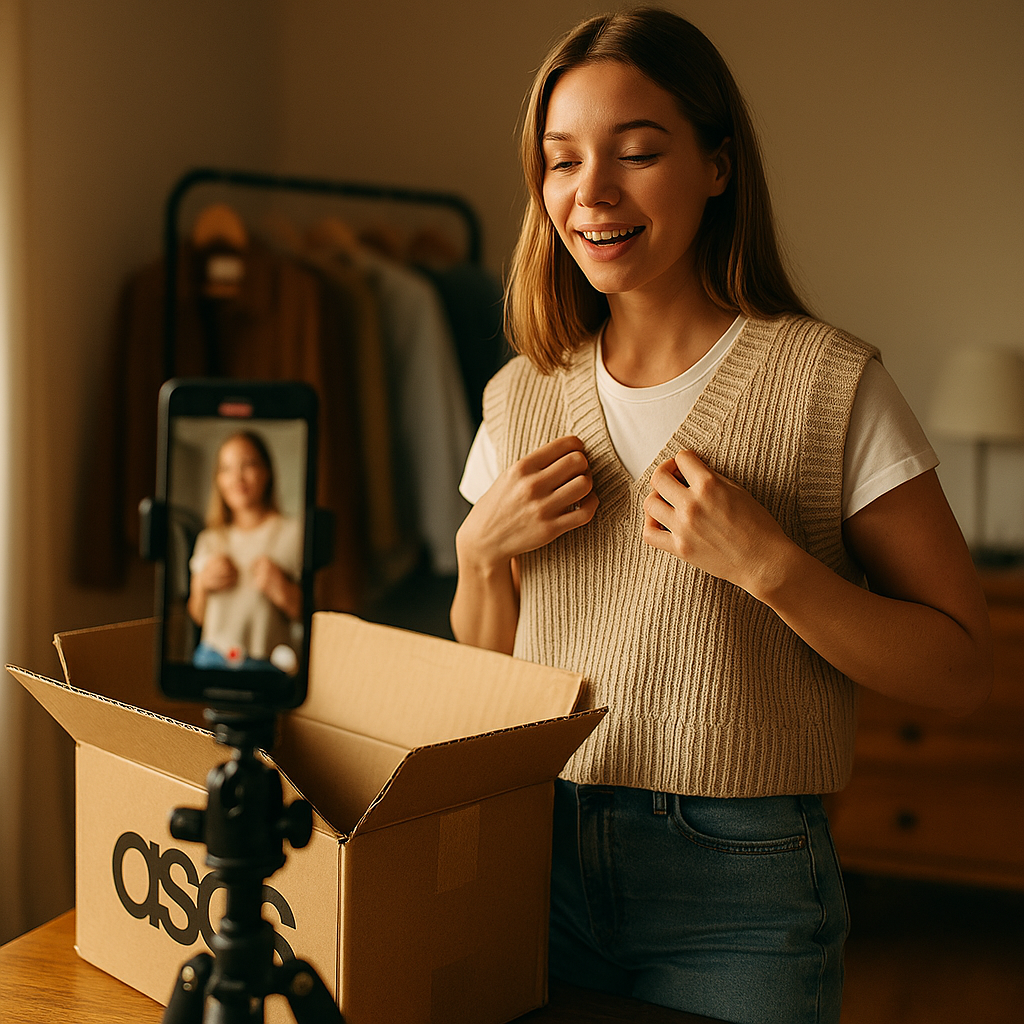
Fashion e-commerce loses roughly a quarter of its revenue to returns, and in occasionwear that number climbs past 40%, according to industry benchmarks tracked by Statista. ASOS knew this better than most. So when its fastest-growing category started bleeding margin on returns, the retailer didn’t reach for better size charts. It reached for micro-creator try-on hauls, and the results are now a template other retailers are quietly copying.
The Return Rate Problem ASOS Couldn’t Ignore
Occasionwear, think going-out dresses, wedding guest outfits, party sets, had become ASOS’s fastest-growing category by unit volume. Growth is great on paper. But occasionwear also carries the highest return rate on the platform, driven by fit anxiety, fabric surprises, and the simple fact that a bodycon dress photographed on a 5’10” model doesn’t tell you much about how it’ll sit on a curvier frame or a shorter torso.
Every return costs money twice: once in reverse logistics, and again in the lost sale if the item comes back damaged or out of season. ASOS’s finance team reportedly flagged the category as a margin risk even as revenue climbed. Growth without profitability isn’t growth, it’s a subsidy.
Why Fit Uncertainty Is the Real Villain
Static product photography answers “what does it look like.” It almost never answers “what will it look like on me.” That gap is where returns are born. Studio shots are lit, steamed, and pinned to fit a sample size. Real bodies aren’t.
ASOS’s own customer service data pointed to fit and sizing as the leading return reason in occasionwear, ahead of “changed my mind” or “arrived damaged.” That’s a solvable problem, but not with better copywriting. It required showing the product on ordinary bodies, in ordinary lighting, doing ordinary things like sitting down or raising an arm.
Fit uncertainty, not price or quality, was the single biggest driver of returns in ASOS’s occasionwear category, and no amount of size-chart copy was fixing it.
Enter the Try-On Haul, Reimagined
Try-on hauls aren’t new. TikTok and YouTube have hosted “outfit haul” content for years. What ASOS did differently was scale the format through micro-creators rather than a handful of paid ambassadors, and tie it directly to product pages and social commerce checkout flows.
The logic is simple. A macro-influencer with a million followers and a stylist on retainer doesn’t look like the average shopper. A micro-creator with 8,000 to 60,000 followers, filming in a bedroom with normal lighting, does. Their body type, their honesty about a dress running small, their unscripted “okay this is actually really flattering” reaction, that’s the content that answers the fit question before a customer clicks buy.
This isn’t a fringe theory. Brands like Curology have already proven the sales lift potential of micro-influencer programs built on authenticity rather than reach, and Aerie’s bet on unretouched creator content showed shoppers respond to realism over polish. ASOS applied that same logic, but pointed it at returns instead of top-line sales.
Inside the Program: How ASOS Actually Built It
ASOS didn’t run this as a one-off campaign. It built a repeatable operational pipeline, which is the part most case studies skip.
- Creator tier: Recruitment focused almost exclusively on creators in the 5,000 to 50,000 follower range, prioritizing diverse body types, heights, and skin tones over polished production value.
- Product seeding at scale: Instead of sending single items, ASOS seeded creators with three to five sizing variants of the same garment so the try-on content itself became a mini size guide.
- Platform mix: Content lived natively on TikTok and Instagram Reels, then got pulled into shoppable galleries on ASOS product detail pages, so the “does this run small” answer sat right next to the buy button.
- Briefing for honesty, not hype: Creators were explicitly briefed to flag sizing quirks, fabric stretch, and length issues rather than deliver a pure endorsement. Counterintuitive, but that’s exactly what built trust.
- Disclosure compliance baked in: Every piece of paid or gifted content carried clear disclosure per FTC and ASA guidance, avoiding the trust erosion that’s tripped up other retailers.
The volume mattered as much as the format. ASOS reportedly worked with hundreds of micro-creators across the category rather than a curated dozen, treating the program more like programmatic seeding than traditional influencer marketing. That approach mirrors what Chipotle did with programmatic creator matching at scale, just applied to fit content instead of brand awareness.
What Happened to the Numbers
Occasionwear return rates in the program’s target SKUs dropped meaningfully within two quarters of rollout, according to figures ASOS shared with retail press. The bigger signal wasn’t the headline percentage, it was where the drop concentrated: items with try-on haul content attached saw a steeper decline than category-wide averages, isolating the creator content as the driver rather than broader seasonal returns trends.
Average order value on try-on-tagged product pages also ticked upward, suggesting the content wasn’t just preventing returns, it was giving hesitant shoppers the confidence to buy in the first place. That’s the dual win brands chase and rarely catch: lower returns and higher conversion from the same asset.
Product pages featuring micro-creator try-on content saw a steeper return-rate decline than the category average, isolating the content itself as the driver, not seasonal noise.
Why Micro Beat Macro Here
It’s worth asking why ASOS didn’t just pay a celebrity stylist to do a glossy try-on series. The answer comes down to relatability math. A shopper deciding between a size 10 and 12 doesn’t need a supermodel’s opinion, she needs someone who looks like her giving an honest reaction. Micro-creators, almost by definition, represent a wider spread of body types and everyday contexts than the handful of macro-influencers a brand can realistically sign.
There’s also a cost argument. Running hundreds of micro-creator relationships costs less per unit of content than a handful of high-fee macro deals, and it produces far more raw footage to test against different product pages. Stanley’s wave-based micro-creator strategy proved the same volume logic works for building product demand. ASOS essentially repurposed that volume playbook to solve a supply chain problem instead of a demand problem.
Operational Lessons for Brands Considering This Playbook
Retailers eyeing this model should think about it as a returns-reduction infrastructure project, not a marketing campaign. A few things matter more than they might expect:
- Sizing diversity in casting is non-negotiable. If every creator wears a US size 4, you’ve solved nothing.
- Content needs a home beyond social. The ROI shows up when try-on video sits on the actual product page, not just in a feed that scrolls past.
- Briefs should reward honesty over enthusiasm. A creator saying “this ran a full size small” is worth more to your returns line than ten glowing reviews.
- Measurement needs to isolate the variable. ASOS could only prove impact because it tracked return rates SKU-by-SKU against content presence, not just category-wide trends.
- Disclosure and compliance can’t be an afterthought. Regulatory scrutiny on influencer marketing has only intensified, and cutting corners here risks the exact trust you’re trying to build. Brands like Poppi have learned this the hard way after rebuilding influencer trust post-FTC settlement.
None of this requires exotic technology. It requires disciplined creator vetting, a content pipeline that ties back to specific SKUs, and a willingness to measure returns as rigorously as brands usually measure conversion. Platforms like TikTok Shop already make the shoppable-content infrastructure available; the harder work is the sourcing and briefing discipline behind it.
The Takeaway
ASOS didn’t fix its fastest-growing category’s return problem with better logistics or cheaper shipping. It fixed it with content that answered the one question static photography can’t: will this actually fit me? Brands sitting on a high-return category should audit whether their creator content is selling the product or actually de-risking the purchase, because those are two very different jobs, and only one of them protects margin.
Frequently Asked Questions
What is a micro-creator try-on haul?
It’s short-form video content, usually posted on TikTok or Instagram Reels, where a creator with a modest but engaged following (typically 5,000 to 50,000 followers) tries on a garment in multiple sizes and gives an unscripted reaction to fit, fabric, and styling.
Why did ASOS use micro-creators instead of larger influencers?
Micro-creators represent a broader range of body types and everyday contexts than a small pool of macro-influencers, which makes their fit feedback more relatable to the average shopper deciding between two sizes.
How does try-on content actually reduce return rates?
It addresses fit uncertainty, the leading cause of returns in categories like occasionwear, before the purchase happens rather than after. Shoppers who see realistic fit references are less likely to order multiple sizes to “try and return.”
Can smaller retailers replicate this strategy without ASOS’s budget?
Yes. The model relies on volume and honesty rather than high production spend, which makes it more accessible to mid-sized retailers than traditional celebrity-driven influencer campaigns.
What compliance requirements apply to try-on haul content?
Any gifted or paid creator content must carry clear disclosure under FTC guidance in the US or ASA rules in the UK, regardless of the creator’s follower count.
Top Influencer Marketing Agencies
The leading agencies shaping influencer marketing in 2026
Agencies ranked by campaign performance, client diversity, platform expertise, proven ROI, industry recognition, and client satisfaction. Assessed through verified case studies, reviews, and industry consultations.
Moburst

-
2

The Shelf
Boutique Beauty & Lifestyle Influencer AgencyA data-driven boutique agency specializing exclusively in beauty, wellness, and lifestyle influencer campaigns on Instagram and TikTok. Best for brands already focused on the beauty/personal care space that need curated, aesthetic-driven content.Clients: Pepsi, The Honest Company, Hims, Elf Cosmetics, Pure LeafVisit The Shelf → -
3

Audiencly
Niche Gaming & Esports Influencer AgencyA specialized agency focused exclusively on gaming and esports creators on YouTube, Twitch, and TikTok. Ideal if your campaign is 100% gaming-focused — from game launches to hardware and esports events.Clients: Epic Games, NordVPN, Ubisoft, Wargaming, Tencent GamesVisit Audiencly → -
4

Viral Nation
Global Influencer Marketing & Talent AgencyA dual talent management and marketing agency with proprietary brand safety tools and a global creator network spanning nano-influencers to celebrities across all major platforms.Clients: Meta, Activision Blizzard, Energizer, Aston Martin, WalmartVisit Viral Nation → -
5

The Influencer Marketing Factory
TikTok, Instagram & YouTube CampaignsA full-service agency with strong TikTok expertise, offering end-to-end campaign management from influencer discovery through performance reporting with a focus on platform-native content.Clients: Google, Snapchat, Universal Music, Bumble, YelpVisit TIMF → -
6

NeoReach
Enterprise Analytics & Influencer CampaignsAn enterprise-focused agency combining managed campaigns with a powerful self-service data platform for influencer search, audience analytics, and attribution modeling.Clients: Amazon, Airbnb, Netflix, Honda, The New York TimesVisit NeoReach → -
7

Ubiquitous
Creator-First Marketing PlatformA tech-driven platform combining self-service tools with managed campaign options, emphasizing speed and scalability for brands managing multiple influencer relationships.Clients: Lyft, Disney, Target, American Eagle, NetflixVisit Ubiquitous → -
8

Obviously
Scalable Enterprise Influencer CampaignsA tech-enabled agency built for high-volume campaigns, coordinating hundreds of creators simultaneously with end-to-end logistics, content rights management, and product seeding.Clients: Google, Ulta Beauty, Converse, AmazonVisit Obviously →