


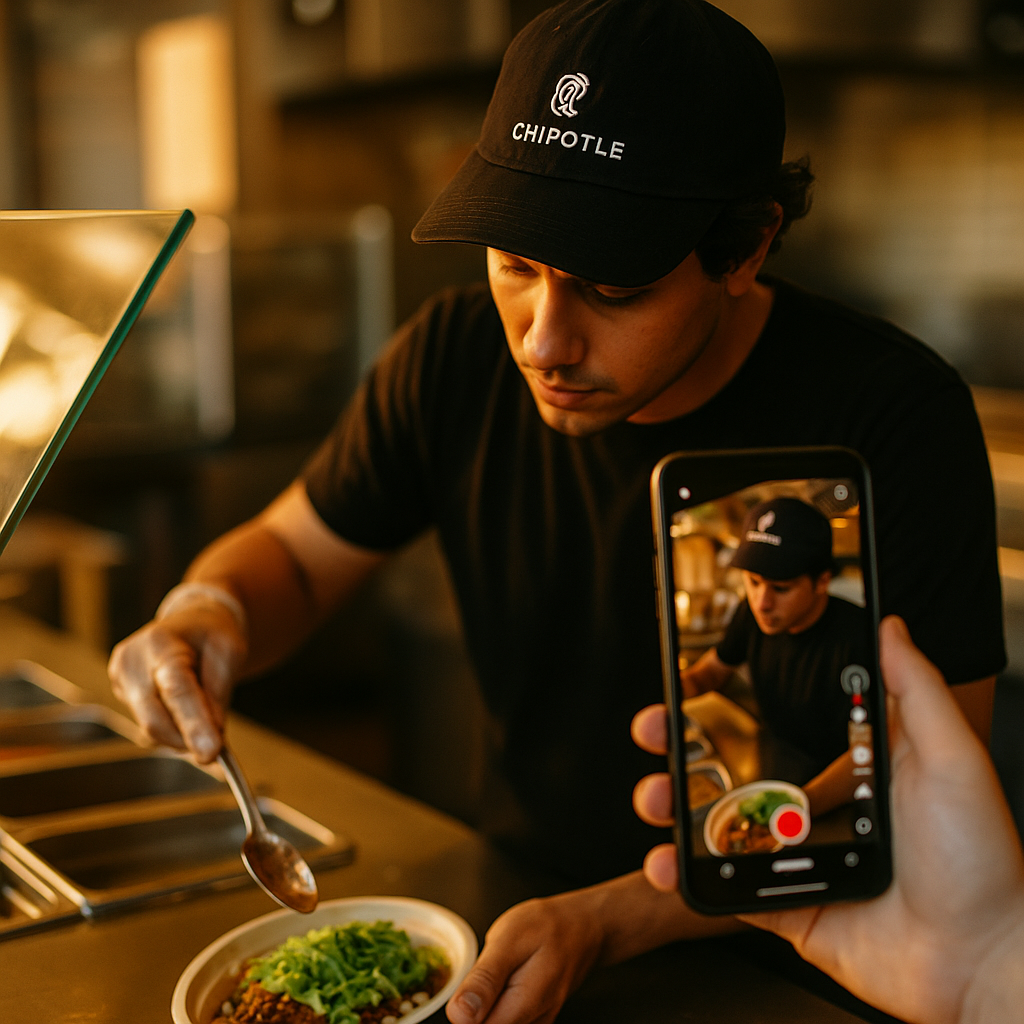
Chipotle ran a TikTok UGC contest that generated over 200,000 video submissions, and AI did the sorting. No human team could have manually reviewed that volume before the trend cycle moved on. That single operational fact is why Chipotle’s AI curated UGC contests on TikTok deserve a closer look from anyone running a brand content program in 2026. This isn’t a story about a clever hashtag. It’s a story about what happens when a QSR chain treats creator content like a supply chain problem instead of a marketing afterthought.
Why Chipotle Bet on Contests Instead of Paid Creators
Chipotle has never been shy about TikTok. The brand built its reputation on lo-fi, meme-friendly content years before “creator economy” became a boardroom phrase. But contests solve a different problem than paid partnerships do. Where a paid creator deal buys you a handful of polished videos, a well-run contest buys you volume, authenticity signals, and a built-in incentive structure that costs a fraction of a traditional influencer roster.
The mechanics are simple on the surface. Chipotle prompts fans to submit videos around a theme (a menu hack, a “burrito ASMR” trend, a seasonal promo) and dangles a prize: free food for a year, cash, or a spot in an official ad. Thousands of teenagers and twenty-somethings with ring lights do the rest. The brand doesn’t need to brief 700 creators individually, because Chipotle already scaled creator tiers through programmatic matching, and the contest format extends that same logic to unpaid, opt-in participation.
What’s different this cycle is the curation layer. Chipotle’s marketing team, working with TikTok’s internal tools and third-party creative platforms, uses AI models to pre-screen submissions for brand safety, engagement potential, and format fit before any human ever hits play. That’s the part most competitors still can’t replicate.
A brand that can review 200,000 UGC submissions in days, not months, has effectively turned a marketing liability (content moderation at scale) into a competitive advantage.
The Numbers Behind the Noise
Contest hype is easy to manufacture. Contest performance is harder to prove. Here’s what stands out from Chipotle’s recent TikTok activations:
- Submission volume regularly exceeds 100,000 to 200,000 videos per major contest window, according to campaign recaps shared by Chipotle’s marketing team and covered across trade press.
- AI pre-screening reportedly cuts manual review workload by more than 80%, letting a lean social team focus only on finalists and edge cases.
- Winning or featured videos routinely outperform Chipotle’s own branded posts on completion rate, a pattern consistent with broader UGC benchmarks that show peer-created content earning higher trust scores than brand-produced content, per research from Sprout Social.
- Cost per video asset, when you account for prize payouts against the volume of usable content generated, lands well below typical creator agency rates for comparable output.
That last point is the one CFOs actually care about. A brand can spend six figures on a slate of mid-tier paid creators and walk away with maybe fifty usable videos. Chipotle’s contest model spends a fraction of that on prizes and platform tooling, and walks away with thousands of raw assets, a subset of which get amplified into paid media.
How the AI Curation Actually Works
“AI curated” gets thrown around loosely in marketing decks, so let’s be specific about what’s happening under the hood. The pipeline generally breaks into three stages.
Stage one: ingestion and filtering. Every submission gets tagged for basic brand safety (no logos of competitors, no flagged audio, no policy violations under TikTok’s own content guidelines, which you can review directly through TikTok’s advertising platform). This step alone eliminates a large share of submissions before a human ever sees them.
Stage two: performance prediction. Machine learning models trained on historical engagement data score each video for likely watch time, share potential, and format quality. This is the same underlying logic that’s helped other brands avoid the trap of chasing raw view counts. It’s worth comparing this to how watch time metrics have reshaped creator briefs across the industry: brands that optimize purely for views often miss the retention signals that actually drive algorithmic reach.
Stage three: human sign-off. This part matters, and Chipotle hasn’t fully automated it, nor should it. A small team makes the final call on winners and featured content, because brand voice and cultural nuance still require a human gut check. AI narrows the field from 200,000 to a few hundred. Humans pick the winners.
This hybrid model mirrors a pattern showing up across QSR marketing more broadly, where AI-generated storyboards have compressed content turnaround to 48 hours for other fast-food brands racing to keep pace with trend cycles. Speed is the operational currency of TikTok marketing now. Contests that took weeks to judge in 2022 need to resolve in days by 2026, or the trend they were built around is already dead.
Risk Mitigation: The Part Nobody Puts in the Case Study
Open contests are a compliance headache waiting to happen. Any brand running a UGC contest has to think through disclosure rules, since prize incentives can trigger material connection disclosure requirements under FTC endorsement guidelines. Chipotle’s contest terms explicitly require winners to disclose the brand relationship if content gets reused in paid media, which is a smart hedge against the kind of scrutiny that’s tripped up other brands.
Consider what happened when a beverage brand’s influencer program came under FTC review for inadequate disclosure practices. Poppi’s path to rebuilding influencer trust after its FTC settlement is a cautionary tale that any team running a high-volume UGC contest should study closely. Volume without governance is how brands end up on a regulator’s radar.
There’s also the intellectual property question. Contest terms need airtight language around usage rights, because a brand that wants to repurpose winning content into paid ads has to own that right explicitly, not assume it. Chipotle’s legal team builds this into contest entry terms upfront, which is standard practice but easy to skip when marketing teams move fast and skip the fine print.
Does This Model Actually Beat Traditional Influencer Spend?
Short answer: it depends on the goal.
If the objective is top-of-funnel awareness and content volume, contests win on cost efficiency almost every time. The math is straightforward: prize pools are fixed costs, and submission volume is variable and often exceeds expectations. Compare that to paid creator programs where cost scales linearly (or worse) with the number of creators and deliverables involved.
If the objective is conversion or attributable sales, contests are weaker on their own. UGC contests generate awareness and social proof, not necessarily bottom-funnel action. That’s where brands pair the contest layer with more targeted, ROI-driven creator partnerships. Chipotle still runs paid creator tiers alongside its contest activity, and other brands in the QSR and CPG space have found similar success blending the two models. One coffee brand tripled ROAS using AI creator matching for its paid tier while running lighter UGC mechanics for top-of-funnel reach, a structure that’s becoming close to industry standard.
Contests are a volume and sentiment play. Paid creator tiers are a conversion play. The brands winning on TikTok right now run both, and let AI handle the sorting so humans can focus on strategy.
What Other Brands Can Actually Steal From This Playbook
You don’t need Chipotle’s budget to replicate the logic, just the discipline.
- Set a submission window short enough to match a trend cycle. Two to three weeks, not two months.
- Build AI screening into the contest infrastructure from day one, not as an afterthought once submissions overwhelm a small team. Platforms and agencies increasingly offer this as a packaged service.
- Write disclosure and usage rights into contest terms before launch, and have legal sign off, not marketing alone.
- Pair the contest with a smaller paid tier for creators who consistently perform, converting the contest into an ongoing pipeline rather than a one-off stunt.
- Measure completion rate and shares, not just submission count. Volume is a vanity metric if none of it gets watched.
Brands in adjacent categories are already testing versions of this. Candy and snack brands running nano-creator taste tests, for instance, have found that structured UGC formats can outsell legacy category incumbents when the content pipeline is systematized rather than ad hoc. The lesson generalizes: it’s not the contest gimmick that wins, it’s the operational backbone behind it.
Industry-wide spend on creator and UGC-driven marketing keeps climbing, with eMarketer tracking continued growth in influencer marketing budgets across categories that once relied purely on traditional media buys. QSR brands are among the fastest movers, partly because their audience skews younger and lives on TikTok by default.
The Takeaway
Chipotle’s AI curated UGC contests work because the brand treated content moderation as an operational bottleneck to solve, not a cost to absorb. If you’re evaluating whether a similar contest model fits your brand, start by asking whether you can actually process the volume it might generate. If the answer is no, fix that infrastructure question before you launch the campaign, not after the submissions start piling up.
FAQs
What makes Chipotle’s TikTok UGC contests different from a typical hashtag challenge?
The AI curation layer is the differentiator. Chipotle uses machine learning to pre-screen and score submissions for brand safety and engagement potential before human reviewers make final selections, allowing the brand to process far higher submission volumes than a manual review process would allow.
How does AI curation reduce costs compared to paid influencer campaigns?
Contest models rely on fixed prize pools rather than per-creator fees, and AI screening cuts the labor cost of reviewing thousands of submissions. This produces a much lower cost per usable video asset compared to traditional paid creator rosters.
Are UGC contest winners required to disclose brand relationships?
Yes. When winning content gets reused in paid media, disclosure is typically required under FTC endorsement guidelines, and well-run contests build this requirement into entry terms upfront to avoid compliance issues later.
Can smaller brands replicate this model without Chipotle’s budget?
Yes, though scale will differ. The core principles (short submission windows, AI-assisted screening, clear usage rights, and pairing contests with a smaller paid creator tier) apply regardless of company size.
Do UGC contests drive sales or just awareness?
Contests primarily drive awareness, sentiment, and content volume. Brands seeking direct conversion typically pair contest mechanics with a targeted paid creator program to close the funnel.
Top Influencer Marketing Agencies
The leading agencies shaping influencer marketing in 2026
Agencies ranked by campaign performance, client diversity, platform expertise, proven ROI, industry recognition, and client satisfaction. Assessed through verified case studies, reviews, and industry consultations.
Moburst

-
2

The Shelf
Boutique Beauty & Lifestyle Influencer AgencyA data-driven boutique agency specializing exclusively in beauty, wellness, and lifestyle influencer campaigns on Instagram and TikTok. Best for brands already focused on the beauty/personal care space that need curated, aesthetic-driven content.Clients: Pepsi, The Honest Company, Hims, Elf Cosmetics, Pure LeafVisit The Shelf → -
3

Audiencly
Niche Gaming & Esports Influencer AgencyA specialized agency focused exclusively on gaming and esports creators on YouTube, Twitch, and TikTok. Ideal if your campaign is 100% gaming-focused — from game launches to hardware and esports events.Clients: Epic Games, NordVPN, Ubisoft, Wargaming, Tencent GamesVisit Audiencly → -
4

Viral Nation
Global Influencer Marketing & Talent AgencyA dual talent management and marketing agency with proprietary brand safety tools and a global creator network spanning nano-influencers to celebrities across all major platforms.Clients: Meta, Activision Blizzard, Energizer, Aston Martin, WalmartVisit Viral Nation → -
5

The Influencer Marketing Factory
TikTok, Instagram & YouTube CampaignsA full-service agency with strong TikTok expertise, offering end-to-end campaign management from influencer discovery through performance reporting with a focus on platform-native content.Clients: Google, Snapchat, Universal Music, Bumble, YelpVisit TIMF → -
6

NeoReach
Enterprise Analytics & Influencer CampaignsAn enterprise-focused agency combining managed campaigns with a powerful self-service data platform for influencer search, audience analytics, and attribution modeling.Clients: Amazon, Airbnb, Netflix, Honda, The New York TimesVisit NeoReach → -
7

Ubiquitous
Creator-First Marketing PlatformA tech-driven platform combining self-service tools with managed campaign options, emphasizing speed and scalability for brands managing multiple influencer relationships.Clients: Lyft, Disney, Target, American Eagle, NetflixVisit Ubiquitous → -
8

Obviously
Scalable Enterprise Influencer CampaignsA tech-enabled agency built for high-volume campaigns, coordinating hundreds of creators simultaneously with end-to-end logistics, content rights management, and product seeding.Clients: Google, Ulta Beauty, Converse, AmazonVisit Obviously →