


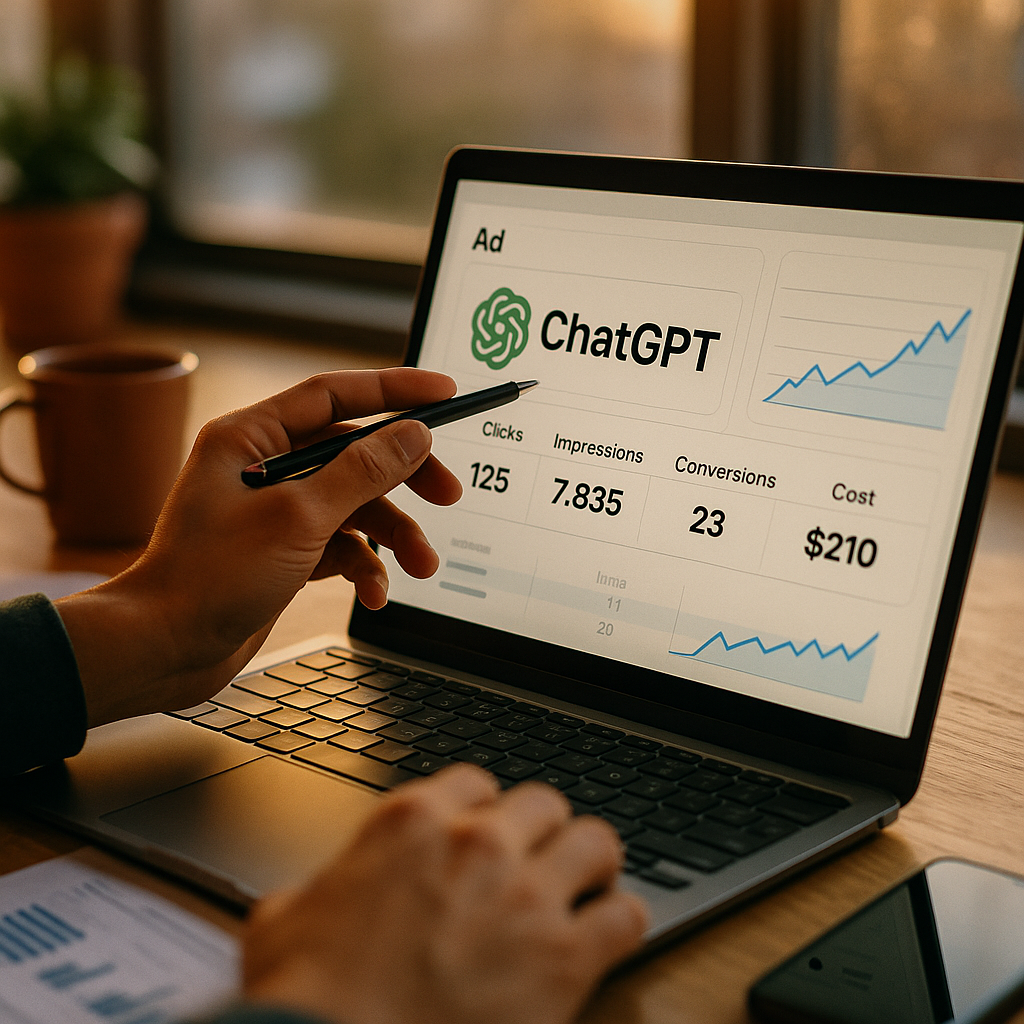
ChatGPT Ads just went live inside a chat interface that 800 million weekly users treat like a search engine, a shopping assistant, and increasingly, a decision-making partner. Marketers who wait for “best practices” to trickle down from case studies will be six months behind. So what should you actually measure in week one?
The Format Nobody Fully Understands Yet
OpenAI’s ad rollout inside ChatGP is unlike anything most media buyers have planned against. There’s no feed to scroll, no carousel to swipe. Ads surface contextually inside conversational threads, sometimes as sponsored product suggestions, sometimes as branded responses woven into an answer. That’s a fundamentally different attention model than Instagram Reels or a Google SERP.
Early access advertisers describe placements that look less like traditional display and more like a hybrid of search intent capture and native recommendation. A user asks ChatGPT for “best noise-canceling headphones under $200,” and a sponsored answer appears alongside organic suggestions. No banner, no obvious “ad” fatigue trigger, at least not yet.
That ambiguity is exactly why tracking discipline matters more here than on any platform launched in the last five years. You’re not just testing creative. You’re testing whether your entire measurement stack can even see what’s happening.
What to Track First: Impressions Won’t Tell You Much
Forget vanity impressions for the first 30 days. ChatGPT ad exposure doesn’t map cleanly to a “view” the way a video ad does. A user might read a sponsored response for eight seconds or forty, and neither the platform nor your existing martech stack has agreed on what counts as meaningful engagement yet.
Instead, prioritize these four signals from day one:
- Referral traffic tagged specifically from ChatGPT, separated from generic “AI chatbot” referral buckets in Google Analytics or your CDP.
- Conversion lag time, since conversational discovery may produce longer consideration windows than a paid social click.
- Branded search lift in the days following exposure, a proxy metric when direct attribution is murky.
- Assisted conversions in multi-touch models, because ChatGPT exposure will rarely be the last touch before purchase.
If your dashboard still lumps ChatGPT referral traffic under “other” or “direct,” you’re already flying blind on the one channel your CFO will ask about first.
This is the same lesson brands learned the hard way when AI shopping agents started erasing creator credit at checkout. Attribution gaps don’t announce themselves. They just quietly eat your reported ROI until someone in finance asks why the numbers don’t reconcile.
Attribution Is Broken Before You Even Start
Here’s the uncomfortable truth: standard UTM parameters weren’t built for conversational referrals. When ChatGPT surfaces a sponsored link, the click behavior, session structure, and even browser fingerprinting differ from a typical paid social or search click. Some early testers report inconsistent UTM pass-through depending on whether the user is on web, mobile app, or API-integrated surfaces.
That means your first job isn’t creative testing. It’s plumbing. Confirm with your analytics team, or your agency, that ChatGPT-sourced sessions are landing in a distinct channel grouping before you spend a single incremental dollar on scaling budget. Otherwise you’ll be optimizing against noise.
This mirrors a broader industry problem. Zero click search already claims 68 percent of queries, and conversational AI platforms are accelerating that shift further away from clean, clickable attribution paths. Brands that built their entire measurement philosophy around last-click will need a new framework, not a patch.
Marketing mix modeling is becoming the fallback for exactly this reason. If you haven’t revisited your MMM inputs recently, now’s the moment, especially since MMM now claims 11 percent of ad budgets industry-wide, a figure likely to climb as platforms like ChatGPT resist granular tracking.
Disclosure and Compliance: A New Gray Zone
Sponsored content inside a conversational AI response raises disclosure questions regulators haven’t fully answered. The FTC’s existing guidance on native advertising and clear labeling was written for feeds and search results, not for an AI assistant blending a paid recommendation into what feels like objective advice.
Brand marketers should assume scrutiny is coming, not wait for enforcement. Ask your legal and compliance teams these questions before scaling spend:
- Is the sponsored nature of the response clearly and persistently labeled, not just on first appearance?
- Does your creative avoid language that could be mistaken for the model’s own “opinion” or independent recommendation?
- Are you archiving ad creative and placement logs in case of a future audit?
This isn’t hypothetical caution. Trust in AI-generated content has already cratered, with AI content trust falling to 34 percent, forcing disclosure requirements across creator content. Sponsored AI responses will face the same skepticism, probably faster, since users have even less context for why a chatbot recommended a specific brand.
The parallel to influencer compliance gaps is worth studying closely. The same governance failures that surfaced at IBC Summit around creator compliance (unclear disclosure, inconsistent labeling, no audit trail) are the exact risks brands now face inside conversational ad placements.
How Much Budget Should You Actually Commit?
Resist the urge to shift a meaningful chunk of your paid social budget into ChatGPT Ads on day one. Treat this like any new channel launch: allocate a test budget you can afford to write off entirely, somewhere in the range of 3 to 5 percent of quarterly digital spend, and build a 60 to 90 day evaluation window before making bigger calls.
Why so conservative? Because early platform economics almost always favor the platform, not the advertiser. CPMs tend to be artificially low during launch phases to attract testers, then normalize once demand catches up. You want enough signal to understand true performance ceilings before auction dynamics shift under you.
This budget discipline echoes a broader trend already reshaping creator and paid media strategy. Brands are increasingly shifting ad budgets from media buys toward creator distribution, precisely because performance visibility has become the deciding factor in where dollars go. ChatGPT Ads need to earn their place in that hierarchy, not assume it.
Also worth noting: reporting infrastructure itself is now a real line item. Dashboards and measurement tools currently claim 19 percent of martech spend, and that number will likely grow as teams scramble to build custom tracking for platforms that don’t yet integrate cleanly with existing stacks.
Building a 30-Day Tracking Playbook
Don’t overthink the launch phase. Here’s a lean framework that works for most mid-to-senior marketing teams testing ChatGPT Ads for the first time:
- Week one: Confirm tracking plumbing works. Validate UTM pass-through, channel grouping, and conversion event tagging before optimizing anything.
- Week two: Launch with two to three creative variants max. Keep messaging simple and compliant, since you’re also testing disclosure clarity.
- Weeks three and four: Layer in branded search lift analysis and assisted conversion review. This is where you’ll see whether ChatGPT exposure is actually influencing downstream behavior, even without clean last-click data.
- Day 30 review: Compare cost per acquisition against your existing channel mix, not in isolation. If ChatGPT Ads only look good when measured on their own terms, that’s a red flag, not a win.
One more thing worth tracking that most teams overlook: sentiment. Ask your social listening tools to flag any user commentary about ads appearing inside ChatGPT responses. Public reaction to sponsored content inside a “trusted” AI assistant could shift fast, and you want early warning if backlash starts building. It’s the same instinct driving community first metrics replacing reach as the leading influencer KPI. Sentiment now moves faster than reach ever did.
For teams that already run influencer and creator programs, there’s a natural crossover point here too. If your creators are recommending products that also show up as sponsored ChatGPT responses, you’ll want unified reporting that captures both, similar to the logic behind revenue per follower overtaking engagement as the top creator metric. Siloed dashboards will only slow you down.
Frequently Asked Questions
What are ChatGPT Ads and how do they appear to users?
ChatGPT Ads are sponsored placements that appear contextually within conversational responses, such as product recommendations or branded answers, rather than as traditional banner or feed-based creative.
How should brands track ChatGPT Ads performance in the first month?
Prioritize confirming that referral traffic is tagged correctly, monitor branded search lift, track assisted conversions in multi-touch attribution models, and avoid relying on impressions or last-click data alone.
Are ChatGPT Ads subject to FTC disclosure rules?
Existing native advertising and disclosure guidance from the FTC likely applies, though enforcement specifics for conversational AI placements are still developing. Brands should assume scrutiny is coming and label sponsored content clearly.
How much budget should marketers allocate to testing ChatGPT Ads?
Most teams should start with a small test budget, roughly 3 to 5 percent of quarterly digital spend, over a 60 to 90 day evaluation window before committing larger budgets.
Why is attribution difficult with ChatGPT Ads?
Conversational referral traffic doesn’t always pass through standard UTM parameters consistently, and session structures differ from typical paid search or social clicks, making clean last-click attribution unreliable.
The brands that win this cycle won’t be the ones who spend fastest. They’ll be the ones who build clean tracking infrastructure before scaling a single dollar into ChatGPT Ads. Fix your attribution plumbing this week, run a small disciplined test, and let the data, not the hype, decide your next budget move.
Top Influencer Marketing Agencies
The leading agencies shaping influencer marketing in 2026
Agencies ranked by campaign performance, client diversity, platform expertise, proven ROI, industry recognition, and client satisfaction. Assessed through verified case studies, reviews, and industry consultations.
Moburst

-
2

The Shelf
Boutique Beauty & Lifestyle Influencer AgencyA data-driven boutique agency specializing exclusively in beauty, wellness, and lifestyle influencer campaigns on Instagram and TikTok. Best for brands already focused on the beauty/personal care space that need curated, aesthetic-driven content.Clients: Pepsi, The Honest Company, Hims, Elf Cosmetics, Pure LeafVisit The Shelf → -
3

Audiencly
Niche Gaming & Esports Influencer AgencyA specialized agency focused exclusively on gaming and esports creators on YouTube, Twitch, and TikTok. Ideal if your campaign is 100% gaming-focused — from game launches to hardware and esports events.Clients: Epic Games, NordVPN, Ubisoft, Wargaming, Tencent GamesVisit Audiencly → -
4

Viral Nation
Global Influencer Marketing & Talent AgencyA dual talent management and marketing agency with proprietary brand safety tools and a global creator network spanning nano-influencers to celebrities across all major platforms.Clients: Meta, Activision Blizzard, Energizer, Aston Martin, WalmartVisit Viral Nation → -
5

The Influencer Marketing Factory
TikTok, Instagram & YouTube CampaignsA full-service agency with strong TikTok expertise, offering end-to-end campaign management from influencer discovery through performance reporting with a focus on platform-native content.Clients: Google, Snapchat, Universal Music, Bumble, YelpVisit TIMF → -
6

NeoReach
Enterprise Analytics & Influencer CampaignsAn enterprise-focused agency combining managed campaigns with a powerful self-service data platform for influencer search, audience analytics, and attribution modeling.Clients: Amazon, Airbnb, Netflix, Honda, The New York TimesVisit NeoReach → -
7

Ubiquitous
Creator-First Marketing PlatformA tech-driven platform combining self-service tools with managed campaign options, emphasizing speed and scalability for brands managing multiple influencer relationships.Clients: Lyft, Disney, Target, American Eagle, NetflixVisit Ubiquitous → -
8

Obviously
Scalable Enterprise Influencer CampaignsA tech-enabled agency built for high-volume campaigns, coordinating hundreds of creators simultaneously with end-to-end logistics, content rights management, and product seeding.Clients: Google, Ulta Beauty, Converse, AmazonVisit Obviously →