


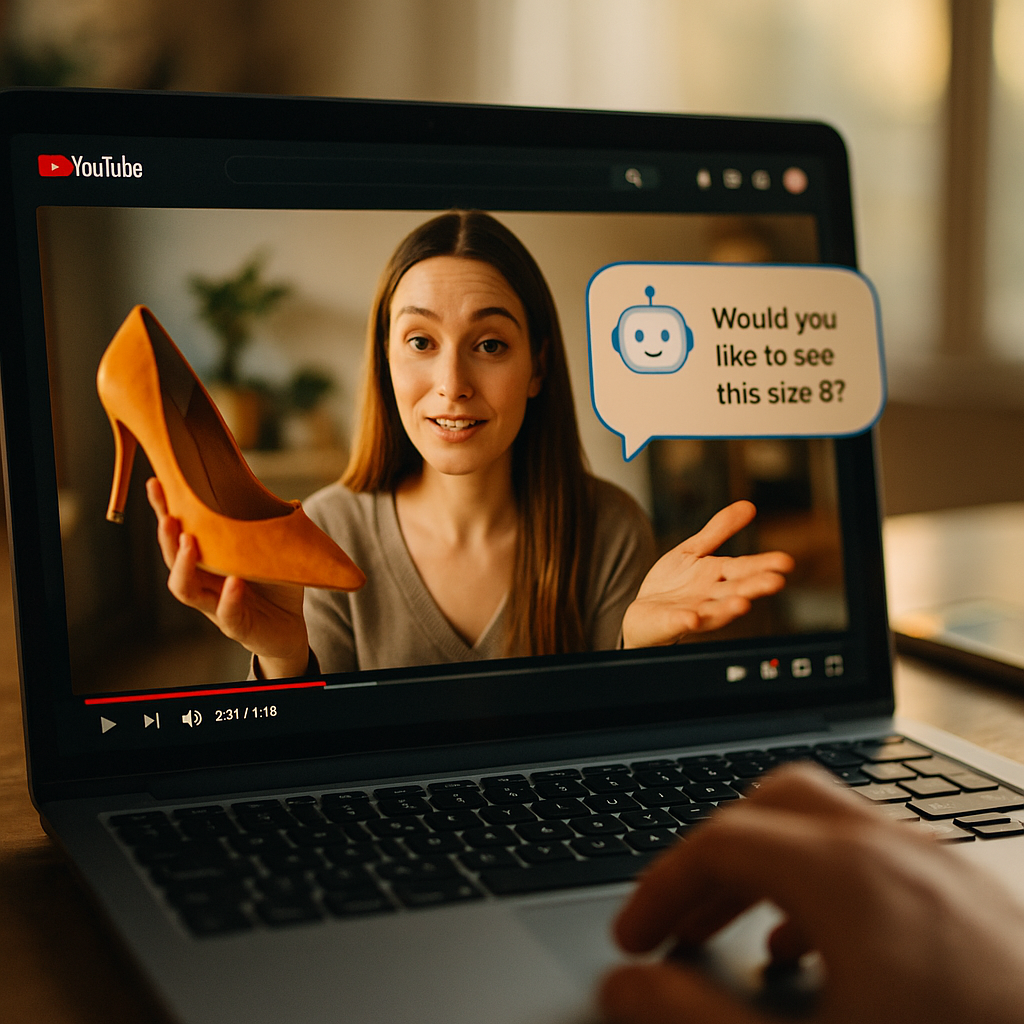
Google says Gemini powered shopping conversations inside YouTube are already influencing purchase decisions for a meaningful share of viewers who watch product related content. If your brand still treats YouTube as a passive awareness channel, that stat should sting a little. YouTube conversational AI shopping is turning watch time into a live sales conversation, and brands that aren’t structurally ready will watch competitors capture the intent they spent years building.
What YouTube Conversational AI Shopping Actually Is
Strip away the marketing language and here’s the mechanism: a viewer watches a creator’s product review or haul video, then asks YouTube’s AI assistant a follow up question, “does this work for oily skin,” “what’s the return policy,” “show me a cheaper alternative.” The assistant answers using a blend of the video’s transcript, product feed data, and merchant information, then surfaces a shoppable link or carousel without the viewer leaving the app.
This is different from a simple shopping tag under a video. It’s contextual, conversational, and it happens at the exact moment purchase intent peaks. Google has been layering this into Search and Shopping for a while, and YouTube is the next logical surface given its scale in product discovery content.
For brands, the implication is blunt. Your product data, your creator content, and your customer service answers now need to be machine readable and consistent, because an AI model is going to synthesize them into a purchase recommendation whether you’ve prepared for it or not.
The brands winning early access to conversational shopping surfaces aren’t the ones with the biggest budgets. They’re the ones with the cleanest product feeds and the most structured creator content.
Why Readiness, Not Adoption, Is the First Decision
Every platform update tempts marketing teams into a “let’s just turn it on” reflex. Resist it here. Conversational AI shopping pulls from multiple data sources simultaneously, your Merchant Center feed, your creator partnership disclosures, your video metadata, and if any of those are stale or contradictory, the AI either gives customers wrong answers or simply excludes your products from the conversation entirely.
Readiness means auditing before you enable. Three questions determine whether you’re actually prepared:
- Is your product feed synced and updated in near real time, including pricing, stock status, and variant data?
- Do your creator partnership videos include structured product mentions the AI can parse, not just verbal shoutouts buried in a 20 minute video?
- Does your team have a process to review and correct AI generated product answers when they’re wrong?
Most brands fail on the second point. Creator content is often unstructured by design, that’s what makes it feel authentic. But an AI assistant answering “what does this reviewer say about durability” needs timestamped, tagged content to draw from. This is where working with creators shifts from a relationship exercise to a data governance exercise.
The Creator Content Problem Nobody’s Solved Yet
Here’s the uncomfortable truth. Most influencer content wasn’t built with machine parsing in mind. Creators talk in tangents, reference products by nickname, and rarely include the SKU level detail that would make their content useful to a conversational AI. That’s fine for human viewers who fill in context naturally. It’s a liability for an AI system trying to extract a definitive answer.
Brands need to start briefing creators differently. That means asking for clear product naming in spoken audio, requesting chapter markers or timestamps for product segments, and providing creators with accurate spec sheets so their descriptions match your official product data instead of contradicting it.
This isn’t a huge lift if you’re already running a structured partnership program. If you’re not, this is a good moment to revisit how you’re briefing and managing creators generally. Our YouTube creator partnerships playbook covers the direct access model that makes this kind of coordination realistic at scale, and it pairs well with tightening up how you’re capturing owned audience signals through YouTube community posts as a supplementary feedback channel.
Feed Hygiene Is the Unsexy Prerequisite
Nobody wants to spend a planning meeting talking about Merchant Center feed hygiene, but it’s the foundation everything else sits on. If your product titles, availability, and pricing aren’t consistent across your feed and your video content, the AI assistant will either serve outdated information or quietly drop your product from consideration in favor of a competitor with cleaner data.
Google’s own guidance on Merchant Center feed requirements is a reasonable starting checklist, but the real work is operational: assign ownership, set update cadence, and build alerts for feed errors before they compound into missed sales during a high traffic moment like a product launch or holiday push.
Risk Mitigation: Where Compliance and AI Shopping Collide
Conversational AI shopping introduces a new compliance wrinkle. When an AI assistant summarizes a creator’s opinion and presents it as a purchase recommendation, who’s responsible for ensuring that summary still reflects proper disclosure of the paid partnership? The FTC’s endorsement guidance already requires clear and conspicuous disclosure in influencer content, and that obligation doesn’t disappear just because an AI is now the intermediary surfacing the recommendation.
Brands should treat this as an extension of existing disclosure protocols, not a separate problem. If you’ve already tightened up your disclosure workflows, you’re in reasonable shape. If you haven’t, start now, because retrofitting compliance after an AI shopping feature has scaled is far more expensive than building it in from the start.
Our disclosure compliance playbook and the automatic flagging guide were written for different platforms, but the underlying principle transfers directly: disclosure needs to be baked into the content itself, not layered on as an afterthought, because automated systems are increasingly the ones reading and acting on that content.
An AI assistant summarizing an undisclosed paid partnership as an “unbiased recommendation” isn’t a hypothetical risk. It’s a predictable outcome of unstructured creator content meeting automated synthesis.
Building the Internal Playbook
Readiness isn’t a single project, it’s an operating model. Here’s a reasonable sequence for a mid to large brand marketing team getting started:
- Audit your product feed for completeness, accuracy, and update frequency across every channel connected to Google Merchant Center.
- Re-brief active creator partners on structured product mentions, timestamps, and consistent naming conventions.
- Assign a cross functional owner, likely someone sitting between e-commerce ops and influencer marketing, who monitors AI generated product summaries for accuracy.
- Build a correction workflow so when the AI surfaces wrong information (wrong price, discontinued variant, outdated claim) your team can flag and fix it quickly.
- Test with a small product set before rolling structured content requirements across your entire creator roster.
Notice that none of this requires a huge new budget line. It requires reallocating attention from campaign creative to operational plumbing, which is a harder sell internally but the actual unlock here.
How This Compares to Other Platform Commerce Moves
If this playbook sounds familiar, it should. TikTok Shop went through a similar maturation curve, where early brands treated it as a content play and later brands realized it was fundamentally a data and operations play. The creator to paid CAC playbook for TikTok Shop covers a parallel readiness curve worth studying, and the bidding discipline in the category CPA optimization guide offers a useful model for how granular category level thinking eventually has to get.
The lesson transfers: platforms rewarding structured, machine readable commerce content will keep rewarding the brands that invested early, and keep punishing the ones waiting for a “best practices” webinar that never quite arrives in time.
Data from eMarketer’s retail media forecasts consistently shows conversational and AI assisted commerce growing faster than traditional social commerce formats, which suggests this isn’t a YouTube specific trend to watch and wait on. It’s a preview of how discovery to purchase paths are being rebuilt across every major platform.
Measuring Whether It’s Working
Standard influencer KPIs (views, engagement rate, click through) don’t fully capture what conversational AI shopping is doing. You need new measurement layers:
- AI mention accuracy rate: how often does the assistant correctly represent your product when summarizing creator content?
- Conversation to conversion rate: of viewers who engage with the AI assistant about your product, how many complete a purchase?
- Feed error frequency: how often is inaccurate product data flagged by the correction workflow you built?
None of this is available in a single dashboard yet, which means your analytics team will need to stitch together Merchant Center reporting, YouTube Analytics, and creator performance data manually for at least the next few quarters. Tools like cross platform payout reconciliation systems already built for creator payment tracking are a reasonable model for how this kind of fragmented reporting eventually gets consolidated.
For broader context on how creator marketplaces are formalizing buyer side standards across platforms, the IAB creator marketplaces playbook is a useful companion read, particularly if your procurement team is asking for standardized vetting criteria before greenlighting new AI shopping integrations.
FAQs
Frequently Asked Questions
What is YouTube conversational AI shopping?
It’s a feature where viewers can ask Google’s AI assistant questions about products shown in videos, and receive answers plus shoppable links generated from a mix of the video transcript, product feed data, and merchant information, without leaving YouTube.
Do brands need to opt in to conversational AI shopping?
Brands with active Google Merchant Center feeds and eligible product listings are generally included by default once the feature rolls out in their region, which is exactly why feed accuracy needs to be addressed proactively rather than reactively.
How does this affect influencer disclosure requirements?
Existing disclosure obligations still apply. If an AI assistant summarizes a paid partnership video, the underlying content still needs clear and conspicuous disclosure per FTC guidance, and brands should treat AI surfaces as an extension of, not an exception to, current compliance protocols.
What’s the biggest readiness gap for most brands?
Unstructured creator content. Most influencer videos aren’t built with timestamps, consistent product naming, or SKU level detail, which makes it hard for an AI assistant to extract accurate, structured answers from them.
How long does it take to become “ready” for this feature?
A focused mid sized brand can typically get feed hygiene and creator briefing processes in reasonable shape within one to two quarters, assuming there’s a dedicated owner coordinating between e-commerce operations and the influencer marketing team.
Does this replace the need for shoppable video tags?
No. Shoppable tags remain a direct, low friction conversion path. Conversational AI shopping adds a second, more dynamic layer on top for viewers who have follow up questions before they’re ready to click.
Start with the feed audit this week, not next quarter. The brands that treat YouTube conversational AI shopping as a data readiness problem now will own the answers customers hear later.
Top Influencer Marketing Agencies
The leading agencies shaping influencer marketing in 2026
Agencies ranked by campaign performance, client diversity, platform expertise, proven ROI, industry recognition, and client satisfaction. Assessed through verified case studies, reviews, and industry consultations.
Moburst

-
2

The Shelf
Boutique Beauty & Lifestyle Influencer AgencyA data-driven boutique agency specializing exclusively in beauty, wellness, and lifestyle influencer campaigns on Instagram and TikTok. Best for brands already focused on the beauty/personal care space that need curated, aesthetic-driven content.Clients: Pepsi, The Honest Company, Hims, Elf Cosmetics, Pure LeafVisit The Shelf → -
3

Audiencly
Niche Gaming & Esports Influencer AgencyA specialized agency focused exclusively on gaming and esports creators on YouTube, Twitch, and TikTok. Ideal if your campaign is 100% gaming-focused — from game launches to hardware and esports events.Clients: Epic Games, NordVPN, Ubisoft, Wargaming, Tencent GamesVisit Audiencly → -
4

Viral Nation
Global Influencer Marketing & Talent AgencyA dual talent management and marketing agency with proprietary brand safety tools and a global creator network spanning nano-influencers to celebrities across all major platforms.Clients: Meta, Activision Blizzard, Energizer, Aston Martin, WalmartVisit Viral Nation → -
5

The Influencer Marketing Factory
TikTok, Instagram & YouTube CampaignsA full-service agency with strong TikTok expertise, offering end-to-end campaign management from influencer discovery through performance reporting with a focus on platform-native content.Clients: Google, Snapchat, Universal Music, Bumble, YelpVisit TIMF → -
6

NeoReach
Enterprise Analytics & Influencer CampaignsAn enterprise-focused agency combining managed campaigns with a powerful self-service data platform for influencer search, audience analytics, and attribution modeling.Clients: Amazon, Airbnb, Netflix, Honda, The New York TimesVisit NeoReach → -
7

Ubiquitous
Creator-First Marketing PlatformA tech-driven platform combining self-service tools with managed campaign options, emphasizing speed and scalability for brands managing multiple influencer relationships.Clients: Lyft, Disney, Target, American Eagle, NetflixVisit Ubiquitous → -
8

Obviously
Scalable Enterprise Influencer CampaignsA tech-enabled agency built for high-volume campaigns, coordinating hundreds of creators simultaneously with end-to-end logistics, content rights management, and product seeding.Clients: Google, Ulta Beauty, Converse, AmazonVisit Obviously →