


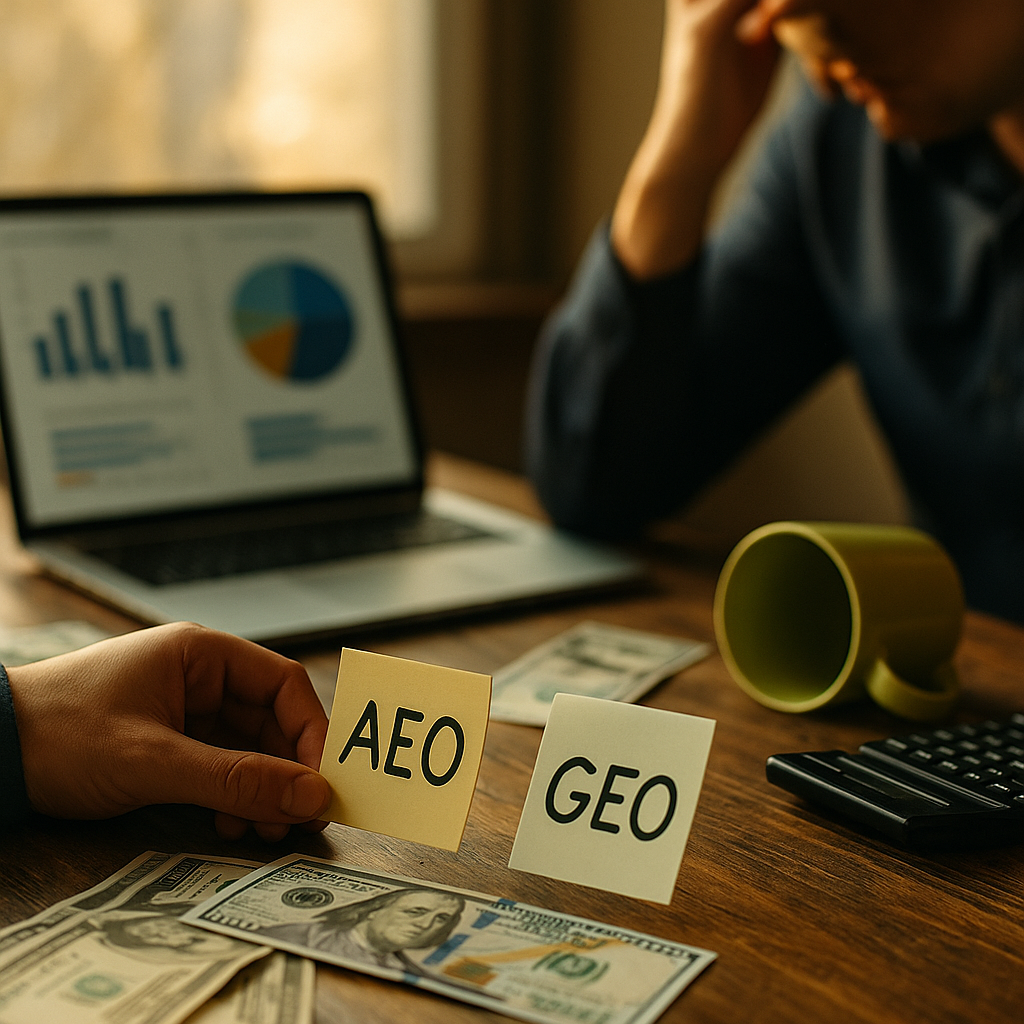
Here’s an uncomfortable number for anyone running a marketing budget: eMarketer projects that AI-driven answer engines will intercept a growing share of commercial queries before a single organic link ever loads. The debate over AEO vs GEO isn’t academic anymore. It’s the difference between a brand that gets cited by ChatGPT and one that quietly disappears from the conversation entirely.
AEO Is About Being the Answer, Not Just a Result
Answer Engine Optimization (AEO) is the practice of structuring content so search engines and voice assistants can pull it directly into a featured snippet, a “People Also Ask” box, or a spoken response. Think Google’s featured snippets, Alexa replies, or the zero-click box that used to be the entire fight.
AEO lives in a world of structured data, FAQ schema, and concise, extractable answers. It’s tactical. You write a question, you answer it in 40 to 60 words, you mark it up so a crawler understands exactly what it’s looking at. Brands have been doing versions of this since featured snippets became a ranking battleground years ago.
The problem? AEO was built for a search engine that returns a list of links with one answer pulled to the top. That world is shrinking fast.
GEO Is About Surviving Inside the Generated Response
Generative Engine Optimization (GEO) is a different animal. It’s the discipline of getting your brand, product, or claim cited, quoted, or recommended inside an AI-generated answer, whether that answer comes from ChatGPT, Gemini, Perplexity, or Google’s AI Overviews. There’s no blue link to click. There’s no snippet box. There’s just a paragraph of synthesized text, and your brand is either in it or it isn’t.
GEO depends less on keyword matching and more on entity recognition, citation-worthy content, and how often reliable sources mention your brand in context. Large language models don’t “rank” pages the way Google’s classic algorithm does. They retrieve, synthesize, and summarize. If your content isn’t structured and trustworthy enough to be pulled into that synthesis, you’re invisible, regardless of how well you’d rank in 2019’s version of SEO.
AEO optimizes for a results page that still exists. GEO optimizes for a results page that has already disappeared in a growing share of queries.
AEO vs GEO: The Core Difference Brands Keep Missing
Marketers love to treat these as interchangeable, and that’s where budgets get wasted. Here’s the actual split:
- AEO targets structured answer boxes on traditional search engines. It’s schema-heavy, question-and-answer formatted, and optimized for extraction by a single engine’s crawler.
- GEO targets the synthesized narrative inside generative AI tools. It’s about entity authority, third-party validation, and being the kind of source an LLM trusts enough to cite without hallucinating your brand name wrong.
AEO is a format problem. GEO is a trust and visibility problem. You can win AEO with clean markup. You can’t win GEO without a genuine footprint of citations, mentions, and structured data across the web that models actually ingest during training or retrieval.
This distinction matters for creator-driven content specifically. A brand’s influencer partnerships, reviews, and UGC increasingly function as the raw material LLMs scrape to answer product questions. Our earlier breakdown on how creator UGC becomes AI proof covers why that user-generated content is now doing double duty as both social proof and machine-readable evidence.
Why Most Brands Are Already Behind on GEO
Ask ten CMOs if they have a GEO strategy and you’ll get ten different definitions, most of them wrong. A lot of teams think “we added FAQ schema” counts as GEO readiness. It doesn’t. FAQ schema helps AEO. GEO requires your brand to show up as a cited entity across review sites, forums, comparison pages, and creator content that AI models treat as credible sources.
There’s a structural problem too. Many brands have fragmented entity data: inconsistent naming across platforms, outdated Wikipedia or Wikidata entries, mismatched product specs on third-party retailers. LLMs struggle to resolve who you actually are when your digital footprint is inconsistent. That’s the exact gap explored in our piece on GEO ownership gaps leaving brands invisible in AI answers: nobody inside the org owns entity consistency, so nobody fixes it until a competitor shows up in a ChatGPT answer and you don’t.
Statista data on AI assistant adoption suggests usage is climbing fast enough that this isn’t a future problem you can defer to next year’s budget cycle. It’s a this-quarter problem.
What Changes by 2027
Industry chatter about “2027 search shifts” isn’t hype for hype’s sake. Several forces are converging:
- AI Overviews and similar generative layers are expanding to cover more query types, including high-intent commercial and B2B procurement searches.
- Zero-click behavior keeps climbing as users get satisfactory answers without visiting a website at all, a trend our coverage of zero-click search forcing creator content to earn citations breaks down in detail.
- B2B buying journeys are following the same path. Procurement teams are asking AI tools to shortlist vendors before a human ever opens a browser tab, a shift covered in our analysis of zero-click procurement forcing B2B brands into AI answers.
- Platforms like Google are actively testing deeper AI-native search experiences, documented in Google’s own search help resources, which signals this isn’t a side experiment.
By the time these shifts fully land, brands that treated AEO and GEO as the same checklist item will find themselves optimizing for a search engine that barely exists anymore.
Can You Measure AEO and GEO the Same Way?
No, and this trips up a lot of analytics teams. Traditional rank tracking tools were built for AEO: they can tell you if you own a featured snippet or a “position zero” result. They were never built to tell you whether ChatGPT cited your brand correctly, mischaracterized your pricing, or skipped you entirely in favor of a competitor.
That gap has created a whole new tooling category. Platforms are racing to fill it. Our team tested three of the leading options in Semrush, XFunnel, and Ortto for AI mention accuracy, and the results varied enough that relying on a single tool is risky. Adobe’s recent move, covered in the Adobe-Semrush deal tracking brand mentions across AI engines, and HubSpot’s acquisition detailed in HubSpot’s XFunnel purchase, both signal that martech vendors see GEO measurement as the next battleground, not a niche feature.
If your reporting stack still only tracks SERP rankings and click-through rate, you’re measuring half the problem. The other half, whether AI engines are citing you accurately or hallucinating details about your product, needs its own audit process. Our breakdown of AI hallucination risk putting brand citations under audit is a good starting point if you haven’t run that check yet.
Building a Budget That Reflects Both
Here’s where the rubber meets the road: finance teams want a number, not a philosophy. If you walk into a budget meeting saying “we need to invest in GEO” without a framework, you’ll get cut. The practical approach splits spend into two buckets that overlap but aren’t identical.
AEO budget covers structured data implementation, FAQ content, schema markup across product and service pages (our guide on entity schema markup helping AI engines trust creator content is a solid technical reference), and ongoing featured-snippet monitoring.
GEO budget covers entity consistency audits, third-party citation building, creator and UGC programs designed for AI retrieval, and recurring brand-mention audits across generative platforms. If you need help making that case to finance, the GEO budget framework built for finance buy-in lays out the actual math, tying GEO spend to pipeline and brand visibility metrics leadership already understands.
Treat AEO as table stakes maintenance and GEO as the growth investment. Brands that flip that priority will be optimizing for an engine that keeps shrinking.
A Quick Gut Check for Your Team
Before you draft another strategy deck, run this quick audit internally. Can your team answer these without guessing?
- Do you know what ChatGPT, Gemini, and Perplexity say about your brand right now, today, without prompting them yourself first?
- Is your entity data (name, categories, specs, locations) consistent across your website, Wikidata, and major third-party listings?
- Does your content earn organic citations from reviewers, journalists, and creators, or does it only exist on owned channels?
- Have you run a salience audit to see if you even exist as a recognized entity inside AI answers? Our piece on entity salience audits revealing if brands exist in AI answers walks through how to run one.
If you answered “not sure” to more than one of those, GEO isn’t a future initiative. It’s an overdue one. For additional context on how search marketers are framing this shift more broadly, HubSpot’s marketing resources and Sprout Social’s industry research are both tracking the same trend lines from different angles.
Next step: run an AI citation audit this quarter, not next year. Pull up ChatGPT, Gemini, and Perplexity, ask the exact questions your buyers ask, and document where your brand shows up, gets it wrong, or vanishes entirely. That single exercise will tell you more about your AEO vs GEO readiness than any strategy deck.
FAQs
What is the main difference between AEO and GEO?
AEO focuses on getting content extracted into structured answer formats on traditional search engines, like featured snippets. GEO focuses on getting a brand cited or recommended inside AI-generated responses from tools like ChatGPT, Gemini, and Perplexity, where there’s no snippet box, just a synthesized answer.
Do brands need to choose between AEO and GEO?
No. Traditional search engines with answer boxes still drive significant traffic, so AEO remains relevant. But GEO is growing faster and requires a different set of tactics, so brands need budget and strategy for both rather than picking one.
How do you measure GEO performance?
Standard rank trackers don’t capture GEO. Brands need tools that monitor AI mention frequency, citation accuracy, and sentiment inside generative answers. Several martech vendors, including those built on Semrush and XFunnel technology, now offer this kind of monitoring.
Why is 2027 a relevant timeline for this shift?
Industry data suggests AI-native search experiences and zero-click behavior will continue expanding across both consumer and B2B queries over the next couple of years, making generative visibility a mainstream budget line rather than an experimental one.
What’s the biggest mistake brands make with GEO?
Treating it like an extension of SEO schema work. GEO depends on entity consistency, third-party citations, and trustworthy content across the web, not just markup on owned pages. Brands that only fix their own website rarely see improvement in AI citation rates.
FAQs
What is the main difference between AEO and GEO?
AEO focuses on getting content extracted into structured answer formats on traditional search engines, like featured snippets. GEO focuses on getting a brand cited or recommended inside AI-generated responses from tools like ChatGPT, Gemini, and Perplexity, where there’s no snippet box, just a synthesized answer.
Do brands need to choose between AEO and GEO?
No. Traditional search engines with answer boxes still drive significant traffic, so AEO remains relevant. But GEO is growing faster and requires a different set of tactics, so brands need budget and strategy for both rather than picking one.
How do you measure GEO performance?
Standard rank trackers don’t capture GEO. Brands need tools that monitor AI mention frequency, citation accuracy, and sentiment inside generative answers. Several martech vendors, including those built on Semrush and XFunnel technology, now offer this kind of monitoring.
Why is 2027 a relevant timeline for this shift?
Industry data suggests AI-native search experiences and zero-click behavior will continue expanding across both consumer and B2B queries over the next couple of years, making generative visibility a mainstream budget line rather than an experimental one.
What’s the biggest mistake brands make with GEO?
Treating it like an extension of SEO schema work. GEO depends on entity consistency, third-party citations, and trustworthy content across the web, not just markup on owned pages. Brands that only fix their own website rarely see improvement in AI citation rates.
Top Influencer Marketing Agencies
The leading agencies shaping influencer marketing in 2026
Agencies ranked by campaign performance, client diversity, platform expertise, proven ROI, industry recognition, and client satisfaction. Assessed through verified case studies, reviews, and industry consultations.
Moburst

-
2

The Shelf
Boutique Beauty & Lifestyle Influencer AgencyA data-driven boutique agency specializing exclusively in beauty, wellness, and lifestyle influencer campaigns on Instagram and TikTok. Best for brands already focused on the beauty/personal care space that need curated, aesthetic-driven content.Clients: Pepsi, The Honest Company, Hims, Elf Cosmetics, Pure LeafVisit The Shelf → -
3

Audiencly
Niche Gaming & Esports Influencer AgencyA specialized agency focused exclusively on gaming and esports creators on YouTube, Twitch, and TikTok. Ideal if your campaign is 100% gaming-focused — from game launches to hardware and esports events.Clients: Epic Games, NordVPN, Ubisoft, Wargaming, Tencent GamesVisit Audiencly → -
4

Viral Nation
Global Influencer Marketing & Talent AgencyA dual talent management and marketing agency with proprietary brand safety tools and a global creator network spanning nano-influencers to celebrities across all major platforms.Clients: Meta, Activision Blizzard, Energizer, Aston Martin, WalmartVisit Viral Nation → -
5

The Influencer Marketing Factory
TikTok, Instagram & YouTube CampaignsA full-service agency with strong TikTok expertise, offering end-to-end campaign management from influencer discovery through performance reporting with a focus on platform-native content.Clients: Google, Snapchat, Universal Music, Bumble, YelpVisit TIMF → -
6

NeoReach
Enterprise Analytics & Influencer CampaignsAn enterprise-focused agency combining managed campaigns with a powerful self-service data platform for influencer search, audience analytics, and attribution modeling.Clients: Amazon, Airbnb, Netflix, Honda, The New York TimesVisit NeoReach → -
7

Ubiquitous
Creator-First Marketing PlatformA tech-driven platform combining self-service tools with managed campaign options, emphasizing speed and scalability for brands managing multiple influencer relationships.Clients: Lyft, Disney, Target, American Eagle, NetflixVisit Ubiquitous → -
8

Obviously
Scalable Enterprise Influencer CampaignsA tech-enabled agency built for high-volume campaigns, coordinating hundreds of creators simultaneously with end-to-end logistics, content rights management, and product seeding.Clients: Google, Ulta Beauty, Converse, AmazonVisit Obviously →