


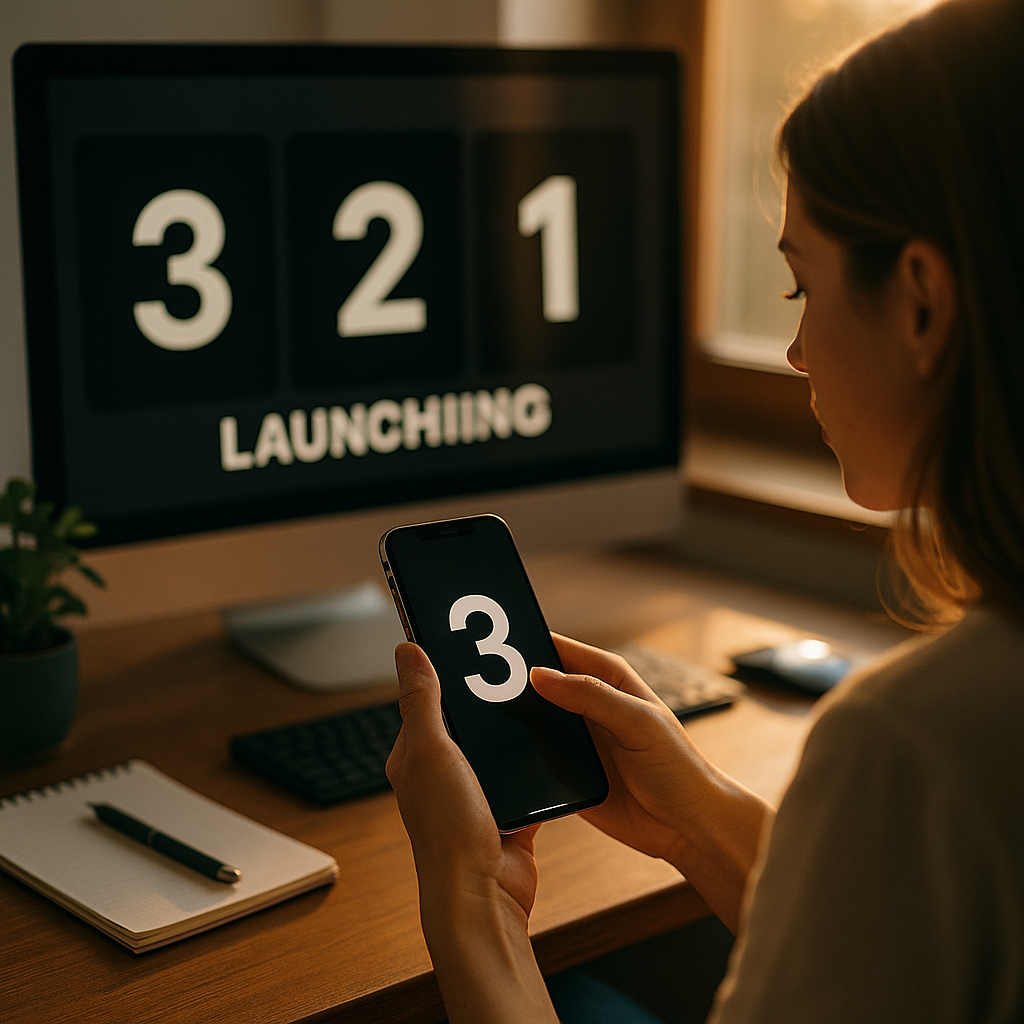
Brands that launch cold leave money on the table. Campaigns built on a countdown teaser series routinely see day-one conversion lifts because the audience already knows what’s coming, why it matters, and when to show up. One well-paced serialized rollout can outperform a single splashy launch video, simply because it gives algorithms and audiences more chances to engage before the “buy” moment ever appears.
So why do most brands still treat launch day as a single event instead of a story arc?
What a Countdown Teaser Series Actually Is
A countdown teaser series is a sequence of short, connected creator videos released on a fixed cadence (daily, every other day, or weekly) that build toward a product drop, feature launch, or event. Think of it as a miniseries with a release date baked into the plot. Each installment answers a small question or reveals a small detail, and the final post lands on launch day with the full reveal.
This isn’t new in concept. Movie studios have used countdown marketing for decades. What’s changed is the execution: instead of paid media waterfalls, brands now lean on creators to produce the serialized content natively, in formats audiences already trust. That shift matters because teaser content from a creator reads as anticipation, not advertising.
A five-part countdown series gives you five separate engagement events, five separate algorithmic signals, and five chances to capture an email or follow before you ever ask for a sale.
Why Serialization Beats a Single Launch Post
A single launch video has one shot. It either hits or it doesn’t, and if your creator’s post underperforms on day one, there’s no recovery window. Serialized content spreads that risk across multiple touchpoints.
There’s also a compounding attention effect. Platforms reward accounts that post consistently around a theme, and viewers who see part one are statistically more likely to seek out part two, especially if the creator uses cliffhanger structure (think “wait until you see what’s inside” or “day 3 of 5”). This mirrors what we’ve seen work in serialized UGC series built for retention, except here the goal is pre-launch momentum rather than post-purchase loyalty.
Marketers running influencer programs already know that a single post rarely tells a complete story. A countdown format solves that by distributing the narrative across days, which also gives your team more optionality: if day two underperforms, you can adjust day three’s hook, CTA, or creator pairing before the real launch moment.
The Anatomy of a Five-Day Countdown
Most effective countdown arcs follow a loose five-beat structure, though the exact cadence depends on launch complexity and budget.
- Day 5 (tease): Something is coming. No product shown, just mood, question, or a partial visual.
- Day 4 (context): Why this matters, framed as a problem the creator has personally experienced.
- Day 3 (reveal partial): A detail drops, maybe a feature, color, or ingredient, but not the full product.
- Day 2 (social proof): Early access reactions, behind-the-scenes footage, or a founder cameo building credibility.
- Day 1 (final countdown): Urgency messaging, link in bio, reminder of exact launch time.
- Day 0 (launch): Full reveal, unboxing, or demo with a direct conversion CTA.
Brands that compress this into two or three days for fast-moving product drops (streetwear, limited-run cosmetics, app features) still see benefit, as long as each post feels distinct rather than repetitive.
Picking the Right Creators for a Multi-Part Arc
Not every creator is built for serialized content. Some creators are excellent at one-off demo videos but lose audience attention across a multi-day arc because their storytelling doesn’t build tension. Look for creators who already run their own serialized content (daily vlogs, “day in the life” formats, or recurring segments) since they understand pacing instinctively.
It also helps to diversify creator roles across the arc instead of relying on one person for all five posts. A founder-style reveal on day two, paired with a more casual creator teaser on day four, creates variety that keeps the feed from feeling repetitive. This pairs well with the thinking behind founder cameo formats, where executive credibility is dropped into an otherwise creator-led arc for an authenticity boost.
If your program runs on a roster model, a countdown series is also a good test case for coordinating multiple creators around one campaign without the usual scheduling chaos. The same logistics challenges that show up in multi-creator collab campaigns apply here: mismatched posting times, inconsistent messaging, and creative drift. A tight content calendar and a shared brief document are non-negotiable.
Format Choices That Make or Break the Series
Countdown teasers live or die on hook strength, since each post has to earn attention independently, even though it’s part of a bigger arc. A few format patterns consistently perform well for this use case:
- POV reveals: First-person framing that puts the viewer inside the anticipation moment rather than watching it happen to someone else. The data on POV framing shows this angle consistently cuts cost-per-acquisition compared to standard third-person UGC.
- Silent, captioned storytelling: Useful for sound-off scroll environments where your teaser needs to land without audio. See how silent captioned storytime formats rebuild engagement for sound-off viewers.
- Text-over-b-roll: Fast, cheap to produce, and effective for daily cadence since it doesn’t require a talking head on camera every single day. This is covered in depth in our piece on text over b-roll briefs.
Mixing formats across the arc, rather than running the same style five times in a row, keeps the series feeling fresh and gives your analytics team cleaner comparative data on what actually drove engagement.
Measuring a Countdown Series Without Losing Your Mind
The biggest measurement mistake brands make is waiting until launch day to check performance. By then it’s too late to course-correct. Instead, track engagement rate, save rate, and comment velocity on each installment as it posts, and compare them against your brand’s historical benchmarks, not against the next brand’s campaign.
Comment velocity is particularly useful here. A countdown post that sparks guesses, questions, or “I need this” comments in the first hour is a strong predictor of launch-day demand. This is the same signal used in live pinned comment formats, where early comment spikes correlate with downstream conversion.
Platforms like Sprout Social and native analytics dashboards on TikTok and Instagram both support day-by-day tracking, which is essential for a multi-part arc. Pull a mid-series report (after post three of five) so you still have time to adjust creator briefs or paid amplification before the final reveal.
Don’t ignore funnel stage either. A countdown series naturally moves viewers from awareness to consideration across its run, and your CTA language should shift accordingly. Early posts should never ask for a purchase. Save that for the final one or two installments, consistent with the logic in funnel stage content mapping.
Compliance Isn’t Optional Just Because It’s “Just a Teaser”
Here’s where a lot of brands get sloppy. Teaser content still counts as sponsored content under FTC disclosure rules, even if no product is shown yet and no purchase link is live. If the creator is being compensated to build hype for a future launch, that relationship needs disclosure from post one, not just on launch day.
This gets murkier internationally. The UK’s ICO guidance and equivalent bodies in other markets expect consistent disclosure across an entire campaign arc, not just the final conversion-focused post. Build disclosure language into your creator brief for every single installment, and don’t leave it to creator discretion on days two through four just because “nothing’s being sold yet.”
If your legal team only reviews the launch-day post and skips the teaser installments, you’ve got a compliance gap that regulators increasingly treat as a pattern, not an oversight.
Repurposing the Arc After Launch Day
A well-built countdown series doesn’t die the day the product ships. The teaser footage, behind-the-scenes clips, and reveal moment all become raw material for retargeting ads, website landing pages, and future campaign recaps. Brands running live event content capture programs already know this: one production window can fund months of downstream assets if you plan the shoot list with reuse in mind.
Before you brief creators, map out which clips you’ll want for paid amplification later. A “day 3” reveal clip often works as a standalone ad months after the original launch, especially once you strip the countdown framing and let it stand as a product demo.
Common Mistakes That Flatten the Hype
- Posting too fast: A countdown that drops all five parts in 24 hours removes the anticipation effect entirely.
- Repeating the same hook: If every post opens with “guess what’s coming,” viewers tune out by part three.
- No clear end date: Audiences need to know when the reveal happens. Vague countdowns lose urgency fast.
- Ignoring sound design: Pacing and audio cues matter across a multi-part arc just as much as in a single video. See vertical video sound design for cadence guidance by platform.
According to recent creator economy benchmarking from eMarketer, campaigns with structured multi-touch creator sequences consistently outperform single-post launches on both reach and conversion efficiency, reinforcing why the format deserves a dedicated line item in your next launch budget rather than an afterthought.
Next Step
Pick your next product or feature launch, map a five-post countdown arc with a single creator or small pod, and track comment velocity after post three before finalizing your launch-day CTA. The data from your own mid-series check will tell you more about demand than any pre-launch survey ever could.
FAQs
How long should a countdown teaser series run before launch?
Most effective arcs run three to seven days. Shorter sequences work for fast-moving drops like limited-run apparel, while longer arcs suit bigger launches such as app features or major product releases where you need more time to build context and social proof.
Do all posts in a countdown series need the same creator?
No. Mixing creator styles across the arc, for example a casual teaser creator early on and a founder cameo near the reveal, often performs better than relying on one creator for all installments because it keeps the content feeling varied.
What’s the biggest risk with a countdown teaser series?
Compliance gaps. Every post in the series counts as sponsored content if the creator is compensated, so disclosure needs to appear on teaser posts, not just the final launch-day reveal.
How do I know if my countdown series is working before launch day?
Track comment velocity, save rate, and engagement on each installment as it posts. A mid-series check after post three gives you enough signal to adjust creator briefs or paid support before the final reveal.
Can countdown teaser content be reused after the launch?
Yes. Teaser clips, behind-the-scenes footage, and the reveal moment all work well as retargeting ads or landing page assets long after the original launch window closes.
Top Influencer Marketing Agencies
The leading agencies shaping influencer marketing in 2026
Agencies ranked by campaign performance, client diversity, platform expertise, proven ROI, industry recognition, and client satisfaction. Assessed through verified case studies, reviews, and industry consultations.
Moburst

-
2

The Shelf
Boutique Beauty & Lifestyle Influencer AgencyA data-driven boutique agency specializing exclusively in beauty, wellness, and lifestyle influencer campaigns on Instagram and TikTok. Best for brands already focused on the beauty/personal care space that need curated, aesthetic-driven content.Clients: Pepsi, The Honest Company, Hims, Elf Cosmetics, Pure LeafVisit The Shelf → -
3

Audiencly
Niche Gaming & Esports Influencer AgencyA specialized agency focused exclusively on gaming and esports creators on YouTube, Twitch, and TikTok. Ideal if your campaign is 100% gaming-focused — from game launches to hardware and esports events.Clients: Epic Games, NordVPN, Ubisoft, Wargaming, Tencent GamesVisit Audiencly → -
4

Viral Nation
Global Influencer Marketing & Talent AgencyA dual talent management and marketing agency with proprietary brand safety tools and a global creator network spanning nano-influencers to celebrities across all major platforms.Clients: Meta, Activision Blizzard, Energizer, Aston Martin, WalmartVisit Viral Nation → -
5

The Influencer Marketing Factory
TikTok, Instagram & YouTube CampaignsA full-service agency with strong TikTok expertise, offering end-to-end campaign management from influencer discovery through performance reporting with a focus on platform-native content.Clients: Google, Snapchat, Universal Music, Bumble, YelpVisit TIMF → -
6

NeoReach
Enterprise Analytics & Influencer CampaignsAn enterprise-focused agency combining managed campaigns with a powerful self-service data platform for influencer search, audience analytics, and attribution modeling.Clients: Amazon, Airbnb, Netflix, Honda, The New York TimesVisit NeoReach → -
7

Ubiquitous
Creator-First Marketing PlatformA tech-driven platform combining self-service tools with managed campaign options, emphasizing speed and scalability for brands managing multiple influencer relationships.Clients: Lyft, Disney, Target, American Eagle, NetflixVisit Ubiquitous → -
8

Obviously
Scalable Enterprise Influencer CampaignsA tech-enabled agency built for high-volume campaigns, coordinating hundreds of creators simultaneously with end-to-end logistics, content rights management, and product seeding.Clients: Google, Ulta Beauty, Converse, AmazonVisit Obviously →