


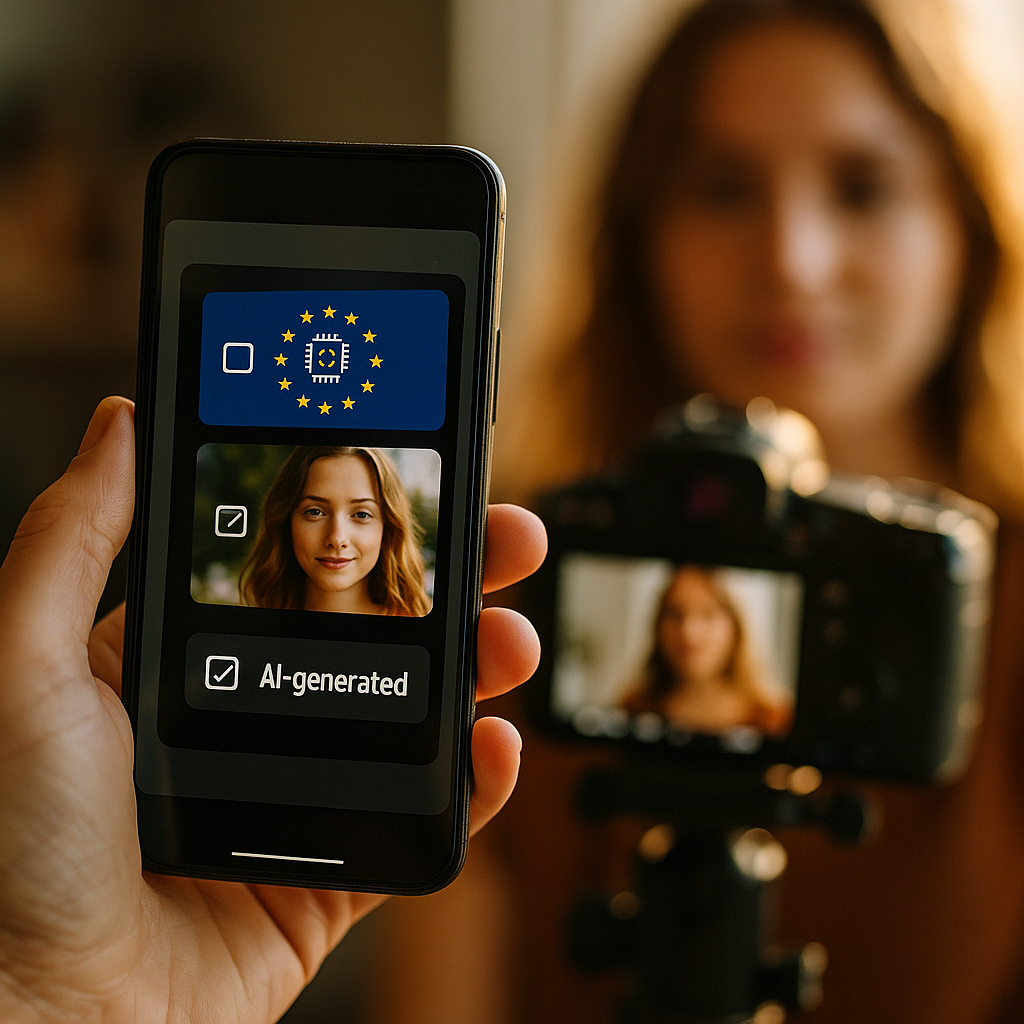
Roughly 40% of sponsored content on major platforms now involves some form of AI generation or enhancement, yet fewer than one in five brands has a disclosure workflow built for it. That gap becomes a legal liability once the EU AI Act content labeling rules move into full enforcement after August 2026. If your creator contracts still treat “AI disclosure” as an afterthought, you are already behind.
What Changed After August 2026
The EU AI Act has been rolling out in phases since its adoption, but the transparency obligations under Article 50 reach full applicability in August 2026. That’s the provision marketers actually need to worry about. It requires that AI-generated or AI-manipulated content, including deepfakes, synthetic voiceovers, and significantly altered images used in commercial communications, be clearly labeled as such to the audience.
This isn’t a vague “best practice” suggestion. It’s a binding regulation with penalties that scale alongside GDPR-style enforcement, up to 7% of global annual turnover for the most serious violations, or 35 million euros, whichever is higher. For a brand running pan-European influencer campaigns, that’s existential money, not a line item you write off.
The EU AI Act doesn’t just regulate AI companies. It regulates anyone deploying AI-generated content commercially, which includes brands running influencer and creator campaigns across the EU.
Who Actually Has to Disclose, and What
Here’s where it gets operationally messy. The obligation falls on “deployers” of AI systems that generate or manipulate content, not just the developers of the underlying models. If a creator uses an AI voice clone to dub a video into German, or a brand’s agency uses generative AI to create a synthetic background for a product shoot, the deploying party (often the brand or its agency, not the platform) carries the disclosure burden.
Practically, brands need to track and label:
- AI-generated avatars or virtual influencers appearing in paid content
- Voice cloning or AI dubbing used in creator videos distributed to EU audiences
- Deepfake-style face swaps, even when used for harmless creative effect
- Significantly AI-altered “authentic” UGC, such as AI-enhanced product demos
- Text-to-video or fully synthetic ad creative featuring realistic human likenesses
Notice what’s missing from that list: minor AI editing like color correction, background noise removal, or standard retouching. The Act distinguishes between assistive AI tools and generative or manipulative ones that create content a reasonable viewer would mistake for authentic. That distinction matters because it means brands can’t just slap a disclosure label on every piece of content and call it compliant. Over-labeling creates its own credibility problem, training audiences to tune out disclosures entirely.
This is the same fatigue risk regulators in other markets have flagged. The FTC’s endorsement guidance has long warned that vague or buried disclosures fail the “clear and conspicuous” test, and the EU’s framework borrows that same logic for AI content specifically.
The Disclosure Itself: What “Clear and Conspicuous” Means Here
Unlike a generic “#ad” tag, AI content labels under the Act need to identify the specific nature of the synthetic element. A caption buried at the bottom of a video description won’t cut it. Regulators are modeling expectations after the GDPR enforcement playbook: labels must be machine-readable where feasible, visible at the point of consumption, and understandable without requiring the viewer to click through to a separate disclosure page.
For video content, that likely means an on-screen label persisting for the duration of AI-generated segments, not just a one-second flash at the start. For audio, it may require a verbal disclosure or a consistent audio watermark. Platforms are already building native tools for this. Meta and TikTok have both expanded their AI-content labeling features ahead of the deadline, but native platform labels do not automatically satisfy the Act’s requirements if they’re easy to miss or inconsistently applied.
Platform-native AI labels are a start, not a compliance strategy. Brands that rely solely on TikTok’s or Meta’s built-in AI tags without their own documentation are still exposed.
Where This Collides With Existing Influencer Workflows
Most brands already juggle FTC disclosure requirements, platform-specific labeling, and regional endorsement laws. Layering the EU AI Act content labeling rules on top means your creator briefs and contracts need a new clause entirely: a requirement that creators disclose their own AI tool usage before content goes live.
That’s a tough ask. Many creators use AI-assisted editing tools (think Adobe Firefly, ElevenLabs for voice, or Runway for video generation) without thinking of it as something requiring disclosure. Your legal team may understand the distinction between assistive and generative AI; your creator roster probably doesn’t.
This echoes the compliance gap brands faced when the FTC started cracking down on AI-generated creator impersonations. Our coverage of the FTC impersonation rule showed how quickly regulatory attention shifts from platforms to the brands deploying the content. The EU is following the same trajectory, just with sharper teeth and bigger fines.
Agencies aren’t off the hook either. If your agency books the creator and approves the final cut, liability can attach to them as a deployer too, a dynamic we’ve already seen play out with agency vicarious liability cases in other jurisdictions. Expect contract renegotiations across the board as agencies try to push disclosure responsibility back onto brands or creators.
Building a Compliance Workflow That Won’t Collapse Under Scale
Trying to manually review every piece of creator content for AI usage is a losing game once you’re running more than a handful of campaigns a quarter. Here’s what actually scales:
- Update creator contracts first. Require creators to disclose any AI tool usage in content creation, with specific categories (voice, video, image manipulation) called out, not a vague catch-all clause.
- Build an AI usage declaration into your briefing software. Treat it like a tax form. No submission without a completed declaration field.
- Standardize your label format across markets. Don’t improvise per-campaign. Consistency reduces both audience confusion and your own legal exposure.
- Audit trail everything. Keep records of AI tool usage, disclosure placement, and approval sign-off for at least as long as your standard advertising record retention period.
- Train your influencer marketing managers, not just legal. The people approving content day to day need to recognize AI content when they see it, which isn’t always obvious.
This mirrors the audit trail discipline brands have had to build for other disclosure regimes. The approach used for ESG greenwashing claims documentation translates almost directly here: document the claim, document the review, document the sign-off.
Why This Isn’t Just a Europe Problem
If you think this only applies to campaigns explicitly targeting EU consumers, think again. The Act applies based on where the content reaches audiences, not where the brand or creator is headquartered. A U.S. brand running a global creator campaign that happens to get distributed or boosted into EU markets through paid media can trigger the same obligations.
That’s the same extraterritorial logic that made GDPR a global compliance headache rather than a regional one, and it’s already shaping how brands approach creator scoring and vendor vetting for data privacy. Expect AI disclosure vetting to become part of that same due diligence layer.
There’s also a knock-on effect for CTV and repurposed content. If a brand takes a TikTok creator video with an AI-generated voiceover and reposts it to a CTV ad slot targeting European viewers, the disclosure obligation travels with it. We’ve already flagged this kind of gap in our piece on CTV creator disclosures, and the AI Act adds another compliance layer to the same repurposing workflow.
Industry data from eMarketer suggests AI-assisted content production in influencer marketing is accelerating faster than brand compliance programs can keep up with, which is exactly the mismatch regulators are targeting. Meanwhile, platforms like TikTok’s advertising policies are already shifting to require AI-content tagging at upload, giving brands a partial head start if they integrate those native flags into their own documentation.
What Enforcement Will Probably Look Like First
Don’t expect sweeping raids on day one. EU regulators tend to start with high-visibility test cases, large brands, viral campaigns, or complaints triggered by competitors or consumer watchdogs. Expect the first wave of enforcement to target:
- Beauty and fashion campaigns using AI-altered “before and after” content without labeling
- Virtual influencer campaigns that blur the line between human and synthetic endorsement
- Voice-cloned testimonials in financial services and health-adjacent advertising, categories already under heightened scrutiny
Brands in regulated or reputationally sensitive categories should treat this as a near-term priority, not a 2027 problem. Insurance underwriters covering influencer campaigns are already asking about AI disclosure practices during policy renewals, a trend covered in our breakdown of creator marketing insurance. If your carrier is asking, your legal team should already have an answer ready.
Next step: Audit your current EU-facing creator campaigns this quarter for any AI-generated or AI-manipulated content, document what disclosure exists today, and close the gap before enforcement priorities get set by someone else’s violation.
Frequently Asked Questions
Does the EU AI Act apply to brands outside the EU?
Yes. The Act applies based on where content reaches audiences, not where the brand or creator is based. If your creator campaign is distributed or paid-media boosted into EU markets, the disclosure obligations apply regardless of your company’s headquarters.
What counts as “AI-generated” content under the disclosure rules?
Content that a reasonable viewer would mistake for authentic human-created material, including deepfakes, voice clones, synthetic avatars, and significantly altered images or video. Minor assistive editing like color correction or noise reduction generally does not trigger the obligation.
Who is legally responsible for disclosure, the brand, agency, or creator?
The “deployer” of the AI system carries primary responsibility, which in most campaigns means the brand or the agency managing content approval, not the platform or the AI tool developer. Contracts should explicitly assign disclosure responsibility to avoid disputes.
Are platform-native AI labels enough to stay compliant?
Not necessarily. Native labels from platforms like Meta or TikTok are a helpful starting point, but they may not meet the Act’s “clear and conspicuous” standard on their own. Brands should maintain their own documentation and labeling practices independent of platform defaults.
What are the penalties for non-compliance?
Violations of the transparency provisions can result in fines up to 7% of global annual turnover or 35 million euros, whichever is higher, putting AI content labeling violations in the same financial risk category as the most serious GDPR breaches.
Top Influencer Marketing Agencies
The leading agencies shaping influencer marketing in 2026
Agencies ranked by campaign performance, client diversity, platform expertise, proven ROI, industry recognition, and client satisfaction. Assessed through verified case studies, reviews, and industry consultations.
Moburst

-
2

The Shelf
Boutique Beauty & Lifestyle Influencer AgencyA data-driven boutique agency specializing exclusively in beauty, wellness, and lifestyle influencer campaigns on Instagram and TikTok. Best for brands already focused on the beauty/personal care space that need curated, aesthetic-driven content.Clients: Pepsi, The Honest Company, Hims, Elf Cosmetics, Pure LeafVisit The Shelf → -
3

Audiencly
Niche Gaming & Esports Influencer AgencyA specialized agency focused exclusively on gaming and esports creators on YouTube, Twitch, and TikTok. Ideal if your campaign is 100% gaming-focused — from game launches to hardware and esports events.Clients: Epic Games, NordVPN, Ubisoft, Wargaming, Tencent GamesVisit Audiencly → -
4

Viral Nation
Global Influencer Marketing & Talent AgencyA dual talent management and marketing agency with proprietary brand safety tools and a global creator network spanning nano-influencers to celebrities across all major platforms.Clients: Meta, Activision Blizzard, Energizer, Aston Martin, WalmartVisit Viral Nation → -
5

The Influencer Marketing Factory
TikTok, Instagram & YouTube CampaignsA full-service agency with strong TikTok expertise, offering end-to-end campaign management from influencer discovery through performance reporting with a focus on platform-native content.Clients: Google, Snapchat, Universal Music, Bumble, YelpVisit TIMF → -
6

NeoReach
Enterprise Analytics & Influencer CampaignsAn enterprise-focused agency combining managed campaigns with a powerful self-service data platform for influencer search, audience analytics, and attribution modeling.Clients: Amazon, Airbnb, Netflix, Honda, The New York TimesVisit NeoReach → -
7

Ubiquitous
Creator-First Marketing PlatformA tech-driven platform combining self-service tools with managed campaign options, emphasizing speed and scalability for brands managing multiple influencer relationships.Clients: Lyft, Disney, Target, American Eagle, NetflixVisit Ubiquitous → -
8

Obviously
Scalable Enterprise Influencer CampaignsA tech-enabled agency built for high-volume campaigns, coordinating hundreds of creators simultaneously with end-to-end logistics, content rights management, and product seeding.Clients: Google, Ulta Beauty, Converse, AmazonVisit Obviously →