


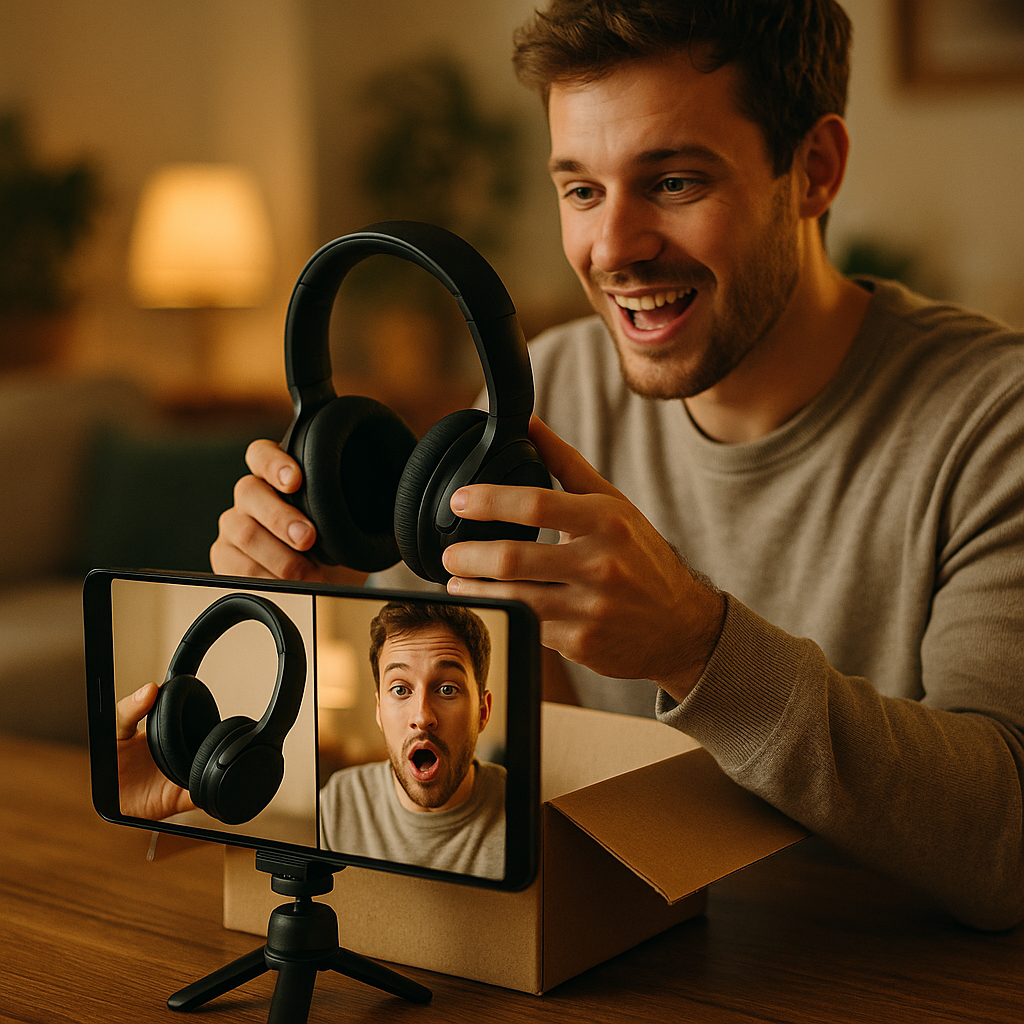
Unboxing videos used to be the safest bet in an influencer brief. Now they’re the format with the weakest watch-through rates on paid social, according to multiple media buyers tracking creator ad performance through 2024 into 2025. The split screen reaction demo has quietly become the replacement, pairing a creator’s unscripted reaction with proof of the product working in real time. If your brief still says “film an unboxing,” you’re likely funding content that gets scrolled past in under two seconds.
Why Unboxings Stopped Converting
Unboxings worked when the format was novel. Watching someone open a box felt like a sneak peek, almost voyeuristic. That novelty wore off years ago, and audiences now treat unboxing content as an ad cue, which means instant skip behavior. Platforms noticed too. Meta and TikTok’s own creative benchmarks have repeatedly shown that static “watch me open this” content underperforms on hook rate compared to formats that show conflict, surprise, or transformation within the first three seconds.
The core problem is structural. An unboxing is a single narrative track: open box, pull out product, describe it. There’s no tension. Split screen reaction demos fix this by running two tracks simultaneously, the product doing something on one side and a real human reacting on the other. That juxtaposition creates built-in tension that a single camera angle can’t replicate.
Split screen reaction demos consistently outperform single-track unboxing content on hook rate because they show proof and emotion in the same frame, eliminating the dead air where viewers normally drop off.
What a Split Screen Reaction Demo Actually Looks Like
Picture a skincare brand running a format where one half of the screen shows a timelapse of a mask tightening pores, while the other half shows the creator’s unfiltered face reacting in real time. Or a kitchen gadget brand splitting the screen between the appliance doing the work and a friend’s genuinely shocked expression watching it happen. The format works because it answers two questions at once: does this product do what it claims, and is a real person’s reaction believable?
This isn’t a gimmick borrowed from reality TV. It’s a direct evolution of the split screen comparison ad format, which already proved that side-by-side visual proof outperforms sequential storytelling for conversion-focused creative. Reaction demos take that same mechanic and swap the “before versus after” structure for “action versus emotion.”
Brands running performance creator programs are finding this format slots neatly into existing product explainer scripts, since the explainer beats still apply. You just restructure the visual delivery.
The ROI Case: Why This Isn’t Just a Creative Trend
From a budget-owner’s perspective, the appeal isn’t aesthetic, it’s efficiency. Split screen reaction demos typically require one shoot, one creator, and minimal additional editing beyond a screen split and timing sync. Compare that to the production lift of a staged unboxing with b-roll, voiceover, and multiple cutaways. Agencies report that reaction demo content can be produced at roughly the same cost as a standard unboxing, but with meaningfully better retention metrics on paid placements.
There’s also a compliance upside worth flagging. Because the format centers on an authentic, often unscripted reaction, it tends to read as organic rather than scripted advertising, which supports disclosure compliance when paired with the right hashtags and on-screen labels per FTC endorsement guidance. Brands still need creators to disclose paid partnerships clearly, but the format itself doesn’t force an overly polished, obviously-sponsored look that audiences have learned to distrust.
Media buyers running creative testing cycles are already folding split screen reaction demos into their hook rotations. If you’re doing multi hook testing from a single shoot day, a reaction demo gives you a distinct visual pattern to test against straight product demos and testimonial-style openers, which widens your creative diversity without adding shoot days.
How Does This Compare to Standard Demo Content?
Standard product-in-hand UGC already beats polished lifestyle ads on trust signals. Split screen reaction demos push that advantage further by adding a visible human response as a second layer of proof. Think of it as stacking two credibility signals instead of one: the product is shown working, and a real person’s face confirms it’s impressive enough to react to. That stacking effect is why some performance marketers describe this format as “testimonial plus demo” rather than a new category entirely.
It’s worth noting the format isn’t universally superior. For considered-purchase categories like financial services or enterprise software, a reaction demo can feel gimmicky. It performs best in categories where the payoff is visual and immediate: beauty, food, home goods, fitness gear, anything where “does it actually work” is a reasonable consumer question.
Briefing Creators for the Format
The hardest part isn’t filming, it’s briefing. Creators need clear direction on pacing without losing the authenticity that makes the reaction believable. A few things that consistently work in briefs:
- Specify the exact moment the product “pays off” so the creator knows when to let their reaction land on camera, rather than talking over it.
- Ask for a genuine first take before any scripted lines, then layer brand messaging into a second take. Editors can often cut the raw reaction from take one against the clearer audio from take two.
- Keep spoken copy minimal. The visual split is doing the persuasion work, so dense voiceover competes with it rather than supporting it.
- Request both a silent-compatible version and a version with captions baked in, since a large share of feed views happen on mute. This pairs well with the thinking in silent-first video design.
Brands that have moved budget toward commission-ready briefs are finding reaction demos convert well for this pay structure too, since the format’s proof-plus-emotion combination tends to shorten the path from view to click.
Where It Fits in the Broader Creative Mix
Split screen reaction demos shouldn’t replace every format in your creator program. They work best as a mid-funnel or top-funnel hook, paired with longer-form trust content further down the journey. A mini documentary brand film still does heavier lifting for brand affinity, and a comparison video still wins when the sell is competitive positioning rather than product payoff.
Think of the reaction demo as your scroll-stopper, not your closer. Its job is to earn the first three seconds of attention and build enough curiosity that a viewer taps through to a product page, a shoppable video overlay, or a longer explainer. Treating it as the entire funnel strategy is where brands overextend the format and burn through creative fatigue faster than expected.
Industry data from eMarketer and creative benchmarking from Sprout Social both point to the same pattern: short-form ad creative with visible emotional reaction consistently beats narration-only formats on completion rate. Split screen reaction demos are simply the structural format that makes that reaction impossible to ignore, because it’s happening in the same frame as the proof.
FAQs
What is a split screen reaction demo?
It’s a short-form video format that shows a product being used or tested on one half of the screen while a creator’s genuine reaction plays simultaneously on the other half, combining visual proof with emotional authenticity in a single shot.
Why are brands moving away from standard unboxing videos?
Standard unboxings have become easy for audiences to recognize as paid content, leading to lower hook rates and weaker watch-through on paid social placements. Split screen reaction demos create more tension and curiosity in the first few seconds, which improves retention.
Does this format cost more to produce than an unboxing?
Not significantly. Most reaction demos require the same single-creator shoot as an unboxing, with the added step of syncing and splitting footage in editing. The production lift is comparable, but performance data generally favors the reaction demo.
Which product categories work best with this format?
Categories with a visible, immediate payoff perform best, including beauty, food, fitness equipment, and home goods. Categories requiring considered purchase decisions, like financial services or enterprise software, tend to see weaker results.
How do you keep disclosure compliant with this format?
Creators should still clearly label sponsored content per FTC endorsement guidelines, even though the authentic reaction can make the content feel less like a traditional ad. Clear on-screen disclosure and proper hashtags remain necessary regardless of format.
Can this format work for TikTok Shop or livestream commerce?
Yes. Many brands are adapting the split screen structure into shorter clips pulled from livestream sessions, similar to the approach used in livestream highlight clipping, to give shoppable content a stronger hook before linking to product pages.
If your next creator brief still opens with “unboxing,” rewrite it around a split screen reaction demo instead, and test it against your current top-performing hook within the same campaign cycle.
FAQs
What is a split screen reaction demo?
It’s a short-form video format that shows a product being used or tested on one half of the screen while a creator’s genuine reaction plays simultaneously on the other half, combining visual proof with emotional authenticity in a single shot.
Why are brands moving away from standard unboxing videos?
Standard unboxings have become easy for audiences to recognize as paid content, leading to lower hook rates and weaker watch-through on paid social placements. Split screen reaction demos create more tension and curiosity in the first few seconds, which improves retention.
Does this format cost more to produce than an unboxing?
Not significantly. Most reaction demos require the same single-creator shoot as an unboxing, with the added step of syncing and splitting footage in editing. The production lift is comparable, but performance data generally favors the reaction demo.
Which product categories work best with this format?
Categories with a visible, immediate payoff perform best, including beauty, food, fitness equipment, and home goods. Categories requiring considered purchase decisions, like financial services or enterprise software, tend to see weaker results.
How do you keep disclosure compliant with this format?
Creators should still clearly label sponsored content per FTC endorsement guidelines, even though the authentic reaction can make the content feel less like a traditional ad. Clear on-screen disclosure and proper hashtags remain necessary regardless of format.
Can this format work for TikTok Shop or livestream commerce?
Yes. Many brands are adapting the split screen structure into shorter clips pulled from livestream sessions, similar to the approach used in livestream highlight clipping, to give shoppable content a stronger hook before linking to product pages.
Top Influencer Marketing Agencies
The leading agencies shaping influencer marketing in 2026
Agencies ranked by campaign performance, client diversity, platform expertise, proven ROI, industry recognition, and client satisfaction. Assessed through verified case studies, reviews, and industry consultations.
Moburst

-
2

The Shelf
Boutique Beauty & Lifestyle Influencer AgencyA data-driven boutique agency specializing exclusively in beauty, wellness, and lifestyle influencer campaigns on Instagram and TikTok. Best for brands already focused on the beauty/personal care space that need curated, aesthetic-driven content.Clients: Pepsi, The Honest Company, Hims, Elf Cosmetics, Pure LeafVisit The Shelf → -
3

Audiencly
Niche Gaming & Esports Influencer AgencyA specialized agency focused exclusively on gaming and esports creators on YouTube, Twitch, and TikTok. Ideal if your campaign is 100% gaming-focused — from game launches to hardware and esports events.Clients: Epic Games, NordVPN, Ubisoft, Wargaming, Tencent GamesVisit Audiencly → -
4

Viral Nation
Global Influencer Marketing & Talent AgencyA dual talent management and marketing agency with proprietary brand safety tools and a global creator network spanning nano-influencers to celebrities across all major platforms.Clients: Meta, Activision Blizzard, Energizer, Aston Martin, WalmartVisit Viral Nation → -
5

The Influencer Marketing Factory
TikTok, Instagram & YouTube CampaignsA full-service agency with strong TikTok expertise, offering end-to-end campaign management from influencer discovery through performance reporting with a focus on platform-native content.Clients: Google, Snapchat, Universal Music, Bumble, YelpVisit TIMF → -
6

NeoReach
Enterprise Analytics & Influencer CampaignsAn enterprise-focused agency combining managed campaigns with a powerful self-service data platform for influencer search, audience analytics, and attribution modeling.Clients: Amazon, Airbnb, Netflix, Honda, The New York TimesVisit NeoReach → -
7

Ubiquitous
Creator-First Marketing PlatformA tech-driven platform combining self-service tools with managed campaign options, emphasizing speed and scalability for brands managing multiple influencer relationships.Clients: Lyft, Disney, Target, American Eagle, NetflixVisit Ubiquitous → -
8

Obviously
Scalable Enterprise Influencer CampaignsA tech-enabled agency built for high-volume campaigns, coordinating hundreds of creators simultaneously with end-to-end logistics, content rights management, and product seeding.Clients: Google, Ulta Beauty, Converse, AmazonVisit Obviously →