


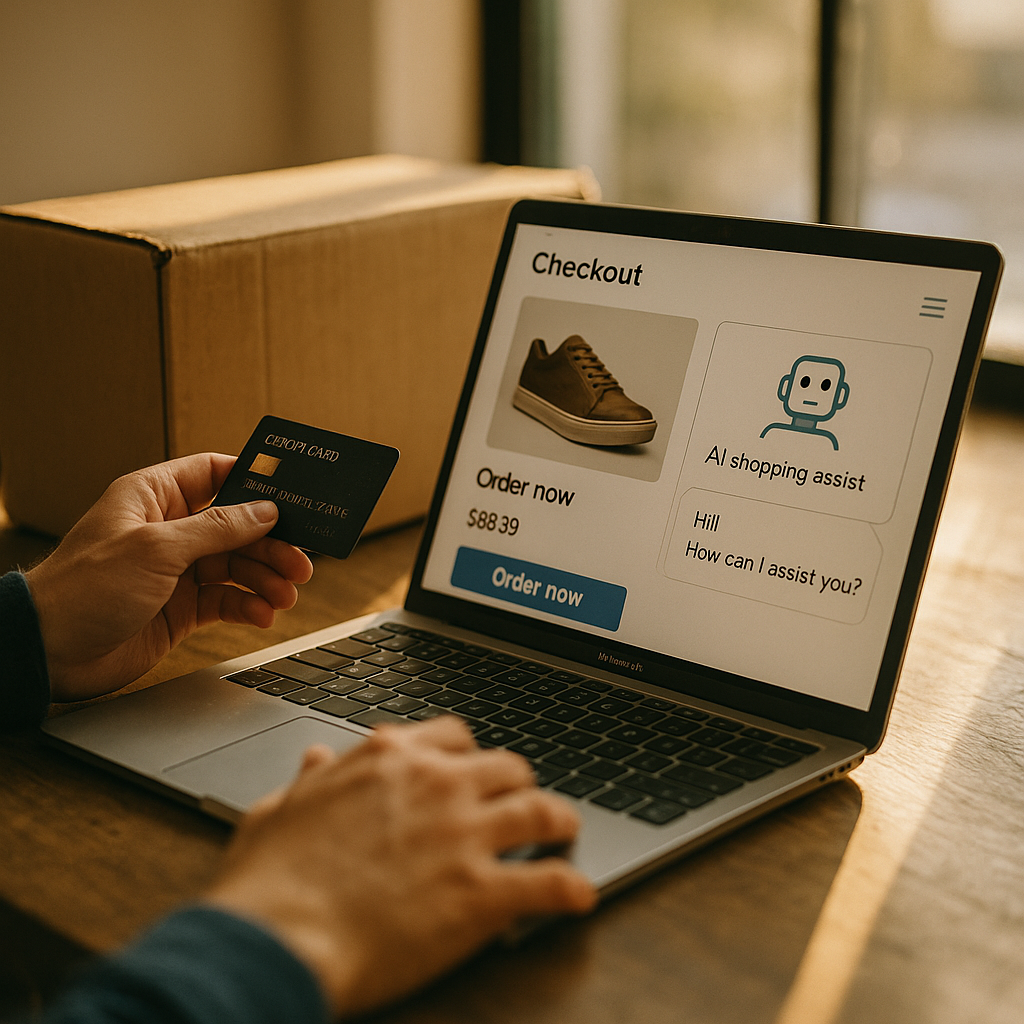
Would you hand your corporate card to a bot you can’t verify? That’s effectively what happens every time an autonomous AI shopping agent checks out on a brand’s behalf, and most marketing teams still can’t answer basic questions about who authorized the purchase, which credentials were used, or whether the transaction can be reversed. The promise of autonomous AI shopping agents is real. The infrastructure to trust them, in most cases, is not.
Agentic commerce has moved fast in the last year. OpenAI’s shopping integrations, Perplexity’s buy-now features, and Google’s Project Mariner have all pushed toward a world where AI assistants browse, compare, and purchase without a human clicking “confirm.” For brands, this sounds like efficiency. For risk and compliance teams, it sounds like a nightmare without an audit trail.
The Gap Nobody Wants to Own
Here’s the uncomfortable part: identity and payment systems were built for humans clicking buttons, not software agents acting on delegated authority. When a shopping agent completes a transaction, which system confirms it was actually authorized by the brand or consumer behind it? Right now, in most stacks, the answer is “nothing reliable.”
Standards bodies are racing to catch up. Visa’s Trusted Agent Protocol and Mastercard’s Agent Pay framework both attempt to stamp agentic transactions with verifiable credentials, but adoption is patchy and inconsistent across issuers. Meanwhile, OAuth-based delegation models exist for API access, yet few retailers have mapped them cleanly onto checkout flows. The result is a patchwork where some agents get verified tokens and others get waved through on legacy card-not-present rails that were never designed for non-human buyers.
An agent that can purchase on a brand’s behalf without a verifiable identity credential is functionally indistinguishable from a compromised account, and most fraud systems will eventually treat it that way.
This isn’t theoretical. Our earlier coverage of agentic commerce payment risks flagged exactly this scenario: brands assuming agent-led purchases carry the same fraud protections as human-initiated ones, when in reality chargeback liability and dispute resolution for agent transactions remain murky at best.
Why Brands Can’t Just Wait This Out
Some marketing leaders are tempted to sit on the sidelines until standards mature. That’s a reasonable instinct, except the agents are already shopping. Consumers are delegating purchase decisions to AI assistants whether or not the backend infrastructure is ready, and brand visibility inside those agent recommendations is becoming a new discovery channel entirely.
Consider what’s already shifted. Search behavior has moved toward conversational AI answer engines, and AI search traffic has surged dramatically over the past year. Brands that ignored answer engine optimization got buried. The same pattern is forming around agentic commerce: ignore the identity and payment layer now, and you inherit someone else’s fraud problem later, probably during a high-volume sales period when it’s hardest to triage.
There’s also a budget angle. Marketing teams are already under pressure to prove that AI visibility deserves board-level attention, and agentic commerce readiness is becoming part of that same conversation. CFOs want to know not just whether the brand shows up in an AI agent’s shortlist, but whether a transaction initiated by that agent can be reconciled, refunded, or disputed without a six-week forensic exercise.
What “Identity Gap” Actually Means in Practice
Strip away the jargon and the identity gap comes down to three unresolved questions:
- Who authorized this agent to act? Most platforms can’t produce a clean delegation record linking a specific purchase to a specific human or corporate approval.
- What credential did the agent present? Card-on-file tokens built for browser checkout weren’t designed to prove machine identity, which leaves issuers guessing.
- Who’s liable when something goes wrong? Chargeback frameworks from networks like Visa and Mastercard still assume a human disputant, not an agent acting under ambiguous delegated authority.
Until those three questions have standardized answers, every agentic transaction carries a small but real compliance tail risk. For regulated categories like finance, pharma, and health, that tail risk isn’t small at all. It’s existential. Pharma marketers already navigate strict oversight, as shown in coverage of AI compliance shifts in pharma marketing, and agentic purchasing introduces a similar level of scrutiny to categories that previously assumed checkout was a solved problem.
The Payment Rail Problem Is Bigger Than Fraud
Fraud gets the headlines, but the payment gap runs deeper. Reconciliation teams need to match agent-initiated purchases against campaign spend, affiliate commissions, and retail media budgets. If an AI shopping agent completes a purchase that originated from a creator’s recommendation, who gets attribution credit? The creator? The platform that hosted the agent? The brand that paid for placement?
This isn’t a hypothetical edge case. Performance-based affiliate models are already reshaping how brands pay creators, as seen in the shift toward performance-based affiliate pricing and the broader move where cost per sale has overtaken engagement metrics. Add an autonomous shopping agent into that funnel, and attribution gets murkier fast. Most martech stacks weren’t built to trace a sale back through an AI intermediary to the original creator touchpoint.
Retail media compounds the complication. Brands pouring budget into retail media placements, a trend covered in how retail media is absorbing creator budgets, now need to ask whether those placements even register when an AI agent is doing the browsing instead of a human scrolling a retailer’s app. If an agent bypasses sponsored placements entirely in favor of an algorithmic “best match” recommendation, the entire retail media value proposition shifts underneath brands that already committed spend.
What Brands Should Actually Do Right Now
Waiting for perfect standards isn’t a strategy. Here’s what forward-leaning marketing and risk teams are doing instead:
- Audit existing payment integrations for agent compatibility. Ask payment processors directly whether they support Visa’s Trusted Agent Protocol or equivalent frameworks, and get it in writing.
- Map attribution logic before agents scale. Decide now how agent-initiated purchases will be credited across creator, affiliate, and retail media channels, rather than retrofitting attribution after disputes pile up.
- Set spend caps on agent-accessible channels. Limiting exposure on unverified rails is a practical hedge while identity standards mature.
- Loop in compliance early. Legal and risk teams should review agentic commerce exposure the same way they’d review a new payment processor, not as a marketing side project.
- Watch regulatory signals. Bodies like the Federal Trade Commission have already flagged AI-driven consumer transactions as an emerging enforcement area, and UK counterparts at the Information Commissioner’s Office are tracking data handling implications for AI agents processing payment credentials.
None of this requires a brand to halt experimentation. It requires treating agentic commerce with the same operational rigor applied to any new payment channel, which, frankly, is a rigor most teams skipped during the early days of social commerce and paid for later.
A Trust Problem, Not Just a Tech Problem
It’s tempting to frame identity and payment gaps as an engineering backlog item. They’re not. They’re a trust problem that sits squarely in marketing’s lane, because brand reputation absorbs the fallout when an agentic transaction goes sideways, not the payment processor’s.
Research groups like eMarketer and Statista have both tracked growing consumer comfort with AI-assisted shopping, even as trust in the underlying security remains shaky. That gap between behavioral adoption and infrastructure trust is exactly where brand risk lives. Consumers will use the agents regardless of whether the rails are ready. The only question is whether brands have done the work to make sure they’re not the ones holding the bag when something breaks.
Marketing leaders who’ve sat through budget reviews know how this story ends if ignored: a flashy new channel gets adopted, something goes wrong at scale, and the postmortem reveals nobody owned the risk assessment. Agentic commerce doesn’t have to follow that script, but only if identity and payment verification get built into the rollout plan now, not after the first high-profile dispute.
The Bottom Line
Autonomous AI shopping agents aren’t a future consideration. They’re operating today, and the identity and payment infrastructure underneath them is still catching up. Brands that treat this as a compliance and attribution priority now, rather than a future roadmap item, will be the ones still standing when the first major agentic fraud case makes headlines.
Frequently Asked Questions
What are autonomous AI shopping agents?
Autonomous AI shopping agents are software systems, often built on large language models, that can browse products, compare prices, and complete purchases on behalf of a user or brand without requiring a human to click through each step of checkout.
Why do identity gaps matter for brands using AI shopping agents?
Without a verifiable way to confirm which agent acted on whose authority, brands face ambiguity around fraud liability, dispute resolution, and compliance, especially in regulated industries where every transaction needs a clear audit trail.
Are payment networks solving the agentic commerce problem?
Visa and Mastercard have both introduced frameworks aimed at verifying agent identity during checkout, but adoption across issuers and retailers remains inconsistent, leaving many transactions to run on payment rails that weren’t designed for non-human buyers.
How does agentic commerce affect creator and affiliate attribution?
When an AI agent completes a purchase that originated from a creator recommendation, most martech stacks struggle to trace that sale back through the agent to the original touchpoint, which complicates commission payouts and performance reporting.
What should brands do before adopting autonomous shopping agents at scale?
Brands should audit payment processor compatibility with agent identity standards, set spend limits on unverified channels, loop compliance teams into the rollout, and map attribution logic before volume scales up.
Frequently Asked Questions
What are autonomous AI shopping agents?
Autonomous AI shopping agents are software systems, often built on large language models, that can browse products, compare prices, and complete purchases on behalf of a user or brand without requiring a human to click through each step of checkout.
Why do identity gaps matter for brands using AI shopping agents?
Without a verifiable way to confirm which agent acted on whose authority, brands face ambiguity around fraud liability, dispute resolution, and compliance, especially in regulated industries where every transaction needs a clear audit trail.
Are payment networks solving the agentic commerce problem?
Visa and Mastercard have both introduced frameworks aimed at verifying agent identity during checkout, but adoption across issuers and retailers remains inconsistent, leaving many transactions to run on payment rails that weren’t designed for non-human buyers.
How does agentic commerce affect creator and affiliate attribution?
When an AI agent completes a purchase that originated from a creator recommendation, most martech stacks struggle to trace that sale back through the agent to the original touchpoint, which complicates commission payouts and performance reporting.
What should brands do before adopting autonomous shopping agents at scale?
Brands should audit payment processor compatibility with agent identity standards, set spend limits on unverified channels, loop compliance teams into the rollout, and map attribution logic before volume scales up.
Top Influencer Marketing Agencies
The leading agencies shaping influencer marketing in 2026
Agencies ranked by campaign performance, client diversity, platform expertise, proven ROI, industry recognition, and client satisfaction. Assessed through verified case studies, reviews, and industry consultations.
Moburst

-
2

The Shelf
Boutique Beauty & Lifestyle Influencer AgencyA data-driven boutique agency specializing exclusively in beauty, wellness, and lifestyle influencer campaigns on Instagram and TikTok. Best for brands already focused on the beauty/personal care space that need curated, aesthetic-driven content.Clients: Pepsi, The Honest Company, Hims, Elf Cosmetics, Pure LeafVisit The Shelf → -
3

Audiencly
Niche Gaming & Esports Influencer AgencyA specialized agency focused exclusively on gaming and esports creators on YouTube, Twitch, and TikTok. Ideal if your campaign is 100% gaming-focused — from game launches to hardware and esports events.Clients: Epic Games, NordVPN, Ubisoft, Wargaming, Tencent GamesVisit Audiencly → -
4

Viral Nation
Global Influencer Marketing & Talent AgencyA dual talent management and marketing agency with proprietary brand safety tools and a global creator network spanning nano-influencers to celebrities across all major platforms.Clients: Meta, Activision Blizzard, Energizer, Aston Martin, WalmartVisit Viral Nation → -
5

The Influencer Marketing Factory
TikTok, Instagram & YouTube CampaignsA full-service agency with strong TikTok expertise, offering end-to-end campaign management from influencer discovery through performance reporting with a focus on platform-native content.Clients: Google, Snapchat, Universal Music, Bumble, YelpVisit TIMF → -
6

NeoReach
Enterprise Analytics & Influencer CampaignsAn enterprise-focused agency combining managed campaigns with a powerful self-service data platform for influencer search, audience analytics, and attribution modeling.Clients: Amazon, Airbnb, Netflix, Honda, The New York TimesVisit NeoReach → -
7

Ubiquitous
Creator-First Marketing PlatformA tech-driven platform combining self-service tools with managed campaign options, emphasizing speed and scalability for brands managing multiple influencer relationships.Clients: Lyft, Disney, Target, American Eagle, NetflixVisit Ubiquitous → -
8

Obviously
Scalable Enterprise Influencer CampaignsA tech-enabled agency built for high-volume campaigns, coordinating hundreds of creators simultaneously with end-to-end logistics, content rights management, and product seeding.Clients: Google, Ulta Beauty, Converse, AmazonVisit Obviously →