


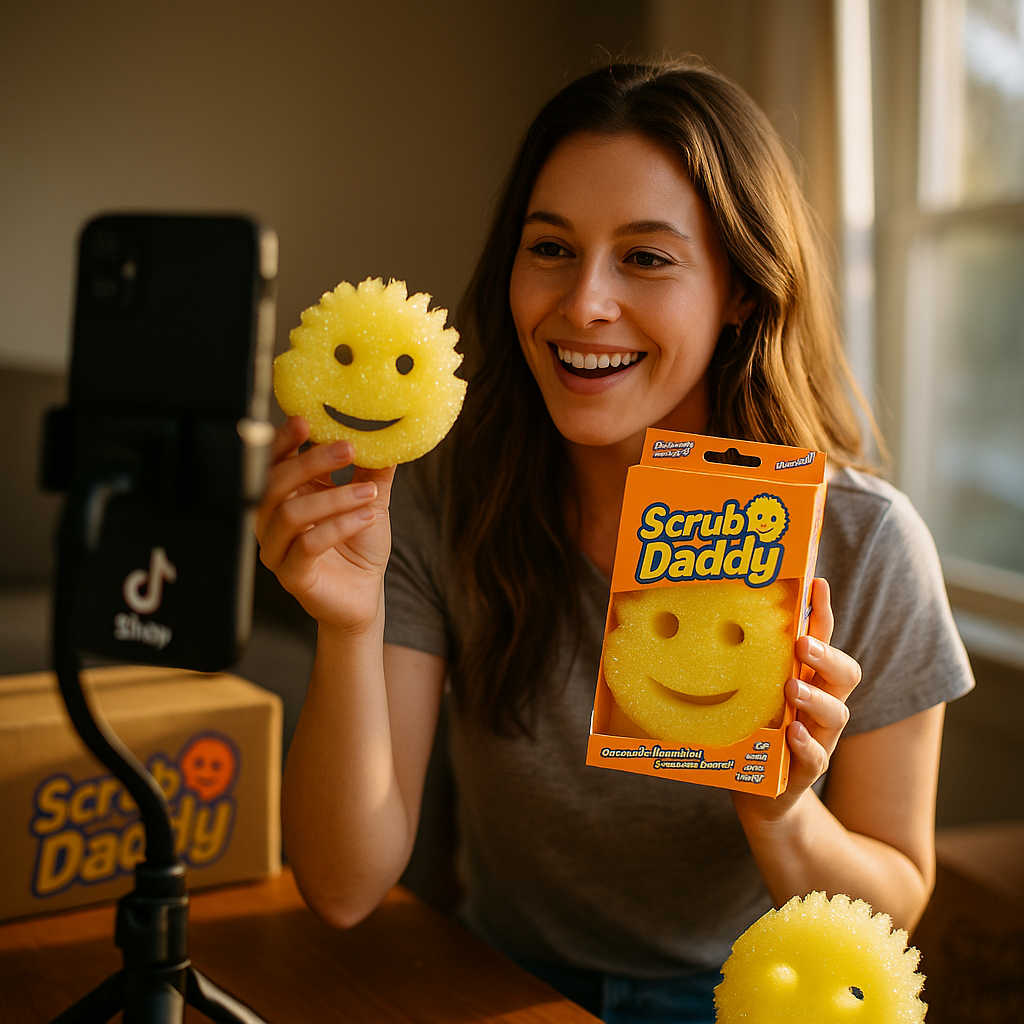
A scrubbing sponge with a permanent grin now outsells entire beauty brands on TikTok Shop. Scrub Daddy, the FlexTexture cleaning tool that walked out of a Shark Tank pitch with a Lori Greiner deal, has quietly become one of the platform’s most studied commerce case studies. For brand strategists still treating TikTok Shop as an experimental side channel, Scrub Daddy’s run proves the format can carry a legacy CPG product into nine-figure territory.
The Flywheel: From Shark Tank to Shop Tab
Scrub Daddy didn’t arrive on TikTok as a scrappy startup looking for its first sale. It arrived with a decade of Shark Tank residuals, a cult following built on QVC, and a product with an inherent gimmick: the sponge softens in warm water and firms up in cold. That built-in visual hook made it tailor made for short form video long before TikTok Shop existed as a checkout option.
What changed was distribution. Once the brand plugged its existing content engine into TikTok’s native storefront, every viral demo clip became a purchase point instead of a dead end. No redirect to a website, no cart abandonment from a slow mobile load. That single friction removal is the entire thesis behind TikTok Shop, and Scrub Daddy had the content volume to exploit it immediately.
Brands that treat TikTok Shop as a bolt on channel miss the point: the format rewards companies that already have hundreds of organic video assets ready to convert, not ones scrambling to produce their first.
Why a $7.99 Sponge Fits the Shop Tab Better Than Luxury Skincare
Low price point, high repeat purchase, universal relevance. Scrub Daddy checks every box that makes a product “TikTok Shop native.” The brand isn’t asking for a considered purchase decision, it’s asking for an impulse add to cart triggered by a satisfying cleaning clip. That’s a fundamentally different sales psychology than the one driving a $120 serum, and it’s worth remembering before leadership mandates TikTok Shop for every SKU in the portfolio.
Household goods brands watching this should take note of how other hardware and home brands have built creator channels to skip retail fees, a model Scrub Daddy effectively pioneered before the term existed. By moving volume through its own TikTok storefront, the brand keeps margin that would otherwise go to a big box retailer’s trade spend.
The Affiliate Math Nobody Talks About
TikTok Shop’s commission structure is the quiet engine here. Scrub Daddy runs an open affiliate program, meaning any creator, not just a vetted partner list, can grab the product, post a video, and earn a cut of every resulting sale. That’s a radically different operating model from the agency-brokered deals most CPG brands are used to negotiating.
- Lower barrier to entry means thousands of small creators post content the brand never had to brief or pay upfront.
- Commission only triggers on conversion, which keeps cost per acquisition predictable in a way flat-fee sponsorships rarely do.
- Volume compounds: a hundred nano creators each generating modest sales often outperforms a single high-fee partnership.
This mirrors the strategy behind Comfrt’s six-figure creator army approach on TikTok Shop, where scale and openness beat curated exclusivity. It’s also the logic driving Crocs’s multi-million dollar creator channel, proving the affiliate-heavy model isn’t a fluke limited to one category.
Livestream Shopping Isn’t Dead, It’s Just Boring Done Wrong
Here’s an uncomfortable truth for brands that tried livestream shopping once, saw low viewership, and quit: Scrub Daddy treats its livestreams less like QVC reruns and more like always-on retention infrastructure. Founder Aaron Krause and brand team members show up regularly, answer questions in real time, and demo new product variants (the brand now sells sponges, brushes, and cleaning paste under the same smiley face identity).
Consistency matters more than production value. A livestream that happens three times a week for months builds an audience habit. One that happens once as a “special event” builds nothing. Per eMarketer’s ongoing coverage of social commerce, livestream shopping engagement in the US still lags China by a wide margin, which means brands willing to show up consistently face less competition for attention than they’d assume.
Compliance Isn’t Optional at This Scale
Running an open affiliate program with thousands of untrained creators is a disclosure nightmare waiting to happen if nobody’s watching. The FTC’s endorsement guidelines apply regardless of whether a creator was personally briefed by the brand or simply grabbed a product through an open affiliate link. Brands scaling affiliate volume the way Scrub Daddy has need monitoring tools and clear creator onboarding language, not just a hope that #ad hashtags appear organically.
This is the same tension Best Buy navigated in its own TikTok Shop launch, where trust and compliance had to scale alongside creator volume. Electronics and household goods carry different risk profiles than beauty, but the underlying operational need is identical: someone on the brand side has to own disclosure compliance as a full time function, not an afterthought.
Attribution: The Part Brands Still Get Wrong
A sponge doesn’t need a complicated purchase journey, but Scrub Daddy’s internal reporting still has to answer the same question every CMO asks: which creators actually drove revenue, not just views? TikTok Shop’s native analytics dashboard provides conversion data per creator link, which is more attribution clarity than most influencer programs get. Brands outside the TikTok Shop ecosystem often struggle with this exact problem, which is why initiatives like making influencer ROI genuinely auditable have become a priority across the industry.
Compare that to the CPA-driven model Princess Polly built across eleven thousand creators, or the sales-tied tiering system in Huda Beauty’s creator tier structure. Scrub Daddy’s affiliate model achieves a similar outcome through a simpler mechanism: TikTok Shop itself handles the attribution layer, removing the need for third-party tracking software that smaller CPG brands often can’t afford.
The brands winning on TikTok Shop aren’t necessarily spending more. They’re spending on infrastructure that makes every creator’s contribution measurable, then doubling down on whoever converts.
What Other Brands Can Actually Steal From This
Not every product has Scrub Daddy’s built-in visual gimmick or decade of Shark Tank brand equity. But the operational playbook is transferable:
- Open the affiliate program wide. Gatekeeping creator access slows volume. Low commission thresholds attract high video output.
- Show up on livestream consistently. Treat it as owned media infrastructure, not a campaign tactic.
- Build disclosure compliance into onboarding, not as a reactive fix after a complaint.
- Use native shop analytics to identify which creator archetypes actually convert, then brief future creator outreach around those patterns.
- Keep price points impulse friendly. TikTok Shop rewards low-consideration purchases far more reliably than high-ticket items.
Household and CPG brands watching this space should also study how Fabletics turned UGC into a membership flywheel, since the retention logic (content driving repeat behavior rather than one-off sales) applies just as well to a cleaning sponge as it does to activewear. Platforms like TikTok’s advertising hub and tools tracked by Sprout Social now offer brands the reporting depth needed to replicate this without guesswork.
FAQs
What makes Scrub Daddy’s TikTok Shop strategy different from typical CPG influencer campaigns?
The brand runs an open affiliate program that lets any creator earn commission on sales, rather than relying exclusively on paid, pre-vetted partnerships. Combined with consistent livestream selling, it builds volume through accessibility rather than exclusivity.
Can smaller brands replicate the Scrub Daddy TikTok Shop model without a big budget?
Yes. The core mechanics (open affiliate commission, consistent livestreams, native attribution) don’t require large media spend. They require operational discipline and a product suited to impulse purchase behavior.
How does TikTok Shop handle compliance for brands using open affiliate programs?
TikTok Shop does not automatically ensure FTC compliance for affiliate creators. Brands remain responsible for providing clear disclosure guidance and monitoring creator content, especially at high volume.
Is livestream shopping still worth investing in for Western markets?
Engagement levels still trail markets like China, but brands that commit to consistent, recurring livestream schedules see meaningfully better results than those treating it as a one-off event.
What type of products perform best on TikTok Shop?
Low-cost, visually demonstrable, repeat-purchase products tend to outperform high-consideration or luxury items, since the platform favors impulse buying behavior over deliberate research.
The takeaway: Scrub Daddy didn’t win on TikTok Shop because of a clever ad campaign, it won because it turned an open affiliate program, a consistent livestream cadence, and native attribution data into repeatable commerce infrastructure. Brands waiting for a bigger budget before testing TikTok Shop are solving the wrong problem; the ones winning right now solved for operations first.
FAQs
What makes Scrub Daddy’s TikTok Shop strategy different from typical CPG influencer campaigns?
The brand runs an open affiliate program that lets any creator earn commission on sales, rather than relying exclusively on paid, pre-vetted partnerships. Combined with consistent livestream selling, it builds volume through accessibility rather than exclusivity.
Can smaller brands replicate the Scrub Daddy TikTok Shop model without a big budget?
Yes. The core mechanics (open affiliate commission, consistent livestreams, native attribution) don’t require large media spend. They require operational discipline and a product suited to impulse purchase behavior.
How does TikTok Shop handle compliance for brands using open affiliate programs?
TikTok Shop does not automatically ensure FTC compliance for affiliate creators. Brands remain responsible for providing clear disclosure guidance and monitoring creator content, especially at high volume.
Is livestream shopping still worth investing in for Western markets?
Engagement levels still trail markets like China, but brands that commit to consistent, recurring livestream schedules see meaningfully better results than those treating it as a one-off event.
What type of products perform best on TikTok Shop?
Low-cost, visually demonstrable, repeat-purchase products tend to outperform high-consideration or luxury items, since the platform favors impulse buying behavior over deliberate research.
Top Influencer Marketing Agencies
The leading agencies shaping influencer marketing in 2026
Agencies ranked by campaign performance, client diversity, platform expertise, proven ROI, industry recognition, and client satisfaction. Assessed through verified case studies, reviews, and industry consultations.
Moburst

-
2

The Shelf
Boutique Beauty & Lifestyle Influencer AgencyA data-driven boutique agency specializing exclusively in beauty, wellness, and lifestyle influencer campaigns on Instagram and TikTok. Best for brands already focused on the beauty/personal care space that need curated, aesthetic-driven content.Clients: Pepsi, The Honest Company, Hims, Elf Cosmetics, Pure LeafVisit The Shelf → -
3

Audiencly
Niche Gaming & Esports Influencer AgencyA specialized agency focused exclusively on gaming and esports creators on YouTube, Twitch, and TikTok. Ideal if your campaign is 100% gaming-focused — from game launches to hardware and esports events.Clients: Epic Games, NordVPN, Ubisoft, Wargaming, Tencent GamesVisit Audiencly → -
4

Viral Nation
Global Influencer Marketing & Talent AgencyA dual talent management and marketing agency with proprietary brand safety tools and a global creator network spanning nano-influencers to celebrities across all major platforms.Clients: Meta, Activision Blizzard, Energizer, Aston Martin, WalmartVisit Viral Nation → -
5

The Influencer Marketing Factory
TikTok, Instagram & YouTube CampaignsA full-service agency with strong TikTok expertise, offering end-to-end campaign management from influencer discovery through performance reporting with a focus on platform-native content.Clients: Google, Snapchat, Universal Music, Bumble, YelpVisit TIMF → -
6

NeoReach
Enterprise Analytics & Influencer CampaignsAn enterprise-focused agency combining managed campaigns with a powerful self-service data platform for influencer search, audience analytics, and attribution modeling.Clients: Amazon, Airbnb, Netflix, Honda, The New York TimesVisit NeoReach → -
7

Ubiquitous
Creator-First Marketing PlatformA tech-driven platform combining self-service tools with managed campaign options, emphasizing speed and scalability for brands managing multiple influencer relationships.Clients: Lyft, Disney, Target, American Eagle, NetflixVisit Ubiquitous → -
8

Obviously
Scalable Enterprise Influencer CampaignsA tech-enabled agency built for high-volume campaigns, coordinating hundreds of creators simultaneously with end-to-end logistics, content rights management, and product seeding.Clients: Google, Ulta Beauty, Converse, AmazonVisit Obviously →