


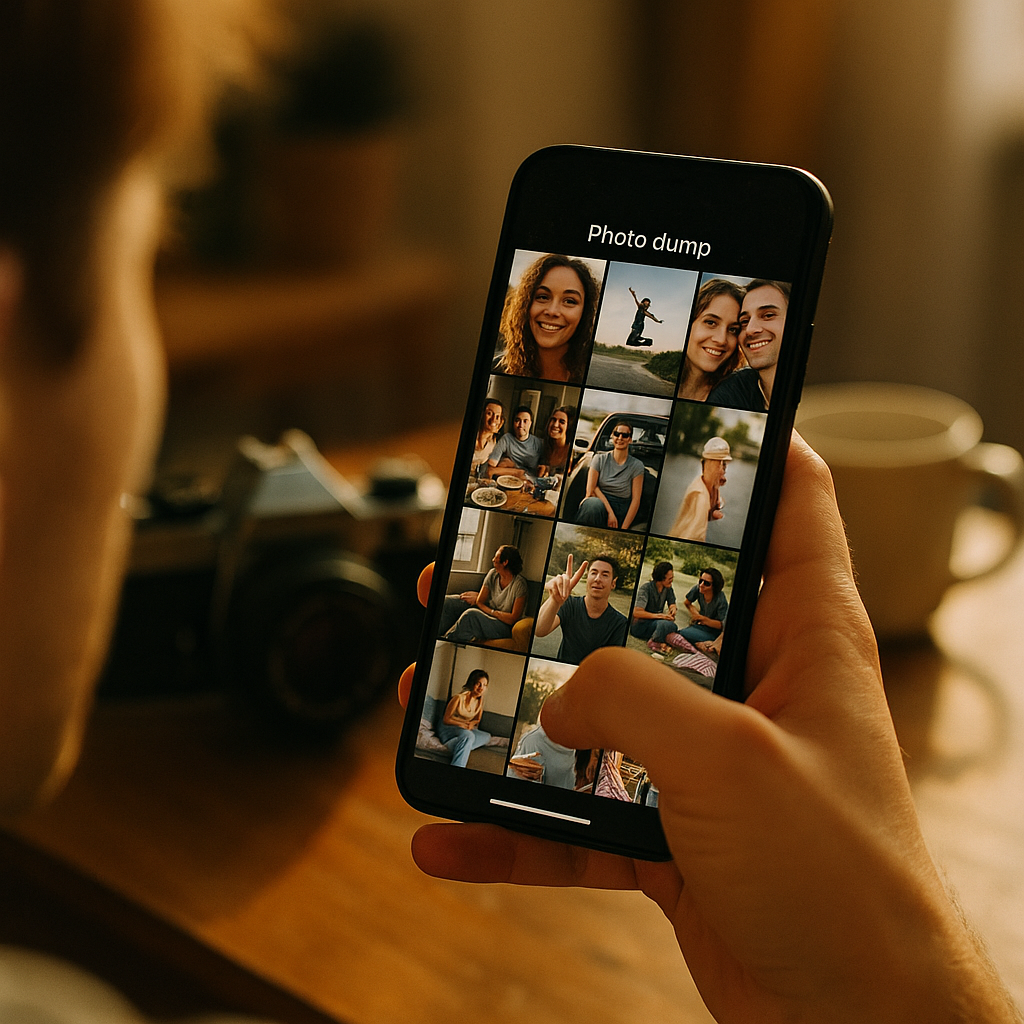
A single slide of blurry, candid shots now regularly out-engages a perfectly lit carousel from the same creator. That is not an accident. The photo dump format has become one of the highest-performing content types on Instagram, and brands clinging to glossy, agency-produced feeds are leaving reach on the table.
Why is this happening, and more importantly, what should a brand marketer do about it? Let’s break down the mechanics, the data, and the operational shift this requires.
What Exactly Is a Photo Dump, and Why Does It Work?
A photo dump is a multi-image carousel, usually five to ten photos, that reads like a loose, unedited diary entry rather than a planned content drop. Think grainy flash photos, mid-chew candids, screenshots of a text thread, a sunset shot next to a blurry gym mirror selfie. No consistent filter. No obvious theme. That is the entire point.
Instagram’s algorithm has shifted hard toward dwell time and carousel completion rate as engagement signals. A photo dump invites swiping because each slide promises something slightly different. A curated nine-grid, by contrast, telegraphs its whole story in the cover image. Users scroll past because they have already seen it.
Carousels with mixed, low-polish imagery often see swipe-through rates two to three times higher than single-image curated posts, because each frame functions as its own micro-hook rather than a repeat of the same aesthetic.
There is also a trust dimension. Audiences, especially Gen Z and younger millennials, have developed what amounts to an immune response to anything that looks like an ad. A low polish carousel reads as personal documentation, not marketing collateral. That perceived authenticity is exactly what makes it effective as marketing, even though the irony is obvious once you say it out loud.
The Data Behind the Shift
Engagement benchmarking from Sprout Social has repeatedly flagged carousel posts as the top-performing format on Instagram by reach and saves, and the photo dump subgenre is driving a disproportionate share of that lift. Meanwhile, eMarketer data on creator content consumption shows younger audiences spending more time on casual, unpolished formats than on traditional brand-produced visuals, a trend that has only accelerated as feed fatigue with studio photography sets in.
This mirrors what we have already documented in the video space. Our coverage of unscripted honesty on CPA found that lower production value videos frequently outperformed polished spots on cost per acquisition. The photo dump is the static-image equivalent of that same consumer preference shift.
It is worth separating correlation from causation here. Low polish does not cause high performance on its own. What causes it is the behavioral signal low polish sends: this is real, this is not trying to sell me something, this person actually used the product in their actual life. Brands that fake the aesthetic without the underlying substance tend to get called out fast in the comments.
Why Curated Feeds Are Losing Ground
Curated, grid-planned feeds were built for a different algorithmic era, one where profile visits and aesthetic consistency mattered more than individual post velocity. That era is mostly over. Instagram’s discovery surfaces, Explore, Reels, and recommended content, now reward individual post performance almost entirely independent of how it fits the broader grid.
There is also a cost problem. A fully curated feed requires consistent color grading, a content calendar, often a photographer, and a lot of pre-production. A photo dump requires a phone and a willingness to post something that is not perfect. For brands managing dozens of creator relationships, that cost delta matters enormously at scale.
- Production cost: Photo dumps can be shot in a single afternoon with a phone camera, no lighting rig required.
- Turnaround time: Content can go live same-day instead of waiting on edits and color correction.
- Perceived authenticity: Audiences rate unpolished content as more trustworthy in brand lift surveys.
- Algorithmic favorability: Higher swipe-through and save rates on mixed-content carousels.
None of this means curated content is dead. Hero launch moments, product photography for paid ads, and evergreen catalog assets still need polish. But as the default feed format for ongoing creator partnerships, curation is losing its grip.
This pattern rhymes with what we outlined in behind the scenes raw footage strategies, where unfinished-looking content consistently drove more purchase intent than finished commercial cuts.
How Should Brands Actually Brief This?
Here is where most brands get it wrong. They see the performance data and ask creators to “make it look more casual,” which produces a fake photo dump, and audiences spot fake instantly. The brief needs to focus on behavior, not aesthetic.
Instead of specifying lighting or composition, specify a scenario: a weekend trip, a morning routine, a shopping haul. Let the product appear naturally within that scenario rather than as the hero of every frame.
A workable brief structure looks like this:
- Define the real-life context the product fits into (travel, routine, social gathering).
- Ask for 6 to 9 images shot across that real context, not staged in one session.
- Require the product to appear in 2 to 3 of those slides naturally, not centered or posed.
- Leave caption tone loose. Over-scripted captions kill the format’s credibility instantly.
- Skip mandatory hashtag stacking or heavy disclosure styling that disrupts the casual read.
This approach overlaps with the thinking behind raw footage capture planning, where the brief sets context and boundaries but leaves room for the creator’s actual instinct to come through. The tighter the script, the more the format collapses.
The Compliance Angle Nobody Talks About
Low polish does not mean low oversight. Disclosure obligations under FTC endorsement guidelines still apply fully to photo dump content, and casual-looking posts are exactly where brands get sloppy on this. A dump slide showing a product with no clear #ad or paid partnership label is still a compliance risk, regardless of how candid it looks.
The UK equivalent guidance from the ICO around data handling in influencer campaigns also applies if any user-generated content is being repurposed into paid media, which many brands now do with their best-performing dumps.
Build disclosure into the brief as a non-negotiable, positioned in a way that does not wreck the casual tone. A simple “paid partnership” tag at the top of the carousel does the job without needing a caption essay.
Measuring Performance Without Overcorrecting
Brands new to this format often panic when a photo dump does not immediately show a polished brand logo or clear CTA in every slide. Resist that instinct. The format’s job is reach, trust-building, and mid-funnel consideration, not direct-response conversion in a single post.
Track swipe-through rate, saves, and shares as primary signals rather than clicks. If you need harder conversion tracking, pair the dump with a shoppable chapter strategy in a companion video asset rather than forcing the carousel itself to carry commerce weight it was never designed for.
Cross-reference performance by testing dump-style carousels against your existing curated controls using a structured hook testing framework. This gives you an apples-to-apples read on whether the format lift is real for your specific audience, rather than assuming industry benchmarks translate directly to your category.
For broader context on how platforms are weighting engagement signals, Meta’s own guidance through Meta for Business continues to emphasize time spent and interaction depth over static reach, which reinforces why swipe-heavy formats keep winning distribution.
Next Step
Run a direct A/B test this quarter: brief three creators for a polished carousel and three for a context-driven photo dump using the same product, then compare swipe-through and save rates head-to-head. The format only proves itself with your audience, not with industry averages.
Frequently Asked Questions
What makes a photo dump different from a regular carousel post?
A photo dump mixes unrelated, candid-feeling images across a single carousel instead of following one consistent theme or aesthetic, which encourages more swiping and feels less like produced marketing content.
Does the photo dump format work for every brand category?
It performs best for lifestyle, beauty, food, and travel categories where products naturally appear in daily life. B2B and highly technical categories typically need a more structured visual approach to convey product function.
How many images should a brand photo dump include?
Most high-performing examples use six to nine images. Fewer than five feels too curated, and more than ten tends to reduce completion rate.
Do photo dumps still need FTC disclosure?
Yes. Casual appearance does not exempt the content from endorsement disclosure rules. A clear paid partnership label is still required regardless of the aesthetic.
Can brands repurpose photo dump content into paid ads?
Yes, and many do, but repurposed content should maintain its original tone. Over-editing a dump for paid media often strips out the authenticity that made it perform in the first place.
FAQs
Top Influencer Marketing Agencies
The leading agencies shaping influencer marketing in 2026
Agencies ranked by campaign performance, client diversity, platform expertise, proven ROI, industry recognition, and client satisfaction. Assessed through verified case studies, reviews, and industry consultations.
Moburst

-
2

The Shelf
Boutique Beauty & Lifestyle Influencer AgencyA data-driven boutique agency specializing exclusively in beauty, wellness, and lifestyle influencer campaigns on Instagram and TikTok. Best for brands already focused on the beauty/personal care space that need curated, aesthetic-driven content.Clients: Pepsi, The Honest Company, Hims, Elf Cosmetics, Pure LeafVisit The Shelf → -
3

Audiencly
Niche Gaming & Esports Influencer AgencyA specialized agency focused exclusively on gaming and esports creators on YouTube, Twitch, and TikTok. Ideal if your campaign is 100% gaming-focused — from game launches to hardware and esports events.Clients: Epic Games, NordVPN, Ubisoft, Wargaming, Tencent GamesVisit Audiencly → -
4

Viral Nation
Global Influencer Marketing & Talent AgencyA dual talent management and marketing agency with proprietary brand safety tools and a global creator network spanning nano-influencers to celebrities across all major platforms.Clients: Meta, Activision Blizzard, Energizer, Aston Martin, WalmartVisit Viral Nation → -
5

The Influencer Marketing Factory
TikTok, Instagram & YouTube CampaignsA full-service agency with strong TikTok expertise, offering end-to-end campaign management from influencer discovery through performance reporting with a focus on platform-native content.Clients: Google, Snapchat, Universal Music, Bumble, YelpVisit TIMF → -
6

NeoReach
Enterprise Analytics & Influencer CampaignsAn enterprise-focused agency combining managed campaigns with a powerful self-service data platform for influencer search, audience analytics, and attribution modeling.Clients: Amazon, Airbnb, Netflix, Honda, The New York TimesVisit NeoReach → -
7

Ubiquitous
Creator-First Marketing PlatformA tech-driven platform combining self-service tools with managed campaign options, emphasizing speed and scalability for brands managing multiple influencer relationships.Clients: Lyft, Disney, Target, American Eagle, NetflixVisit Ubiquitous → -
8

Obviously
Scalable Enterprise Influencer CampaignsA tech-enabled agency built for high-volume campaigns, coordinating hundreds of creators simultaneously with end-to-end logistics, content rights management, and product seeding.Clients: Google, Ulta Beauty, Converse, AmazonVisit Obviously →