


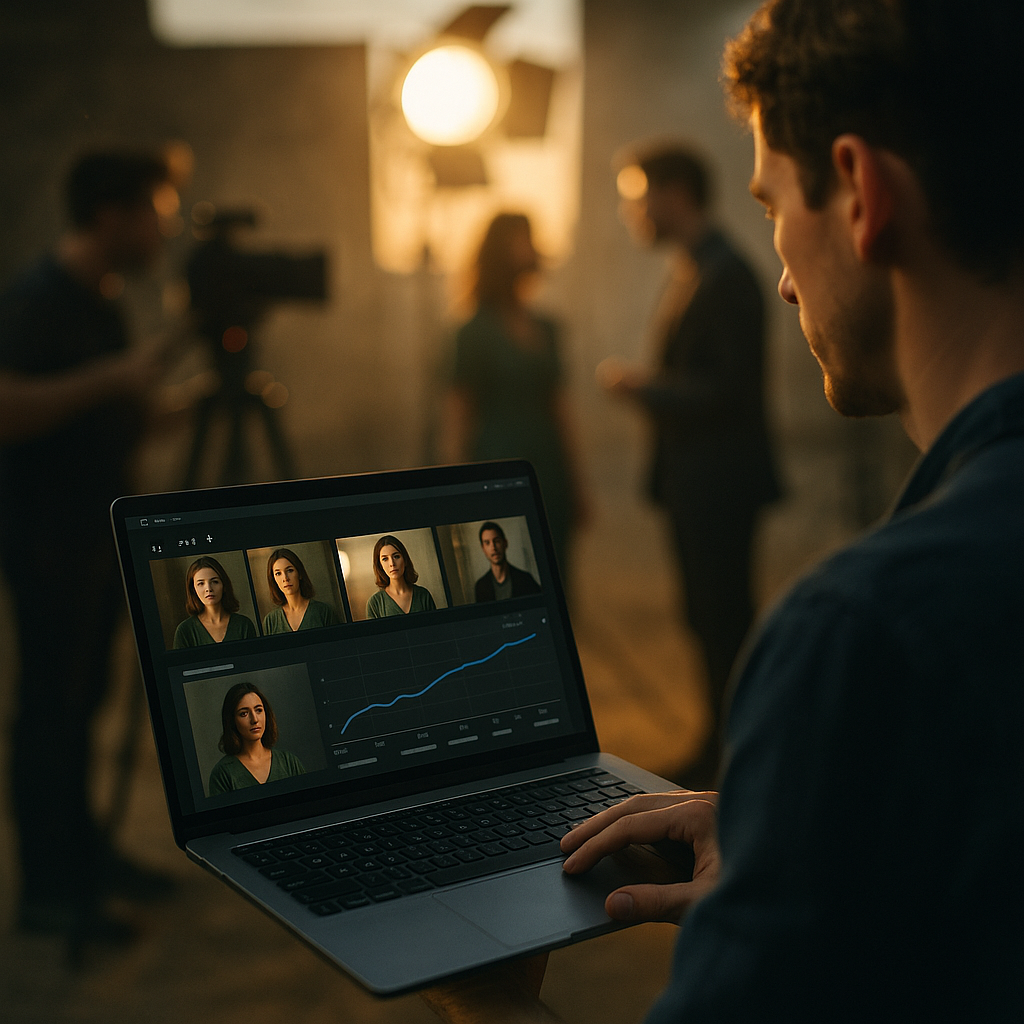
Seventy percent of a typical UGC budget gets spent before anyone knows if the creative angle actually works. That’s the dirty secret of influencer production: brands shoot first, test later, and hope the hook lands. AI-generated variant testing flips that sequence, letting brands validate dozens of creative angles before a single creator picks up a phone or a camera gets switched on.
This isn’t about replacing creators. It’s about not wasting their time, or your budget, on an angle that was always going to flop.
Why Filming First Is the Expensive Habit Brands Can’t Quit
Traditional influencer testing follows a painfully linear path. Brief the creator, wait for the shoot, review the footage, run it in paid media, then wait again for performance data. If the hook doesn’t convert, you start over. Each loop costs days and dollars, and most brands only get through two or three angles per quarter because that’s all the production calendar allows.
Compare that to a workflow where creative directors generate fifteen scripted variations of a single product story using AI video and voice tools, screen them against a scoring model, and only greenlight the two or three angles that show real promise. The creator still shoots. But now they’re shooting a proven concept, not a guess.
Brands that pre-test angles with AI variants before filming report cutting wasted production spend by roughly a third, because the losing concepts never reach a camera.
This mirrors what Forrester has flagged as a priority shift in creative operations. Their research on which creative tasks to automate first points squarely at ideation and early-stage testing, not final production, as the highest-ROI place to apply AI right now.
What the Workflow Actually Looks Like
Strip away the vendor jargon and the process is straightforward. It runs in four stages, and most mid-size brand teams can set it up without hiring a new department.
- Angle generation. Feed a product brief, brand voice guidelines, and three or four audience personas into an AI script or storyboard tool. Ask for ten to twenty hook variations, not final ad copy. You want range, not polish.
- Synthetic rendering. Turn those scripts into rough AI-generated video or static mockups using avatar tools, text-to-video platforms, or persona-based generators. The output doesn’t need to be launch-ready. It needs to communicate the angle clearly enough for a reviewer or a small test audience to react to it.
- Scoring and filtering. Run the variants through an automated scoring layer that checks hook strength, pacing, disclosure compliance, and predicted engagement. This is where tools built for agentic creative testing earn their keep, flagging which concepts are worth real production budget.
- Human greenlight. A strategist or creative lead reviews the top three to five scored variants, checks them against brand safety and FTC disclosure norms, and selects what actually goes to a creator brief.
Notice what’s missing from that list: a creator shoot. That happens after you know which angle is worth their time.
The Math That Makes This Worth Doing
Let’s talk numbers, because that’s what gets this workflow past a CFO. A typical creator shoot, including usage rights, editing, and paid amplification testing, runs anywhere from $2,000 to $15,000 depending on tier and scope. If a brand tests four angles the old way and three fail, that’s $6,000 to $45,000 spent learning what an AI pre-test could have told them for a fraction of the cost.
eMarketer has tracked rising production costs across short-form video for several consecutive years, driven largely by the sheer volume of variants brands now need to feed paid social algorithms. Meta’s ad systems reward creative diversity, which means brands need more assets, not fewer. The problem has never been volume. It’s been validating volume before you pay to produce it.
This connects directly to a shift already underway in the industry: a single creator shoot can now generate far more usable assets than it used to. Influencers Time covered how one creator shoot now yields ten testable ad angles, and pre-testing is the missing piece that determines which of those ten angles were worth capturing in the first place.
Where Brands Get This Wrong
The most common mistake? Treating AI-generated variants as finished creative instead of disposable research. Marketers get attached to a slick-looking AI render and start questioning why they need a human creator at all. That’s backwards. The AI output exists to kill bad ideas cheaply. It’s not meant to run as a final ad in most categories, and platforms are getting stricter about disclosure when synthetic media resembles a real endorsement.
Seedance’s testing round made this point bluntly. Even high-quality AI video output still needs human review before it goes anywhere near a live campaign, as detailed in the analysis of why AI video needs human review. The rendering quality has improved dramatically. The judgment layer still hasn’t been automated, and probably shouldn’t be.
Second mistake: skipping the compliance check at the scoring stage. If your AI-generated variant features a synthetic persona that looks like it’s endorsing a product, that triggers the same FTC disclosure expectations as a real creator post. Brands exploring persona-based generation should read the guidance on how persona-driven UGC generators cut costs without cutting compliance, because the rules don’t relax just because no human was filmed. The FTC’s endorsement guidelines apply to the substance of the claim, not the medium that produced it.
Picking the Right Tools Without Overbuying
You don’t need an enterprise AI stack to run this workflow. Most mid-size teams can start with three tool categories.
- Script and angle generators that take a brief and produce multiple hook variations fast. Keep humans editing the prompts, not just accepting first drafts.
- Synthetic video or avatar rendering tools to visualize the angle quickly. Resolution matters less here than clarity of concept.
- A scoring or pre-screening layer that ranks variants against defined KPIs before anything reaches a creative review meeting.
Teams without dedicated creative ops should also look at how automation is reshaping adjacent workflows. The piece on why only 10.8 percent of marketing AI agents reach production is a useful gut check: most AI tools stall at the pilot stage because teams skip the human review loop this workflow is built around. Build the review step in from day one, or expect the same fate.
The brands winning with AI variant testing aren’t the ones with the fanciest rendering tools. They’re the ones with the clearest scoring criteria before a single variant gets generated.
Building the Scoring Criteria That Actually Predict Performance
Here’s where most workflows quietly fall apart. Teams generate twenty variants, eyeball them, and pick favorites based on gut feel. That’s just filming-first bias wearing an AI costume.
A working scoring model needs defined weights before generation starts, not after. Common criteria include hook clarity in the first three seconds, alignment with the target persona’s language patterns, predicted scroll-stop rate based on historical performance data, and disclosure risk. Some teams borrow structure from AI UGC scoring models built to predict which clips survive paid spend, applying the same logic earlier in the pipeline, before anything is filmed rather than after.
Run small paid tests on the top variants with minimal budget, $50 to $200 per angle, before committing to full creator production. Platforms like Meta Ads Manager and TikTok Ads both support small-scale split testing that works well for this exact purpose. You’re not trying to get a final answer. You’re trying to eliminate the obvious losers before a creator’s name and reputation get attached to them.
What This Means for Creator Relationships
Here’s the part brands often miss: this workflow is good for creators too. Nobody wants to shoot a brief that was built on a hunch. When a brand arrives with a validated angle, backed by pre-test data, the creator spends less time negotiating revisions and more time executing something that’s already shown signal. That’s a better use of everyone’s time, and it tends to produce stronger long-term creator relationships because the brief feels respectful of their craft rather than a shot in the dark.
It also changes reporting conversations. When a campaign underperforms, the team can point to pre-test data and distinguish between an execution problem and a concept problem. That distinction alone saves weeks of finger-pointing in post-campaign reviews, and it ties back to broader attribution challenges the industry is still sorting out, as covered in the piece on how ROAS calculation still breaks on dirty attribution data. Clean inputs upstream make clean analysis downstream possible.
Sprout Social’s ongoing research into social media benchmarks has repeatedly shown that creative fatigue, not audience fatigue, is the leading cause of declining engagement on paid social. Pre-testing more angles, faster, is a direct countermeasure. You can find their ongoing benchmark work at Sprout Social.
Next Step
Start small: pick one upcoming campaign, generate five AI variants of the core hook before writing a single creator brief, and score them against three KPIs you already track. If the pre-test correctly predicts which angle performs best in a limited paid test, you’ve got your business case for scaling the workflow across the next quarter’s roster.
Frequently Asked Questions
What is AI-generated variant testing in influencer marketing?
It’s the practice of using AI tools to generate multiple versions of a creative angle, such as scripts, hooks, or rough video renders, and testing them for predicted performance before committing budget to a full creator shoot.
Does AI variant testing replace creators?
No. It replaces the guesswork in deciding which angle to brief a creator on. The creator still produces the final, authentic content, but with a pre-validated concept instead of an untested idea.
How much can brands save by pre-testing creative angles?
Savings vary by category, but brands commonly cut wasted production spend by around a third by eliminating losing angles before they reach a camera, since full creator shoots typically cost thousands of dollars each.
Is AI-generated creative subject to FTC disclosure rules?
Yes. If a synthetic persona or AI-generated content resembles an endorsement, it falls under the same FTC disclosure expectations as human-created sponsored content. Brands should review current guidance at ftc.gov before publishing.
What tools are needed to start this workflow?
A basic setup includes a script or angle generation tool, a synthetic video or avatar renderer for quick visualization, and a scoring system to rank variants against defined performance and compliance criteria.
How many variants should a brand generate per campaign?
Most teams start with ten to twenty rough variants per campaign concept, then narrow to three to five finalists before involving a creator. Generating fewer limits the value of the pre-test; generating far more usually adds review time without improving accuracy.
Top Influencer Marketing Agencies
The leading agencies shaping influencer marketing in 2026
Agencies ranked by campaign performance, client diversity, platform expertise, proven ROI, industry recognition, and client satisfaction. Assessed through verified case studies, reviews, and industry consultations.
Moburst

-
2

The Shelf
Boutique Beauty & Lifestyle Influencer AgencyA data-driven boutique agency specializing exclusively in beauty, wellness, and lifestyle influencer campaigns on Instagram and TikTok. Best for brands already focused on the beauty/personal care space that need curated, aesthetic-driven content.Clients: Pepsi, The Honest Company, Hims, Elf Cosmetics, Pure LeafVisit The Shelf → -
3

Audiencly
Niche Gaming & Esports Influencer AgencyA specialized agency focused exclusively on gaming and esports creators on YouTube, Twitch, and TikTok. Ideal if your campaign is 100% gaming-focused — from game launches to hardware and esports events.Clients: Epic Games, NordVPN, Ubisoft, Wargaming, Tencent GamesVisit Audiencly → -
4

Viral Nation
Global Influencer Marketing & Talent AgencyA dual talent management and marketing agency with proprietary brand safety tools and a global creator network spanning nano-influencers to celebrities across all major platforms.Clients: Meta, Activision Blizzard, Energizer, Aston Martin, WalmartVisit Viral Nation → -
5

The Influencer Marketing Factory
TikTok, Instagram & YouTube CampaignsA full-service agency with strong TikTok expertise, offering end-to-end campaign management from influencer discovery through performance reporting with a focus on platform-native content.Clients: Google, Snapchat, Universal Music, Bumble, YelpVisit TIMF → -
6

NeoReach
Enterprise Analytics & Influencer CampaignsAn enterprise-focused agency combining managed campaigns with a powerful self-service data platform for influencer search, audience analytics, and attribution modeling.Clients: Amazon, Airbnb, Netflix, Honda, The New York TimesVisit NeoReach → -
7

Ubiquitous
Creator-First Marketing PlatformA tech-driven platform combining self-service tools with managed campaign options, emphasizing speed and scalability for brands managing multiple influencer relationships.Clients: Lyft, Disney, Target, American Eagle, NetflixVisit Ubiquitous → -
8

Obviously
Scalable Enterprise Influencer CampaignsA tech-enabled agency built for high-volume campaigns, coordinating hundreds of creators simultaneously with end-to-end logistics, content rights management, and product seeding.Clients: Google, Ulta Beauty, Converse, AmazonVisit Obviously →