


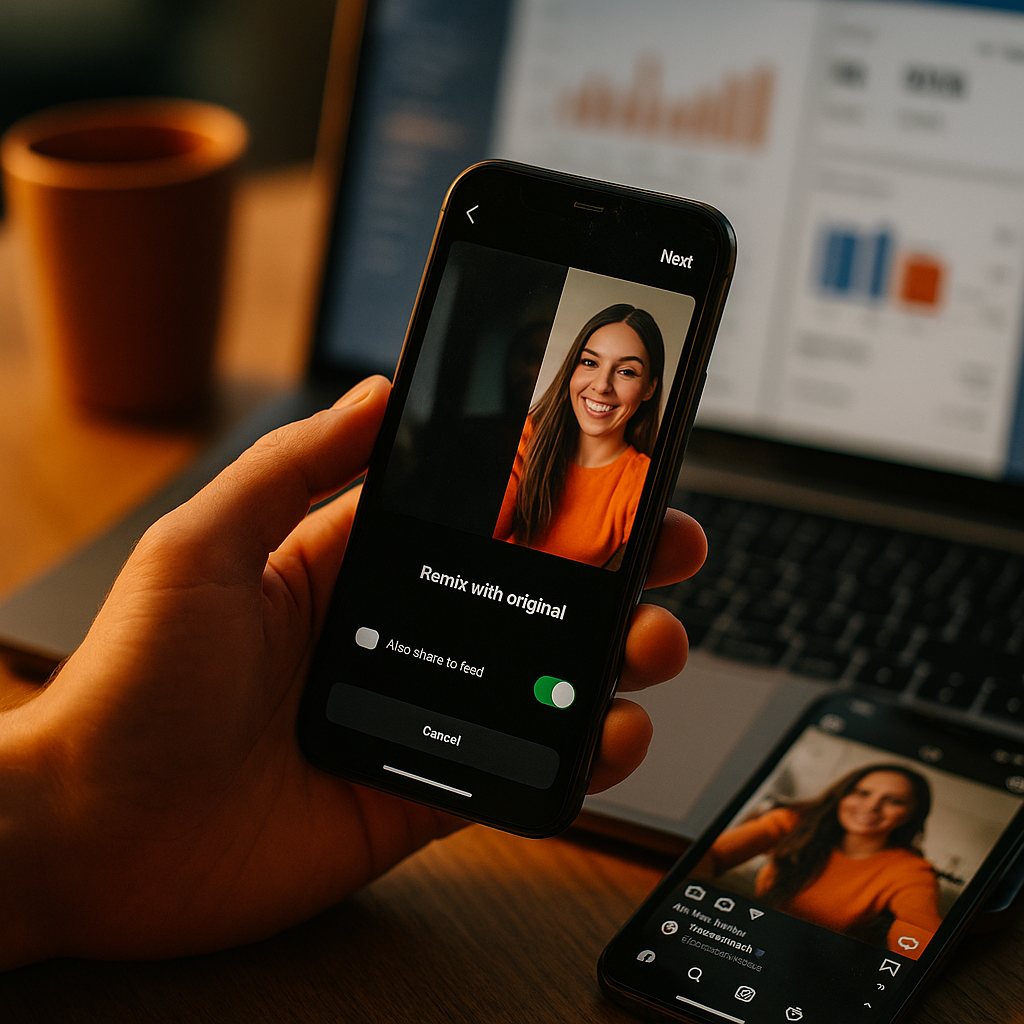
Meta quietly rolled out expanded Remix permissions for business accounts, and most brands haven’t noticed. That’s a problem, because Instagram Reels Remix is turning into one of the cheapest amplification levers in the platform’s toolkit. A single well-placed duet can outperform a paid creator brief at a fraction of the cost. The question isn’t whether Remix works. It’s whether your brand has a process to catch it when it does.
What Remix Actually Does for Brand Content
Remix lets any user record a side-by-side or reaction-style video next to an existing Reel. For brands, that means your product demo, your founder story, or your customer testimonial can become raw material for hundreds of creators without you lifting a finger. The original post stays intact. The Remix layers new commentary, reactions, or context on top.
This isn’t new technology. Duets have existed on TikTok for years, and Instagram’s version has been live since 2020. What’s changed is the business layer around it. Meta now surfaces Remix analytics inside Creator Studio and Business Suite, giving brands visibility into which Remixes are driving engagement, something that was previously invisible unless you manually tracked tagged content.
Why Organic Duets Are an Underused Growth Channel
Here’s the uncomfortable truth: most brand social teams treat Remix as a vanity metric. They see the count go up, feel good, move on. That’s leaving money on the table.
Organic Remixes carry a trust signal that paid creator content often lacks. A viewer sees a real person reacting to your product in real time, unscripted, unpaid. Sprout Social’s research on social proof consistently shows that user-generated reactions outperform branded content on engagement rate, sometimes by double digits. Remix is essentially a built-in UGC engine that costs nothing to activate.
A Remix with organic traction already has validated creative. You’re not guessing what resonates, you’re amplifying proof that it already does.
Compare that to the traditional influencer workflow: brief a creator, wait for drafts, approve revisions, negotiate usage rights, then decide whether to boost. Remix skips most of that. The content already exists. The engagement data already exists. Your only job is deciding whether to put money behind it.
h2
The Paid Amplification Play
This is where most brands stop short. They let Remixes happen organically, then never convert the good ones into paid media. That’s a missed opportunity, especially given how Meta’s ad auction rewards content with early organic momentum.
Here’s the workflow that’s working for mid-market and enterprise brands running this in 2026:
- Monitor Remix volume weekly. Set a threshold (say, 15+ Remixes in 48 hours) that triggers a manual review.
- Secure usage rights fast. Reach out to top-performing Remix creators within 24 hours. Most will grant usage rights for a small flat fee or product credit, especially nano and micro creators who want the exposure.
- Run it through Partnership Ads. Once rights are secured, the Remix can be boosted as paid media attributed to the creator’s handle, preserving the authenticity signal while adding your media budget behind it.
- Test against your standard creator briefs. Run the amplified Remix in the same ad set as a traditionally briefed creator post and compare cost per result.
Brands already running partnership ads setup have the infrastructure in place for this. The permissions workflow is nearly identical, you’re just sourcing the creative from an unsolicited Remix instead of a commissioned post.
What This Costs vs. Traditional Influencer Seeding
Traditional seeding campaigns run anywhere from $500 to $5,000 per creator depending on tier, before any paid boost. Remix amplification flips that math. You’re paying a usage fee (often $50 to $300 for nano and micro creators) plus media spend, and you’re only paying for content that’s already proven itself organically. There’s no guesswork about whether the creative will land, because it already has.
That doesn’t mean Remix replaces seeding entirely. It’s a complement. Seeding generates the volume of organic Remixes in the first place. You still need product in creators’ hands, or at minimum a compelling piece of source content worth duetting. Think of Remix amplification as the second stage of a funnel that starts with nano creator seeding and ends with paid media.
Compliance Isn’t Optional Here
Brands get excited about free UGC and forget the legal groundwork. Running a Remix as paid media without explicit, documented permission from the original creator is a fast way to end up in a dispute, and the FTC has made clear it’s watching disclosure practices closely across all forms of paid creator content, remixed or not.
Build a simple rights-clearance template: creator name, handle, date of agreement, scope of use (organic only vs. paid amplification), duration, and compensation. Keep it in a shared drive your legal and media teams can both access. This isn’t bureaucracy for its own sake. It’s the difference between a campaign you can defend and one you can’t.
Review Meta’s own Meta Business Tools documentation on content usage rights before you scale this past a handful of creators. The platform’s rules around branded content tagging and paid partnership labels apply to Remixed content the same way they apply to original posts.
If you’re already running a compliance checklist for other Instagram features, this slots in naturally. Teams following the Instagram payout and compliance checklist should add a Remix-specific line item covering usage rights documentation.
How to Build Remix Monitoring Into Your Existing Workflow
You don’t need new headcount for this. Most social teams already have someone checking engagement dashboards daily. Add Remix tracking to that routine.
- Tag your top 10 to 15 Reels per month as “Remix candidates” based on early engagement velocity.
- Check Remix counts on those posts every 48 to 72 hours using Instagram’s native insights.
- Flag anything with disproportionate engagement relative to the original post’s reach.
- Route flagged Remixes to whoever owns creator relationships for rights outreach.
- Log the decision (amplify, pass, or revisit) so you’re building a historical record of what Remix content actually converts.
That last step matters more than it sounds. Six months of data on which Remixes you amplified and how they performed becomes the business case for expanding budget here. Without it, you’re relitigating the value of Remix amplification every quarter.
Where This Fits in the Broader Creator Strategy
Remix amplification isn’t a standalone tactic. It works best layered into a broader approach where organic creator activity feeds paid media, and paid media reinforces the creators worth continuing to work with. If you’re already running retargeting between platforms, Remix content can slot into that funnel too. Brands using cross-platform Reels retargeting are finding that Remix-sourced creative, because it already carries proven engagement, performs well as retargeting assets for users who saw the original TikTok version.
It’s also worth watching how this interacts with Meta’s broader AI-driven content tools. As Instagram’s Edits app matures, expect creators to produce Remix-ready content more deliberately, structuring their original Reels specifically to invite duets. Smart brands will start briefing for “remixability” the same way they brief for hook strength or caption copy.
Keep an eye on eMarketer’s ongoing coverage of short-form video ad spend, which has consistently shown UGC-adjacent formats outperforming polished branded content on cost efficiency. Remix sits squarely in that category, and the data trend isn’t reversing anytime soon.
Frequently Asked Questions
What is Instagram Reels Remix and how does it differ from Duets on TikTok?
Remix is Instagram’s version of the side-by-side or reaction video format popularized by TikTok’s Duet feature. Functionally they’re nearly identical: a creator records new content alongside an existing video. The main difference is platform-specific analytics and ad integration, which Meta has been expanding for business accounts.
Can brands require usage rights before amplifying a Remix as paid media?
Yes. Before boosting any Remixed content as paid media, brands need explicit written permission from the creator covering scope, duration, and compensation. Running paid amplification without documented rights creates legal exposure and violates most platform policies.
How much does it typically cost to secure Remix usage rights?
Costs vary by creator tier, but nano and micro creators often grant usage rights for $50 to $300 or product value, significantly less than a traditional sponsored post brief, since the content already exists and has proven engagement.
Does Remix amplification work better than traditional influencer seeding?
It’s not a replacement, it’s a complement. Seeding generates the organic Remix activity in the first place. Amplification is the second stage, where brands identify which organic Remixes performed well and put paid media behind the proven winners.
What tools does Instagram offer to track Remix performance?
Meta’s Business Suite and Creator Studio surface Remix counts and engagement data alongside standard Reels insights, allowing brands to monitor which original posts are generating the most Remix activity without manual tracking.
Next step: Audit your last 90 days of Reels for Remix volume, pick the top three performers, and run a rights-clearance outreach this week. That’s the fastest way to test paid amplification without committing a dedicated budget line yet.
Frequently Asked Questions
What is Instagram Reels Remix and how does it differ from Duets on TikTok?
Remix is Instagram’s version of the side-by-side or reaction video format popularized by TikTok’s Duet feature. Functionally they’re nearly identical: a creator records new content alongside an existing video. The main difference is platform-specific analytics and ad integration, which Meta has been expanding for business accounts.
Can brands require usage rights before amplifying a Remix as paid media?
Yes. Before boosting any Remixed content as paid media, brands need explicit written permission from the creator covering scope, duration, and compensation. Running paid amplification without documented rights creates legal exposure and violates most platform policies.
How much does it typically cost to secure Remix usage rights?
Costs vary by creator tier, but nano and micro creators often grant usage rights for $50 to $300 or product value, significantly less than a traditional sponsored post brief, since the content already exists and has proven engagement.
Does Remix amplification work better than traditional influencer seeding?
It’s not a replacement, it’s a complement. Seeding generates the organic Remix activity in the first place. Amplification is the second stage, where brands identify which organic Remixes performed well and put paid media behind the proven winners.
What tools does Instagram offer to track Remix performance?
Meta’s Business Suite and Creator Studio surface Remix counts and engagement data alongside standard Reels insights, allowing brands to monitor which original posts are generating the most Remix activity without manual tracking.
Top Influencer Marketing Agencies
The leading agencies shaping influencer marketing in 2026
Agencies ranked by campaign performance, client diversity, platform expertise, proven ROI, industry recognition, and client satisfaction. Assessed through verified case studies, reviews, and industry consultations.
Moburst

-
2

The Shelf
Boutique Beauty & Lifestyle Influencer AgencyA data-driven boutique agency specializing exclusively in beauty, wellness, and lifestyle influencer campaigns on Instagram and TikTok. Best for brands already focused on the beauty/personal care space that need curated, aesthetic-driven content.Clients: Pepsi, The Honest Company, Hims, Elf Cosmetics, Pure LeafVisit The Shelf → -
3

Audiencly
Niche Gaming & Esports Influencer AgencyA specialized agency focused exclusively on gaming and esports creators on YouTube, Twitch, and TikTok. Ideal if your campaign is 100% gaming-focused — from game launches to hardware and esports events.Clients: Epic Games, NordVPN, Ubisoft, Wargaming, Tencent GamesVisit Audiencly → -
4

Viral Nation
Global Influencer Marketing & Talent AgencyA dual talent management and marketing agency with proprietary brand safety tools and a global creator network spanning nano-influencers to celebrities across all major platforms.Clients: Meta, Activision Blizzard, Energizer, Aston Martin, WalmartVisit Viral Nation → -
5

The Influencer Marketing Factory
TikTok, Instagram & YouTube CampaignsA full-service agency with strong TikTok expertise, offering end-to-end campaign management from influencer discovery through performance reporting with a focus on platform-native content.Clients: Google, Snapchat, Universal Music, Bumble, YelpVisit TIMF → -
6

NeoReach
Enterprise Analytics & Influencer CampaignsAn enterprise-focused agency combining managed campaigns with a powerful self-service data platform for influencer search, audience analytics, and attribution modeling.Clients: Amazon, Airbnb, Netflix, Honda, The New York TimesVisit NeoReach → -
7

Ubiquitous
Creator-First Marketing PlatformA tech-driven platform combining self-service tools with managed campaign options, emphasizing speed and scalability for brands managing multiple influencer relationships.Clients: Lyft, Disney, Target, American Eagle, NetflixVisit Ubiquitous → -
8

Obviously
Scalable Enterprise Influencer CampaignsA tech-enabled agency built for high-volume campaigns, coordinating hundreds of creators simultaneously with end-to-end logistics, content rights management, and product seeding.Clients: Google, Ulta Beauty, Converse, AmazonVisit Obviously →