


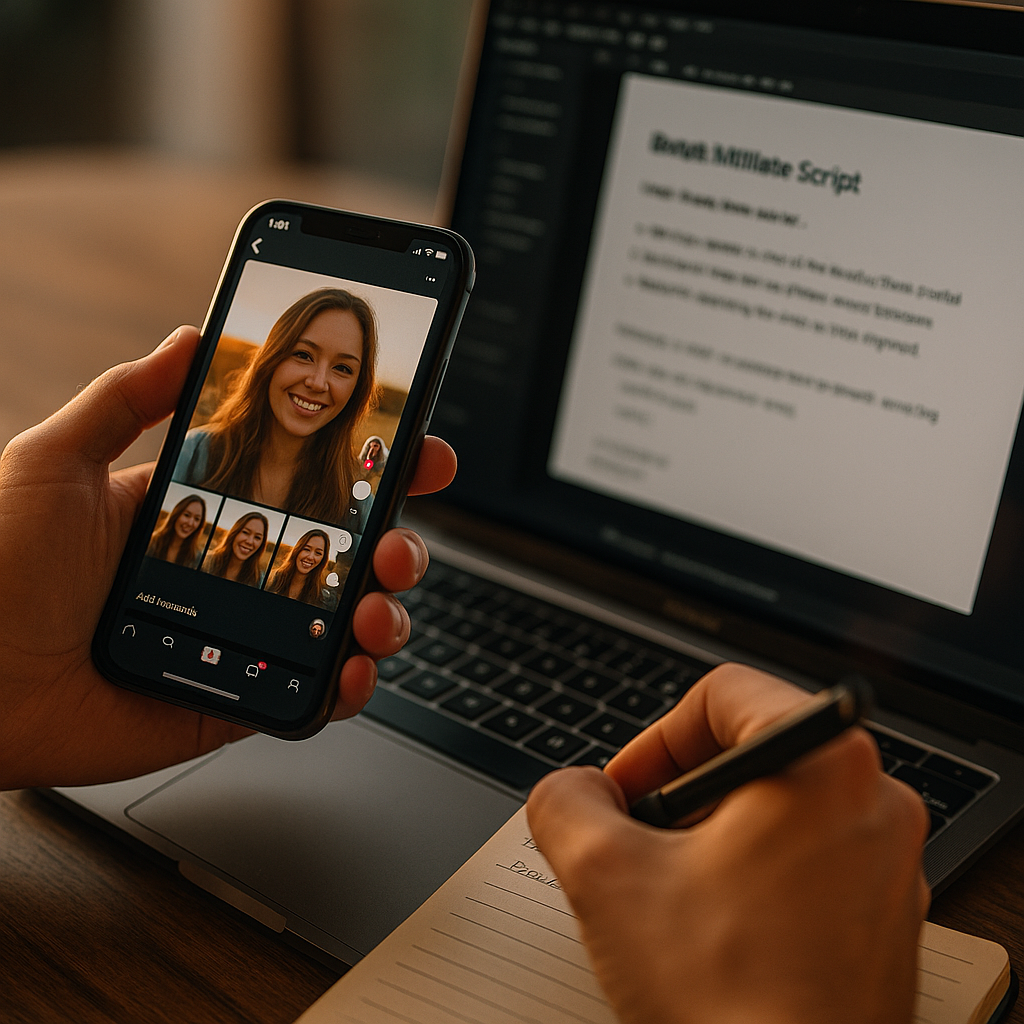
Only a sliver of brand content on TikTok uses photo carousel mode, yet Instagram carousels consistently out-earn single-image posts on engagement. That gap is not a coincidence. It is an open lane for any brand or affiliate creator willing to treat TikTok photo carousel mode as a storytelling tool instead of an afterthought bolted onto a video-first platform.
Most marketing teams still default to video because that is what built TikTok. Fair enough. But the carousel format solves specific problems that video cannot: static product detail, side-by-side comparisons, and scroll-at-your-own-pace browsing that mimics how people actually shop on Amazon or a retailer’s product grid. For affiliate content specifically, that slower pace is a feature, not a limitation.
What Is TikTok Photo Carousel Mode, Actually?
TikTok’s photo mode lets creators upload up to 35 still images into a single swipeable post, paired with a soundtrack and captions, and published to the same feed as video content. It launched years ago as a quiet feature update, got minimal promotion, and has largely stayed under the radar while Reels and video dominated brand strategy conversations.
That obscurity is exactly why it works. The algorithm has not been flooded with carousel spam the way it has with templated video hooks. Novelty still carries weight in the For You feed, and a well-built carousel stands out precisely because audiences see fewer of them.
A format with less competition inside the algorithm often outperforms a saturated one, even with a smaller production budget behind it.
Why Affiliate Marketers Should Care
Affiliate content lives or dies on one thing: can the viewer understand the product well enough to click and buy? Video is great for demonstrating motion, texture, or a process. But for comparison shopping, ingredient lists, pricing breakdowns, or “here’s what’s in the box” content, static images paired with text overlays often communicate faster than a 30-second clip.
Think about how a shopper actually evaluates a product on Amazon. They scroll through images. They read captions. They compare angles. TikTok carousels replicate that exact behavior natively inside the app, which shortens the mental distance between discovery and purchase intent.
There is also a production cost argument that agencies and brand teams cannot ignore. A ten-slide product carousel can be built from existing product photography, no videographer, no editing software, no voiceover talent. For affiliate programs running dozens of SKUs across multiple creators, that efficiency compounds fast. Compare that to the resource load behind something like livestream replay clips, which require editing a full broadcast down to usable moments. Carousels skip that entirely.
The ROI Case: Lower Cost, Longer Shelf Life
Static content ages better than trend-dependent video. A carousel built around a product’s features or a seasonal use case does not rely on a trending sound or format to stay relevant. According to eMarketer, short-form video remains the dominant content type for social commerce, but that dominance also means video feeds move fast and content decays quickly. Carousels, by contrast, can be reused as whitelisted paid ads for months after the organic post has fallen out of the feed.
That durability matters for affiliate programs tracking cost per acquisition over a full quarter, not just a single viral spike.
There is a compliance angle here too, and it is worth taking seriously. The FTC requires clear and conspicuous disclosure regardless of format, and carousels actually make this easier to execute correctly. A static slide dedicated entirely to “#ad” or “paid partnership” disclosure, placed early in the swipe sequence, is harder to miss than a disclosure buried in a video caption or spoken quickly at the start of a clip. Brands that have had to clean up disclosure practices after working through formats like expert reaction videos will recognize the appeal of a format where the disclosure slide simply cannot be scrolled past unseen.
How to Script a Carousel for Affiliate Conversion
Scripting a carousel is not the same as scripting a video, and treating it that way is the most common mistake brands make when they first test the format. Video scripts are built around pacing and retention curves. Carousel scripts are built around sequence logic, because each slide needs to justify the swipe to the next one.
Here is a structure that performs well for affiliate product storytelling:
- Slide 1: A bold claim or question that stops the scroll, paired with the product clearly visible.
- Slide 2: The problem the product solves, stated in plain language.
- Slides 3 to 6: Feature breakdowns, one claim per slide, each with a close-up image.
- Slide 7: Pricing, discount code, or affiliate link callout.
- Slide 8: Social proof, a review snippet or a before/after comparison.
- Final slide: A clear call to action directing the swipe-through viewer to the link in bio or comment.
This is not unlike the comparison logic used in dupe comparison content, where the goal is helping a shopper decide between two options quickly. The difference is that carousels let you slow that decision down across multiple frames instead of compressing it into a single scene.
Captions matter more here than almost any other TikTok format. Because there is no voiceover carrying the narrative, the on-slide text has to do the work that a script would normally handle out loud. Teams that already write faceless UGC scripts will find the caption-writing muscle transfers directly, since both formats depend on text carrying the emotional and persuasive weight of the content.
Where This Format Falls Short
It is not a universal replacement for video, and pretending otherwise would be dishonest. Carousels struggle with anything that requires demonstrated motion: skincare application, a supplement mixing into water, a gadget actually being used. For those cases, video still wins, and formats like satisfying process videos will always outperform a static image sequence.
Carousels also underperform with younger audiences who are conditioned to expect sound and motion the instant they open the app. If your affiliate program skews heavily toward Gen Z impulse purchases, lead with video and treat carousels as a supporting asset rather than the centerpiece.
There is also a measurement gap worth flagging. TikTok’s analytics for photo mode posts are thinner than video analytics, with less granular data on where viewers drop off mid-swipe. Brands running performance audits should budget extra time for manual review rather than relying purely on the dashboard, similar to the kind of scrutiny already applied during retail media ad review processes.
Testing the Format Without Overcommitting Budget
Start small. Pick three or four SKUs with strong static photography already available, rather than commissioning new shoots immediately. Run them as organic posts first, track swipe-through rate and link clicks, then decide whether to push paid spend behind the top performer.
A useful benchmark: if a carousel’s average swipe depth exceeds 60 percent of total slides, that is a strong signal the sequencing is working and the content is worth whitelisting for paid distribution. Sprout Social and similar social analytics platforms can help track this metric alongside TikTok’s native dashboard for a fuller picture.
For brands running affiliate programs across multiple creators, carousels also solve a scalability problem that video cannot. One product photography set can be repackaged into dozens of carousel variants with different captions, different creator voices, and different angles of persuasion, echoing the efficiency logic behind persona driven ad variations built from a single creative brief.
Quick Takeaway
Test TikTok photo carousel mode on your next affiliate drop with product photography you already have, measure swipe-through rate against a 60 percent benchmark, and reserve budget for video only where motion genuinely matters to the sale.
FAQs
Is TikTok photo carousel mode available to all brand accounts?
Yes. Any TikTok account, business or personal, can post in photo mode from the standard upload flow. No special feature access or follower threshold is required.
Can carousels be used for paid whitelisted ads?
Yes. TikTok’s ad platform supports photo mode content as a spark ad format, meaning brands can boost an organic creator carousel directly through TikTok Ads Manager without rebuilding the asset.
Do carousels need music to perform well?
Not strictly, but adding a trending or relevant audio track helps the post surface in sound-based discovery, similar to how audio functions in video content.
How many slides perform best for affiliate product content?
Most high-performing affiliate carousels run between eight and twelve slides. Fewer slides can feel thin on detail, while more than fifteen tends to see steep drop-off before the final call-to-action slide.
Does the FTC treat carousel disclosure differently than video disclosure?
No. The same clear and conspicuous disclosure standard applies regardless of format. What changes is execution: a dedicated disclosure slide is often easier to make unmissable than a spoken or caption-based disclosure in video.
Visible FAQ (HTML)
FAQs
Is TikTok photo carousel mode available to all brand accounts?
Yes. Any TikTok account, business or personal, can post in photo mode from the standard upload flow. No special feature access or follower threshold is required.
Can carousels be used for paid whitelisted ads?
Yes. TikTok’s ad platform supports photo mode content as a spark ad format, meaning brands can boost an organic creator carousel directly through TikTok Ads Manager without rebuilding the asset.
Do carousels need music to perform well?
Not strictly, but adding a trending or relevant audio track helps the post surface in sound-based discovery, similar to how audio functions in video content.
How many slides perform best for affiliate product content?
Most high-performing affiliate carousels run between eight and twelve slides. Fewer slides can feel thin on detail, while more than fifteen tends to see steep drop-off before the final call-to-action slide.
Does the FTC treat carousel disclosure differently than video disclosure?
No. The same clear and conspicuous disclosure standard applies regardless of format. What changes is execution: a dedicated disclosure slide is often easier to make unmissable than a spoken or caption-based disclosure in video.
Top Influencer Marketing Agencies
The leading agencies shaping influencer marketing in 2026
Agencies ranked by campaign performance, client diversity, platform expertise, proven ROI, industry recognition, and client satisfaction. Assessed through verified case studies, reviews, and industry consultations.
Moburst

-
2

The Shelf
Boutique Beauty & Lifestyle Influencer AgencyA data-driven boutique agency specializing exclusively in beauty, wellness, and lifestyle influencer campaigns on Instagram and TikTok. Best for brands already focused on the beauty/personal care space that need curated, aesthetic-driven content.Clients: Pepsi, The Honest Company, Hims, Elf Cosmetics, Pure LeafVisit The Shelf → -
3

Audiencly
Niche Gaming & Esports Influencer AgencyA specialized agency focused exclusively on gaming and esports creators on YouTube, Twitch, and TikTok. Ideal if your campaign is 100% gaming-focused — from game launches to hardware and esports events.Clients: Epic Games, NordVPN, Ubisoft, Wargaming, Tencent GamesVisit Audiencly → -
4

Viral Nation
Global Influencer Marketing & Talent AgencyA dual talent management and marketing agency with proprietary brand safety tools and a global creator network spanning nano-influencers to celebrities across all major platforms.Clients: Meta, Activision Blizzard, Energizer, Aston Martin, WalmartVisit Viral Nation → -
5

The Influencer Marketing Factory
TikTok, Instagram & YouTube CampaignsA full-service agency with strong TikTok expertise, offering end-to-end campaign management from influencer discovery through performance reporting with a focus on platform-native content.Clients: Google, Snapchat, Universal Music, Bumble, YelpVisit TIMF → -
6

NeoReach
Enterprise Analytics & Influencer CampaignsAn enterprise-focused agency combining managed campaigns with a powerful self-service data platform for influencer search, audience analytics, and attribution modeling.Clients: Amazon, Airbnb, Netflix, Honda, The New York TimesVisit NeoReach → -
7

Ubiquitous
Creator-First Marketing PlatformA tech-driven platform combining self-service tools with managed campaign options, emphasizing speed and scalability for brands managing multiple influencer relationships.Clients: Lyft, Disney, Target, American Eagle, NetflixVisit Ubiquitous → -
8

Obviously
Scalable Enterprise Influencer CampaignsA tech-enabled agency built for high-volume campaigns, coordinating hundreds of creators simultaneously with end-to-end logistics, content rights management, and product seeding.Clients: Google, Ulta Beauty, Converse, AmazonVisit Obviously →