


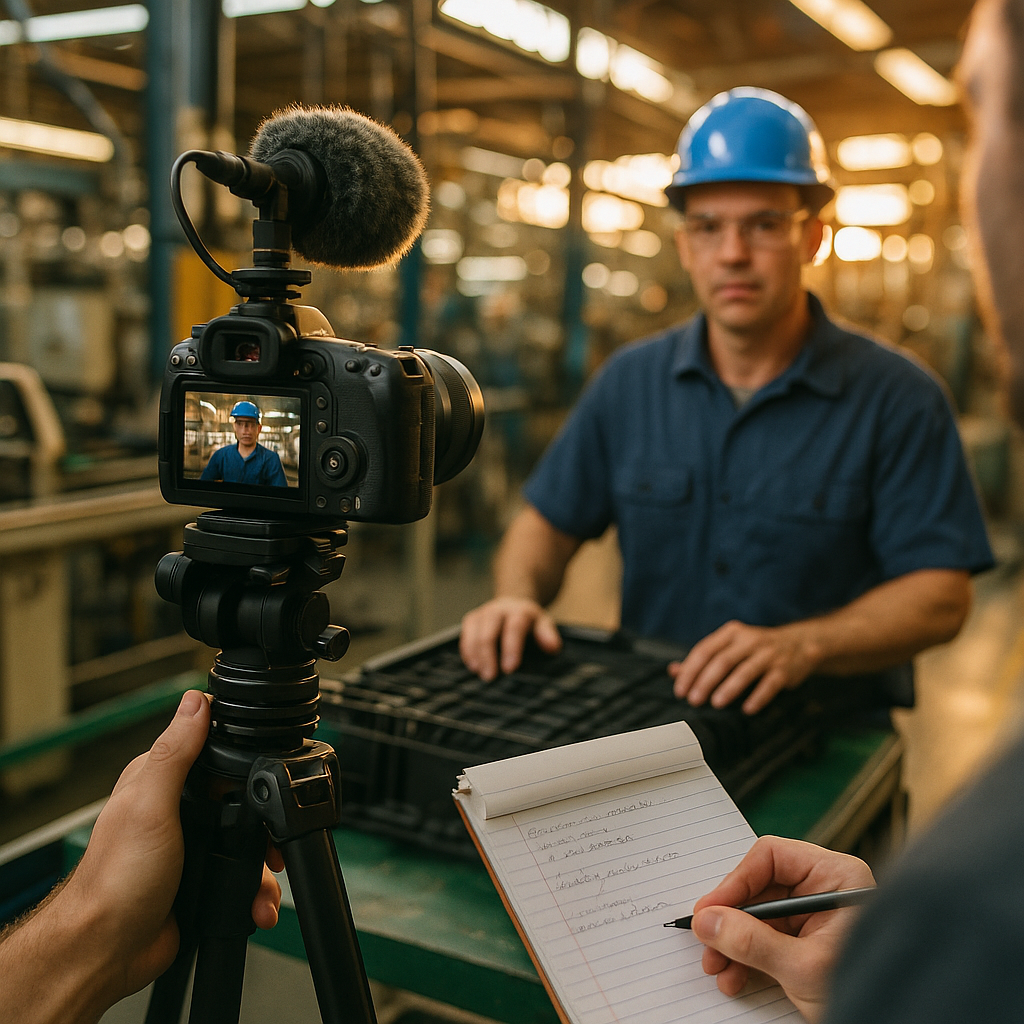
Only 34% of consumers say they trust brands overall, according to Edelman’s trust research, yet factory tour content routinely pulls engagement rates three to four times higher than standard product ads. Why? Because viewers trust what they can see being made more than what they’re told to believe. A factory tour format is not a nice-to-have brand video anymore. It is a conversion asset, and it needs a script, not a wandering camera.
Most brands treat behind the scenes content as an afterthought. Point a phone at the production line, slap on some lo-fi music, post it, done. That approach wastes the single biggest trust lever a manufacturer or DTC brand has: proof. If you’re serious about this format, you need a script structure that turns raw footage into something that actually moves skeptical buyers down the funnel.
Why Factory Tours Convert Better Than Polished Product Shots
Polished product photography answers “what does it look like.” Factory tour content answers “is this real, and can I trust the people who make it.” That second question matters more every year as AI-generated product shots flood feeds and consumers grow numb to anything that looks too perfect. A slightly imperfect, unscripted-feeling factory walkthrough reads as authentic precisely because it doesn’t look like an ad.
This matters most for categories carrying trust friction: supplements, skincare, food, electronics, anything with a “what’s actually in this” question hanging over it. Showing raw material intake, quality checks, and packaging in sequence does more to neutralize skepticism than any claims-based copy ever could.
Brands running factory tour content alongside standard product ads report return rate reductions of 15 to 20% in post-purchase surveys, because buyers arrive with accurate expectations instead of inflated ones set by overly polished marketing.
The Script Structure That Actually Works
“Unscripted” is the goal of the final product. The process behind it should be tightly scripted. Here’s the five-beat structure that consistently outperforms loose, run-and-gun factory footage:
- The hook (0 to 3 seconds): Open mid-action. A machine stamping, liquid pouring, hands sealing a box. No logo intro, no “welcome to our factory” voiceover. Movement first.
- The context drop (3 to 8 seconds): One sentence establishing where you are and why it matters. “This is the only facility that hand-tests every batch before it ships.”
- The process walk (8 to 35 seconds): Sequential steps, not a highlight reel. Raw material, transformation, quality check, packaging. Skipping steps makes viewers suspicious you’re hiding something.
- The human moment (35 to 45 seconds): A worker, a quote, a small imperfection acknowledged on camera. This is the credibility anchor. Perfection reads as staged; humanity reads as real.
- The close (45 to 60 seconds): A specific, provable claim tied to what was just shown. Not “we care about quality,” but “every unit gets a 12-point inspection before it leaves this room.”
Notice what’s missing from that structure: a hard sell. Factory tour content isn’t the place for discount codes or urgency language. It’s the place where you earn the right to sell elsewhere.
Script the Camera Moves, Not Just the Words
A common mistake: writing a voiceover script and leaving the visuals to whoever’s holding the camera that day. The visual sequence carries more trust weight than the narration. Specify shot types in your script document. “Wide shot of production floor, cut to close-up of hands on the line, cut to macro shot of the material being tested.” Editors and on-site talent need this level of direction, or you end up with generic wide shots that feel like a corporate recruitment video instead of proof of process.
This is the same discipline that makes satisfying process videos work: the sequencing itself is the hook, not just the narration layered over it.
Who Should Be On Camera?
Executives rarely make good factory tour hosts. Viewers want the person who actually does the work, not the person who approved the budget. A line worker explaining a quality check in their own words will outperform a polished CEO walkthrough almost every time, because the language is unrehearsed and the expertise is real.
If you’re worried about camera-shy staff, script prompts instead of lines. Give them a question to answer in their own words (“What do you check for before this moves to the next station?”) rather than a scripted sentence to recite. The slight hesitation and natural phrasing is the trust signal. This mirrors the logic behind expert reaction videos, where credibility comes from genuine, unscripted-sounding commentary rather than brand-approved talking points.
Compliance: What You Can and Can’t Claim on Camera
Factory tours feel safer than testimonial content because there’s no “I lost 20 pounds” claim floating around. But they carry their own compliance risk. Showing a quality check implies a standard. If you show a worker inspecting for defects and say “every single unit,” you’d better be able to back that up if the FTC ever asks.
Three rules keep factory tour scripts compliant:
- Never show a process step you don’t actually perform on every unit. If the 12-point inspection happens on 90% of batches, don’t claim 100%.
- Avoid implied superiority claims (“the cleanest facility in the industry”) unless you have third-party verification to cite.
- If workers mention health, safety, or efficacy benefits unscripted, review that footage with the same scrutiny you’d apply to a paid testimonial.
This is the same discipline covered in myth busting video scripts and proof-based video formats: specificity protects you, vague superlatives expose you.
Where This Format Fits in the Funnel
Factory tour content is a mid-funnel trust accelerant, not a top-of-funnel hook or a bottom-of-funnel closer. It works best retargeted to users who’ve already engaged with a product ad but haven’t converted. Someone who watched a 15-second product demo and then sees a 60-second factory walkthrough gets the “okay, this is a real company” confirmation they were missing.
Pair it with format diversity rather than running it standalone. A speed run demo video for the hook, a factory tour for the trust build, and a expert reaction pairing for the final push covers three distinct psychological triggers without repeating the same creative angle three times.
Repurposing: One Shoot, Multiple Formats
A single day on the production floor, shot with a script that anticipates edits, can generate a 60-second hero cut, three to five 15-second cutdowns for paid social, a photo carousel for static placements, and raw b-roll for future ads. This is the efficient play. Don’t treat factory tour shoots as single-use content when the raw footage library value compounds over months, the same logic behind building short form video libraries that feed both organic and paid channels.
Budget for editing time, not just shoot time. The script should flag which segments are “modular,” meaning they can stand alone as a 10-second clip, versus “sequential,” meaning they only work in the full walkthrough. This saves your editor from guessing and your media buyer from waiting.
Measuring What Actually Matters
Standard video metrics undersell factory tour performance. Watch time and completion rate matter more than click-through rate here, because the content’s job is trust-building, not immediate conversion. Track assisted conversions: did users who watched the factory tour convert at a higher rate on a later touchpoint, even if they didn’t click through directly? Platforms like Meta Ads Manager and TikTok Ads Manager both support view-through attribution windows that make this visible, but you have to set it up deliberately rather than relying on default last-click reporting.
Sprout Social’s engagement benchmarking through Sprout Social and category data from eMarketer both point to the same trend: trust-building formats underperform on immediate CTR but overperform on downstream conversion and reduced return rates. Judge the format by the right metric or you’ll kill a high-performing asset for the wrong reason.
Next Step
Pick one production stage this quarter, script the five-beat structure above, and shoot it with a worker (not an executive) narrating in their own words. Run it as a retargeting asset against warm traffic for 30 days and compare conversion rate against your current mid-funnel creative before scaling the format further.
Frequently Asked Questions
How long should a factory tour video be for paid social?
Sixty seconds works best as a hero asset for retargeting, but cut it down to 15 and 30 second versions for cold traffic placements where attention spans are shorter. The full version should still exist on owned channels like YouTube or your website for users who want deeper proof.
Do we need professional actors or can we use real employees?
Real employees almost always outperform actors for this format. The entire value of factory tour content is authenticity, and professional delivery works against that goal. Use prompts instead of scripted lines so employees speak naturally.
What’s the biggest compliance risk with factory tour content?
Implied claims about consistency and quality standards that aren’t actually true for every unit produced. If you show one inspection step, make sure it reflects your actual standard process, not a best-case scenario staged for the camera.
How often should we refresh factory tour content?
Every six to twelve months, or sooner if you change suppliers, facilities, or production processes. Stale behind the scenes content that no longer reflects reality is a bigger risk than not having any at all.
Can this format work for brands that don’t manufacture their own products?
Yes, with adjustment. Brands using third-party manufacturers can film the fulfillment, quality check, or packaging process instead, or partner with the manufacturer directly for access. The trust mechanism is the same: showing real process beats describing it.
FAQs
How long should a factory tour video be for paid social?
Sixty seconds works best as a hero asset for retargeting, but cut it down to 15 and 30 second versions for cold traffic placements where attention spans are shorter. The full version should still exist on owned channels like YouTube or your website for users who want deeper proof.
Do we need professional actors or can we use real employees?
Real employees almost always outperform actors for this format. The entire value of factory tour content is authenticity, and professional delivery works against that goal. Use prompts instead of scripted lines so employees speak naturally.
What’s the biggest compliance risk with factory tour content?
Implied claims about consistency and quality standards that aren’t actually true for every unit produced. If you show one inspection step, make sure it reflects your actual standard process, not a best-case scenario staged for the camera.
How often should we refresh factory tour content?
Every six to twelve months, or sooner if you change suppliers, facilities, or production processes. Stale behind the scenes content that no longer reflects reality is a bigger risk than not having any at all.
Can this format work for brands that don’t manufacture their own products?
Yes, with adjustment. Brands using third-party manufacturers can film the fulfillment, quality check, or packaging process instead, or partner with the manufacturer directly for access. The trust mechanism is the same: showing real process beats describing it.
Top Influencer Marketing Agencies
The leading agencies shaping influencer marketing in 2026
Agencies ranked by campaign performance, client diversity, platform expertise, proven ROI, industry recognition, and client satisfaction. Assessed through verified case studies, reviews, and industry consultations.
Moburst

-
2

The Shelf
Boutique Beauty & Lifestyle Influencer AgencyA data-driven boutique agency specializing exclusively in beauty, wellness, and lifestyle influencer campaigns on Instagram and TikTok. Best for brands already focused on the beauty/personal care space that need curated, aesthetic-driven content.Clients: Pepsi, The Honest Company, Hims, Elf Cosmetics, Pure LeafVisit The Shelf → -
3

Audiencly
Niche Gaming & Esports Influencer AgencyA specialized agency focused exclusively on gaming and esports creators on YouTube, Twitch, and TikTok. Ideal if your campaign is 100% gaming-focused — from game launches to hardware and esports events.Clients: Epic Games, NordVPN, Ubisoft, Wargaming, Tencent GamesVisit Audiencly → -
4

Viral Nation
Global Influencer Marketing & Talent AgencyA dual talent management and marketing agency with proprietary brand safety tools and a global creator network spanning nano-influencers to celebrities across all major platforms.Clients: Meta, Activision Blizzard, Energizer, Aston Martin, WalmartVisit Viral Nation → -
5

The Influencer Marketing Factory
TikTok, Instagram & YouTube CampaignsA full-service agency with strong TikTok expertise, offering end-to-end campaign management from influencer discovery through performance reporting with a focus on platform-native content.Clients: Google, Snapchat, Universal Music, Bumble, YelpVisit TIMF → -
6

NeoReach
Enterprise Analytics & Influencer CampaignsAn enterprise-focused agency combining managed campaigns with a powerful self-service data platform for influencer search, audience analytics, and attribution modeling.Clients: Amazon, Airbnb, Netflix, Honda, The New York TimesVisit NeoReach → -
7

Ubiquitous
Creator-First Marketing PlatformA tech-driven platform combining self-service tools with managed campaign options, emphasizing speed and scalability for brands managing multiple influencer relationships.Clients: Lyft, Disney, Target, American Eagle, NetflixVisit Ubiquitous → -
8

Obviously
Scalable Enterprise Influencer CampaignsA tech-enabled agency built for high-volume campaigns, coordinating hundreds of creators simultaneously with end-to-end logistics, content rights management, and product seeding.Clients: Google, Ulta Beauty, Converse, AmazonVisit Obviously →