


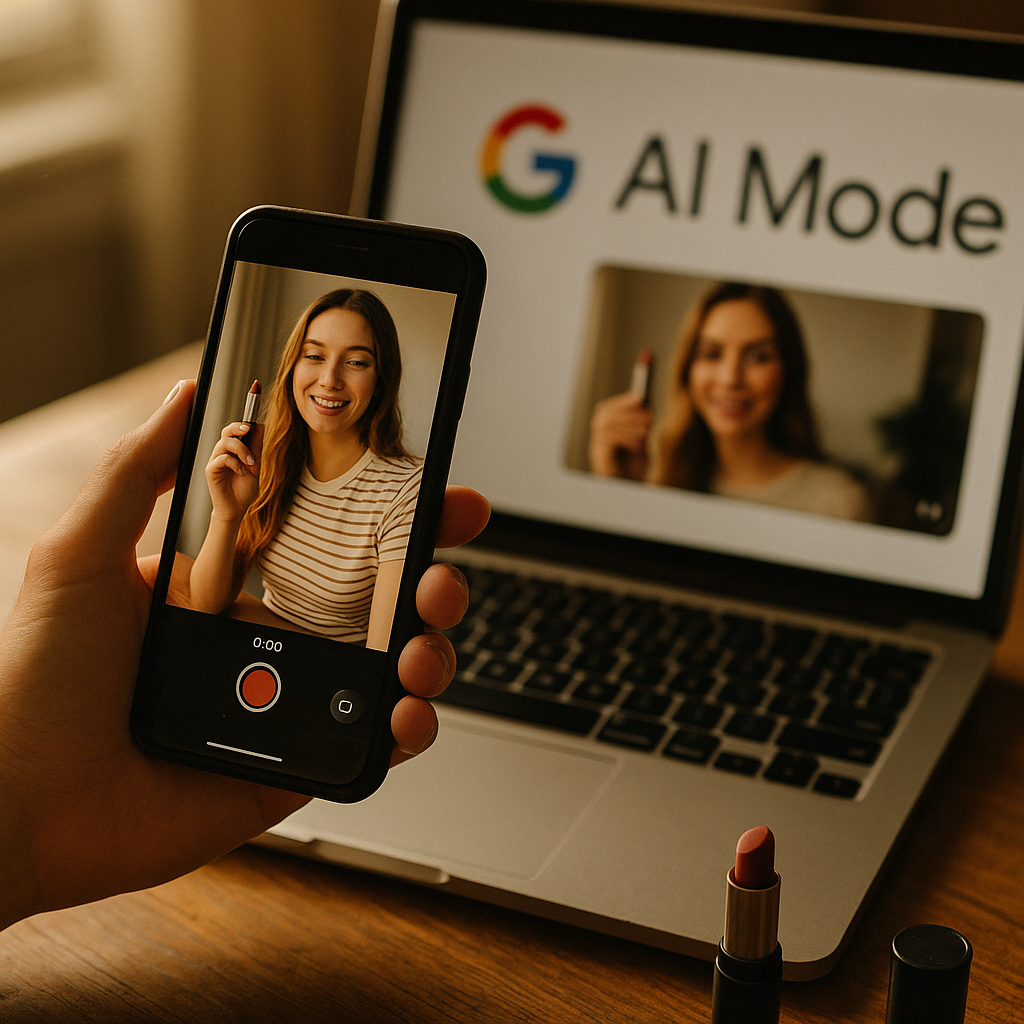
Most Creator Content Will Never Surface in Google’s AI Mode. Here’s Why.
Google’s AI Mode, powered by Gemini, is already reshaping how branded content gets discovered — and early data from eMarketer suggests that AI-generated search responses are now influencing purchase decisions at a rate that traditional search ads simply cannot match. Brand teams still briefing creators the same way they did three years ago are building for a format that is rapidly losing relevance. Designing creator content for Google AI Mode ad formats is no longer optional infrastructure — it is your next competitive moat.
What AI Mode Ad Placements Actually Are (And Why They’re Different)
Google’s AI Mode does not serve standard text or display ads the way Search and Display campaigns do. When a user asks a conversational query — “What’s the best collagen supplement for women over 40 who run marathons?” — Gemini synthesizes a response that can include sponsored creator assets, product carousels, and cited content pulled from across the web. The ad placement lives inside the answer, not beside it.
This is a structural shift. Traditional paid search captures intent at the keyword level. AI Mode captures intent at the meaning level. That distinction completely changes what creator content needs to do and how it needs to be built.
For brand teams, the implication is immediate: creator assets that are optimized only for social feed performance will not be picked up by Gemini’s retrieval layer. The AI is looking for something different. Specifically, it favors content that is structured, citable, and aligned with the conversational query patterns that real users are typing into AI Mode search.
Creator content briefed purely for engagement metrics — views, saves, shares — is structurally invisible to Gemini’s retrieval logic. Brand teams that re-architect their briefs for query alignment will hold a first-mover advantage as the format scales through the year.
How Gemini Retrieves and Scores Creator Content
Understanding retrieval is the foundation of winning placement. Gemini does not crawl social posts in real time. It draws on indexed web content, YouTube videos with transcripts, publisher articles, and increasingly, sponsored content distributed through Google’s advertising infrastructure. This means your creator assets need to exist in formats that Gemini can actually read and evaluate.
Three signals appear to drive placement priority based on current testing patterns:
- Query-to-content semantic match: Does the creator’s language mirror how users phrase conversational questions? A creator saying “this serum helped my dry skin” is weaker than “if you’re dealing with dry skin in winter, here’s what actually worked for me after trying six products.”
- Structured specificity: Gemini rewards content with verifiable claims, specific use cases, and named comparisons. Vague endorsements get filtered out.
- Source authority signals: Content published on indexed creator sites, long-form YouTube videos with closed captions, or sponsored articles placed on authoritative domains carries more retrieval weight than ephemeral Stories or TikTok clips alone.
This does not mean social-native content is worthless. It means social-native content needs a companion asset strategy that feeds Gemini’s retrieval layer directly. Think of it as two layers: the feed layer (for awareness and engagement) and the retrieval layer (for AI Mode placement).
Structuring Creator Briefs for AI Mode Compatibility
The brief is where most brand teams are leaving money on the table. Standard influencer briefs focus on deliverable format, brand talking points, and hashtag requirements. AI Mode-compatible briefs need four additional elements.
1. Query-mapped messaging. Work with your SEO team to pull the actual conversational queries users are entering into AI Mode for your category. These are longer, more nuanced than traditional keywords. Brief creators to address those queries directly in their content, ideally in the opening 60 seconds of video or the first 150 words of written content.
2. Claim substantiation requirements. Gemini is trained to surface helpful, accurate content. Creator claims that are vague, hyperbolic, or unsubstantiated will be deprioritized. Build into your brief a requirement for specific, demonstrable claims — timeframes, measurable outcomes, named comparisons where compliant. Check FTC disclosure guidelines before adding comparative claims, especially in regulated categories.
3. Transcript and caption discipline. For video creators, the spoken word becomes the indexed text. Brief your creators to include the key query phrase naturally in their narration. A YouTube creator talking about “the best ergonomic chair for remote workers with back pain” should say those words, not just imply them visually. For more on briefs optimized for AI Mode citations, the structural principles carry across formats.
4. Long-form companion content. Pair every social creator asset with a long-form indexed version — a YouTube video over 8 minutes, a sponsored article on a domain with strong authority, or a creator-owned blog post that Google can index. This companion content is what Gemini actually retrieves to support its AI Mode answer. The social post drives traffic and signals; the companion content wins placement.
Platform Selection Matters More Than You Think
Not every platform feeds AI Mode equally. YouTube has the clearest pathway: Google indexes YouTube content natively, Gemini can surface YouTube videos directly inside AI Mode responses, and the transcript infrastructure is already in place. If your creator program is not anchored in YouTube for AI Mode strategy, you are working uphill. For brands already evaluating YouTube creator CPMs against paid social, the AI Mode retrieval premium makes YouTube economics even more favorable.
Creator content on TikTok and Instagram can support AI Mode indirectly — through brand search volume lift, social proof signals, and content that gets repurposed into indexed formats. But neither platform provides a direct pipeline into Gemini’s retrieval layer the way YouTube and publisher-placed content does. Teams running TikTok creator programs should treat those assets as consideration-layer fuel, not AI Mode candidates.
The exception worth watching: Google’s own AI-powered shopping and discovery surfaces. As Google integrates creator content through its advertising products, assets served through Google’s ecosystem — including Performance Max campaigns with creator video — gain preferential retrieval signals. Brands with strong search market share data in their category should factor AI Mode placement into their Google ad spend modeling now.
YouTube is the only major creator platform with native indexing that feeds directly into Gemini’s retrieval layer. For AI Mode placement strategy, it is not one channel among many — it is the primary channel, full stop.
Compliance, Disclosure, and Brand Safety at Scale
AI Mode introduces a new compliance wrinkle. When a sponsored creator asset is surfaced inside a Gemini-generated answer, the disclosure context shifts. The user may not see the creator’s original “#ad” caption — they see a synthesized response that cites or features the content. Brand teams need to ensure that disclosure language is embedded in the content itself, not just the caption metadata.
Work with your legal team and reference Google’s ad policies to understand how sponsored content must be labeled when surfaced through AI Mode placements. This is an evolving compliance area, and brands that get ahead of it now will avoid enforcement risk as the format scales. The FTC’s existing guidance on endorsements applies regardless of the delivery mechanism — AI Mode does not create a disclosure exemption.
Brand safety is equally important. If your creator content is retrieved and displayed inside an AI Mode answer adjacent to competitor content or off-brand topics, the brand association risk is real. Build content specificity into your briefs as a brand safety mechanism: the more precisely your creator content addresses a specific audience and use case, the less likely it is to surface in misaligned query contexts.
Measurement: What to Track and What to Ignore
Traditional influencer metrics — reach, engagement rate, EMV — do not capture AI Mode performance. You need a different measurement stack. Track these instead:
- AI Mode impression share: Available through Google Search Console for content that ranks in AI-generated responses. Monitor this weekly as the format scales.
- Branded query lift: Run creator campaigns with control periods and measure whether branded search volume increases in AI Mode query categories during and after campaign flights.
- Assisted conversion attribution: AI Mode placements will rarely show direct last-click conversions. Build assisted attribution models that capture touchpoints earlier in the funnel.
- Citation frequency: For long-form companion content, track how often your creator assets are cited inside Gemini responses using third-party AI visibility tools like those emerging from the marketing analytics ecosystem.
Ignore raw impression counts for AI Mode. The surface is too new and too variable to use aggregate impressions as a meaningful proxy for performance.
Your Next Move
Audit your current creator brief templates against the four AI Mode compatibility elements above, and identify which active creator relationships include YouTube as a primary deliverable. If fewer than 30% of your creator program budget is flowing to YouTube long-form content with indexed transcripts, restructure that allocation before your next campaign cycle.
FAQs
What types of creator content are most likely to appear in Google’s AI Mode ad placements?
Long-form YouTube videos with complete captions, sponsored articles on indexed authoritative domains, and creator-owned blog posts are the most retrievable formats for Google’s AI Mode. Content with specific, structured claims that directly address conversational search queries performs best in Gemini’s retrieval layer.
Do standard influencer disclosure requirements apply to AI Mode placements?
Yes. FTC endorsement guidelines apply regardless of how content is delivered or displayed. Because AI Mode may surface creator content without showing the original caption, disclosure language must be embedded in the content itself, not just the post metadata. Brand teams should also review Google’s ad policies for AI-surfaced sponsored content specifically.
How should brand teams measure the ROI of creator content in Google’s AI Mode?
Focus on AI Mode impression share in Google Search Console, branded query volume lift during campaign periods, and assisted conversion attribution rather than last-click metrics. Citation frequency tools that track how often your content appears in Gemini-generated answers are also becoming standard measurement infrastructure for this format.
Is TikTok or Instagram creator content eligible for Google AI Mode placement?
Not directly. TikTok and Instagram content does not feed into Gemini’s retrieval layer in the same way that indexed YouTube content or publisher-placed articles do. These platforms support AI Mode performance indirectly through branded search volume lift and social proof signals, but brands should use YouTube and long-form indexed content as their primary AI Mode placement strategy.
How do I brief creators differently for AI Mode versus standard social campaigns?
AI Mode-compatible briefs require four additional elements: query-mapped messaging that mirrors how users phrase conversational searches, substantiated and specific claims, transcript and caption discipline for video content, and a long-form companion asset that Google can index. Standard social briefs focused only on engagement metrics will not produce content that Gemini can retrieve and place.
Top Influencer Marketing Agencies
The leading agencies shaping influencer marketing in 2026
Agencies ranked by campaign performance, client diversity, platform expertise, proven ROI, industry recognition, and client satisfaction. Assessed through verified case studies, reviews, and industry consultations.
Moburst

-
2

The Shelf
Boutique Beauty & Lifestyle Influencer AgencyA data-driven boutique agency specializing exclusively in beauty, wellness, and lifestyle influencer campaigns on Instagram and TikTok. Best for brands already focused on the beauty/personal care space that need curated, aesthetic-driven content.Clients: Pepsi, The Honest Company, Hims, Elf Cosmetics, Pure LeafVisit The Shelf → -
3

Audiencly
Niche Gaming & Esports Influencer AgencyA specialized agency focused exclusively on gaming and esports creators on YouTube, Twitch, and TikTok. Ideal if your campaign is 100% gaming-focused — from game launches to hardware and esports events.Clients: Epic Games, NordVPN, Ubisoft, Wargaming, Tencent GamesVisit Audiencly → -
4

Viral Nation
Global Influencer Marketing & Talent AgencyA dual talent management and marketing agency with proprietary brand safety tools and a global creator network spanning nano-influencers to celebrities across all major platforms.Clients: Meta, Activision Blizzard, Energizer, Aston Martin, WalmartVisit Viral Nation → -
5

The Influencer Marketing Factory
TikTok, Instagram & YouTube CampaignsA full-service agency with strong TikTok expertise, offering end-to-end campaign management from influencer discovery through performance reporting with a focus on platform-native content.Clients: Google, Snapchat, Universal Music, Bumble, YelpVisit TIMF → -
6

NeoReach
Enterprise Analytics & Influencer CampaignsAn enterprise-focused agency combining managed campaigns with a powerful self-service data platform for influencer search, audience analytics, and attribution modeling.Clients: Amazon, Airbnb, Netflix, Honda, The New York TimesVisit NeoReach → -
7

Ubiquitous
Creator-First Marketing PlatformA tech-driven platform combining self-service tools with managed campaign options, emphasizing speed and scalability for brands managing multiple influencer relationships.Clients: Lyft, Disney, Target, American Eagle, NetflixVisit Ubiquitous → -
8

Obviously
Scalable Enterprise Influencer CampaignsA tech-enabled agency built for high-volume campaigns, coordinating hundreds of creators simultaneously with end-to-end logistics, content rights management, and product seeding.Clients: Google, Ulta Beauty, Converse, AmazonVisit Obviously →