


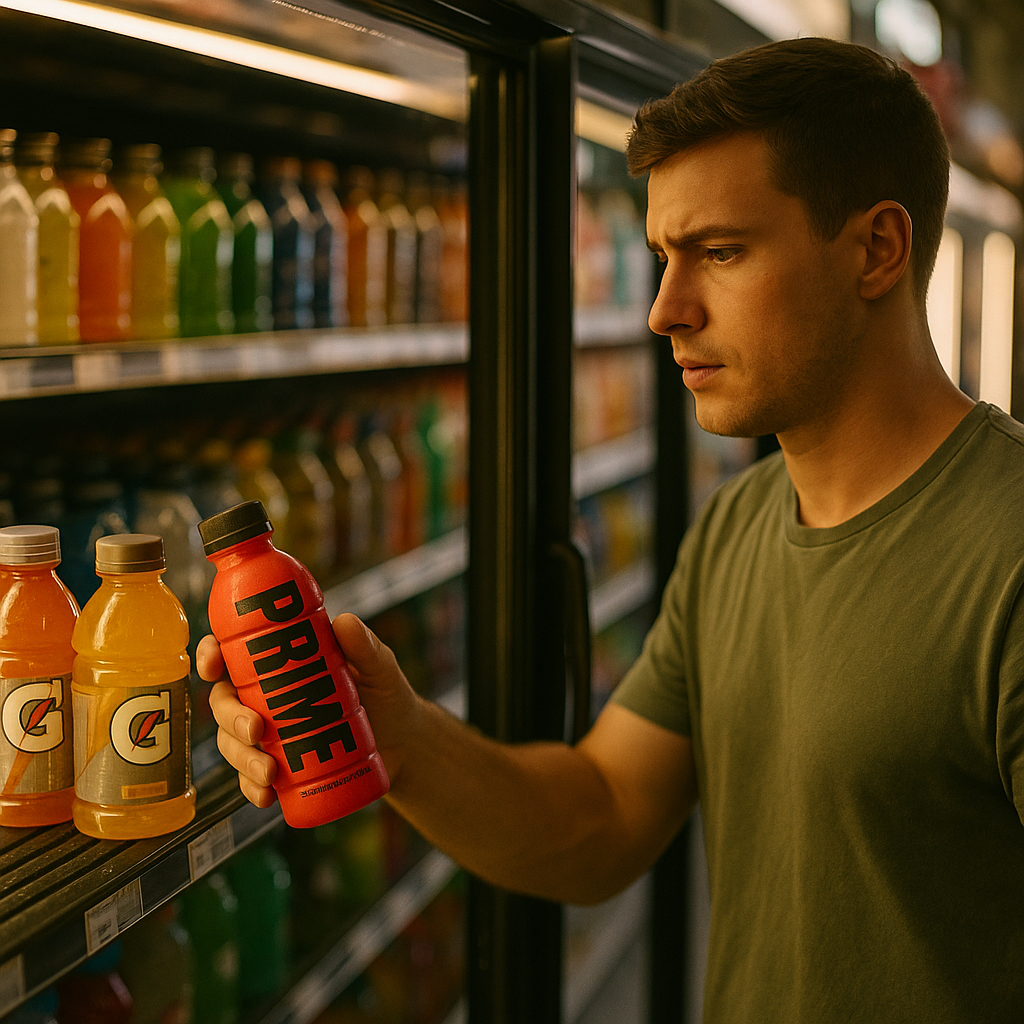
Gatorade spent decades and billions building convenience store dominance. Prime Hydration cracked it in under three years, largely without buying a single endcap display. The secret wasn’t a bigger budget — it was treating convenience store distribution as a media channel in its own right, one that runs on creator drama instead of trade spend.
This is the case study every beverage brand manager pretends they’ve already figured out. Most haven’t.
The Setup: Why C-Stores Became the Battleground
Prime launched in 2022 backed by KSI and Logan Paul, two creators with a well-documented history of mutual antagonism turned business partnership. That tension wasn’t a PR liability. It was the product’s core marketing asset.
Convenience stores move fast. A gas station cooler turns over inventory in days, not weeks. Unlike grocery, where planogram resets happen quarterly and buyer relationships get locked in a year ahead, c-store distribution rewards velocity — proof that product is flying off shelves right now. Prime’s team understood something most beverage marketers miss: you don’t need a national ad campaign to win c-store shelf space. You need visible, recurring demand signals that make a regional distributor nervous about running out.
That’s a fundamentally different growth model than what Gatorade, BodyArmor, or Liquid I.V. were running. Those brands built demand through retail media programs, endcap buys, and sports sponsorships. Prime built demand through creator conflict that played out in real time on TikTok and YouTube, then let scarcity do the rest.
Prime treated every KSI-Logan Paul spat as an unpaid media event, then let convenience store scarcity convert that attention into purchase urgency — no retail media line item required.
How Creator Feuds Became a Distribution Lever
Here’s the mechanic worth stealing: every time KSI and Logan Paul had a public disagreement, engagement spiked. Fans speculated about the brand’s future. Would Prime survive the drama? Clips got re-uploaded, stitched, and debated across YouTube and TikTok for days.
Each cycle produced a predictable spike in search interest and in-store inquiries. Store owners noticed. Distributors noticed faster. When a regional Circle K or Wawa location sells out of Prime three days after a viral clip, that’s not a coincidence a category manager can ignore. It’s a reorder trigger.
This is fundamentally different from the influencer gifting model most CPG brands run, where a creator posts a sponsored unboxing and hopes for a bump. Prime’s founders were the content engine. They didn’t need a media plan because their organic beef generated more impressions than most Super Bowl buys, and it cost the brand’s P&L nothing in traditional retail media terms.
Compare that to how other beverage and CPG challengers have approached distribution. Prime Hydration’s convenience store velocity strategy against Gatorade shows the same pattern: win the small-format channel first, let big-box follow the demand signal instead of trying to force it.
The Shelf Velocity Data Point Nobody Talks About
Velocity, in retail terms, means units sold per store per week. It’s the metric that determines whether a distributor keeps you on shelf or swaps you out for the next challenger brand. Prime consistently posted velocity numbers in convenience channels that outpaced legacy sports drinks in the same cooler space, according to trade press coverage during its peak growth period.
That’s the part traditional retail media can’t replicate. You can buy an endcap. You can’t buy authentic velocity. Distributors read velocity as truth — it’s the one number that isn’t padded by co-op ad spend or slotting fees. When a brand shows real sell-through without a media budget behind it, retail buyers start asking why they’re not stocking more.
No Retail Media Spend? Here’s What Replaced It
Skipping traditional retail media (think Kroger Precision Marketing, Walmart Connect, Instacart ads) doesn’t mean skipping investment. Prime redirected resources into three areas instead:
- Founder content velocity — KSI and Logan Paul posted constantly, often unscripted, keeping the brand in constant cultural rotation without paid amplification.
- Scarcity engineering — limited flavor drops and regional exclusives created FOMO that drove foot traffic into c-stores specifically, not just big-box retail.
- Distributor relationship speed — because demand was organic and immediate, Prime’s team could move faster on distribution deals than brands waiting on quarterly retail media performance reviews to justify shelf expansion.
None of this required a media buying team negotiating CPMs with a retailer’s ad network. It required a content operation that never stopped and a distribution team ready to capitalize on demand spikes within days, not months.
Brand strategists should note: this only works if the creator conflict feels real. Manufactured drama gets sniffed out fast by an audience fluent in parasocial media literacy. KSI and Logan Paul’s history predated the brand by years — that authenticity is what made the feud narrative sustainable instead of a one-off stunt.
Risk Mitigation: What Could Have Gone Wrong
Building a brand on creator conflict is not without risk, and any marketer studying this playbook needs to reckon with the downside scenarios.
First, reputational spillover. If a feud tips from “entertaining tension” into genuinely toxic behavior, the brand absorbs the damage. Prime has faced its share of scrutiny, including FTC attention around marketing to younger audiences and questions about caffeine content disclosure. Any brand borrowing this model needs a compliance function reviewing creator content before it becomes a liability, not after.
Second, supply chain fragility. Scarcity marketing works until it doesn’t. Persistent stockouts eventually frustrate retailers and consumers alike. Prime dealt with resale markups and secondary market speculation that, while good for hype, created friction with retail partners who couldn’t keep shelves stocked reliably.
Third, founder dependency. When your entire go-to-market engine rests on two individuals’ willingness to keep generating content and, occasionally, conflict, you’ve built a brand with concentrated key-person risk. Any reputational event involving either founder becomes a brand event, full stop.
Scarcity marketing and founder-led conflict content generate velocity fast, but they also concentrate risk in ways a traditional retail media program never would.
What This Means for Brands Without a Built-In Feud
Not every brand has two famous founders with a documented rivalry to lean on. So what’s the transferable lesson here?
It’s this: convenience retail rewards proof of demand more than it rewards media spend. Brands can manufacture that proof through nano and micro-creator networks generating consistent, localized content, even without a built-in celebrity narrative. The approach echoes what worked for Chamberlain Coffee’s nano-creator strategy in winning shelf space at Target, or how Poppi rebuilt trust using nano-creators on TikTok Shop after facing its own PR challenges.
The common thread across these case studies: velocity signals travel faster than ad campaigns, and retail buyers trust organic demand more than a media plan’s projected reach numbers.
Brands should also study how zero-budget approaches scale in adjacent categories. Trader Joe’s zero-dollar influencer strategy proves that scarcity and cult-like community enthusiasm can substitute for paid media even in a category as commoditized as grocery.
Building Your Own Velocity Signal (Without Owning a Feud)
Practically, this means:
- Track sell-through data by region weekly, not monthly, and share spikes directly with distributor reps as leverage for expanded placement.
- Seed nano-creators in specific ZIP codes near target convenience chains to create hyperlocal demand before a national push.
- Use limited drops or flavor exclusives to test which markets respond fastest, then let that data drive expansion decisions instead of guessing.
- Keep a legal and compliance review cycle in place for any creator content tied to product claims, especially around ingredients like caffeine or supplements.
Data from eMarketer continues to show creator-driven commerce outperforming traditional display formats on conversion efficiency, which reinforces why retail buyers increasingly weight social proof alongside historical sales data when making shelf decisions. Platforms like Sprout Social and HubSpot now offer social listening tools specifically built to help brand teams spot these velocity signals before competitors do.
The Takeaway for Retail Media Planners
Prime’s model doesn’t mean retail media is dead. Walmart Connect and Kroger Precision Marketing still move serious volume for brands with the budget to compete there. But Prime proved a smaller brand can out-maneuver category leaders in a specific channel by treating creator conflict as a demand-generation engine rather than a PR risk to suppress.
Any brand strategist studying convenience retail expansion should ask a harder question before reaching for the retail media checkbook: is there an organic tension or narrative already living in our founder or creator network that we’re currently trying to suppress instead of amplify?
Frequently Asked Questions
Did Prime Hydration spend nothing on retail media?
Prime minimized traditional retail media spend like paid endcap placements and retailer ad network buys, redirecting that budget toward founder-led content and scarcity-driven product drops instead. This doesn’t mean zero marketing spend overall, just a different allocation strategy focused on organic demand generation.
Can this convenience-store-first strategy work without celebrity founders?
Yes, though it requires substituting nano and micro-creator networks for celebrity-driven content. Brands like Chamberlain Coffee and Poppi have shown that hyperlocal creator seeding can generate similar velocity signals without a built-in celebrity narrative.
What is shelf velocity and why does it matter more than media spend?
Shelf velocity measures units sold per store per week. Retail buyers and distributors treat velocity as unbiased proof of demand, unlike media spend metrics that can be inflated by co-op advertising dollars or slotting fees.
What are the biggest risks of building a brand on creator conflict?
Key risks include reputational spillover if conflict turns genuinely toxic, regulatory scrutiny around marketing claims and audience targeting, supply chain strain from scarcity marketing, and concentrated key-person risk tied to founder behavior.
How can smaller brands measure this kind of organic demand signal?
Track regional sell-through data weekly, monitor social listening tools for spikes in brand mentions, and correlate those spikes with retailer reorder patterns. Sharing this data proactively with distributors can accelerate shelf expansion decisions.
Next step: Before signing another retail media contract, audit whether your brand has an underused organic narrative, founder tension, community rivalry, or creator relationship, that could generate the same velocity signal Prime built for free.
Frequently Asked Questions
Did Prime Hydration spend nothing on retail media?
Prime minimized traditional retail media spend like paid endcap placements and retailer ad network buys, redirecting that budget toward founder-led content and scarcity-driven product drops instead. This doesn’t mean zero marketing spend overall, just a different allocation strategy focused on organic demand generation.
Can this convenience-store-first strategy work without celebrity founders?
Yes, though it requires substituting nano and micro-creator networks for celebrity-driven content. Brands like Chamberlain Coffee and Poppi have shown that hyperlocal creator seeding can generate similar velocity signals without a built-in celebrity narrative.
What is shelf velocity and why does it matter more than media spend?
Shelf velocity measures units sold per store per week. Retail buyers and distributors treat velocity as unbiased proof of demand, unlike media spend metrics that can be inflated by co-op advertising dollars or slotting fees.
What are the biggest risks of building a brand on creator conflict?
Key risks include reputational spillover if conflict turns genuinely toxic, regulatory scrutiny around marketing claims and audience targeting, supply chain strain from scarcity marketing, and concentrated key-person risk tied to founder behavior.
How can smaller brands measure this kind of organic demand signal?
Track regional sell-through data weekly, monitor social listening tools for spikes in brand mentions, and correlate those spikes with retailer reorder patterns. Sharing this data proactively with distributors can accelerate shelf expansion decisions.
Top Influencer Marketing Agencies
The leading agencies shaping influencer marketing in 2026
Agencies ranked by campaign performance, client diversity, platform expertise, proven ROI, industry recognition, and client satisfaction. Assessed through verified case studies, reviews, and industry consultations.
Moburst

-
2

The Shelf
Boutique Beauty & Lifestyle Influencer AgencyA data-driven boutique agency specializing exclusively in beauty, wellness, and lifestyle influencer campaigns on Instagram and TikTok. Best for brands already focused on the beauty/personal care space that need curated, aesthetic-driven content.Clients: Pepsi, The Honest Company, Hims, Elf Cosmetics, Pure LeafVisit The Shelf → -
3

Audiencly
Niche Gaming & Esports Influencer AgencyA specialized agency focused exclusively on gaming and esports creators on YouTube, Twitch, and TikTok. Ideal if your campaign is 100% gaming-focused — from game launches to hardware and esports events.Clients: Epic Games, NordVPN, Ubisoft, Wargaming, Tencent GamesVisit Audiencly → -
4

Viral Nation
Global Influencer Marketing & Talent AgencyA dual talent management and marketing agency with proprietary brand safety tools and a global creator network spanning nano-influencers to celebrities across all major platforms.Clients: Meta, Activision Blizzard, Energizer, Aston Martin, WalmartVisit Viral Nation → -
5

The Influencer Marketing Factory
TikTok, Instagram & YouTube CampaignsA full-service agency with strong TikTok expertise, offering end-to-end campaign management from influencer discovery through performance reporting with a focus on platform-native content.Clients: Google, Snapchat, Universal Music, Bumble, YelpVisit TIMF → -
6

NeoReach
Enterprise Analytics & Influencer CampaignsAn enterprise-focused agency combining managed campaigns with a powerful self-service data platform for influencer search, audience analytics, and attribution modeling.Clients: Amazon, Airbnb, Netflix, Honda, The New York TimesVisit NeoReach → -
7

Ubiquitous
Creator-First Marketing PlatformA tech-driven platform combining self-service tools with managed campaign options, emphasizing speed and scalability for brands managing multiple influencer relationships.Clients: Lyft, Disney, Target, American Eagle, NetflixVisit Ubiquitous → -
8

Obviously
Scalable Enterprise Influencer CampaignsA tech-enabled agency built for high-volume campaigns, coordinating hundreds of creators simultaneously with end-to-end logistics, content rights management, and product seeding.Clients: Google, Ulta Beauty, Converse, AmazonVisit Obviously →