


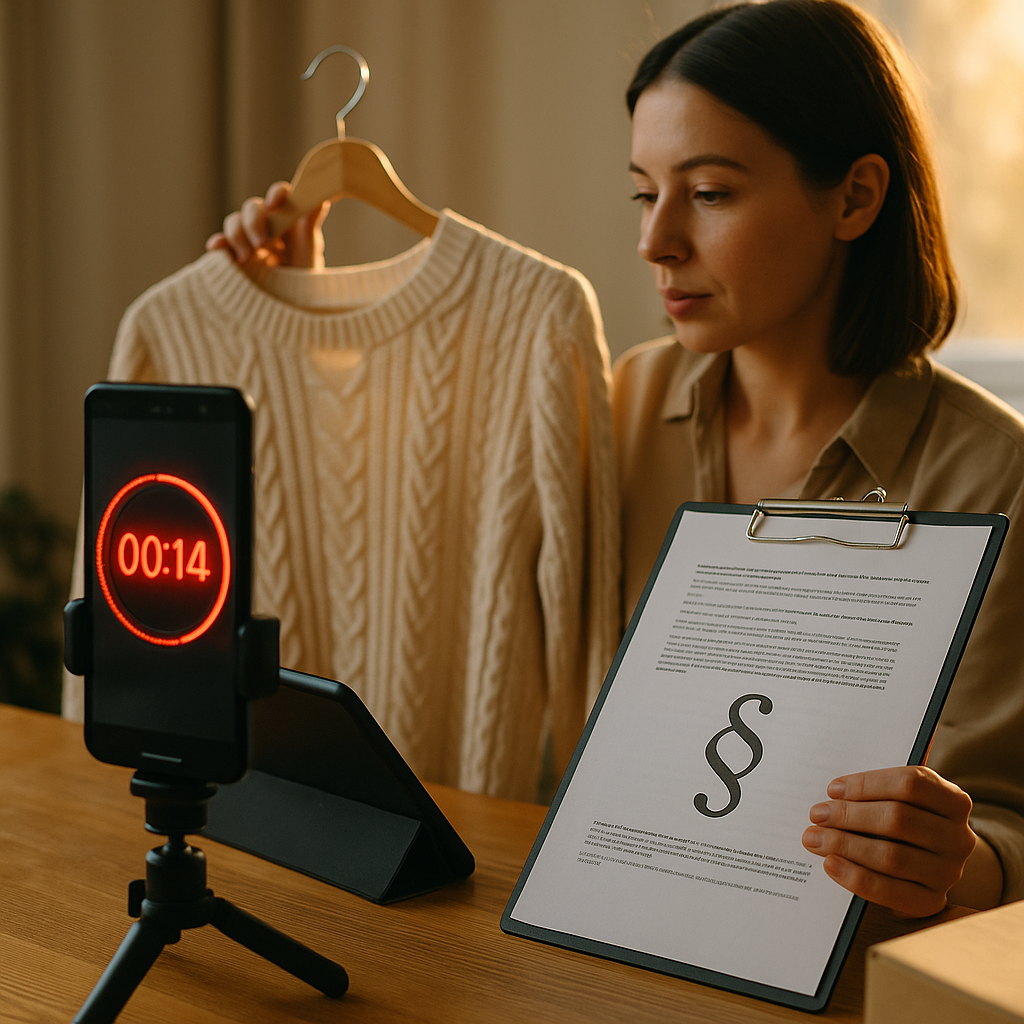
Sixty-nine percent of shoppers say scarcity messaging influences their purchase decisions, according to consumer research cited by the FTC. Now imagine that messaging isn’t written by a marketer at all — it’s generated in real time by an AI model optimizing for conversion. That’s the situation brands face with a livestream shopping compliance clause for AI-curated countdown timers, and most contracts weren’t built for it.
Countdown timers used to be simple. A creator or brand set a fixed discount window, the timer ticked down, the sale ended. Easy to audit, easy to defend. Now platforms like TikTok Shop, Amazon Live, and Whatnot are layering algorithmic logic on top: timers that extend, shrink, or reset based on viewer count, inventory signals, or engagement velocity. The problem is that the FTC doesn’t care who — or what — generated the scarcity claim. It only cares whether the claim was true.
Why AI-Curated Timers Are a Different Legal Animal
A static countdown timer is a factual claim: “This deal ends at 9:00 PM.” If it’s false, that’s straightforward deceptive advertising. AI-curated timers introduce a second layer of risk because the timer itself is a variable, not a constant. The countdown a shopper sees might differ from the one shown to another viewer thirty seconds earlier, based entirely on a model’s read of demand signals.
That’s not inherently illegal. But it does mean your compliance documentation has to answer a harder question: can you prove the urgency displayed to any given viewer reflected a real constraint at that moment?
The FTC’s guidance on deceptive scarcity claims hasn’t changed dramatically, but enforcement attention has. Regulators have flagged countdown clocks that reset after expiration and “limited stock” messaging that doesn’t match actual inventory. Layer in an AI system making thousands of micro-decisions about what timer to show whom, and you’ve created an accountability gap that’s hard to close after the fact. Our earlier breakdown of livestream countdown timers and FTC price-claim compliance covers the baseline rules; AI curation just raises the stakes on documentation.
If your AI vendor can’t tell you why a specific timer showed a specific number to a specific viewer, your legal team can’t defend it either.
What Actually Needs to Be in the Clause
A generic “vendor shall comply with FTC guidelines” line does nothing. It’s the contractual equivalent of shrugging. Here’s what a working clause structure actually requires:
- Data-source attestation. The clause should require the AI vendor to specify exactly which signals drive timer behavior — real inventory counts, cart abandonment rates, viewer volume — and confirm none of those signals are simulated or padded for effect.
- Real-time audit logging. Every timer variation shown to a viewer segment needs a timestamped record: what was displayed, what triggered it, and what the underlying inventory or demand state actually was. Without this, you can’t reconstruct a defense if a regulator or plaintiff’s attorney asks.
- Discrepancy thresholds. Define an acceptable margin between displayed urgency and actual scarcity. If the AI shows “only 3 left” and there are actually 40 units in the warehouse, that’s a discrepancy that needs a contractual trigger — not a quiet fix after a complaint.
- Human override rights. The brand (or its compliance team) needs contractual authority to pause, adjust, or kill a countdown feature mid-stream if it looks like the AI is generating misleading urgency at scale.
- Indemnification scoped to AI decisioning. Standard indemnification language often assumes a human made the claim. You need language that extends liability allocation to algorithmic outputs specifically, including cases where the vendor’s model made an unsupervised adjustment.
None of this is theoretical. TikTok Shop’s live-selling environment already runs dynamic promotional windows in some markets, and the checklist we published on TikTok Shop live countdown timers and FTC compliance is a useful companion document for teams building out these clauses market by market.
The Audit Trail Is the Whole Ballgame
Here’s the uncomfortable truth: most brands can’t currently answer “why did the timer show that number” for any given livestream moment. The AI vendor has the data. The brand rarely has contractual access to it in a usable format.
That’s the gap the clause needs to close. Require structured, exportable logs — not screenshots, not vendor dashboards you have to manually screen-record. Real audit infrastructure. This is the same principle behind the audit log standard for attribution and ad-tech vendors, just applied to promotional timing instead of attribution data.
Ask your vendor this directly: can they produce, within 48 hours, a log showing every timer variant served during a specific livestream, cross-referenced against actual inventory at that moment? If the answer is “we’d have to check with engineering,” that’s your answer about whether the current contract is doing its job.
Where Brands Get This Wrong
Most compliance failures here aren’t malicious. They’re structural. A few recurring patterns:
- Treating the AI vendor’s platform terms as sufficient. Platform-level AI labeling and disclosure standards, as we noted in platform AI labels and FTC disclosure gaps, frequently fall short of what the FTC actually expects. The same logic applies to scarcity claims — a platform’s built-in “dynamic pricing” disclosure isn’t a substitute for your own contractual controls.
- No script-level review of AI-generated urgency language. If your livestream host is reading AI-suggested prompts (“only a few left, don’t miss out”), that language needs the same scrutiny as any other creator script. The sign-off process outlined in our piece on the sign-off matrix for AI creator scripts is directly applicable — countdown copy is still a script.
- Assuming indemnification covers algorithmic decisions by default. It usually doesn’t, unless the clause explicitly names AI-driven decisioning as a covered scenario. General liability language written for human error doesn’t automatically extend to a model’s autonomous output.
An AI vendor that can optimize a countdown timer for conversion in real time can also produce a real-time audit log. If they say they can’t, that’s a vendor-selection problem, not a technical limitation.
Drafting Language That Holds Up
You don’t need to reinvent contract law here. You need specificity. A working clause should include, at minimum:
- A defined term for “AI-curated scarcity display” that covers countdown timers, stock-level indicators, and viewer-count-based urgency messaging generated or adjusted algorithmically.
- An explicit warranty from the vendor that all scarcity signals correspond to verifiable, real-time conditions (inventory, time windows, actual demand) rather than engagement-optimized approximations.
- A data access provision granting the brand or its compliance/legal team on-demand access to timer-decision logs, not just aggregated performance reports.
- A remediation timeline (24-72 hours is typical) for correcting or disabling a timer feature found to be generating misleading urgency.
- Indemnification language that names algorithmic decisioning explicitly, closing the gap left by contracts drafted before generative and agentic AI tools were part of the livestream stack. Our deeper look at contract clauses for autonomous AI agent liability is a useful reference point for structuring this section.
This isn’t about slowing down your livestream program. It’s about making sure the program survives contact with a regulator, a plaintiff’s attorney, or a viral consumer complaint. Brands running high-volume livestream shopping — multiple sessions weekly across TikTok Shop, Amazon Live, or owned platforms — are exposed at scale. One bad timer pattern across a hundred streams is a hundred potential violations, not one.
Marketing teams evaluating livestream commerce growth data should pair every projection with a parallel compliance review. Growth without documentation is just exposure with better conversion rates.
Building This Into Vendor Selection, Not Just Contract Renewal
The best time to negotiate this clause is before you sign, not after a complaint lands. When evaluating AI-driven livestream commerce vendors, ask for a sample audit log before you sign anything. Ask how their model weights urgency signals. Ask whether their system has ever auto-generated a scarcity claim that didn’t match real inventory — and if they hesitate, that’s your answer.
Procurement teams should treat this the same way they’d treat a data processing agreement: as a non-negotiable technical exhibit, not boilerplate legal filler. For teams building broader governance around creator-facing AI tools, the creator compliance dashboard framework offers a useful model for centralizing this kind of monitoring across vendors and platforms.
Consider also how your legal and marketing teams currently handle disclosure review generally. The HubSpot state of marketing research and similar industry surveys consistently show compliance review lagging behind AI adoption speed — livestream scarcity claims are simply the newest front in that gap.
FAQs
What is a livestream shopping compliance clause, exactly?
It’s a contractual provision — typically embedded in a vendor or platform agreement — that defines how AI-driven features like countdown timers, stock alerts, and urgency messaging must operate to stay within FTC advertising rules. It sets warranties, audit access, and remediation timelines specific to algorithmic scarcity claims.
Does the FTC treat AI-generated scarcity claims differently from human-written ones?
No. The FTC evaluates the claim’s truthfulness and impact on consumers, not who or what produced it. That said, AI-generated claims can be harder to audit after the fact, which increases practical risk even if the legal standard hasn’t shifted.
Who is liable if an AI vendor’s model generates a misleading countdown timer?
Liability typically depends on contract language. Without explicit indemnification covering algorithmic decisioning, brands often bear more exposure than they expect, since the FTC generally holds the advertiser responsible regardless of which party’s technology generated the claim.
How often should AI-curated timer logs be audited?
Ongoing spot audits are ideal, with full log reviews at minimum monthly or after any livestream event with unusually high conversion or complaint volume. High-frequency livestream sellers should consider automated monitoring rather than manual sampling.
Can platforms like TikTok Shop or Amazon Live provide this compliance coverage themselves?
Platform-level disclosure and AI labeling features generally don’t meet full FTC disclosure standards on their own. Brands still need their own contractual controls and audit access rather than relying solely on platform defaults.
Visible FAQ
See FAQ section above for full visible content.
Start by asking your current livestream AI vendor for a sample timer-decision log today — if they can’t produce one within a week, that’s the clearest signal you need this clause in your next contract renewal, not your next legal review cycle.
Top Influencer Marketing Agencies
The leading agencies shaping influencer marketing in 2026
Agencies ranked by campaign performance, client diversity, platform expertise, proven ROI, industry recognition, and client satisfaction. Assessed through verified case studies, reviews, and industry consultations.
Moburst

-
2

The Shelf
Boutique Beauty & Lifestyle Influencer AgencyA data-driven boutique agency specializing exclusively in beauty, wellness, and lifestyle influencer campaigns on Instagram and TikTok. Best for brands already focused on the beauty/personal care space that need curated, aesthetic-driven content.Clients: Pepsi, The Honest Company, Hims, Elf Cosmetics, Pure LeafVisit The Shelf → -
3

Audiencly
Niche Gaming & Esports Influencer AgencyA specialized agency focused exclusively on gaming and esports creators on YouTube, Twitch, and TikTok. Ideal if your campaign is 100% gaming-focused — from game launches to hardware and esports events.Clients: Epic Games, NordVPN, Ubisoft, Wargaming, Tencent GamesVisit Audiencly → -
4

Viral Nation
Global Influencer Marketing & Talent AgencyA dual talent management and marketing agency with proprietary brand safety tools and a global creator network spanning nano-influencers to celebrities across all major platforms.Clients: Meta, Activision Blizzard, Energizer, Aston Martin, WalmartVisit Viral Nation → -
5

The Influencer Marketing Factory
TikTok, Instagram & YouTube CampaignsA full-service agency with strong TikTok expertise, offering end-to-end campaign management from influencer discovery through performance reporting with a focus on platform-native content.Clients: Google, Snapchat, Universal Music, Bumble, YelpVisit TIMF → -
6

NeoReach
Enterprise Analytics & Influencer CampaignsAn enterprise-focused agency combining managed campaigns with a powerful self-service data platform for influencer search, audience analytics, and attribution modeling.Clients: Amazon, Airbnb, Netflix, Honda, The New York TimesVisit NeoReach → -
7

Ubiquitous
Creator-First Marketing PlatformA tech-driven platform combining self-service tools with managed campaign options, emphasizing speed and scalability for brands managing multiple influencer relationships.Clients: Lyft, Disney, Target, American Eagle, NetflixVisit Ubiquitous → -
8

Obviously
Scalable Enterprise Influencer CampaignsA tech-enabled agency built for high-volume campaigns, coordinating hundreds of creators simultaneously with end-to-end logistics, content rights management, and product seeding.Clients: Google, Ulta Beauty, Converse, AmazonVisit Obviously →