


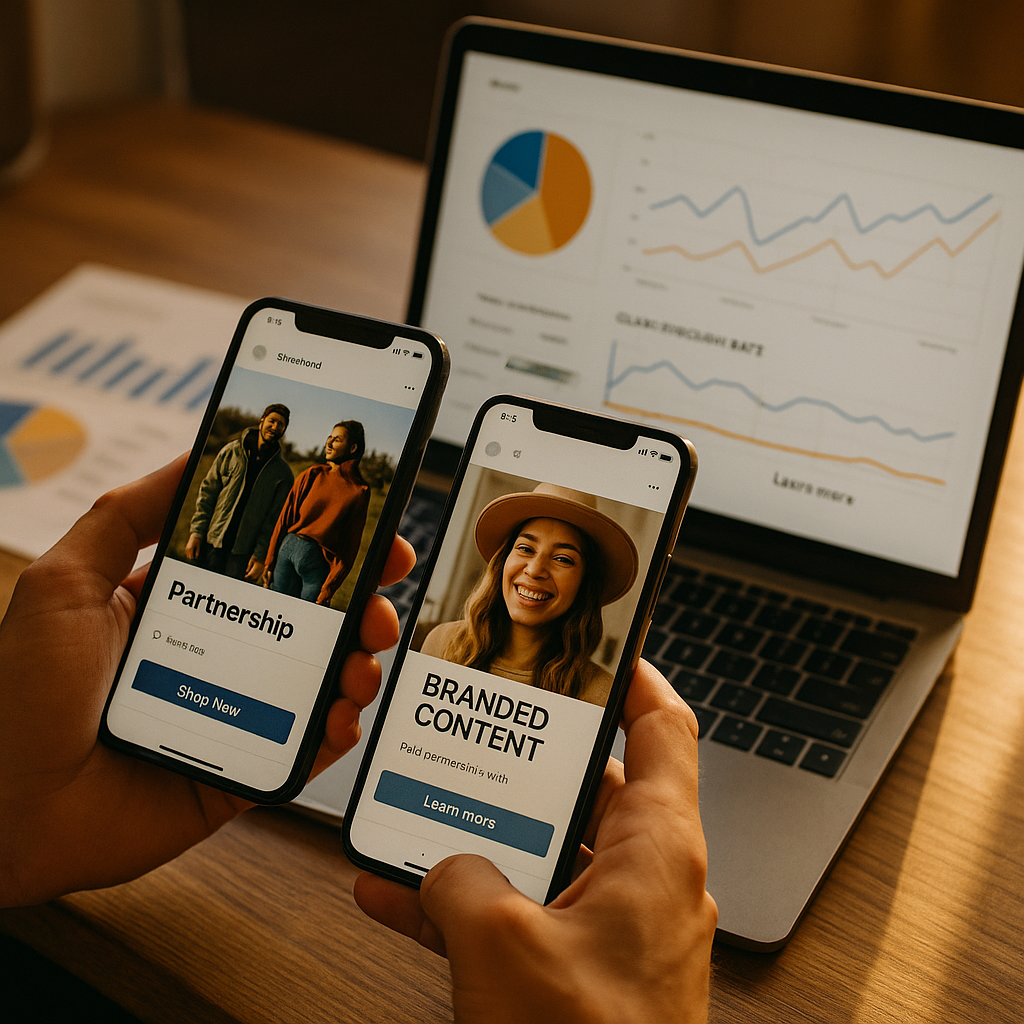
Brands running Instagram Partnership Ads are seeing click-through rates jump 30 to 60 percent higher than organic branded content, yet most marketing teams still can’t explain why one format beats the other in their own dashboards. That gap between knowing a format works and knowing when to deploy it is costing budgets real money. This playbook breaks down Instagram Partnership Ads vs Branded Content Ads on the metrics that matter to performance marketers: CTR, CPA, and the operational tradeoffs that determine which one actually fits your funnel.
Two Formats, One Confusing Naming Problem
Let’s clear up the terminology first, because Meta hasn’t made this easy. Branded Content Ads are organic creator posts that carry the “Paid partnership with” tag, which brands can then boost through Ads Manager using the creator’s handle. Partnership Ads (formerly Branded Content Ads, now bundled under the broader Partnership Ads suite) give brands deeper access: full ad account level control, custom targeting, placement flexibility across Reels, Stories, and Feed, and the ability to run the creator’s content as if it were native brand creative.
The practical difference comes down to control. Branded Content Ads boost what already exists. Partnership Ads let you build a campaign around creator content with the same targeting precision you’d apply to any paid social asset. If you’ve ever wondered why your boosted creator post underperforms a seemingly identical campaign, this is usually the reason.
CTR: Why Partnership Ads Usually Win the Click
Click-through rate is where the format gap shows up fastest. Partnership Ads consistently post higher CTR because they inherit the targeting stack of a full paid campaign: lookalikes, interest layering, retargeting pools, and placement optimization that boosted branded content simply doesn’t get.
Boosted Branded Content Ads are constrained by the original post’s audience logic. You’re essentially paying to extend reach on content optimized for organic engagement, not click intent. Partnership Ads flip that. The creative stays authentic (it’s still the creator’s voice and format) but the delivery engine behind it is built for performance, not just reach.
In practice, agencies running side-by-side tests typically see Partnership Ads post CTR improvements in the 20 to 50 percent range over boosted branded content, largely because of placement and audience targeting advantages rather than creative differences.
That said, CTR isn’t the whole story. A high click rate on cold traffic that never converts is a vanity metric dressed up as performance. Which brings us to the number that actually matters for budget owners.
CPA Is Where the Real Decision Gets Made
Cost per acquisition is the metric that decides renewal conversations with your CFO. Partnership Ads tend to deliver lower CPA at scale because they unlock full-funnel retargeting: you can run a Partnership Ad to warm audiences who already visited your product page, something boosted branded content can’t efficiently replicate without duplicating the creative into a separate standard ad.
But there’s a catch nobody talks about enough: Partnership Ads require more upfront coordination. Creators need to grant partnership permissions, brands need ad account access configured correctly, and campaigns need enough lead time to avoid rushed targeting. Skip those steps and CPA can actually spike above what you’d get from a simple boosted post, because you’ve added complexity without adding optimization discipline.
Branded Content Ads still have a place. For brands testing a new creator relationship or running a quick awareness push, boosting organic content is faster, cheaper to set up, and lower risk operationally. The CPA tradeoff is acceptable when the goal is reach, not conversion.
When Branded Content Ads Still Make Sense
- Early-stage creator testing: before committing to a full whitelisting agreement, boosting a post validates audience resonance cheaply.
- Awareness and top-funnel pushes: when the KPI is reach or video views rather than conversions, the simpler setup saves time without sacrificing much performance.
- Short campaign windows: Partnership Ads setup (permissions, account linking, creative review) takes longer. If you’ve got 48 hours to launch, boosting is often the only realistic option.
- Lower production budgets: smaller brands without dedicated paid social teams may not have the bandwidth to manage full Partnership Ads targeting logic.
None of this means Branded Content Ads are a lesser format. They’re a different tool for a different job. The mistake most brands make is defaulting to whichever format their last campaign used instead of matching the format to the funnel stage.
Building the Decision Framework
Here’s a simple way to think about format selection without overcomplicating the brief:
- If the objective is conversions, sales, or app installs, default to Partnership Ads and budget time for proper whitelisting setup.
- If the objective is reach, impressions, or creator relationship testing, boosted Branded Content Ads get you there faster and cheaper.
- If you’re running always-on influencer programs with recurring creators, invest in Partnership Ads infrastructure once and reuse it across campaigns rather than rebuilding permissions each time.
- If your team lacks the operational maturity to manage full ad account access across dozens of creators, start with a hybrid: Partnership Ads for your top 20 percent of performers, boosted content for the long tail.
This mirrors a pattern we’ve documented in Meta Partnership Ads whitelisting work: the format only pays off when the operational setup matches the campaign ambition. Rushing whitelisting to hit a launch date almost always produces worse CPA than taking an extra week to configure targeting properly.
The Measurement Trap Most Teams Fall Into
Here’s a problem that doesn’t get enough attention: brands often compare Partnership Ads CTR against Branded Content Ads CPA, or vice versa, because their reporting dashboards pull different attribution windows by default. Partnership Ads campaigns frequently run on 7-day click attribution while boosted posts might default to 1-day click. That’s not a fair comparison, and it skews internal benchmarking in ways that lead to bad budget decisions.
Before you declare one format the winner, normalize your attribution windows across both campaign types. Pull them into the same reporting view, same date range, same conversion event definition. It sounds basic, but it’s the single most common reason brands misjudge which format is actually driving results.
A format comparison built on mismatched attribution windows isn’t a performance insight. It’s a reporting artifact that will misdirect next quarter’s budget.
If you’re building out a broader measurement pipeline for influencer-driven paid social, it’s worth reviewing how the Instagram Partnership Ads pipeline fits into your existing ROI workflow before you scale creator count. Most CPA inflation problems trace back to pipeline gaps, not creative underperformance.
Creative Fatigue Hits Partnership Ads Faster
One underappreciated operational reality: because Partnership Ads get pushed harder and longer across paid placements, creative fatigue sets in faster than it does for organic branded content. A boosted post naturally cycles out of relevance within its organic lifecycle. A Partnership Ad can keep running against the same audience for weeks, and frequency caps matter more here than most brands initially set them.
Watch frequency metrics closely. Once average frequency crosses 3 to 4 within a 7-day window on Partnership Ads, CTR typically starts declining and CPA creeps up, even if the creator content itself is strong. Refreshing creative variants, not just rotating budget, is the fix. This is similar to lessons learned from TikTok Spark Ads authorization campaigns, where authorized creator content also needs a refresh cadence to avoid diminishing returns.
What Industry Data Says About Creator-Driven Ad Performance
Broader industry benchmarking backs up what brands see internally. Reports from eMarketer have consistently shown creator-attributed paid social outperforming standard brand ad creative on engagement metrics, and Statista data on influencer marketing spend shows brands increasingly shifting budget toward paid amplification of creator content rather than organic-only strategies. Meta’s own guidance via Meta Business resources reinforces that Partnership Ads are designed specifically to close the gap between creator authenticity and paid targeting precision, which is exactly the tension this playbook is built to resolve.
For brands running adjacent creator ad formats on TikTok, the authorization and CPA dynamics are strikingly similar, worth a look if you’re building a cross-platform paid creator strategy rather than treating each platform in isolation.
FAQs
Frequently Asked Questions
What’s the main difference between Instagram Partnership Ads and Branded Content Ads?
Branded Content Ads are boosted organic creator posts with limited targeting control. Partnership Ads give brands full ad account level access to run creator content with custom targeting, placements, and retargeting, similar to standard paid social campaigns.
Which format has better CTR, Partnership Ads or Branded Content Ads?
Partnership Ads typically post higher CTR, often 20 to 50 percent better, because they benefit from full targeting and placement optimization rather than relying on the original post’s organic audience logic.
Do Partnership Ads always deliver lower CPA?
Not automatically. Partnership Ads tend to lower CPA at scale when setup and permissions are configured correctly and given enough lead time. Rushed setups can actually produce worse CPA than a simple boosted post.
When should a brand choose Branded Content Ads instead of Partnership Ads?
Branded Content Ads make sense for quick creator testing, short campaign windows, top-funnel awareness goals, or when the brand lacks the operational bandwidth to manage full Partnership Ads permissions across many creators.
How does creative fatigue affect Partnership Ads differently than Branded Content Ads?
Partnership Ads run longer and harder against the same audiences, so frequency builds faster. Once frequency crosses 3 to 4 within a week, CTR often drops and CPA rises, requiring creative refreshes sooner than organic boosted content typically needs.
What attribution mistake most skews Partnership Ads vs Branded Content Ads comparisons?
Using mismatched attribution windows, such as comparing 7-day click data for Partnership Ads against 1-day click data for boosted posts, produces misleading benchmarks that can lead to poor budget allocation decisions.
Match the format to the funnel stage, normalize your attribution windows before comparing results, and treat Partnership Ads setup as an infrastructure investment, not a last-minute checkbox. Get that sequence right and the CTR and CPA gains will show up in the dashboard without any further guesswork.
Top Influencer Marketing Agencies
The leading agencies shaping influencer marketing in 2026
Agencies ranked by campaign performance, client diversity, platform expertise, proven ROI, industry recognition, and client satisfaction. Assessed through verified case studies, reviews, and industry consultations.
Moburst

-
2

The Shelf
Boutique Beauty & Lifestyle Influencer AgencyA data-driven boutique agency specializing exclusively in beauty, wellness, and lifestyle influencer campaigns on Instagram and TikTok. Best for brands already focused on the beauty/personal care space that need curated, aesthetic-driven content.Clients: Pepsi, The Honest Company, Hims, Elf Cosmetics, Pure LeafVisit The Shelf → -
3

Audiencly
Niche Gaming & Esports Influencer AgencyA specialized agency focused exclusively on gaming and esports creators on YouTube, Twitch, and TikTok. Ideal if your campaign is 100% gaming-focused — from game launches to hardware and esports events.Clients: Epic Games, NordVPN, Ubisoft, Wargaming, Tencent GamesVisit Audiencly → -
4

Viral Nation
Global Influencer Marketing & Talent AgencyA dual talent management and marketing agency with proprietary brand safety tools and a global creator network spanning nano-influencers to celebrities across all major platforms.Clients: Meta, Activision Blizzard, Energizer, Aston Martin, WalmartVisit Viral Nation → -
5

The Influencer Marketing Factory
TikTok, Instagram & YouTube CampaignsA full-service agency with strong TikTok expertise, offering end-to-end campaign management from influencer discovery through performance reporting with a focus on platform-native content.Clients: Google, Snapchat, Universal Music, Bumble, YelpVisit TIMF → -
6

NeoReach
Enterprise Analytics & Influencer CampaignsAn enterprise-focused agency combining managed campaigns with a powerful self-service data platform for influencer search, audience analytics, and attribution modeling.Clients: Amazon, Airbnb, Netflix, Honda, The New York TimesVisit NeoReach → -
7

Ubiquitous
Creator-First Marketing PlatformA tech-driven platform combining self-service tools with managed campaign options, emphasizing speed and scalability for brands managing multiple influencer relationships.Clients: Lyft, Disney, Target, American Eagle, NetflixVisit Ubiquitous → -
8

Obviously
Scalable Enterprise Influencer CampaignsA tech-enabled agency built for high-volume campaigns, coordinating hundreds of creators simultaneously with end-to-end logistics, content rights management, and product seeding.Clients: Google, Ulta Beauty, Converse, AmazonVisit Obviously →