


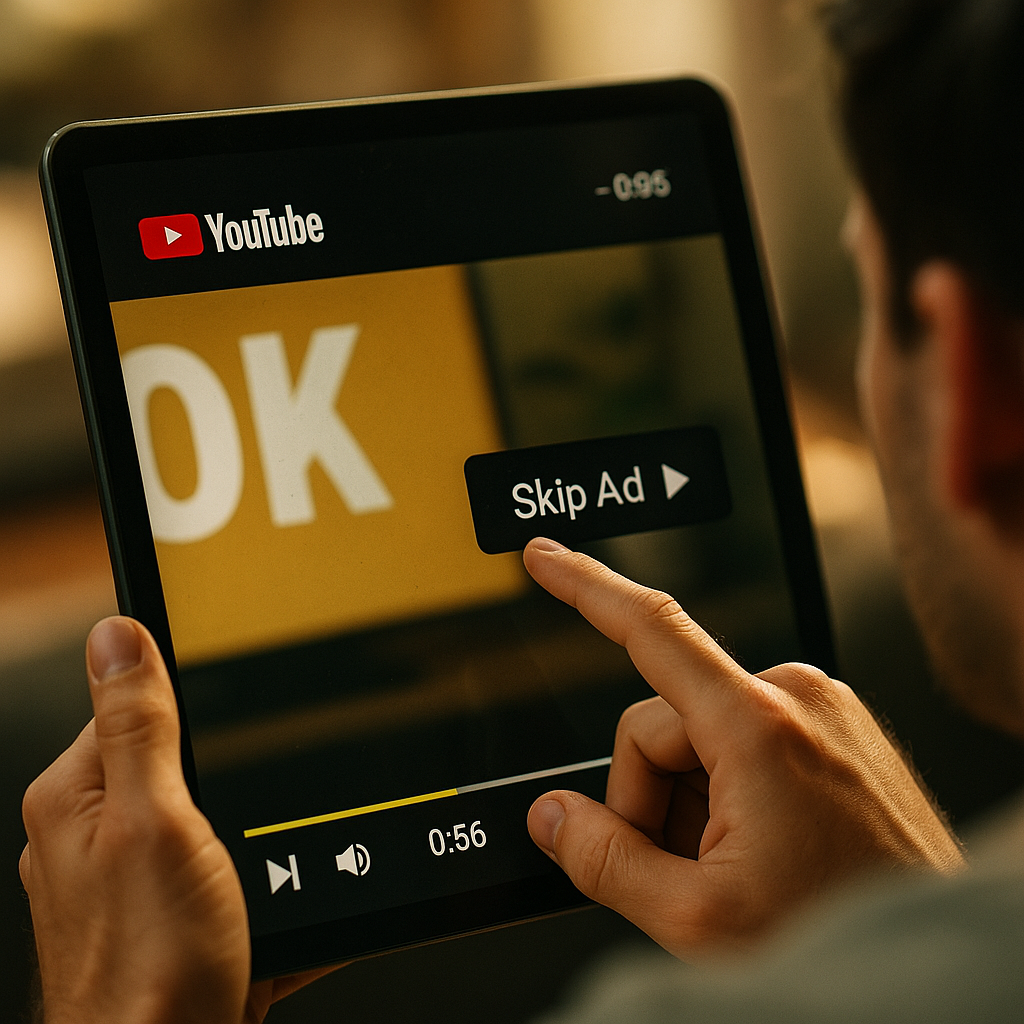
Five seconds. That’s the entire window YouTube gives your pre-roll ad before viewers get the option to skip. YouTube’s first-five-seconds rule isn’t a suggestion, it’s a hard platform mechanic that has quietly rewritten the economics of video advertising. Miss that window, and your media spend evaporates before your logo even lands. So why do most brands still open ads with a slow pan and a tagline?
The Five-Second Wall Is Non-Negotiable
Google’s own guidance has said for years that skippable in-stream ads only get charged when a viewer watches 30 seconds or the full ad, whichever is shorter, or when they interact with it. But the real battle happens long before that billing event. It happens in the first five seconds, when the skip button unlocks and the viewer’s thumb hovers.
Most brands still treat this window as throat-clearing. Logo bumper, slow zoom, a voiceover that says “Meet the future of…” By the time the actual message shows up, the viewer is gone. That’s not a creative failing. It’s a structural one.
If your hook doesn’t earn attention inside five seconds, everything after it is a cost center, not a message.
Why Skip Behavior Isn’t Random
Viewers don’t skip because they hate ads. They skip because their brain hasn’t found a reason to stay. Attention research consistently shows that decision-making in short video windows is driven by pattern interruption, not polish. A jarring first frame, an unexpected question, a face reacting to something off-camera, these outperform beauty shots every time.
This mirrors what’s happening across short-form platforms generally. The redesigned hook strategies built for 2x-speed Shorts consumption apply the same logic: assume the viewer is impatient by default, and design for the first instant, not the eventual payoff.
Skip behavior also correlates with format mismatch. An ad that looks like a TV commercial dropped into YouTube signals “this wasn’t made for me” almost instantly. Viewers are pattern-matching against native YouTube content, creator intros, vlogs, tutorials, and anything that doesn’t match that grammar gets flagged as an interruption worth escaping.
What Actually Survives the Skip Button
Data from ad effectiveness studies (Google has published creative research through its Think with Google arm for years) consistently points to a handful of patterns that hold attention past the five-second mark:
- Open on the payoff, not the setup. Show the result, the reaction, or the conflict in frame one. Explain it in frame three.
- Put a human face on screen immediately. Faces process faster than text or product shots, and they signal “this is a person talking to you,” not “this is an ad.”
- Use on-screen text as a second channel. A large percentage of YouTube viewing happens with sound off or low. If your hook depends entirely on audio, you’re losing viewers who never hear the line that would’ve stopped them.
- Name the audience or the problem, fast. “If you run a Shopify store and hate your CAC…” does more work in three seconds than any brand tagline.
- Avoid brand-first framing. Save the logo reveal for after the hook has landed. Nobody skips less because they saw your logo sooner.
None of this is exotic. It’s discipline. It’s writing five different five-second openers and testing them against each other before you ever storyboard the rest of the ad.
Building the Hook Backwards
Here’s a practical shift for creative teams: stop storyboarding front-to-back. Storyboard the hook as its own asset, separate from the narrative arc of the full ad. Treat it like a headline you’d A/B test in a paid search campaign, because functionally, that’s what it is.
A useful exercise: take your existing 30-second pre-roll and ask what would happen if you deleted the first five seconds entirely and started at second six. In most cases, nothing important is lost. That’s the tell. If your ad still makes sense without its own opening, the opening was dead weight.
This backwards-build approach also forces brands to separate “brand safe” from “brand effective.” A hook doesn’t need brand colors, brand fonts, or brand voice guidelines perfectly applied in the first frame. It needs to stop the scroll, or in this case, stop the skip. Compliance and legal can review the full asset. The first five seconds should be judged purely on retention data.
Format Differences: In-Stream vs. Shorts vs. Bumper
Not every YouTube ad format plays by the same rules, and treating them identically is a common budget-waster.
Skippable in-stream ads live and die by the five-second rule directly. Non-skippable formats (15-second or 20-second) don’t have a skip button, but they still have an attention cliff, viewers mentally “check out” even when they can’t physically leave. Bumper ads, capped at six seconds total, essentially are the hook, there’s no separate act two.
YouTube Shorts ads follow a different attention curve entirely, closer to TikTok and Reels than to traditional pre-roll. The swipe-away behavior is faster and more reflexive than a skip-button click, which is why watch-time and shop overlay mechanics reshaping Shorts reach reward a different pacing structure than long-form in-stream. Brands running both formats off the same creative asset are almost always underperforming in one or the other.
A hook built for skippable in-stream will often flop as a Shorts ad, and vice versa. Platform-native pacing isn’t optional anymore, it’s the price of entry.
The Compliance and Brand Safety Angle
There’s an operational risk piece here too, and it’s one legal and brand safety teams should weigh in on early, not after creative is locked. Aggressive pattern-interrupt hooks, jarring cuts, provocative first frames, can occasionally clash with brand guidelines or platform policy if they misrepresent the product or overpromise in that critical opening beat.
The FTC’s endorsement and advertising guidance still applies to the first five seconds just as much as the rest of the ad. A hook that implies a claim the rest of the ad doesn’t support is a liability, not just a creative choice. Review teams should treat hook copy with the same scrutiny as a headline claim in any other channel. Check current guidance at the FTC’s advertising resource hub before finalizing scripts that make performance or results claims in that opening window.
This is also where the broader platform shift toward creator-style, less-polished content matters. YouTube, like Instagram’s algorithm favoring raw content over polished ads, is rewarding creative that reads as authentic over creative that reads as produced. A hyper-produced five-second hook can actually work against you if it screams “ad” louder than it earns attention.
Skip Rate Isn’t the Only Metric That Matters
Teams obsess over view-through rate and skip rate, but the first-five-seconds discipline should be measured against a broader set: cost-per-view, audience retention curves inside YouTube Studio or Campaign Manager, and downstream conversion lift. A hook that reduces skip rate but attracts the wrong viewer isn’t a win, it’s a vanity metric dressed up as performance.
Media buyers running whitelisting or creator-fronted pre-roll should also check how their creator whitelisting setup handles hook-level testing, since MCM structures often allow more granular creative rotation than standard brand campaigns. Testing five hooks against one core ad body, inside the same MCM account, is far cheaper than rebuilding five full ads.
Benchmarks published by industry researchers, including data referenced by eMarketer’s video advertising research, consistently show that hook-level testing produces the largest single lift in overall campaign efficiency, larger than targeting refinement, larger than bidding strategy changes. It’s the cheapest lever with the biggest payoff, and most teams still under-invest in it.
What This Means for Creator-Led Pre-Roll
Brands increasingly run pre-roll through creator partnerships rather than in-house production, borrowing the creator’s face and voice to lower the “this is an ad” signal. That’s smart, but it doesn’t exempt the hook from scrutiny. The recent skip button mechanics forcing new creator hook strategy apply just as much to branded creator content as they do to in-house production, arguably more, since creator audiences have even less patience for anything that feels like a detour from the content they subscribed for.
The practical move: brief creators on the five-second rule explicitly, not just on messaging points. Give them the retention data. Most creators already intuit this from their organic content performance, they just need permission to apply the same instincts to branded pre-roll instead of defaulting to a scripted intro that sounds like an ad read.
Next Step
Audit your last five pre-roll campaigns: pull the audience retention graphs from YouTube Studio or Campaign Manager and mark exactly where the drop happens inside that first five seconds. Then rebuild only the hook, keep the rest of the ad, and re-test. You’ll likely find more efficiency in that single edit than in an entire quarter of targeting adjustments.
FAQs
What is YouTube’s five-second rule for ads?
It refers to the window before the skip button becomes available on skippable in-stream ads, during which viewers decide whether to continue watching or skip. Advertisers are only charged for skippable ads once a viewer watches 30 seconds, watches to completion, or interacts, but the first five seconds determine whether that view happens at all.
How long should a YouTube pre-roll hook be?
The hook itself should resolve within the first five seconds, matching the skip-button timer. That doesn’t mean the whole message needs to land in five seconds, but the viewer needs a clear reason to keep watching before that window closes.
Does the five-second rule apply to YouTube Shorts ads?
Not directly. Shorts ads follow swipe-based attention patterns closer to TikTok and Reels, which are typically faster and more reflexive than a skip-button click. Hooks built for skippable in-stream often need to be re-cut for Shorts pacing rather than reused as-is.
What’s the biggest mistake brands make with pre-roll hooks?
Opening with logo bumpers, slow establishing shots, or brand-first framing before delivering any value or payoff. These conventions from TV advertising don’t survive the skip button because they delay the moment a viewer decides the ad is worth their time.
How do you test hook performance without rebuilding entire ads?
Storyboard hooks as standalone assets and A/B test multiple five-second openers against the same ad body. Using MCM or whitelisting setups allows more granular creative rotation, making hook-level testing far cheaper than producing entirely separate ads.
Top Influencer Marketing Agencies
The leading agencies shaping influencer marketing in 2026
Agencies ranked by campaign performance, client diversity, platform expertise, proven ROI, industry recognition, and client satisfaction. Assessed through verified case studies, reviews, and industry consultations.
Moburst

-
2

The Shelf
Boutique Beauty & Lifestyle Influencer AgencyA data-driven boutique agency specializing exclusively in beauty, wellness, and lifestyle influencer campaigns on Instagram and TikTok. Best for brands already focused on the beauty/personal care space that need curated, aesthetic-driven content.Clients: Pepsi, The Honest Company, Hims, Elf Cosmetics, Pure LeafVisit The Shelf → -
3

Audiencly
Niche Gaming & Esports Influencer AgencyA specialized agency focused exclusively on gaming and esports creators on YouTube, Twitch, and TikTok. Ideal if your campaign is 100% gaming-focused — from game launches to hardware and esports events.Clients: Epic Games, NordVPN, Ubisoft, Wargaming, Tencent GamesVisit Audiencly → -
4

Viral Nation
Global Influencer Marketing & Talent AgencyA dual talent management and marketing agency with proprietary brand safety tools and a global creator network spanning nano-influencers to celebrities across all major platforms.Clients: Meta, Activision Blizzard, Energizer, Aston Martin, WalmartVisit Viral Nation → -
5

The Influencer Marketing Factory
TikTok, Instagram & YouTube CampaignsA full-service agency with strong TikTok expertise, offering end-to-end campaign management from influencer discovery through performance reporting with a focus on platform-native content.Clients: Google, Snapchat, Universal Music, Bumble, YelpVisit TIMF → -
6

NeoReach
Enterprise Analytics & Influencer CampaignsAn enterprise-focused agency combining managed campaigns with a powerful self-service data platform for influencer search, audience analytics, and attribution modeling.Clients: Amazon, Airbnb, Netflix, Honda, The New York TimesVisit NeoReach → -
7

Ubiquitous
Creator-First Marketing PlatformA tech-driven platform combining self-service tools with managed campaign options, emphasizing speed and scalability for brands managing multiple influencer relationships.Clients: Lyft, Disney, Target, American Eagle, NetflixVisit Ubiquitous → -
8

Obviously
Scalable Enterprise Influencer CampaignsA tech-enabled agency built for high-volume campaigns, coordinating hundreds of creators simultaneously with end-to-end logistics, content rights management, and product seeding.Clients: Google, Ulta Beauty, Converse, AmazonVisit Obviously →