


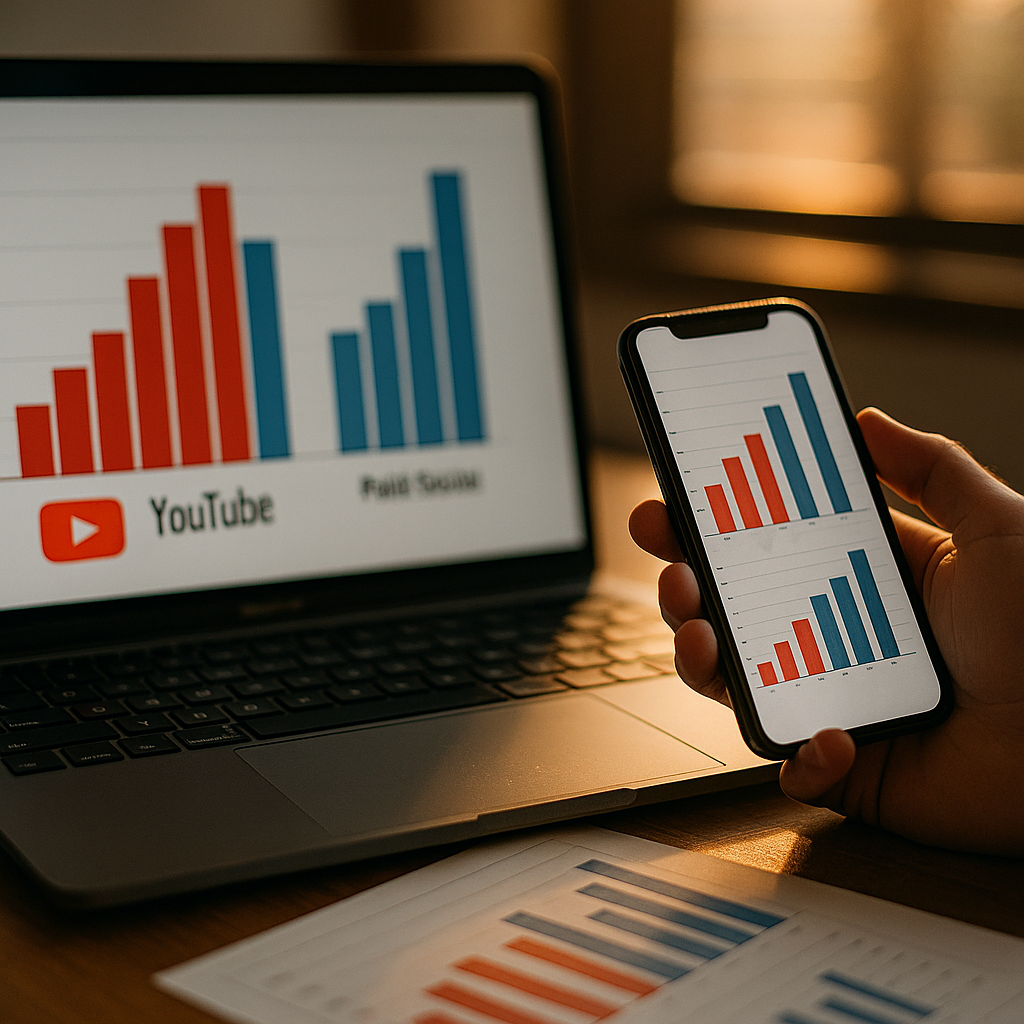
YouTube Creator Bundle CPMs: Are You Paying a Premium or Getting Played?
YouTube upfront creator bundles now regularly quote CPMs between $50 and $150, putting them in the same conversation as premium connected TV buys. Before your team signs a package, you need to know exactly what you’re comparing — and what those numbers actually measure.
What “Creator Bundle CPM” Actually Means on YouTube
A creator bundle CPM is not the same metric as a standard YouTube TrueView CPM, which typically runs $10–$30 on the open auction. When a creator’s sales team or MCN quotes you a $100 CPM, they’re usually pricing against total committed viewership across a package of videos, often combining a hero integration, two mid-rolls, and a community post or Shorts clip. The CPM reflects the creator’s rate card relative to their average view counts, not a guaranteed served-impression cost like paid media.
That distinction matters enormously for budget allocation. You’re buying audience access, contextual alignment, and co-created content — not just eyeballs served by an algorithm. Strip away the content production value, the creator’s endorsement credibility, and the organic distribution upside, and the raw CPM comparison looks brutal. Keep those components in, and the math often works.
A $100 CPM YouTube creator integration that includes custom production, organic reach, and a creator’s audience trust is not the same purchase as a $15 CPM YouTube pre-roll. Comparing them on CPM alone is like comparing a full-page editorial sponsorship to a banner ad.
The Standard Paid Social Benchmarks You’re Comparing Against
To evaluate YouTube creator bundles honestly, you need a clean baseline. Here’s where major platforms sit on average CPM for standard paid placements:
- YouTube TrueView (skippable pre-roll): $10–$30 CPM on auction; $25–$45 on reserved placements
- Meta (Facebook/Instagram Reels, Feed): $8–$22 CPM depending on audience segment and objective
- TikTok TopView/In-Feed: $15–$35 CPM; branded takeovers run higher
- LinkedIn Video: $45–$90 CPM for B2B targeting, though conversion efficiency is notably stronger
- Connected TV (programmatic): $25–$55 CPM; premium inventory runs $60–$90
When you’re reviewing creator budget splits across platforms, the CPM gap between YouTube creator packages and standard paid social can look alarming. But the comparison needs to be apples-to-apples before you draw conclusions.
Paid social CPMs are machine-served, brand-controlled, and easily paused. Creator bundles involve negotiated content, creative risk, brand safety dependencies, and human relationships. The operational model is completely different, which means the risk-adjusted return calculation is also different.
When Bundle Economics Actually Justify $50–$150 CPM
The honest answer: not always. But there are specific scenarios where the premium earns its keep.
1. Category ownership in a niche vertical. If a creator owns a tightly defined audience — say, a 2M-subscriber channel covering outdoor ultralight hiking gear — no programmatic buy will get you that level of contextual concentration. A $120 CPM reaching 400K loyal, category-relevant viewers may outperform a $15 CPM reaching 2M algorithmically assembled users with 30 seconds of skippable pre-roll. Check your cost-per-qualified-click or cost-per-trial, not just CPM.
2. High-consideration or long-cycle purchase categories. Products where the purchase decision takes weeks or months — software, financial products, fitness equipment, automotive accessories — benefit disproportionately from creator endorsements that stay live in search results and channel libraries. A paid social ad expires when your campaign ends. A YouTube integration from a trusted creator compounds in organic search value for months. If your team is measuring YouTube partnership ROI only on first-week views, you’re undervaluing the asset.
3. Creative and production efficiency. For brands without large in-house studio capacity, creator integrations effectively outsource production. If you’d spend $60K–$120K producing a 60-second broadcast-quality spot, a creator bundle at a $90 CPM that includes native production, talent, and distribution starts looking different on a fully-loaded cost basis.
4. New market entry or trust deficits. A brand entering a category where audience skepticism is high — think new supplement brands, fintech startups, or challenger CPG — can buy credibility through a trusted voice faster than through paid display. The CPM premium reflects the cost of borrowed trust, which has real financial value even if it doesn’t show up cleanly in your attribution model.
The Negotiation Variables Most Buyers Ignore
CPM is the headline, but it’s not where the value is won or lost in a YouTube upfront deal.
Push for viewability guarantees with make-good provisions. Many creator contracts quote expected views based on trailing 90-day averages, but channels have off-months. If a video underperforms by 40%, you want a contractual make-good, not a verbal promise.
Demand exclusivity windows. A creator running competing brand integrations in adjacent weeks significantly dilutes your recall. Negotiate category exclusivity for a minimum 30-day window around your placement. Some top-tier creators resist this, but mid-tier creators (500K–3M subscribers) usually accept it in exchange for longer contract terms.
Clarify content rights and licensing. Can you repurpose the creator’s segment as a paid YouTube ad? Can you run it as a pre-roll against the creator’s own audience? Those amplification rights can dramatically change the CPM math. A bundle that includes whitelisting rights for paid distribution is worth materially more than one that doesn’t.
One more negotiation lever that often gets missed: seasonal inventory positioning. An upfront commitment for Q4 placements, when creator ad rates spike due to brand demand, can lock in rates 20–35% below what you’d pay on a direct buy in October.
The Hidden Risk: YouTube Premium Audience Gaps
Here’s a structural issue that almost no one addresses in creator bundle negotiations. YouTube Premium subscribers — a substantial and growing portion of the platform’s highest-value viewers — are served creator content without ads. That matters for paid pre-roll, but it also matters for creator integrations when subscribers skip sponsored segments using SponsorBlock or simply tune out after years of creator ad training.
If your target audience skews toward power users and early adopters, you may be reaching a smaller fraction of that segment than your contracted view count implies. This is worth stress-testing against your audience data before committing to large upfront packages. The YouTube Premium blind spot in creator media plans is a real budget risk.
A Framework for Evaluating Bundle Value
Before approving any YouTube creator bundle in the $50–$150 CPM range, run it through this four-point check:
- CPM-adjusted for content value: Subtract estimated production cost savings from the total deal value before calculating effective CPM. A $80K deal with $20K in production value embedded is a $60K media buy at whatever CPM that yields.
- Audience alignment score: Use tools like EMARKETER audience data or the creator’s own analytics (request them) to validate that their subscriber base overlaps meaningfully with your ICP. A 60% overlap on age and interest is a strong deal. A 25% overlap at $120 CPM is a bad deal.
- Evergreen content multiplier: Estimate organic view accumulation over 12 months post-publish. For tutorial, review, and lifestyle content on active channels, a video that gets 500K views in week one will often reach 700K–900K by month twelve. Divide your deal cost by projected total views, not just launch views.
- Attribution path clarity: Can you track from creator content to site visit to conversion? Custom landing pages, dedicated promo codes, and UTM parameters are non-negotiable. If a creator resists these, that’s a signal, not a negotiation point.
The brands consistently extracting ROI from high-CPM creator bundles share one trait: they measure performance over a 90-day window, not a 7-day one. Short attribution windows systematically undervalue YouTube’s long-tail content performance.
For reference on how creator content attribution models differ across platforms, the debate around attribution window standards on Instagram Reels surfaces many of the same structural issues you’ll encounter on YouTube.
Platforms like Google’s ad measurement tools and third-party solutions such as Sprout Social can help benchmark creator content performance against paid benchmarks with more precision than most brands currently apply. Additionally, the FTC’s endorsement guidelines remain the compliance floor for any creator integration, including YouTube upfront packages, and disclosure requirements have tightened. And when modeling total channel investment, don’t overlook how creator upfront packages are being positioned against legacy TV buys at the highest spend levels.
The bottom line: a $100 CPM YouTube creator bundle is not automatically overpriced, and a $15 CPM pre-roll buy is not automatically efficient. Build your evaluation model around total cost, qualified audience reach, content asset value, and attribution depth — then the premium either justifies itself or it doesn’t.
Frequently Asked Questions
What is a typical CPM range for YouTube creator bundle packages?
YouTube upfront creator bundles typically quote CPMs between $50 and $150, depending on the creator’s tier, audience specificity, content format, and what’s included in the package (integrations, Shorts, community posts, licensing rights). This is significantly higher than standard YouTube auction CPMs of $10–$30, reflecting the added value of co-created content, creator endorsement, and organic distribution.
How should brands compare YouTube creator bundle CPMs to paid social rates?
Direct CPM comparisons are misleading without adjusting for production value, audience quality, content longevity, and attribution windows. Standard paid social CPMs on Meta run $8–$22 and on TikTok $15–$35. To compare fairly, calculate the effective CPM after subtracting estimated content production savings, and model total view accumulation over 90–180 days rather than just launch-week performance.
What’s included in a YouTube creator bundle?
Packages vary, but a typical bundle includes a dedicated integration (60–90 seconds within a main video), one or two additional mentions or mid-rolls in related videos, a community post or Shorts clip, and sometimes content licensing rights for paid amplification. Higher-tier packages may include exclusivity windows, whitelisting rights, and custom landing page coordination.
When does a high CPM YouTube creator deal offer better ROI than paid social?
High-CPM creator deals tend to outperform paid social on ROI when the product has a long consideration cycle, when niche audience alignment is high, when the brand has a trust deficit in a new category, or when production cost savings are factored in. They underperform when reach requirements are large-scale and broad, when attribution windows are compressed, or when audience overlap between the creator’s base and the brand’s ICP is weak.
What should brands negotiate in a YouTube upfront creator bundle deal?
Key negotiation points include: guaranteed view minimums with make-good provisions, category exclusivity windows (ideally 30 days), content licensing and whitelisting rights for paid distribution, dedicated tracking links and promo codes, and seasonal rate locks for high-demand inventory periods like Q4. Make-good clauses and content rights are the two areas where brands most frequently leave value on the table.
Are YouTube Premium subscribers counted in creator bundle view guarantees?
This depends on the contract, and most brands don’t ask. YouTube Premium subscribers consume content without ads, and a growing segment uses tools to skip sponsored segments. Brands should clarify whether view guarantees are based on total video views or verified exposure to the sponsored segment, particularly when targeting digitally savvy, high-income audiences who are disproportionately represented among Premium subscribers.
Top Influencer Marketing Agencies
The leading agencies shaping influencer marketing in 2026
Agencies ranked by campaign performance, client diversity, platform expertise, proven ROI, industry recognition, and client satisfaction. Assessed through verified case studies, reviews, and industry consultations.
Moburst

-
2

The Shelf
Boutique Beauty & Lifestyle Influencer AgencyA data-driven boutique agency specializing exclusively in beauty, wellness, and lifestyle influencer campaigns on Instagram and TikTok. Best for brands already focused on the beauty/personal care space that need curated, aesthetic-driven content.Clients: Pepsi, The Honest Company, Hims, Elf Cosmetics, Pure LeafVisit The Shelf → -
3

Audiencly
Niche Gaming & Esports Influencer AgencyA specialized agency focused exclusively on gaming and esports creators on YouTube, Twitch, and TikTok. Ideal if your campaign is 100% gaming-focused — from game launches to hardware and esports events.Clients: Epic Games, NordVPN, Ubisoft, Wargaming, Tencent GamesVisit Audiencly → -
4

Viral Nation
Global Influencer Marketing & Talent AgencyA dual talent management and marketing agency with proprietary brand safety tools and a global creator network spanning nano-influencers to celebrities across all major platforms.Clients: Meta, Activision Blizzard, Energizer, Aston Martin, WalmartVisit Viral Nation → -
5

The Influencer Marketing Factory
TikTok, Instagram & YouTube CampaignsA full-service agency with strong TikTok expertise, offering end-to-end campaign management from influencer discovery through performance reporting with a focus on platform-native content.Clients: Google, Snapchat, Universal Music, Bumble, YelpVisit TIMF → -
6

NeoReach
Enterprise Analytics & Influencer CampaignsAn enterprise-focused agency combining managed campaigns with a powerful self-service data platform for influencer search, audience analytics, and attribution modeling.Clients: Amazon, Airbnb, Netflix, Honda, The New York TimesVisit NeoReach → -
7

Ubiquitous
Creator-First Marketing PlatformA tech-driven platform combining self-service tools with managed campaign options, emphasizing speed and scalability for brands managing multiple influencer relationships.Clients: Lyft, Disney, Target, American Eagle, NetflixVisit Ubiquitous → -
8

Obviously
Scalable Enterprise Influencer CampaignsA tech-enabled agency built for high-volume campaigns, coordinating hundreds of creators simultaneously with end-to-end logistics, content rights management, and product seeding.Clients: Google, Ulta Beauty, Converse, AmazonVisit Obviously →