


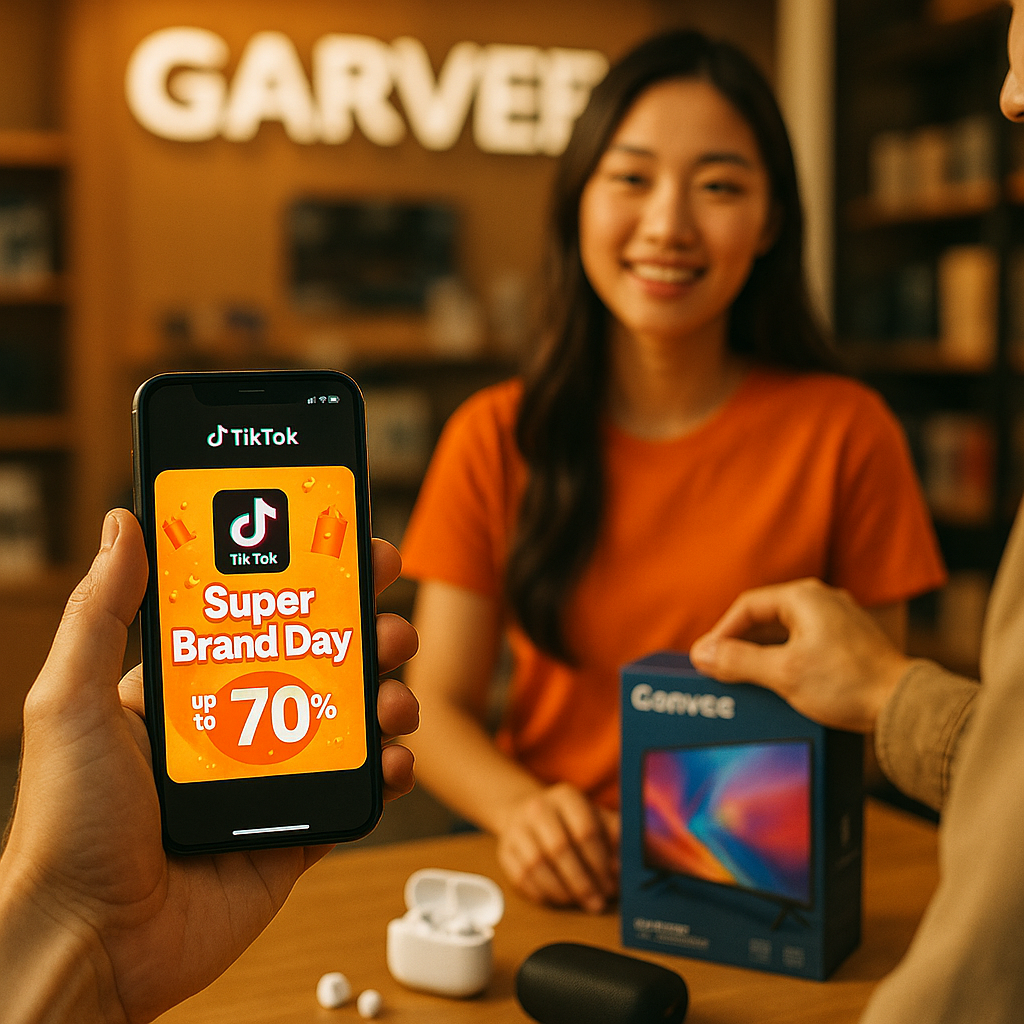
One Brand Day. Real Sell-Through. Here’s What Actually Worked.
TikTok Shop’s Super Brand Day program has quietly become one of the most effective seasonal sell-through mechanisms available to DTC brands, and GARVEE’s summer campaign is a case study worth dissecting. If you’re allocating budget to creator-commerce this year, this breakdown matters.
What Is TikTok Shop Super Brand Day — and Why GARVEE Bet on It
TikTok Shop’s Super Brand Day is a platform-managed promotional event that gives eligible brands a dedicated window of elevated visibility: boosted discoverability in the Shop tab, co-marketing support from TikTok, and access to high-traffic creator slots. Think of it as a flash-sale infrastructure layer that the platform builds for you, provided your creative and operational setup can support the volume.
GARVEE, a DTC brand specializing in outdoor and utility gear (cargo trailers, hitches, and vehicle accessories), isn’t the obvious candidate for a TikTok commerce moment. Their products are considered purchases, not impulse buys. Average order values run high. That made their decision to anchor a summer sell-through push around Super Brand Day genuinely interesting from a strategy standpoint.
The core hypothesis: summer is when their customer is actively solving problems (road trips, hauls, seasonal projects), so collapsing the consideration window with social proof and limited-time pricing could convert a category that normally requires weeks of research into something closer to a same-session decision.
When your product demands a considered purchase, the job of influencer content isn’t to sell on first touch. It’s to compress the research phase by answering objections inside the content itself.
Campaign Architecture: Three Tiers, One Flywheel
GARVEE structured their creator roster in three distinct tiers, each serving a different function in the purchase journey.
Tier 1: Category-adjacent macro creators (1M+ followers) handled awareness and legitimacy. These weren’t gear reviewers. They were truck owners, overlanders, and DIY home improvement creators whose audiences already had latent demand for trailer and towing solutions. Their content didn’t sell GARVEE directly. It normalized the problem.
Tier 2: Mid-tier product reviewers (100K–500K) delivered the depth. These creators filmed unboxings, installation walkthroughs, and real-use scenarios. Their briefs were deliberately product-specific: show the hitch receiver install in under three minutes, include the coupon code on-screen, and link directly to the Shop listing. No soft-sell here. This is where attribution was designed to happen.
Tier 3: Micro and nano creators in overlanding, camping, and truck enthusiast communities drove social proof at scale. Lower CPV, higher purchase intent audiences, and significantly better comment engagement from viewers who were already in the consideration set.
This tiered architecture mirrors what brands like e.l.f. Beauty’s mid-tier creator model have demonstrated: the middle tier does the heaviest lifting on conversion, while macros and micros anchor reach and credibility from both ends.
Creator Brief Design: How GARVEE Closed the Briefing Gap
The brief is where most DTC brands lose their Super Brand Day investment. They over-specify the wrong things (exact script, required hashtags, mandatory logo placement) and under-specify the ones that actually drive sales (objection handling, call-to-action placement, price anchoring).
GARVEE’s brief structure was organized around three questions creators had to answer in their content:
- Why this product for your specific audience? Creators were required to contextualize the product within their own content universe, not deliver a generic pitch.
- What would stop someone from buying right now? Briefs explicitly listed the top three audience objections (installation complexity, compatibility, shipping time) and provided factual answers creators could work into their narrative naturally.
- What is the single action you want the viewer to take? One CTA per video: tap the product link in the TikTok Shop tab. No alternatives, no confusion.
That third point deserves attention. One of the most common attribution failures in creator campaigns is CTA fragmentation: the creator mentions a website, a coupon code, a link in bio, and a Shop listing simultaneously. The viewer does nothing because they’ve been given too many choices. GARVEE enforced a single conversion path and built their attribution model around it.
For brands building out brief frameworks, the analysis of creator brief architecture in high-frequency purchase categories offers a useful structural contrast to what GARVEE deployed in a high-AOV context.
Attribution: What They Measured, What They Missed, and What You Should Fix
Attribution on TikTok Shop is both easier and messier than it looks. Easier because TikTok’s native analytics give you product page views, add-to-cart events, and completed purchases tied to specific creator content directly inside the TikTok Ads Manager. Messier because that data doesn’t talk cleanly to your own DTC stack unless you’ve set up the integration intentionally.
GARVEE used creator-specific UTM parameters appended to their Shop product URLs, which allowed them to cross-reference TikTok’s native data against their Shopify backend. This sounds basic, but a significant share of brands skip this step and end up attributing all Shop revenue to a generic “TikTok” channel.
What they measured well: creator-level ROAS, video-to-purchase conversion rate by content format (unboxing outperformed talking-head by roughly 2.3x in their category), and time-to-purchase from first content interaction.
What they likely underweighted: view-through attribution. When a viewer watches a GARVEE installation video, doesn’t tap, searches Google for “GARVEE cargo trailer review” three days later, and converts via paid search, that sale doesn’t trace back to the creator. eMarketer data consistently shows that last-click models undercount social commerce’s actual contribution by 20–40% in considered-purchase categories. GARVEE’s real creator-attributed revenue was almost certainly higher than their dashboard reported.
Last-click attribution on TikTok Shop consistently undercounts creator influence in high-AOV categories. Build in a view-through window and cross-reference with direct and branded search lift to get closer to truth.
The smarter play, which brands like those referenced in AI CRM attribution playbooks are now executing, is to layer incrementality modeling on top of platform-native data. Run a holdout group, measure branded search volume lift during the campaign window, and compare direct-to-site conversion rates against baseline. That triangulation gets you closer to the actual revenue contribution.
Sell-Through Mechanics: What Made the Summer Timing Work
Super Brand Day’s structural advantage is urgency without desperation. The time-limited window gives creators a legitimate reason to say “right now” without it sounding like a manufactured push. For GARVEE, the summer timing amplified this: their customer was already in project mode, already researching, already primed.
They also deployed a product bundling strategy specifically for the event, creating a Summer Haul Kit (hitch plus accessories) available only through the TikTok Shop listing at a bundled price. This served two purposes: it increased average order value beyond a single SKU purchase, and it gave creators a reason to show multiple products in a single video without the content feeling like a product catalog dump.
The Ulta Beauty TikTok Shop strategy used a similar bundling logic during its peak campaigns, and the pattern holds across categories: giving creators a hero product cluster rather than a single item generates richer content and higher cart values simultaneously.
Post-event, GARVEE used TikTok’s Spark Ads to amplify the top-performing creator videos beyond the Super Brand Day window. This is often where brands leave money on the table: the event ends, the paid amplification stops, and the content dies. Sparking the three to five best-performing videos for an additional two weeks extended the sell-through tail without requiring new creative production. Sprout Social research supports this approach, showing that creator content reaches peak engagement efficiency in the 48–72 hours after initial posting but can sustain meaningful conversion rates for 10–14 days when amplified with paid placement.
What DTC Brands Should Take Into Their Next Super Brand Day Planning Cycle
A few operational realities that this campaign surfaces for anyone planning a similar event:
- Brief specificity on objection handling beats creative control. Let creators find their own angle. Mandate that they answer the customer’s three biggest purchase barriers. That’s where the conversion happens.
- UTM every creator path, every time. There is no acceptable reason to skip this. If you can’t attribute it, you can’t scale it.
- Build your Spark Ads shortlist before the event ends. Set performance thresholds in advance (view rate, CTR, add-to-cart) and automatically flag videos that hit them. Don’t make this a post-mortem decision.
- Layer branded search monitoring into your attribution model. Use Google Search Console to track branded query volume during and after the campaign window. Lift here is your signal that creator content is influencing purchase intent that completes off-platform.
- Product bundling for events is table stakes. A single-SKU Shop listing gives creators less to work with and caps your AOV. Create an event-specific bundle at minimum.
For DTC brands navigating the creator selection side of this, the analysis of how zero-ad-spend brands ranked on TikTok Shop is a useful contrast point: organic creator alignment, not paid placement, drove their results. GARVEE’s model is the hybrid version of that, and it’s the more replicable playbook for brands with established marketing infrastructure.
Run your next Super Brand Day brief through GARVEE’s three-question framework before a single creator receives it. That alone will tighten conversion performance more than any platform optimization you’ll find in a dashboard.
Frequently Asked Questions
What is TikTok Shop Super Brand Day and how do brands qualify?
TikTok Shop Super Brand Day is a platform-managed promotional event that gives qualifying brands elevated visibility in the Shop tab, co-marketing support, and access to premium creator inventory during a defined campaign window. Eligibility is typically based on shop performance history, minimum GMV thresholds, and product catalog completeness. Brands should apply through their TikTok Shop seller account and work with a TikTok commerce partner or account manager to confirm eligibility criteria for their category.
How should DTC brands structure their creator roster for a TikTok Shop campaign?
A three-tier structure works best for most DTC brands: macro creators for category-level awareness and legitimacy, mid-tier creators for product depth and direct attribution, and micro or nano creators for high-intent community engagement. Each tier should have a distinct brief and a distinct success metric. Mid-tier creators typically drive the most measurable conversion in a single campaign window.
What attribution methods work best for TikTok Shop influencer campaigns?
Combine TikTok’s native Shop analytics with creator-specific UTM parameters appended to every Shop product link. Cross-reference platform data with your Shopify or DTC backend to avoid channel-level aggregation. Supplement with branded search volume monitoring in Google Search Console to capture off-platform conversion influence. For high-AOV categories, build in a view-through attribution window and consider incrementality testing with a holdout group to quantify the full revenue contribution.
How does product bundling improve Super Brand Day performance?
Event-specific bundles give creators richer content to work with, increase average order value beyond a single SKU, and create a genuine reason for urgency (bundle pricing available only during the event window). Bundles also simplify the creator’s job: they have one hero offering to direct viewers toward rather than choosing between multiple individual listings.
Should brands continue amplifying creator content after Super Brand Day ends?
Yes. Using TikTok Spark Ads to amplify the top-performing creator videos for two to three weeks after the event extends the sell-through tail without requiring new creative production. Set performance thresholds before the event ends (view rate, CTR, add-to-cart rate) and automatically flag videos that qualify. This is one of the highest-ROI post-event moves available to brands running creator-commerce programs on TikTok.
Top Influencer Marketing Agencies
The leading agencies shaping influencer marketing in 2026
Agencies ranked by campaign performance, client diversity, platform expertise, proven ROI, industry recognition, and client satisfaction. Assessed through verified case studies, reviews, and industry consultations.
Moburst

-
2

The Shelf
Boutique Beauty & Lifestyle Influencer AgencyA data-driven boutique agency specializing exclusively in beauty, wellness, and lifestyle influencer campaigns on Instagram and TikTok. Best for brands already focused on the beauty/personal care space that need curated, aesthetic-driven content.Clients: Pepsi, The Honest Company, Hims, Elf Cosmetics, Pure LeafVisit The Shelf → -
3

Audiencly
Niche Gaming & Esports Influencer AgencyA specialized agency focused exclusively on gaming and esports creators on YouTube, Twitch, and TikTok. Ideal if your campaign is 100% gaming-focused — from game launches to hardware and esports events.Clients: Epic Games, NordVPN, Ubisoft, Wargaming, Tencent GamesVisit Audiencly → -
4

Viral Nation
Global Influencer Marketing & Talent AgencyA dual talent management and marketing agency with proprietary brand safety tools and a global creator network spanning nano-influencers to celebrities across all major platforms.Clients: Meta, Activision Blizzard, Energizer, Aston Martin, WalmartVisit Viral Nation → -
5

The Influencer Marketing Factory
TikTok, Instagram & YouTube CampaignsA full-service agency with strong TikTok expertise, offering end-to-end campaign management from influencer discovery through performance reporting with a focus on platform-native content.Clients: Google, Snapchat, Universal Music, Bumble, YelpVisit TIMF → -
6

NeoReach
Enterprise Analytics & Influencer CampaignsAn enterprise-focused agency combining managed campaigns with a powerful self-service data platform for influencer search, audience analytics, and attribution modeling.Clients: Amazon, Airbnb, Netflix, Honda, The New York TimesVisit NeoReach → -
7

Ubiquitous
Creator-First Marketing PlatformA tech-driven platform combining self-service tools with managed campaign options, emphasizing speed and scalability for brands managing multiple influencer relationships.Clients: Lyft, Disney, Target, American Eagle, NetflixVisit Ubiquitous → -
8

Obviously
Scalable Enterprise Influencer CampaignsA tech-enabled agency built for high-volume campaigns, coordinating hundreds of creators simultaneously with end-to-end logistics, content rights management, and product seeding.Clients: Google, Ulta Beauty, Converse, AmazonVisit Obviously →