


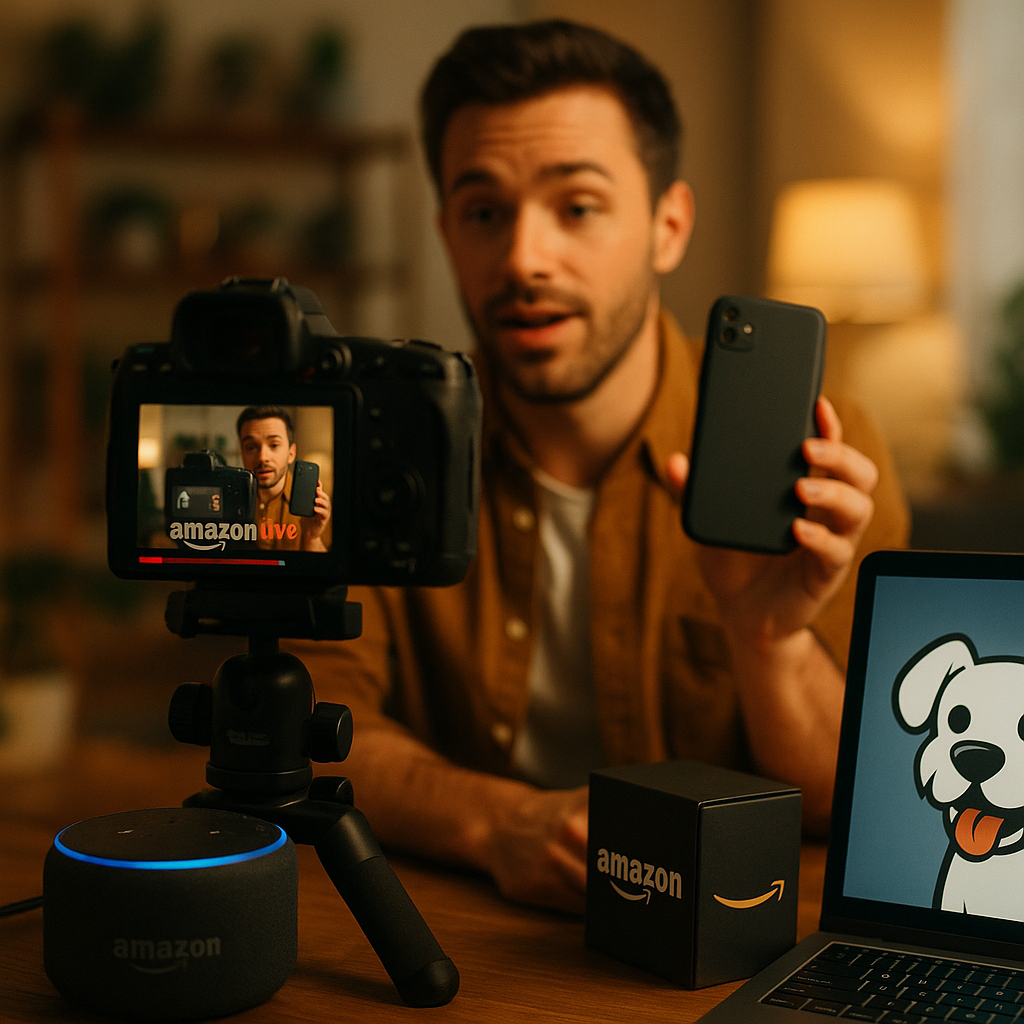
Rufus now answers the question your product page used to. That’s the uncomfortable truth Amazon sellers are waking up to: shoppers ask Rufus “what’s the best budget espresso machine” and get a shortlist before they ever hit search results. If your Amazon Live stream isn’t positioned to catch that traffic the moment Rufus hands it off, you’re funding someone else’s conversion.
This isn’t a theoretical problem. Amazon has been quietly rewiring discovery around its AI assistant, and livestream commerce sits right at the intersection of “found via Rufus” and “bought right now.” Get the structure wrong, and you lose shoppers to a competitor’s listing three scrolls down. Get it right, and you turn a five-minute stream into your highest-converting SKU of the week.
Why Rufus Traffic Behaves Differently Than Search Traffic
Shoppers who land on your stream via Rufus recommendations aren’t browsing. They’ve already had a conversational exchange with an AI that filtered options for them based on stated needs, budget, and use case. That means they arrive pre-qualified, but also pre-loaded with expectations Rufus set on their behalf.
If Rufus told a shopper your blender is “the best option for small kitchens under $80,” and your host spends the first two minutes talking about horsepower and smoothie recipes, you’ve lost the thread. The shopper’s mental model doesn’t match the stream’s opening pitch. That mismatch costs conversions.
Rufus-referred viewers convert on relevance to their stated problem, not on production value. A host who nails the “why this, why now” framing in the first 15 seconds will consistently outperform a polished but generic pitch.
We covered the underlying algorithm shift in detail in our earlier breakdown of Rufus’s impact on streaming cadence. The short version: Amazon’s assistant is now a discovery layer sitting above your listings, and live content that acknowledges its framing converts better than content that ignores it.
Structuring the Stream Around the Handoff Moment
Think of the Rufus handoff as a relay baton pass. The AI carries the shopper to your storefront doorstep. Your host has maybe 10-15 seconds to grab the baton before the shopper bounces to a competing listing or closes the tab entirely.
Here’s the structural sequence that’s producing the strongest same-session conversion rates right now:
- Open with the use-case, not the brand. Skip the “hi everyone, welcome back” intro. Lead with “if you’re comparing air purifiers for allergies under $150, here’s what you need to know” — language that mirrors how Rufus would have summarized the product.
- Validate the AI’s claim within the first minute. If Rufus told shoppers this product is “quietest in its class,” demonstrate the noise level on camera immediately. Don’t bury proof points in minute eight.
- Surface comparison context early. Rufus users often arrived after comparing 2-3 options. Address the comparison directly: “compared to the [competitor], here’s where this wins and where it doesn’t.” Honesty here builds trust fast.
- Push the CTA within the first five minutes, then repeat every 3-4 minutes. Rufus-referred viewers have shorter patience for slow builds. They came for an answer, not a narrative arc.
- Pin a live comment answering the most likely Rufus-prompted question. If shoppers are asking Rufus “does this work for X,” pin that Q&A visibly so late-joining viewers see it instantly.
This structure isn’t about compressing your usual playbook. It’s a different opening act entirely, built for viewers who already did homework before they showed up.
What “Same-Session Purchase” Actually Requires
Same-session conversion is the metric that matters here, not overall stream reach. A stream that pulls 40,000 views but converts at 0.8% is worse business than one pulling 4,000 views converting at 6%, especially when Rufus traffic tends to arrive already deep in the consideration funnel.
Three operational levers control this more than anything else:
Inventory visibility on-screen. Rufus shoppers move fast. If your host can’t confirm stock and estimated delivery date verbally within the pitch, hesitation creeps in. Brands running dedicated Amazon Live production teams now build real-time inventory feeds directly into the host’s earpiece prompts, not just the on-screen overlay.
Checkout friction inside the stream. Amazon’s native “buy without leaving the stream” flow works, but only if hosts explicitly narrate it. Say the words: “tap the product card, you can check out right here without leaving the stream.” Assume nothing about viewer familiarity with the UI, especially for viewers new to Amazon Live from a Rufus referral.
Post-purchase reinforcement within the same session. Once a viewer converts, don’t let them drift off. A quick on-screen thank-you plus a bundle or accessory upsell (still within the same stream) captures incremental revenue while purchase intent is hot. This is where a lot of streams leave money sitting on the table — they treat the sale as the finish line instead of the midpoint.
Picking Hosts Who Can Improvise Around AI-Set Expectations
Not every creator handles this well. The hosts who win Rufus-referred sessions tend to share a specific skill: they can pivot mid-sentence based on live chat questions without losing the thread of their pitch. That’s a different skill than scripted QVC-style presentation.
Look for creators who already run structured Q&A segments well, since that’s essentially what Rufus-informed viewers expect from minute one. If you’ve evaluated creators for other high-interactivity formats, the same instincts apply. Our breakdown of running Discord Stage AMAs — wait, correcting that: our breakdown of Discord Stage AMAs covers the improvisation skill set that transfers directly to Amazon Live hosting under AI-driven traffic conditions.
Brands sourcing hosts through Amazon’s Creator Connections program should specifically ask for demo reels showing unscripted product Q&A, not just polished sales pitches. It’s a small ask that filters out a lot of hosts who look great on paper but freeze when chat throws them a curveball.
Commission Structures and the Case for Paying for Speed
Standard Amazon Influencer Program commissions run flat regardless of how fast a creator converts a stream. That’s a mismatch when Rufus traffic rewards speed to CTA. Some brands are experimenting with tiered bonus structures that pay creators extra for hitting same-session conversion benchmarks, not just total sales volume.
This mirrors a shift happening across affiliate commerce broadly. TikTok Shop’s newer commission tiers reward creators based on match quality and conversion signals rather than flat rates, a model detailed in our look at TikTok Shop’s Q4 commission tiers. Amazon hasn’t formalized an equivalent structure publicly, but nothing stops brands from layering their own performance bonuses on top of standard program payouts.
If you’re running multiple creators across a launch week, track same-session conversion rate per host, not just gross merchandise value. A host who drives fewer total sales but converts Rufus-referred viewers at double the rate deserves the bigger retainer next quarter.
Measurement: What to Actually Track
Amazon’s native stream analytics give you views, watch time, and units sold. That’s not enough to diagnose Rufus-specific performance. Layer in:
- Traffic source tagging where available through Amazon Attribution, isolating Rufus-referred sessions from organic search and paid traffic.
- Time-to-first-CTA-click within the stream, benchmarked against your non-Rufus streams.
- Drop-off timestamps, especially in the first 90 seconds, which tells you whether your opening hook is landing.
- Repeat-viewer rate for shoppers who came back after an initial Rufus-prompted visit but didn’t convert same-session.
That last metric matters more than brands give it credit for. Not every Rufus-referred viewer converts on the first stream. Some come back after checking two more listings. Retargeting these viewers with a follow-up stream notification, rather than a generic ad, tends to close the loop more efficiently.
For a broader foundation on structuring creator-hosted commerce streams before layering in AI-traffic considerations, our original Amazon Live shopping playbook covers the core mechanics worth mastering first.
Where This Is Headed
Amazon has every incentive to keep expanding Rufus’s role in discovery. It reduces search friction and keeps shoppers inside Amazon’s ecosystem instead of researching on Google or Reddit first. According to eMarketer’s coverage of retail media trends, conversational commerce interfaces are expected to capture a growing share of product research time across major retailers, not just Amazon. That means the handoff-to-livestream structure described here isn’t a temporary tactic. It’s becoming core infrastructure for anyone running commerce streams at scale.
Brands that treat Rufus as a threat to organic discovery are missing the opportunity. Treat it instead as a qualified-lead generator feeding your highest-converting sales channel. The stream just needs to be built to catch what Rufus sends it.
FAQs
Frequently Asked Questions
What is Rufus AI and how does it affect Amazon Live streams?
Rufus is Amazon’s generative AI shopping assistant that answers product questions and recommends items conversationally. It affects Amazon Live by pre-qualifying viewers before they arrive, meaning streams need to open with use-case framing rather than generic introductions to match shopper expectations.
How quickly should a host issue a call-to-action in a Rufus-referred stream?
Within the first five minutes, then repeated every three to four minutes. Rufus-referred viewers typically arrive with shorter patience since they’ve already done comparison research through the AI assistant.
Can brands track which stream viewers arrived via Rufus specifically?
Amazon Attribution can help isolate traffic sources, though granular Rufus-specific tagging is still limited compared to full campaign-level analytics. Brands should benchmark time-to-CTA-click and drop-off timestamps as proxy indicators.
Should creator commission structures change for Rufus-driven streams?
Many brands are testing performance bonuses tied to same-session conversion speed rather than flat commissions, since Rufus traffic rewards hosts who convert quickly rather than those who build slow narrative arcs.
What’s the biggest mistake brands make with Rufus-referred stream traffic?
Treating the opening minutes like a standard stream intro instead of directly addressing the comparison or question Rufus likely surfaced for the viewer. That mismatch drives immediate drop-off.
Next step: Audit your last three Amazon Live streams for time-to-CTA and opening-line relevance, then rebuild your host script around the use-case-first structure before your next scheduled stream.
Top Influencer Marketing Agencies
The leading agencies shaping influencer marketing in 2026
Agencies ranked by campaign performance, client diversity, platform expertise, proven ROI, industry recognition, and client satisfaction. Assessed through verified case studies, reviews, and industry consultations.
Moburst

-
2

The Shelf
Boutique Beauty & Lifestyle Influencer AgencyA data-driven boutique agency specializing exclusively in beauty, wellness, and lifestyle influencer campaigns on Instagram and TikTok. Best for brands already focused on the beauty/personal care space that need curated, aesthetic-driven content.Clients: Pepsi, The Honest Company, Hims, Elf Cosmetics, Pure LeafVisit The Shelf → -
3

Audiencly
Niche Gaming & Esports Influencer AgencyA specialized agency focused exclusively on gaming and esports creators on YouTube, Twitch, and TikTok. Ideal if your campaign is 100% gaming-focused — from game launches to hardware and esports events.Clients: Epic Games, NordVPN, Ubisoft, Wargaming, Tencent GamesVisit Audiencly → -
4

Viral Nation
Global Influencer Marketing & Talent AgencyA dual talent management and marketing agency with proprietary brand safety tools and a global creator network spanning nano-influencers to celebrities across all major platforms.Clients: Meta, Activision Blizzard, Energizer, Aston Martin, WalmartVisit Viral Nation → -
5

The Influencer Marketing Factory
TikTok, Instagram & YouTube CampaignsA full-service agency with strong TikTok expertise, offering end-to-end campaign management from influencer discovery through performance reporting with a focus on platform-native content.Clients: Google, Snapchat, Universal Music, Bumble, YelpVisit TIMF → -
6

NeoReach
Enterprise Analytics & Influencer CampaignsAn enterprise-focused agency combining managed campaigns with a powerful self-service data platform for influencer search, audience analytics, and attribution modeling.Clients: Amazon, Airbnb, Netflix, Honda, The New York TimesVisit NeoReach → -
7

Ubiquitous
Creator-First Marketing PlatformA tech-driven platform combining self-service tools with managed campaign options, emphasizing speed and scalability for brands managing multiple influencer relationships.Clients: Lyft, Disney, Target, American Eagle, NetflixVisit Ubiquitous → -
8

Obviously
Scalable Enterprise Influencer CampaignsA tech-enabled agency built for high-volume campaigns, coordinating hundreds of creators simultaneously with end-to-end logistics, content rights management, and product seeding.Clients: Google, Ulta Beauty, Converse, AmazonVisit Obviously →