


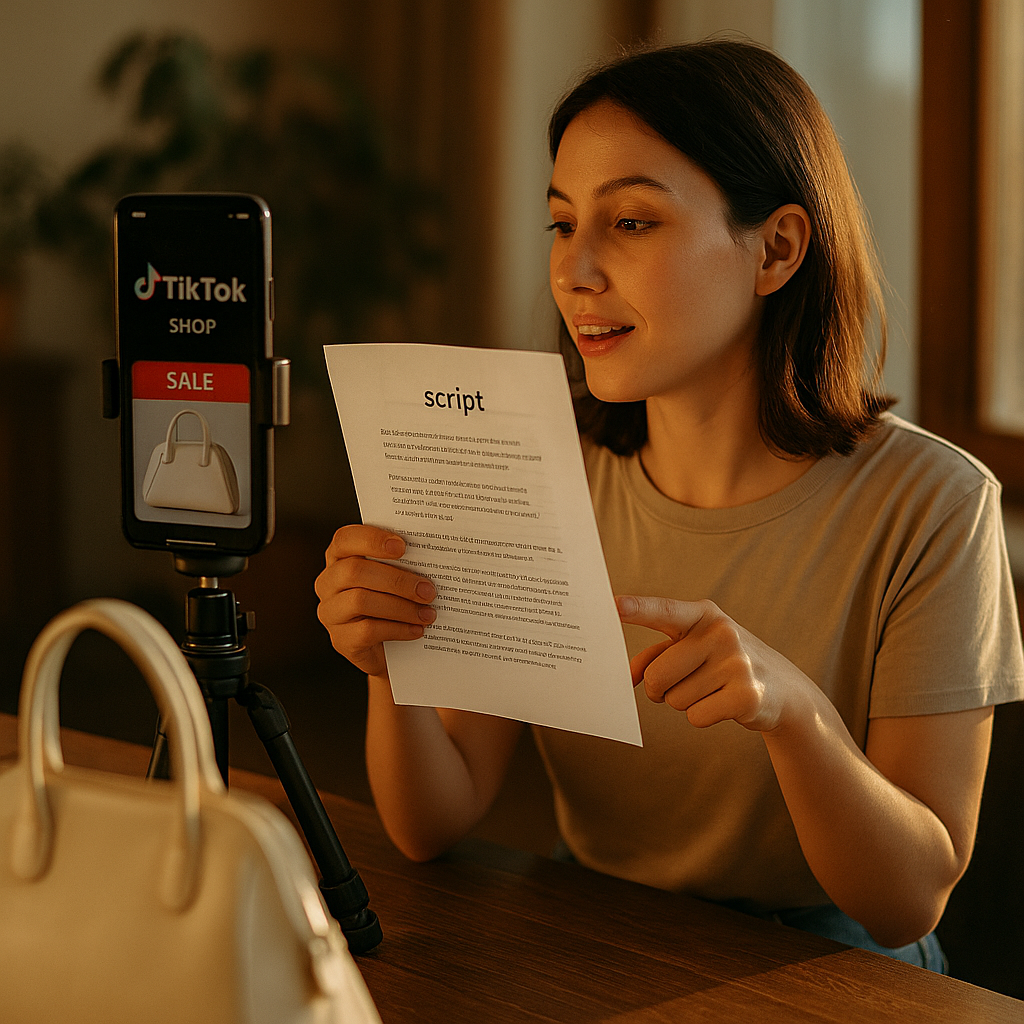
Seventy percent of TikTok Shop livestream viewers decide whether to stay or scroll within the first 90 seconds. That’s not a guess — it’s what happens when you watch retention graphs on your own streams. Get that window wrong, and your commission rates, your GMV, your whole TikTok Shop live commerce strategy collapses before you’ve said a single product benefit out loud.
Most brands treat the opening of a livestream as throat-clearing. “Hey guys, welcome, give us a second while we get set up.” That sentence alone costs you half your audience. This playbook breaks down exactly what to script, second by second, so viewers stay long enough to see the offer.
Why the first 90 seconds decide everything
TikTok’s live algorithm rewards watch time and engagement velocity in the opening minutes, then uses that data to decide whether to keep pushing your stream into more For You feeds. A slow open doesn’t just lose viewers — it tells the algorithm your stream isn’t worth distributing. That’s a double penalty: fewer people watching now, and fewer people discovering you later in the session.
Compare this to a QVC-style broadcast, where hosts have thirty seconds of dead air to work with because viewers already tuned in intentionally. TikTok Shop viewers didn’t tune in. They scrolled past a thumbnail, or a friend’s share, or an algorithmic nudge. They’re one thumb-flick away from gone. There’s no loyalty to burn.
If your stream doesn’t earn a reason to stay within 90 seconds, the algorithm stops recommending it — and no product discount fixes a distribution problem.
The three jobs your opening script must do
Every successful opening handles three things simultaneously, not sequentially. You don’t have time for sequence.
- Orient the scroller. What is this, in one glance? Product category, brand name, and why it matters — visible and spoken within the first five seconds.
- Create urgency without looking desperate. A reason to stay watching right now, not “later in the stream.”
- Signal social proof immediately. Viewer count, sales counter, or a live comment acknowledgment — anything that tells a newcomer other people are already invested.
Miss any one of these and you’re relying on product quality alone to hold attention. Product quality matters eventually. It doesn’t matter in second four.
Second-by-second breakdown: 0 to 30
This is the orientation window. Script it tight, and rehearse it until it sounds unscripted — that tension is the whole craft of live commerce hosting.
- 0-3 seconds: Say the product category and the deal out loud, on camera, before anything else. “We just dropped 40% off our best-selling serum, and I’m showing you why it sells out every drop.” No greeting, no “hey guys.”
- 3-10 seconds: Physically hold or demonstrate the product. Movement catches scroll-through eyes far better than a static host talking to camera.
- 10-20 seconds: Acknowledge new viewers by name or handle if your setup allows it, referencing live chat. This single move dramatically increases comment rates because it proves the stream is actually live and responsive, not a loop.
- 20-30 seconds: State the scarcity mechanic clearly — limited units, time-boxed discount, or bundle only available during the stream. Vague urgency (“don’t miss out”) underperforms specific urgency (“only 200 bundles at this price, 40 already claimed”).
Second-by-second breakdown: 30 to 60
This is where you build proof and reduce friction simultaneously.
Introduce a quick credibility marker: a review count, a repeat-customer stat, or a recognizable face if you’re working with a creator. “This is the serum with 40,000 five-star reviews” lands harder than a product description. Keep it to one sentence. This isn’t the moment for a features list — that comes later, once retention is secured.
Then walk through exactly how to buy without leaving the stream. Sounds basic, but a huge share of drop-off happens because first-time TikTok Shop viewers don’t understand the yellow cart icon is clickable mid-video. Say it plainly: “Tap the yellow basket at the bottom, it’s the orange cart icon, that takes you straight to checkout without leaving this stream.”
Second-by-second breakdown: 60 to 90
Close the opening loop by transitioning into the first real demo or comparison, but tease what’s coming later in the stream. “In the next ten minutes, I’m showing you the three ways we use this, plus a bundle deal that’s only live for the next hour.” This is the mechanism that keeps people through minute five, ten, twenty — a rolling promise of more value, always just ahead.
Never let this section go silent. Dead air past 60 seconds, even five seconds of it, reads as low-energy and viewers bail. Hosts who succeed at this treat silence as the enemy, not pacing.
What actually kills retention (and it’s rarely the product)
Brands blame product-market fit for weak streams. Usually it’s execution. A few recurring failure patterns show up across TikTok Shop accounts we’ve reviewed:
- Tech setup fumbling on camera. Adjusting ring lights or fixing audio while live tells new viewers this isn’t ready for them.
- Generic greetings that waste the golden seconds. “Welcome to the stream, thanks for joining” is ten wasted seconds with zero information value.
- No visible offer in the first frame. If a scroller can’t tell what’s being sold and why it’s urgent within two seconds of landing, they’re gone.
- Hosts who talk to the camera instead of the product. Livestream commerce is visual-first. Hands need to be doing something the entire time.
This mirrors patterns seen across other live commerce formats too. The Amazon Live streaming cadence shifts driven by Rufus AI traffic show the same principle: platforms increasingly reward hosts who front-load clarity and urgency rather than build to it slowly.
Scripting versus sounding scripted
There’s a real tension here. Script too tightly, and hosts sound like they’re reading cue cards, which erodes the authenticity that makes live commerce work in the first place. Script too loosely, and you get the meandering opens that cost views.
The fix: script the beats, not the words. Give hosts a checklist of what must happen by which second mark, then let them use their own phrasing. A good rehearsal process runs the same 90-second open five or six times before going live, timing it with a stopwatch, until the beats land naturally without sounding memorized.
Brands running affiliate-driven streams should build this into creator briefs directly. If you’re negotiating affiliate commission structures with creators, include opening-script requirements as a condition of higher tiers. Creators who consistently hit strong 90-second retention should be the ones getting premium commission rates — that’s a direct, measurable signal tied to match-signal-based commission tiers already shaping TikTok Shop’s creator economics.
Measuring whether your open is actually working
TikTok Shop’s live analytics dashboard shows average view duration and viewer retention curves. Pull this after every stream, not just the aggregate GMV number. Look specifically at the drop-off slope in the first 90 seconds — a steep early cliff followed by a flatter curve tells you the open is broken even if the rest of the stream performs.
Compare retention across different hosts and different scripted opens if you’re running multiple streams weekly. This is the same operational discipline brands apply to organic TikTok livestream commerce formats, where testing hooks systematically beats guessing at what “feels right.”
According to data cited by eMarketer, live commerce continues to grow as a share of total social commerce spend, which means competition for those first-90-second attention windows is only intensifying. Platforms like TikTok are increasingly transparent about performance data through TikTok Ads Manager and Shop analytics, giving brands more granular retention data than ever — use it.
Retention curves don’t lie. If viewers are leaving in the first 90 seconds across every host and every product, the problem isn’t the script — it’s the strategy behind it.
Compliance notes brands can’t skip
Live commerce moves fast, but disclosure rules don’t bend for speed. Any paid partnership or affiliate relationship needs clear, on-screen disclosure per FTC guidelines, and that disclosure should ideally happen within the opening segment, not buried at minute twenty when most viewers have already left. Build the disclosure line into the script itself — “this is a paid partnership with [brand]” takes three seconds and protects the brand from regulatory risk while barely denting pacing.
Brands operating in the UK or EU should also review disclosure expectations from bodies like the ICO, particularly around data handling during live shopping events where viewer information may be captured for retargeting.
Bringing it together for your next stream
Write the 90-second open as its own document, separate from the general stream outline, and treat it with the same rigor as a paid ad script. Test it, time it, revise it after every stream based on retention data — then hold your hosts accountable to the beats, not just the vibe. That discipline, more than any single hook or discount, is what separates TikTok Shop streams that scale from ones that plateau.
FAQs
How long should a TikTok Shop livestream opening script actually be?
Keep the scripted beats to the first 90 seconds, roughly 150-200 spoken words if delivered at a natural pace. Anything longer risks sounding rehearsed rather than energetic.
What’s the single biggest mistake brands make in the opening seconds?
Leading with a greeting instead of the offer. Viewers need to see the product and the deal within the first few seconds, not after a “hey guys, welcome” preamble.
Should every host use the exact same script?
No. Script the required beats and their timing, but let each host use their own phrasing. Rigid word-for-word scripts tend to sound stiff and hurt authenticity, which undercuts trust and conversion.
How do I know if my opening is actually causing drop-off?
Check TikTok Shop’s live analytics for viewer retention curves. A steep decline in the first 90 seconds, followed by a flatter line later, is a clear signal the open needs revision.
Does disclosure have to happen in the first 90 seconds?
It’s best practice to disclose paid partnerships early, ideally within the opening segment, since most viewer drop-off happens before the midpoint of a stream and disclosure buried later may never reach most viewers.
Can a strong opening script improve algorithmic reach?
Yes. TikTok’s live algorithm factors in early watch time and engagement velocity when deciding how widely to distribute a stream, so a strong 90-second open can directly increase discovery for the rest of the session.
FAQs
How long should a TikTok Shop livestream opening script actually be?
Keep the scripted beats to the first 90 seconds, roughly 150-200 spoken words if delivered at a natural pace. Anything longer risks sounding rehearsed rather than energetic.
What’s the single biggest mistake brands make in the opening seconds?
Leading with a greeting instead of the offer. Viewers need to see the product and the deal within the first few seconds, not after a “hey guys, welcome” preamble.
Should every host use the exact same script?
No. Script the required beats and their timing, but let each host use their own phrasing. Rigid word-for-word scripts tend to sound stiff and hurt authenticity, which undercuts trust and conversion.
How do I know if my opening is actually causing drop-off?
Check TikTok Shop’s live analytics for viewer retention curves. A steep decline in the first 90 seconds, followed by a flatter line later, is a clear signal the open needs revision.
Does disclosure have to happen in the first 90 seconds?
It’s best practice to disclose paid partnerships early, ideally within the opening segment, since most viewer drop-off happens before the midpoint of a stream and disclosure buried later may never reach most viewers.
Can a strong opening script improve algorithmic reach?
Yes. TikTok’s live algorithm factors in early watch time and engagement velocity when deciding how widely to distribute a stream, so a strong 90-second open can directly increase discovery for the rest of the session.
Top Influencer Marketing Agencies
The leading agencies shaping influencer marketing in 2026
Agencies ranked by campaign performance, client diversity, platform expertise, proven ROI, industry recognition, and client satisfaction. Assessed through verified case studies, reviews, and industry consultations.
Moburst

-
2

The Shelf
Boutique Beauty & Lifestyle Influencer AgencyA data-driven boutique agency specializing exclusively in beauty, wellness, and lifestyle influencer campaigns on Instagram and TikTok. Best for brands already focused on the beauty/personal care space that need curated, aesthetic-driven content.Clients: Pepsi, The Honest Company, Hims, Elf Cosmetics, Pure LeafVisit The Shelf → -
3

Audiencly
Niche Gaming & Esports Influencer AgencyA specialized agency focused exclusively on gaming and esports creators on YouTube, Twitch, and TikTok. Ideal if your campaign is 100% gaming-focused — from game launches to hardware and esports events.Clients: Epic Games, NordVPN, Ubisoft, Wargaming, Tencent GamesVisit Audiencly → -
4

Viral Nation
Global Influencer Marketing & Talent AgencyA dual talent management and marketing agency with proprietary brand safety tools and a global creator network spanning nano-influencers to celebrities across all major platforms.Clients: Meta, Activision Blizzard, Energizer, Aston Martin, WalmartVisit Viral Nation → -
5

The Influencer Marketing Factory
TikTok, Instagram & YouTube CampaignsA full-service agency with strong TikTok expertise, offering end-to-end campaign management from influencer discovery through performance reporting with a focus on platform-native content.Clients: Google, Snapchat, Universal Music, Bumble, YelpVisit TIMF → -
6

NeoReach
Enterprise Analytics & Influencer CampaignsAn enterprise-focused agency combining managed campaigns with a powerful self-service data platform for influencer search, audience analytics, and attribution modeling.Clients: Amazon, Airbnb, Netflix, Honda, The New York TimesVisit NeoReach → -
7

Ubiquitous
Creator-First Marketing PlatformA tech-driven platform combining self-service tools with managed campaign options, emphasizing speed and scalability for brands managing multiple influencer relationships.Clients: Lyft, Disney, Target, American Eagle, NetflixVisit Ubiquitous → -
8

Obviously
Scalable Enterprise Influencer CampaignsA tech-enabled agency built for high-volume campaigns, coordinating hundreds of creators simultaneously with end-to-end logistics, content rights management, and product seeding.Clients: Google, Ulta Beauty, Converse, AmazonVisit Obviously →