


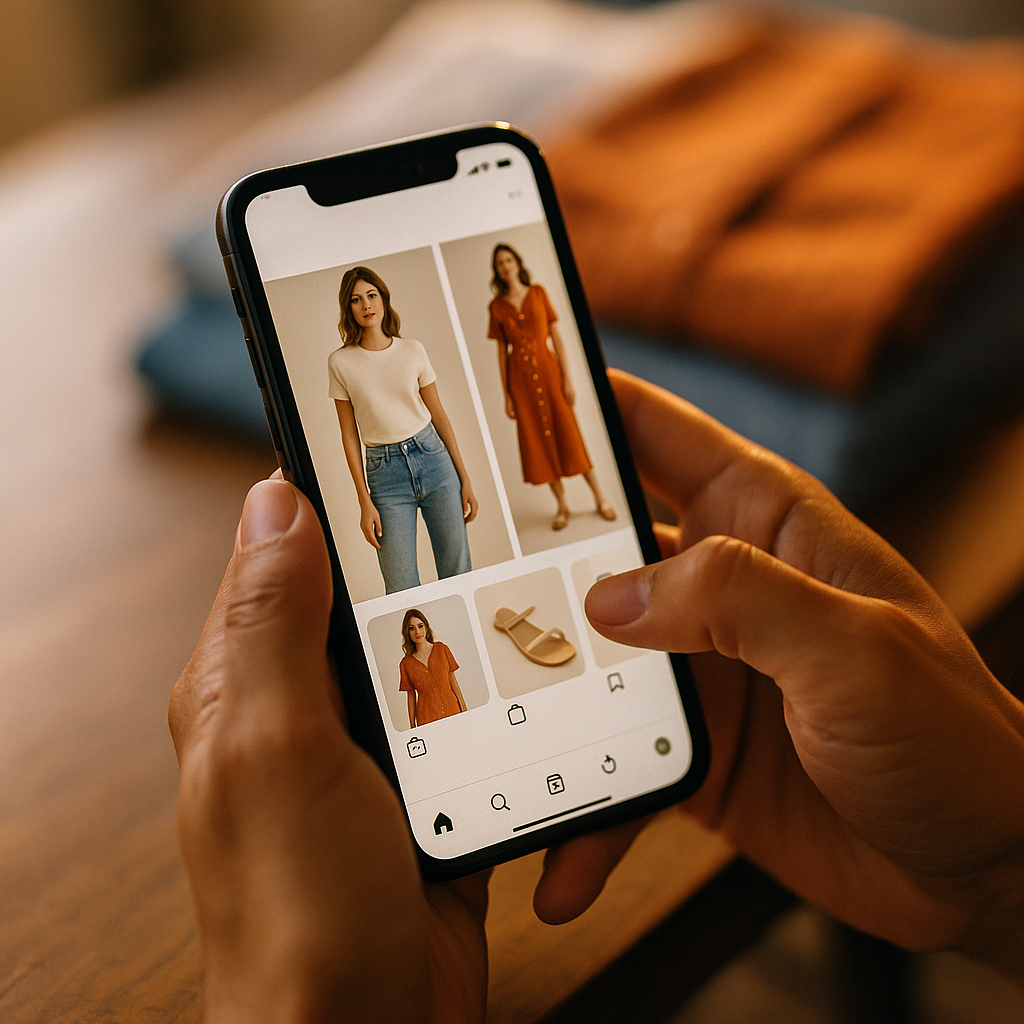
Instagram carousels get 1.4x more reach than single-image posts, but most brands still build them backwards. They lead with the hero product shot, bury the context, and wonder why saves stay flat and checkout links get ignored. An Instagram shoppable carousel isn’t a slideshow of catalog images — it’s a sequenced narrative that has to earn a swipe before it earns a sale.
If your carousel strategy is “put five product photos in a row and tag them all,” you’re leaving conversion on the table. This playbook breaks down how to sequence multi-product story arcs that actually move people from scroll to save to checkout.
Why Sequencing Matters More Than Product Selection
Marketers obsess over which products to feature. Fair enough — that matters. But the order you show them in changes how the algorithm and the human brain both respond. Instagram’s ranking systems weight early engagement signals heavily, and the first two slides largely determine whether someone keeps swiping or bounces. Instagram’s GEM algorithm rewards content that sustains attention across a session, not just content that gets a quick like.
Carousels behave the same way. Meta’s own creative guidance confirms that completion rate — how many people swipe all the way through — is a meaningful distribution signal, not just a vanity metric. Meta’s business platform documentation has repeatedly emphasized story-driven formats over static catalog dumps.
A carousel that front-loads its best product shot often gets the worst save rate, because there’s nothing left to discover on slide three.
The Problem With “Best Foot Forward” Thinking
Traditional retail merchandising says lead with your hero SKU. Social merchandising works differently. People save carousels they intend to revisit — for gift ideas, outfit inspiration, or a “figure this out later” purchase decision. If slide one gives away the full picture, there’s no reason to save it. The save button is essentially a bookmark for unfinished business. Your job is to create productive incompleteness.
The Five-Beat Arc: Setup, Tension, Reveal, Proof, Action
We covered the foundational structure in our earlier breakdown of the 5-slide story arc, but it’s worth restating the core sequencing logic here because it’s the backbone of everything that follows.
- Slide 1 — Setup: A relatable problem or scenario, not a product. Think “3pm slump” or “packing for a weekend trip,” not a bottle shot.
- Slide 2 — Tension: Introduce friction. Why do existing solutions fall short? This is where you can subtly needle a category pain point without naming competitors.
- Slide 3 — Reveal: The hero product enters, but framed as the resolution to slides one and two, not as an isolated product shot.
- Slide 4 — Proof: Social proof, a stat, a before/after, or a complementary product that extends the use case.
- Slide 5 — Action: The shoppable tag, a clear CTA, and ideally a reason to act now (limited restock, bundle pricing, seasonal relevance).
Multi-product carousels complicate this arc because you’re not resolving one tension, you’re resolving several. That’s where most brands lose the thread.
Sequencing Multiple Products Without Losing the Narrative
When you’re tagging four or five SKUs in one carousel, the temptation is to treat each slide as its own mini-ad. Resist that. Instead, structure the carousel like a shoppable outfit build or a routine, where each product slide answers the question raised by the previous one.
A skincare brand promoting a four-step routine, for example, shouldn’t just show four product bottles in sequence. Slide two should show the skin concern the first product addresses, slide three should show how the second product builds on the first result, and so on. Each slide asks “then what?” and the next slide answers it.
Carousels that maintain a single continuous question across all slides see meaningfully higher save rates than carousels that reset context on every slide, according to creative testing shared by agencies working within Sprout Social’s content performance benchmarks.
The “Then What” Test
Before publishing, run every slide transition through a simple test: does slide N+1 answer a question implicitly raised by slide N? If a slide could be moved to a different position in the carousel without changing the meaning, your sequencing is weak. Tight sequencing means order is load-bearing.
Save Rate Is a Different Metric Than Reach — Optimize for It Separately
Brands often report reach and engagement as if they’re proxies for purchase intent. They’re not. Saves correlate far more strongly with eventual conversion because saving is a deliberate, low-friction commitment to revisit. A carousel optimized purely for reach (broad appeal, generic hooks) often underperforms on saves compared to a narrower, more specific carousel that speaks directly to a use case.
Practical levers that increase save rate:
- Text overlay specificity. “5 products for a capsule work wardrobe” outperforms “our favorite picks” because it signals a reason to bookmark for later planning.
- Slide count discipline. Carousels with 6-8 slides tend to outperform both very short (3-4) and maximal (10) carousels for save behavior, because they feel complete but not exhausting.
- A recap slide. Adding a final “all products in this carousel” grid slide gives people a reason to save even if they only cared about one item — it becomes a reference card.
- Caption reinforcement. Explicitly inviting a save (“save this for your next trip”) measurably lifts save rate, a tactic borrowed from Pinterest-style behavior nudges similar to what we outlined in the Pinterest Idea Pins playbook.
From Save to Checkout: Closing the Loop
Saves are worthless if they don’t eventually convert. This is where most brands fumble the handoff — they treat the carousel as the end of the funnel rather than the entry point. Instagram Shopping’s product tagging feature needs to be paired with retargeting logic, because a save today rarely means checkout today.
Set up a retargeting sequence for anyone who saved or engaged with the carousel but didn’t tap through to product pages. A follow-up Reel or Story featuring the same product arc, seven to ten days later, catches people at the point they were originally planning to revisit. Cross-platform ad tools and Meta’s own retargeting stack both support this kind of sequential remarketing, but few brands actually build the workflow.
Checkout conversion also depends heavily on tag placement. Tagging every product on every slide dilutes attention. Instead, tag the hero product prominently on the reveal slide, and use lighter, secondary tags on the proof slide for complementary items. This mirrors merchandising logic used in Amazon Posts and Storefronts strategies, where primary and secondary product placement get intentionally different visual weight.
Where Compliance Fits In
Any carousel using paid partnership tags or affiliate links needs clear disclosure, both to satisfy Instagram’s branded content policies and FTC endorsement guidelines. This isn’t optional legal boilerplate — undisclosed sponsored carousels have drawn enforcement attention, and the reputational risk to a brand outweighs any short-term lift from a “cleaner” looking post. Build disclosure into the caption template from the start rather than retrofitting it after legal flags a post.
Testing Cadence: What to Measure and How Often
Treat carousel sequencing like any other creative variable — test it deliberately rather than assuming last quarter’s winning format still works. A reasonable cadence:
- Weekly: Track save rate and swipe-through rate (percentage reaching the final slide) as leading indicators.
- Bi-weekly: Compare checkout conversion by carousel structure (single-product hero vs. multi-product routine vs. bundle) to see which arc format is driving revenue, not just engagement.
- Monthly: Audit whether retargeting sequences tied to carousel saves are actually running and converting, not just configured and forgotten.
This is similar in spirit to the disciplined measurement cadence we’ve recommended for TikTok Shop affiliate programs, where creative testing without a consistent measurement rhythm just produces noise, not insight.
Swipe-through rate to the final slide is the single best predictor of whether your sequencing, not just your product selection, is working.
Common Sequencing Mistakes Worth Fixing Now
- Front-loading the discount. Leading with “20% off” trains people to skip straight to checkout without absorbing the story, which lowers save rate and average order value.
- Ignoring mobile thumb behavior. Most swipes happen fast; slides with dense text get skipped. Keep text overlays under ten words per slide.
- Treating every slide as equally important. Not every slide needs a shoppable tag. Overtagging reads as cluttered and actually suppresses tap-through, per multiple creative audits referenced in eMarketer’s social commerce research.
- No recap or CTA slide. Ending on a product shot instead of a clear next step wastes the narrative you just built.
None of this requires new tooling or budget. It requires discipline in the storyboard phase, before a single asset gets shot.
Next step: Audit your last three published carousels against the five-beat arc. If any slide could be reordered without changing the story, rebuild the sequence before you brief the next shoot.
FAQs
How many products should be in a shoppable carousel?
Four to six tagged products across six to eight total slides tends to balance narrative completeness with save-worthy specificity. Beyond that, engagement typically drops off before the final slide.
Does slide order actually affect the Instagram algorithm?
Yes. Early-slide engagement and swipe-through completion are both used as ranking signals, so a weak opening slide can suppress distribution regardless of how strong later slides are.
Should every slide have a product tag?
No. Tagging every slide dilutes attention and can reduce tap-through. Reserve prominent tags for the hero reveal slide and use lighter secondary tags for complementary products.
How do I measure whether a carousel’s sequencing is working?
Track swipe-through rate to the final slide alongside save rate. High reach with low swipe-through usually means the sequencing, not the product selection, needs work.
Do shoppable carousels need FTC disclosure?
Any carousel involving paid partnerships or affiliate commissions needs clear disclosure per FTC endorsement guidelines and Instagram’s branded content policies, regardless of how the tags are structured.
Top Influencer Marketing Agencies
The leading agencies shaping influencer marketing in 2026
Agencies ranked by campaign performance, client diversity, platform expertise, proven ROI, industry recognition, and client satisfaction. Assessed through verified case studies, reviews, and industry consultations.
Moburst

-
2

The Shelf
Boutique Beauty & Lifestyle Influencer AgencyA data-driven boutique agency specializing exclusively in beauty, wellness, and lifestyle influencer campaigns on Instagram and TikTok. Best for brands already focused on the beauty/personal care space that need curated, aesthetic-driven content.Clients: Pepsi, The Honest Company, Hims, Elf Cosmetics, Pure LeafVisit The Shelf → -
3

Audiencly
Niche Gaming & Esports Influencer AgencyA specialized agency focused exclusively on gaming and esports creators on YouTube, Twitch, and TikTok. Ideal if your campaign is 100% gaming-focused — from game launches to hardware and esports events.Clients: Epic Games, NordVPN, Ubisoft, Wargaming, Tencent GamesVisit Audiencly → -
4

Viral Nation
Global Influencer Marketing & Talent AgencyA dual talent management and marketing agency with proprietary brand safety tools and a global creator network spanning nano-influencers to celebrities across all major platforms.Clients: Meta, Activision Blizzard, Energizer, Aston Martin, WalmartVisit Viral Nation → -
5

The Influencer Marketing Factory
TikTok, Instagram & YouTube CampaignsA full-service agency with strong TikTok expertise, offering end-to-end campaign management from influencer discovery through performance reporting with a focus on platform-native content.Clients: Google, Snapchat, Universal Music, Bumble, YelpVisit TIMF → -
6

NeoReach
Enterprise Analytics & Influencer CampaignsAn enterprise-focused agency combining managed campaigns with a powerful self-service data platform for influencer search, audience analytics, and attribution modeling.Clients: Amazon, Airbnb, Netflix, Honda, The New York TimesVisit NeoReach → -
7

Ubiquitous
Creator-First Marketing PlatformA tech-driven platform combining self-service tools with managed campaign options, emphasizing speed and scalability for brands managing multiple influencer relationships.Clients: Lyft, Disney, Target, American Eagle, NetflixVisit Ubiquitous → -
8

Obviously
Scalable Enterprise Influencer CampaignsA tech-enabled agency built for high-volume campaigns, coordinating hundreds of creators simultaneously with end-to-end logistics, content rights management, and product seeding.Clients: Google, Ulta Beauty, Converse, AmazonVisit Obviously →