


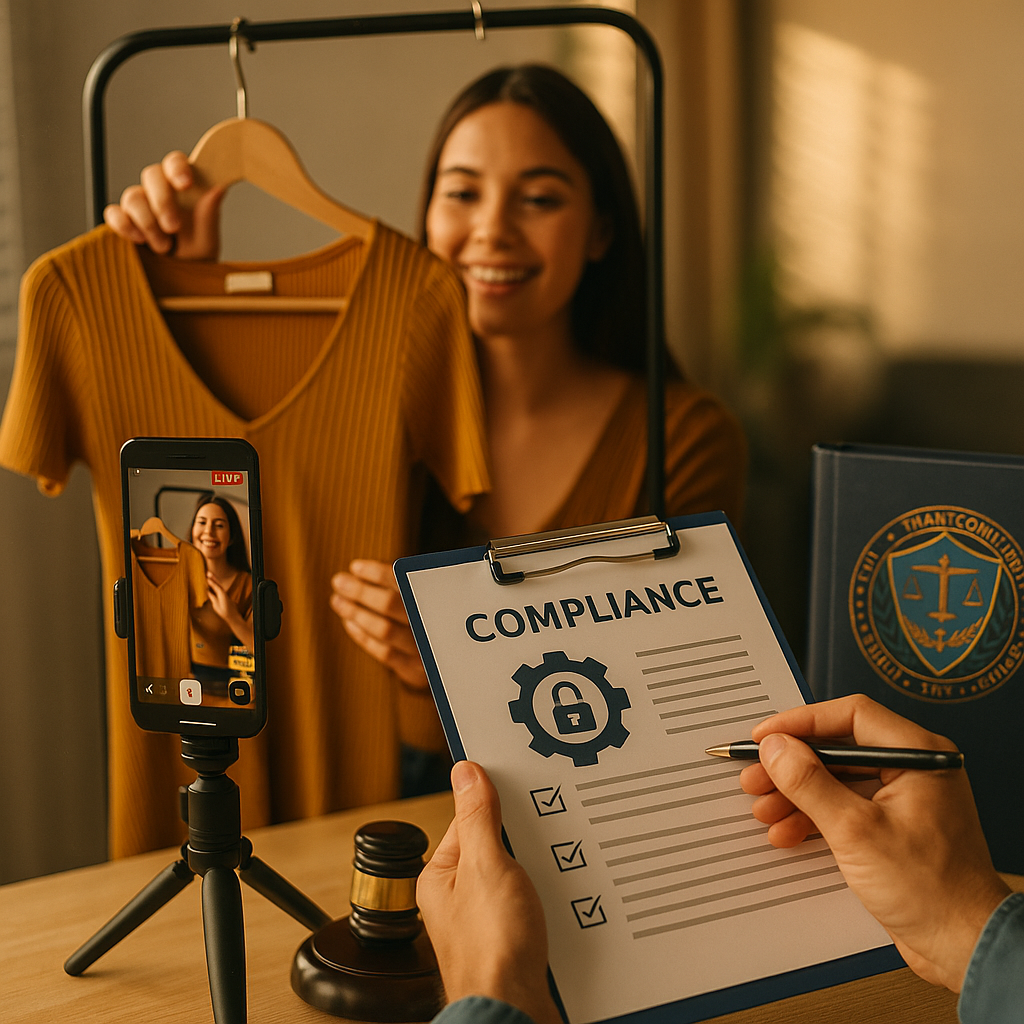
A single unscripted “this cured my eczema in three days” during a live TikTok Shop event can trigger an FTC inquiry before the stream even ends. That’s the risk profile of live commerce now. A TikTok Shop live selling compliance framework isn’t optional anymore — it’s the only thing standing between your brand and a claim nobody at legal ever approved.
Live selling moves fast. Hosts riff, chat scrolls, and claims fly out uncontrolled — no teleprompter, no pre-approved script, no pause button. Brands that treat live commerce like static content are building on sand.
Why Live Selling Breaks Your Existing Compliance Playbook
Most brand compliance programs were built for static posts and pre-recorded video. You draft guidelines, a creator submits a script or rough cut, someone on legal or marketing ops reviews it, and everyone signs off before it goes live. That workflow assumes time. Live selling removes it.
During a TikTok Shop live event, a host might make forty or fifty product claims in an hour, reacting to comments, urgency prompts, and sales dashboards in real time. There’s no draft to review. The claim exists the moment it’s spoken, and it’s already been seen by however many viewers were watching when it happened. TikTok’s own commerce data shows live shopping conversion rates running several times higher than standard video posts, per eMarketer’s social commerce research — which means more revenue riding on words nobody reviewed in advance.
The FTC doesn’t care that a claim was improvised. It cares whether it was substantiated, disclosed, and truthful the moment it left the host’s mouth.
That’s the core tension. Regulators evaluate endorsements on outcome, not intent. A well-meaning host who says “this sold out three times because it actually works” has just made an efficacy and popularity claim in one breath, live, unscripted, and fully monetized through an in-app checkout.
What FTC Endorsement Rules Actually Require in a Live Format
The FTC’s Endorsement Guides don’t have a special carve-out for live commerce. The same principles apply: disclosures must be clear and conspicuous, claims must be substantiated, and the relationship between brand and endorser must be obvious to a reasonable consumer. The challenge is applying static rules to a dynamic format.
A few requirements matter most for live selling specifically:
- Continuous disclosure, not one-time disclosure. A “#ad” tag at the start of a two-hour stream doesn’t cover viewers who join at minute ninety. The FTC has signaled that disclosures need to be repeated or persistently visible throughout a livestream, not just front-loaded.
- Substantiation before the claim, not after. If a host says a supplement “reduces bloating in a week,” that claim needs to be backed by evidence the brand already has, not evidence the brand scrambles to find after a complaint.
- Material connection disclosure for commission-based hosts. Many TikTok Shop affiliates earn a percentage of sales they drive. That’s a material connection requiring disclosure, similar to what we covered in recent commission disclosure cases.
- Brand responsibility for creator statements. The FTC has repeatedly held brands liable for what their endorsers say, not just what the brand itself publishes. “The creator said it, not us” is not a defense.
None of this is new law. What’s new is the format’s speed, and the fact that TikTok Shop live events are commerce-native — every claim is adjacent to a “buy now” button, which raises the stakes on materiality.
Building the Framework: Five Layers of Control
A workable compliance framework for live selling needs to operate on multiple timelines simultaneously: before the stream, during it, and after it ends. Think of it as five layers, each catching what the previous one might miss.
1. Pre-Stream Claim Libraries
Before any host goes live, they need a claim library, not a script. A script gets ignored the moment engagement dips and the host starts improvising. A claim library is different: it’s a pre-approved list of statements about the product that have already been substantiated, plus a parallel list of claims that are explicitly off-limits (health outcomes, comparative superiority, unverified statistics).
Give hosts language they can pull from live, and make clear which categories are landmines. This is the same discipline we recommend for pre-clearing health claims before they ever reach a public channel.
2. Real-Time Monitoring, Not Post-Hoc Review
Post-stream review is too late. By the time someone watches a recording and flags a problematic claim, the stream has ended, sales have processed, and the clip has already been screenshotted and shared. Brands running serious TikTok Shop volume need either a live compliance monitor watching the stream in real time (an actual human with authority to flag or pause) or an AI-assisted transcription tool flagging risky language as it’s spoken.
Several brands have started assigning a “compliance producer” role to live selling events, someone whose only job is watching for claim violations and disclosure lapses while the stream runs. It’s a new job title, but it’s cheaper than an FTC inquiry.
3. Persistent, Not Point-in-Time, Disclosures
Disclosure needs to be baked into the stream’s visual and verbal rhythm. That means on-screen text banners that persist or recur throughout the broadcast, plus verbal disclosure repeated at intervals, not just at the open. TikTok Shop’s own creator tools support pinned comments and persistent overlays; brands should require their use contractually, not just suggest it.
For brands running the same host across TikTok, Instagram, and YouTube, disclosure consistency also matters cross-platform. Our cross-platform disclosure matrix is a useful reference point for keeping the standard uniform regardless of where the stream is happening.
4. Contractual Claim Guardrails
Every live selling agreement should include specific, enforceable claim guardrails, not vague “comply with all applicable laws” boilerplate. Spell out prohibited claim categories, require the host to use only pre-approved substantiated language for efficacy or performance statements, and build in a clawback or pause clause if a host goes off-script into risky territory.
This is where morality clauses and claim clauses increasingly overlap. If you’re updating creator contracts anyway, review them alongside the guidance in creator morality clause standards, since clipped fragments of a live stream can circulate long after the event ends and create reputational exposure separate from the original FTC risk.
5. Post-Stream Archiving and Audit Trail
Once the stream ends, the compliance job isn’t done. Brands need a full recording archive, time-stamped, with claim logs mapped to timestamps so that if a complaint arises weeks later, there’s a documented trail showing what was said, when, and what substantiation existed at that moment. Regulators respond far better to brands that can produce clean documentation than to brands that shrug and say the stream is gone.
This audit trail also matters for state-level laws layering on top of FTC requirements. Vermont’s notice-and-cure framework, for instance, gives brands a window to fix violations before penalties apply, but only if you can demonstrate what happened and when.
The Affiliate Commission Wrinkle
TikTok Shop’s affiliate structure adds a layer most brands underweight. Hosts running live selling events are frequently paid on commission, sometimes stacked with flat fees, sometimes pure performance. That compensation structure is itself a disclosable material connection, separate from any “brand partner” or “gifted” disclosure already in place.
A host might say “I only recommend stuff I actually use” while earning 20% of every unit sold during the stream. That’s a disclosure gap the FTC has shown increasing interest in, and it compounds the claims risk: a host motivated by commission has more incentive to oversell, which means more risky claims per hour of stream time.
If your hosts are paid on commission, your disclosure standard needs to be higher, not the same as a flat-fee sponsorship. Incentive and risk move together.
Where AI Fits, and Where It Doesn’t
AI-assisted monitoring tools can transcribe live audio, flag keyword triggers (“cure,” “guaranteed,” “clinically proven”), and alert a human reviewer within seconds. That’s genuinely useful for scale — a brand running twenty simultaneous live selling events can’t staff twenty human monitors, but it can run twenty AI transcription feeds into one compliance dashboard.
What AI can’t do yet is make the judgment call on whether a claim is substantiated or whether a disclosure was “clear and conspicuous” enough for a reasonable viewer. That’s still a human decision, and brands that over-rely on automated flagging without a human escalation path are building a false sense of security. We’ve seen similar overreach in branded chatbot substantiation gaps — automation flags patterns, it doesn’t replace legal judgment.
Platforms are also starting to require their own AI-generated content labels, which can conflict with FTC disclosure language if brands aren’t careful. If your live selling program uses any AI-generated overlays, avatars, or voice tools, cross-check against TikTok’s AI overlay tagging requirements before your next flight.
What This Costs vs. What It Saves
A full five-layer framework isn’t free. Claim libraries take legal time to build. Real-time monitoring needs either headcount or software spend. Contract updates need outside counsel review. Realistically, a mid-size brand running weekly TikTok Shop live events should budget for a dedicated compliance producer role or software subscription, plus quarterly claim library refreshes.
Compare that to the cost of an FTC inquiry: legal fees, potential consent decrees, mandatory compliance monitoring for years afterward, and the reputational hit of a public enforcement action. The FTC’s enforcement history shows it doesn’t need many high-profile cases to change industry behavior. Being the example is expensive in ways that don’t show up on a single P&L line.
For context on where influencer marketing spend is headed generally, Statista’s creator economy data continues to show double-digit growth in social commerce allocation, meaning more brands are exposed to this exact risk every quarter, not fewer.
Building the Framework Doesn’t Have to Start From Zero
If your brand already has TikTok Shop merchant compliance protocols in place, like real IP verification requirements or data handling standards from a data minimization addendum, the live selling claim framework slots in as an extension, not a rebuild. Compliance teams that treat these as separate silos waste time; the smart move is one unified TikTok Shop governance document covering data, verification, and claims together.
Start with a one-week audit: pull recordings from your last five live selling events, transcribe them, and flag every efficacy, comparative, or guarantee claim made. That single exercise will tell you more about your actual risk exposure than any policy document sitting in a shared drive.
Frequently Asked Questions
FAQs
Does the FTC treat live selling claims differently than pre-recorded content?
No. The Endorsement Guides apply the same substantiation and disclosure standards regardless of format. What changes is enforcement difficulty, since live claims happen in real time without a review step, making brands more exposed if they don’t have monitoring in place.
Who is legally responsible when a host makes an unsubstantiated claim during a TikTok Shop live event?
Both the host and the brand can face liability. The FTC has consistently held brands accountable for endorser statements, especially when the brand provided products, compensation, or scripting that contributed to the claim.
How often does a disclosure need to appear during a livestream?
The FTC expects disclosures to be clear and conspicuous throughout the viewing experience, not just at the start. Best practice is a persistent on-screen banner plus repeated verbal disclosure at regular intervals, since viewers join and leave a live stream at different times.
Does commission-based pay for hosts change disclosure requirements?
Yes. Commission or performance-based compensation is a material connection separate from any brand partnership disclosure. It should be disclosed clearly, and brands should treat commission-paid hosts as higher risk for overstated claims.
Can AI monitoring tools replace human compliance review for live selling?
Not entirely. AI transcription and keyword-flagging tools help scale monitoring across multiple simultaneous streams, but judgment calls on substantiation adequacy and disclosure clarity still require human legal or compliance review.
What should a brand do immediately after a live selling event to reduce risk?
Archive the full recording with timestamps, log any claims made against your substantiation records, and flag anything questionable for legal review before the same host goes live again.
Next step: audit your last five TikTok Shop live events this week, flag every unscripted claim, and build your claim library before your next scheduled stream, not after your next complaint.
FAQs
Does the FTC treat live selling claims differently than pre-recorded content?
No. The Endorsement Guides apply the same substantiation and disclosure standards regardless of format. What changes is enforcement difficulty, since live claims happen in real time without a review step, making brands more exposed if they don’t have monitoring in place.
Who is legally responsible when a host makes an unsubstantiated claim during a TikTok Shop live event?
Both the host and the brand can face liability. The FTC has consistently held brands accountable for endorser statements, especially when the brand provided products, compensation, or scripting that contributed to the claim.
How often does a disclosure need to appear during a livestream?
The FTC expects disclosures to be clear and conspicuous throughout the viewing experience, not just at the start. Best practice is a persistent on-screen banner plus repeated verbal disclosure at regular intervals, since viewers join and leave a live stream at different times.
Does commission-based pay for hosts change disclosure requirements?
Yes. Commission or performance-based compensation is a material connection separate from any brand partnership disclosure. It should be disclosed clearly, and brands should treat commission-paid hosts as higher risk for overstated claims.
Can AI monitoring tools replace human compliance review for live selling?
Not entirely. AI transcription and keyword-flagging tools help scale monitoring across multiple simultaneous streams, but judgment calls on substantiation adequacy and disclosure clarity still require human legal or compliance review.
What should a brand do immediately after a live selling event to reduce risk?
Archive the full recording with timestamps, log any claims made against your substantiation records, and flag anything questionable for legal review before the same host goes live again.
Top Influencer Marketing Agencies
The leading agencies shaping influencer marketing in 2026
Agencies ranked by campaign performance, client diversity, platform expertise, proven ROI, industry recognition, and client satisfaction. Assessed through verified case studies, reviews, and industry consultations.
Moburst

-
2

The Shelf
Boutique Beauty & Lifestyle Influencer AgencyA data-driven boutique agency specializing exclusively in beauty, wellness, and lifestyle influencer campaigns on Instagram and TikTok. Best for brands already focused on the beauty/personal care space that need curated, aesthetic-driven content.Clients: Pepsi, The Honest Company, Hims, Elf Cosmetics, Pure LeafVisit The Shelf → -
3

Audiencly
Niche Gaming & Esports Influencer AgencyA specialized agency focused exclusively on gaming and esports creators on YouTube, Twitch, and TikTok. Ideal if your campaign is 100% gaming-focused — from game launches to hardware and esports events.Clients: Epic Games, NordVPN, Ubisoft, Wargaming, Tencent GamesVisit Audiencly → -
4

Viral Nation
Global Influencer Marketing & Talent AgencyA dual talent management and marketing agency with proprietary brand safety tools and a global creator network spanning nano-influencers to celebrities across all major platforms.Clients: Meta, Activision Blizzard, Energizer, Aston Martin, WalmartVisit Viral Nation → -
5

The Influencer Marketing Factory
TikTok, Instagram & YouTube CampaignsA full-service agency with strong TikTok expertise, offering end-to-end campaign management from influencer discovery through performance reporting with a focus on platform-native content.Clients: Google, Snapchat, Universal Music, Bumble, YelpVisit TIMF → -
6

NeoReach
Enterprise Analytics & Influencer CampaignsAn enterprise-focused agency combining managed campaigns with a powerful self-service data platform for influencer search, audience analytics, and attribution modeling.Clients: Amazon, Airbnb, Netflix, Honda, The New York TimesVisit NeoReach → -
7

Ubiquitous
Creator-First Marketing PlatformA tech-driven platform combining self-service tools with managed campaign options, emphasizing speed and scalability for brands managing multiple influencer relationships.Clients: Lyft, Disney, Target, American Eagle, NetflixVisit Ubiquitous → -
8

Obviously
Scalable Enterprise Influencer CampaignsA tech-enabled agency built for high-volume campaigns, coordinating hundreds of creators simultaneously with end-to-end logistics, content rights management, and product seeding.Clients: Google, Ulta Beauty, Converse, AmazonVisit Obviously →