


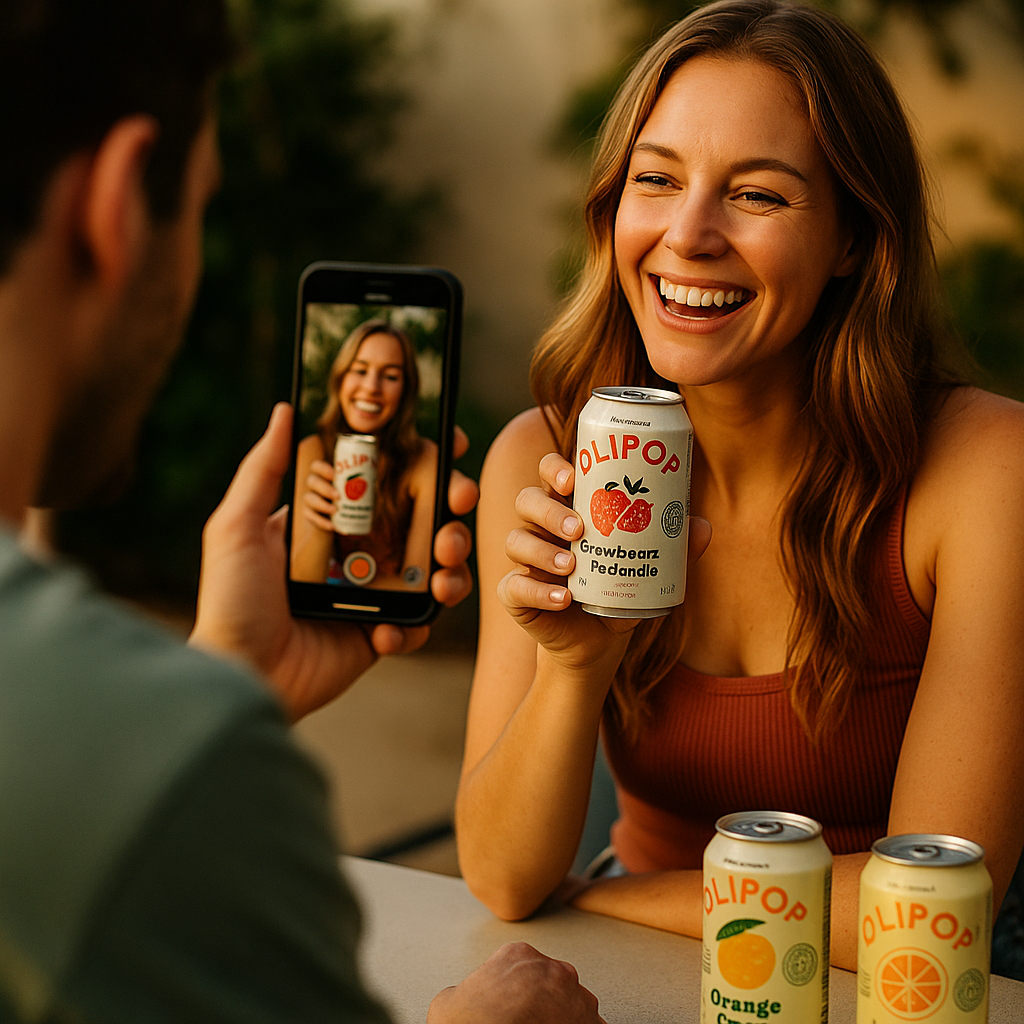
Prebiotic soda didn’t exist as a grocery category before Olipop made it one. No Super Bowl spot. No A-list endorsement deal. Instead, Olipop spent years running tiered creator whitelisting programs that turned nano-creators and dietitians into the brand’s de facto sales force. The result: a category worth an estimated $2 billion, built almost entirely on creator whitelisting instead of celebrity clout.
The Celebrity Endorsement Trap Olipop Avoided
Most beverage startups chase the same playbook: sign a celebrity, run a splashy campaign, hope awareness converts to trial. It rarely works for a product category consumers don’t understand yet. Prebiotic soda wasn’t Coke or Pepsi with a new flavor. It was an entirely unfamiliar proposition — soda that’s supposedly good for your gut.
Celebrity endorsement sells recognition. It doesn’t sell education. And Olipop’s core challenge wasn’t awareness, it was comprehension. Shoppers needed to understand what prebiotic fiber does, why it matters, and why it justified a price premium over a can of Coke. That’s a job for hundreds of credible voices repeating the same message in different contexts, not one celebrity face on a billboard.
Olipop’s bet was simple: a category nobody understands needs repetition and credibility, not reach and glamour.
This mirrors what Poppi’s micro-creator seeding strategy demonstrated in the same functional soda space: trust gets built through volume and specificity, not star power.
What Tiered Whitelisting Actually Means
Whitelisting, for anyone who hasn’t run one of these programs, means a brand gets paid-media access to a creator’s ad account. Instead of boosting a post from the brand’s own handle, Olipop could run ads that appeared to come directly from the creator — same handle, same profile photo, same comments section. It reads as organic. It performs like paid.
Olipop layered this across three tiers:
- Tier one — nano and micro creators (1,000-50,000 followers): Registered dietitians, gut-health enthusiasts, home cooks, and CrossFit moms. Cheap to activate, high trust, hyper-specific niches.
- Tier two — mid-size lifestyle and wellness creators (50,000-500,000 followers): Broader reach, still credible, used to validate the product across adjacent audiences like fitness, parenting, and clean-eating communities.
- Tier three — a small set of larger creators and category tastemakers: Used sparingly, mostly to seed cultural relevance and generate the kind of content that could later be whitelisted for paid amplification.
The bulk of the budget sat in tier one. That’s the inversion worth studying. Most legacy CPG marketers still allocate the majority of influencer spend to the top of the pyramid. Olipop flipped it.
Why Nano-Creators Carried the Category
Nano-creators aren’t just cheap. They’re specific. A dietitian with 8,000 followers talking about fiber intake and blood sugar has more category authority than a celebrity ever could, even with 8 million followers. When Olipop needed to explain a genuinely novel value proposition, specificity beat scale.
This is the same principle behind Liquid Death’s nano-creator seeding approach and the tactics detailed in how snack brands beat paid search CPA using nano-creators. Across categories, the pattern repeats: when a brand needs to educate rather than just remind, smaller creators with tighter niche authority outperform celebrity reach on a cost-per-acquisition basis.
Olipop reportedly worked with thousands of creators across its lifecycle, a volume that would be financially impossible with celebrity-tier contracts. Instead of one $2 million campaign, the brand ran what amounts to a distributed content engine, constantly testing new hooks, new angles, new proof points about gut health.
The Whitelisting Mechanics: Paid Media Wearing Organic Clothes
Here’s where the operational discipline shows up. Once a piece of organic creator content proved it could hold attention (measured through watch time, saves, and comment sentiment), Olipop’s team would request whitelisting access and push media dollars behind it.
This let the brand:
- Test dozens of creative angles cheaply before committing real spend
- Attribute performance to specific creators and specific hooks, not just vague “influencer marketing” line items
- Run split tests on identical content shown as ads versus organic posts
- Retarget audiences who’d already engaged with organic content, using the same creator’s face for continuity
It’s a model that treats creator content like ad creative, not like a PR placement. That distinction matters enormously for budget owners trying to justify spend to a CFO. You’re not buying “exposure.” You’re buying testable, attributable media units.
Whitelisting turns influencer content into an always-on creative testing pipeline, not a one-off campaign expense.
This operational rigor echoes what L’Oréal’s tiered creator roster strategy achieved with an 82% lift in views, and the structured seeding tiers behind Gap’s denim sell-out campaign. Tiered whitelisting isn’t unique to beverage brands. It’s a repeatable operating model across retail, CPG, and DTC.
Retail Was the Real Battleground
Awareness doesn’t matter if the product isn’t on shelf. Olipop’s creator strategy did double duty: it drove direct-to-consumer trial while simultaneously building the social proof that retail buyers wanted to see before committing shelf space.
Grocery and convenience buyers increasingly ask brands for social engagement data during category reviews. A wall of TikToks and Reels showing real people drinking the product, explaining the benefits, and tagging the retailer where they bought it functions as unpaid sales enablement. It’s the same dynamic Chamberlain Coffee used to win Target shelf space through nano-creator volume rather than a single hero campaign.
Olipop’s creator content, whitelisted and amplified as paid media, effectively served as a always-running retail sales deck. Every viral gut-health explainer became ammunition for the next buyer meeting.
What Brands Get Wrong When They Copy This
Plenty of brands have tried to copy Olipop’s playbook and failed. Usually because they skip the unglamorous parts:
- They under-invest in creator vetting. Tiered whitelisting only works if tier-one creators are genuinely credible in their niche, not just cheap and available.
- They treat whitelisting as an afterthought. Whitelisting requires legal agreements, ad account access permissions, and a content review workflow most teams haven’t built.
- They chase virality instead of repetition. One viral video doesn’t build a category. Hundreds of consistent, boring-but-credible explainer videos do.
- They don’t budget for testing volume. A tiered whitelisting program needs enough creative volume to actually find winners. Underfunded tests produce underwhelming data.
According to eMarketer, influencer marketing spend in the US continues to grow faster than traditional media spend, and functional beverage brands are among the categories investing most aggressively in creator-led education campaigns. The brands winning aren’t the ones spending the most. They’re the ones spending most precisely.
Compliance matters here too. Whitelisting arrangements still fall under FTC endorsement guidelines, and brands running paid amplification through a creator’s handle need clear disclosure language baked into every asset, not bolted on after the fact. Get this wrong and you’re not just risking a fine, you’re risking the credibility the whole strategy depends on.
The ROI Case, Stripped of Hype
Strip away the DTC growth-hacking mythology and the case for tiered whitelisting comes down to unit economics. Nano and micro-creator rates run a fraction of celebrity or macro-influencer fees. Multiply that by hundreds of creators and the total spend can still land below what a single celebrity contract would cost, while generating far more creative variety to test against.
Add whitelisting’s paid-media efficiency (creator content typically outperforms brand-account content on cost-per-click and cost-per-thousand impressions, per data cited by Sprout Social) and the math tilts even further toward tiered creator programs over top-down celebrity bets.
For brand teams building the business case internally, the framing that lands best with finance leadership: this isn’t influencer marketing as a brand-awareness line item. It’s a performance media channel with a content sourcing layer attached.
Next Step for Brand Teams
Don’t try to replicate Olipop’s exact creator count or budget. Replicate the structure: build tier-one volume first, prove which creators and hooks convert, then whitelist and amplify only what’s already working organically. Category creation is expensive when you buy attention. It’s affordable when you earn credibility at scale.
FAQs
What is creator whitelisting?
Creator whitelisting is an arrangement where a brand gets access to run paid ads through a creator’s own social media account, making the ad appear as an organic post from that creator’s handle rather than the brand’s.
Why did Olipop avoid celebrity endorsement deals?
Olipop needed to educate consumers on an unfamiliar product category, prebiotic soda, which required repeated, credible explanations from niche voices rather than the broad awareness a celebrity endorsement typically provides.
How does tiered creator whitelisting differ from a standard influencer campaign?
Tiered whitelisting segments creators into nano, mid-size, and top tiers with different budget allocations and objectives, then applies paid amplification only to organic content that already shows strong engagement, turning influencer marketing into a testable performance media channel.
Is creator whitelisting compliant with FTC guidelines?
Yes, but brands must ensure clear endorsement disclosures appear on whitelisted content, since the FTC’s endorsement guidelines apply regardless of whether a post is run as paid media through a creator’s account.
Can smaller brands afford a tiered whitelisting program?
Yes. Because nano and micro-creator fees are significantly lower than celebrity or macro-influencer rates, smaller brands can run tiered programs with modest budgets by prioritizing volume and testing over a single high-cost placement.
Top Influencer Marketing Agencies
The leading agencies shaping influencer marketing in 2026
Agencies ranked by campaign performance, client diversity, platform expertise, proven ROI, industry recognition, and client satisfaction. Assessed through verified case studies, reviews, and industry consultations.
Moburst

-
2

The Shelf
Boutique Beauty & Lifestyle Influencer AgencyA data-driven boutique agency specializing exclusively in beauty, wellness, and lifestyle influencer campaigns on Instagram and TikTok. Best for brands already focused on the beauty/personal care space that need curated, aesthetic-driven content.Clients: Pepsi, The Honest Company, Hims, Elf Cosmetics, Pure LeafVisit The Shelf → -
3

Audiencly
Niche Gaming & Esports Influencer AgencyA specialized agency focused exclusively on gaming and esports creators on YouTube, Twitch, and TikTok. Ideal if your campaign is 100% gaming-focused — from game launches to hardware and esports events.Clients: Epic Games, NordVPN, Ubisoft, Wargaming, Tencent GamesVisit Audiencly → -
4

Viral Nation
Global Influencer Marketing & Talent AgencyA dual talent management and marketing agency with proprietary brand safety tools and a global creator network spanning nano-influencers to celebrities across all major platforms.Clients: Meta, Activision Blizzard, Energizer, Aston Martin, WalmartVisit Viral Nation → -
5

The Influencer Marketing Factory
TikTok, Instagram & YouTube CampaignsA full-service agency with strong TikTok expertise, offering end-to-end campaign management from influencer discovery through performance reporting with a focus on platform-native content.Clients: Google, Snapchat, Universal Music, Bumble, YelpVisit TIMF → -
6

NeoReach
Enterprise Analytics & Influencer CampaignsAn enterprise-focused agency combining managed campaigns with a powerful self-service data platform for influencer search, audience analytics, and attribution modeling.Clients: Amazon, Airbnb, Netflix, Honda, The New York TimesVisit NeoReach → -
7

Ubiquitous
Creator-First Marketing PlatformA tech-driven platform combining self-service tools with managed campaign options, emphasizing speed and scalability for brands managing multiple influencer relationships.Clients: Lyft, Disney, Target, American Eagle, NetflixVisit Ubiquitous → -
8

Obviously
Scalable Enterprise Influencer CampaignsA tech-enabled agency built for high-volume campaigns, coordinating hundreds of creators simultaneously with end-to-end logistics, content rights management, and product seeding.Clients: Google, Ulta Beauty, Converse, AmazonVisit Obviously →