


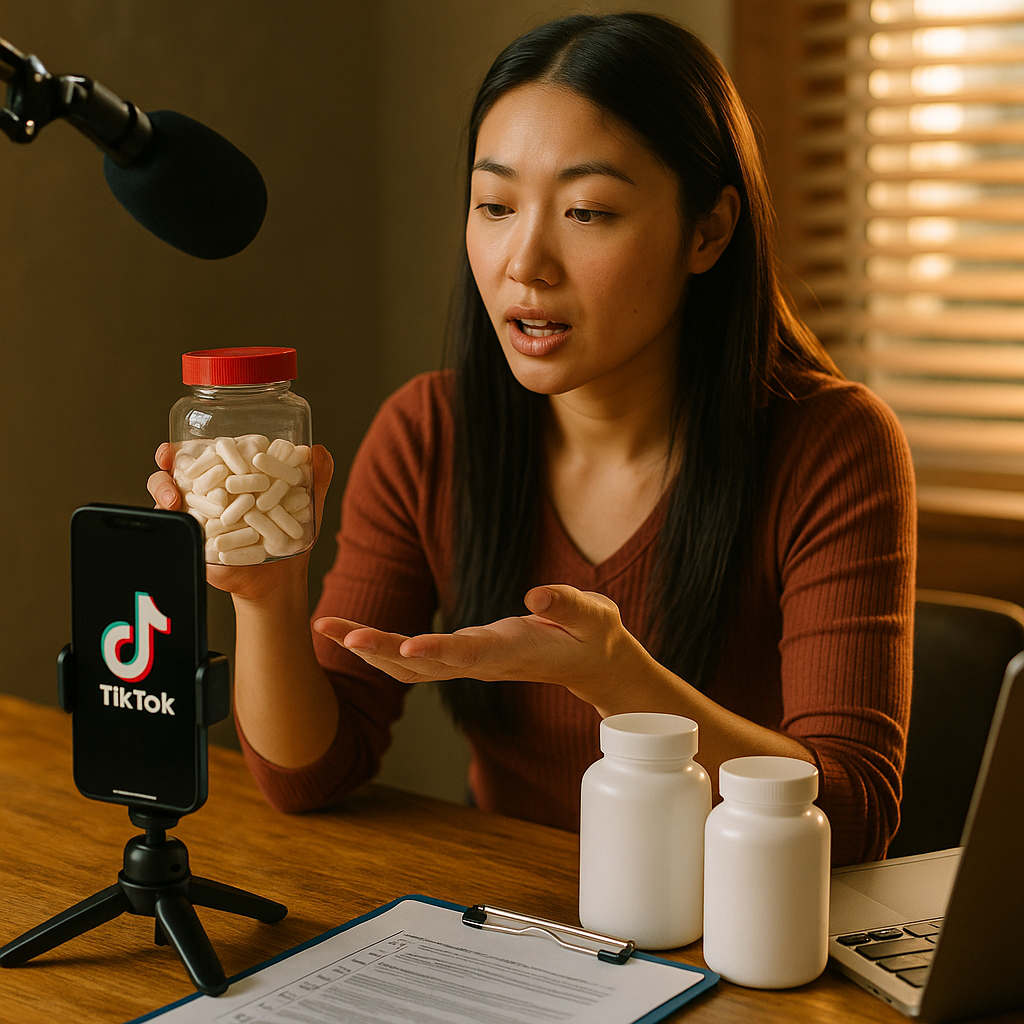
The FDA sent more warning letters over unsubstantiated supplement claims last year than in the previous three years combined. Now overlay that trend onto TikTok Shop livestream commerce — a format built entirely on unscripted, real-time claims — and you have a collision course. Compliance for marketing regulated supplements through TikTok Shop livestreams isn’t optional risk management anymore. It’s the difference between a scalable revenue channel and a shut-down storefront.
Why Livestreams Are a Regulatory Minefield
Livestream shopping compresses the sales funnel into one continuous, improvised performance. A host talking for ninety minutes straight will, statistically, say something they shouldn’t. “This cured my anxiety.” “It’s basically Ozempic in a gummy.” “Doctors don’t want you to know this.” Every one of those lines is a potential disease claim, and disease claims on dietary supplements are exactly what triggers FDA warning letters under the Federal Food, Drug, and Cosmetic Act.
Unlike a pre-recorded ad, a livestream can’t be scrubbed before it airs. There’s no legal review gate, no script approval checkpoint, no pause button. That’s the appeal for viewers — and the nightmare for compliance teams.
A single unscripted claim in a livestream selling to thousands of concurrent viewers carries the same regulatory exposure as a national TV ad — except nobody reviewed it first.
What Actually Triggers an FDA Warning Letter
The FDA doesn’t monitor every livestream in real time. Warning letters typically follow one of three paths: consumer complaints, competitor tips, or the agency’s own periodic sweeps of high-visibility platforms (TikTok Shop has been on that radar since its supplement category exploded). The claims that get flagged fall into predictable buckets:
- Disease claims: Anything implying a product diagnoses, treats, cures, or prevents a disease (cancer, diabetes, depression, “cures inflammation”).
- Drug comparisons: Referencing prescription medications by name or effect (“like Adderall for focus,” “works like Ozempic”).
- Structure/function overreach: Claims about affecting body structure or function are allowed under DSHEA, but only with the required disclaimer, and only if not implying disease treatment.
- Unsubstantiated efficacy: “Clinically proven” or “doctor recommended” language with no study to back it up.
Livestream hosts, especially affiliate creators paid on commission, have every incentive to oversell. Nobody closes a sale by saying “may support general wellness.” They close sales by promising outcomes. That tension is the entire problem.
Build the Pre-Live Claims Library, Not a Rulebook
Generic compliance training doesn’t work for live commerce because hosts improvise. What works is giving them a pre-approved claims library: a bank of specific, legally vetted phrases they can pull from live, organized by product benefit. If a host wants to talk about energy, they reach for “supports sustained energy levels” instead of freestyling “gives you Adderall-level focus.”
This isn’t theoretical. It mirrors the same discipline outlined in auditing AI-generated supplement claims before FDA letters, where the fix wasn’t banning AI copy but auditing it against a claims taxonomy before it ever reached a consumer. Livestream hosts need the same guardrail, just delivered as a live cheat sheet rather than a copy doc.
Pair the claims library with a banned-words list. Keep it short and memorable: “cure,” “treat,” “prevent,” any FDA-regulated disease name, any prescription drug name. Hosts should know these ten to fifteen words cold, the way bartenders know which IDs to refuse.
The Three-Tier Escalation Model for Live Commerce
Supplement brands running frequent livestreams need a real-time monitoring structure, not just pre-live training. The most functional model borrows from the tiered response frameworks used across live commerce more broadly, detailed in livestream shopping compliance’s 3-tier escalation protocol. Applied to supplements, it looks like this:
- Tier 1 — In-stream moderator flag: A brand-side compliance monitor (not the host) watches the feed live and has a direct message channel to the host for real-time correction. “Reframe that as structure/function” typed into an earpiece app is often enough.
- Tier 2 — Immediate stream interruption: For a clear disease claim or drug comparison, the moderator has authority to cut to a pre-recorded segment or end the segment early. This requires pre-negotiated authority in the creator contract — hosts can’t be allowed to override a compliance cut mid-sale.
- Tier 3 — Post-stream legal review and clip removal: TikTok Shop livestreams generate replay clips and cut-downs automatically. Legal needs to review the recording within hours, not days, and request removal of any archived clip containing a flagged claim before it accumulates views as evergreen content.
Tier 3 matters more than most brands realize. An FDA warning letter can cite a clip that’s been sitting on a profile for weeks after the live event ended. The live moment passes; the liability doesn’t.
Contracts Have to Do the Heavy Lifting
None of this works without contract language that gives the brand actual authority over what happens on someone else’s stream. Standard influencer agreements written for static posts don’t cover live, improvised commerce. Brands need clauses specifying:
- Pre-approved claims libraries are mandatory reference material, not suggestions.
- Brand compliance staff have real-time override authority during the stream.
- Hosts bear financial responsibility (chargeback or clawback) for sales generated during a segment later flagged for a compliance violation.
- Recorded replays are subject to brand-directed takedown at any time.
This is the same logic driving creator contract clauses for script approval FTC liability and the parallel script control clause frameworks — except for live commerce, “script” becomes “claims library,” and approval happens before the broadcast, not after.
Don’t skip the indemnification math either. If a host’s ad-libbed claim triggers an FDA letter, who pays for the legal response? Who pays if TikTok Shop suspends the storefront pending review? Get this in writing before the first stream, not after the first violation.
Age Verification Isn’t Separate From Supplement Compliance
Supplements marketed for weight management, energy, or sexual wellness routinely attract underage viewers on TikTok, and that’s a second regulatory front layered on top of FDA risk. TikTok Shop’s own age-gating tools are inconsistent at best, which is why brands selling regulated categories need the kind of operational checklist covered in TikTok Shop age verification’s new supplement brief checklist. There’s also a structural gap worth understanding: TikTok Shop ID verification’s FTC disclosure rules gap shows how platform-level verification and FTC-level disclosure obligations don’t automatically sync, leaving brands to bridge the gap themselves.
State-level rules compound this. Age-related consent requirements are getting more aggressive, and the same segmentation logic driving Texas and Florida parental consent laws forcing creator ad segmentation increasingly applies to supplement livestreams targeting younger demographics, particularly in weight-loss and nootropic categories.
Substantiation: The Paperwork Nobody Wants to Do
FDA warning letters almost always cite a lack of substantiation alongside the claim itself. If a host says a product “supports metabolism,” the brand needs a study or credible scientific basis for that claim on file, not necessarily aired, but available on request. This is the exact discipline built out in the FTC substantiation checklist for GLP-1 creator campaigns, and it transfers directly to any supplement category riding the weight-management wave. If your product claims are trending anywhere near GLP-1-adjacent language, assume regulatory scrutiny is already elevated.
Also worth flagging: many supplement livestreams increasingly script or draft claims using AI copy tools for speed. That introduces a fresh failure point covered in wellness creator campaigns facing FTC AI and state telehealth rules — AI-generated claim language needs the same audit trail as anything a human writer produces. Don’t let a chatbot draft your disclaimer language and assume it’s compliant by default.
What This Looks Like Operationally, Week to Week
Brands that run this well treat livestream compliance as a production discipline, not a legal afterthought. A realistic operating cadence:
- Weekly claims library refresh based on new SKUs, promotions, or seasonal messaging.
- Mandatory pre-live briefing with every host, recorded for proof of training.
- Live moderator on every stream above a minimum viewer or revenue threshold.
- 24-hour post-stream clip audit with takedown authority.
- Quarterly legal review of the entire claims library against current FDA guidance and any new warning letters issued to competitors (these are public and genuinely useful intelligence).
That last point deserves emphasis. The FDA publishes warning letters publicly. Reading letters sent to competitors in your category is one of the cheapest compliance research tools available, and almost nobody does it consistently.
For broader context on how this fits into overall regulatory posture, the escalation matrix aligning FTC, state AG, and platform risk is a useful reference for mapping which regulator cares about which failure mode — because FDA letters are rarely the only risk in play once state attorneys general and platform trust-and-safety teams start paying attention too.
Industry data on livestream commerce growth backs up the urgency here: eMarketer’s research on live commerce shows the format scaling fast in the US, and Statista’s ecommerce data consistently ranks health and wellness among the top-performing livestream categories. Growth without compliance infrastructure is exactly how warning letters happen. For the regulatory source of truth itself, the FTC’s official guidance remains the baseline every brand should be checking claims against, alongside FDA’s own enforcement actions.
Frequently Asked Questions
FAQs
What is the biggest FDA risk specific to TikTok Shop supplement livestreams?
Unscripted disease claims made in real time by hosts, especially comparisons to prescription drugs or promises to “cure” or “treat” a condition, since dietary supplements cannot legally make those claims under DSHEA.
Can a brand be held liable for what an affiliate host says live, even without a script?
Yes. The FDA and FTC generally hold brands responsible for claims made about their products regardless of who says them, which is why contract clauses giving brands real-time override authority and claim ownership are essential.
Does deleting a livestream clip after the fact reduce regulatory exposure?
It helps limit ongoing exposure but doesn’t erase the original violation if it was captured or reported during the live broadcast. Fast post-stream review and takedown reduces further risk but isn’t a substitute for preventing the claim in the first place.
How is livestream compliance different from standard influencer post compliance?
Standard posts can go through script and legal review before publishing. Livestreams are improvised and broadcast instantly, so compliance has to shift from pre-publication review to real-time moderation plus fast post-stream audits.
What should a pre-approved claims library actually include?
Specific, legally vetted phrases organized by product benefit (energy, focus, digestion, etc.), a companion list of banned words and drug comparisons, and required structure/function disclaimers hosts can recite verbatim.
Start with the claims library and the moderator seat, not the contract redline. Get those two operational pieces running on your next three livestreams, and the legal language will catch up faster because you’ll finally know exactly what you’re trying to control.
Top Influencer Marketing Agencies
The leading agencies shaping influencer marketing in 2026
Agencies ranked by campaign performance, client diversity, platform expertise, proven ROI, industry recognition, and client satisfaction. Assessed through verified case studies, reviews, and industry consultations.
Moburst

-
2

The Shelf
Boutique Beauty & Lifestyle Influencer AgencyA data-driven boutique agency specializing exclusively in beauty, wellness, and lifestyle influencer campaigns on Instagram and TikTok. Best for brands already focused on the beauty/personal care space that need curated, aesthetic-driven content.Clients: Pepsi, The Honest Company, Hims, Elf Cosmetics, Pure LeafVisit The Shelf → -
3

Audiencly
Niche Gaming & Esports Influencer AgencyA specialized agency focused exclusively on gaming and esports creators on YouTube, Twitch, and TikTok. Ideal if your campaign is 100% gaming-focused — from game launches to hardware and esports events.Clients: Epic Games, NordVPN, Ubisoft, Wargaming, Tencent GamesVisit Audiencly → -
4

Viral Nation
Global Influencer Marketing & Talent AgencyA dual talent management and marketing agency with proprietary brand safety tools and a global creator network spanning nano-influencers to celebrities across all major platforms.Clients: Meta, Activision Blizzard, Energizer, Aston Martin, WalmartVisit Viral Nation → -
5

The Influencer Marketing Factory
TikTok, Instagram & YouTube CampaignsA full-service agency with strong TikTok expertise, offering end-to-end campaign management from influencer discovery through performance reporting with a focus on platform-native content.Clients: Google, Snapchat, Universal Music, Bumble, YelpVisit TIMF → -
6

NeoReach
Enterprise Analytics & Influencer CampaignsAn enterprise-focused agency combining managed campaigns with a powerful self-service data platform for influencer search, audience analytics, and attribution modeling.Clients: Amazon, Airbnb, Netflix, Honda, The New York TimesVisit NeoReach → -
7

Ubiquitous
Creator-First Marketing PlatformA tech-driven platform combining self-service tools with managed campaign options, emphasizing speed and scalability for brands managing multiple influencer relationships.Clients: Lyft, Disney, Target, American Eagle, NetflixVisit Ubiquitous → -
8

Obviously
Scalable Enterprise Influencer CampaignsA tech-enabled agency built for high-volume campaigns, coordinating hundreds of creators simultaneously with end-to-end logistics, content rights management, and product seeding.Clients: Google, Ulta Beauty, Converse, AmazonVisit Obviously →