


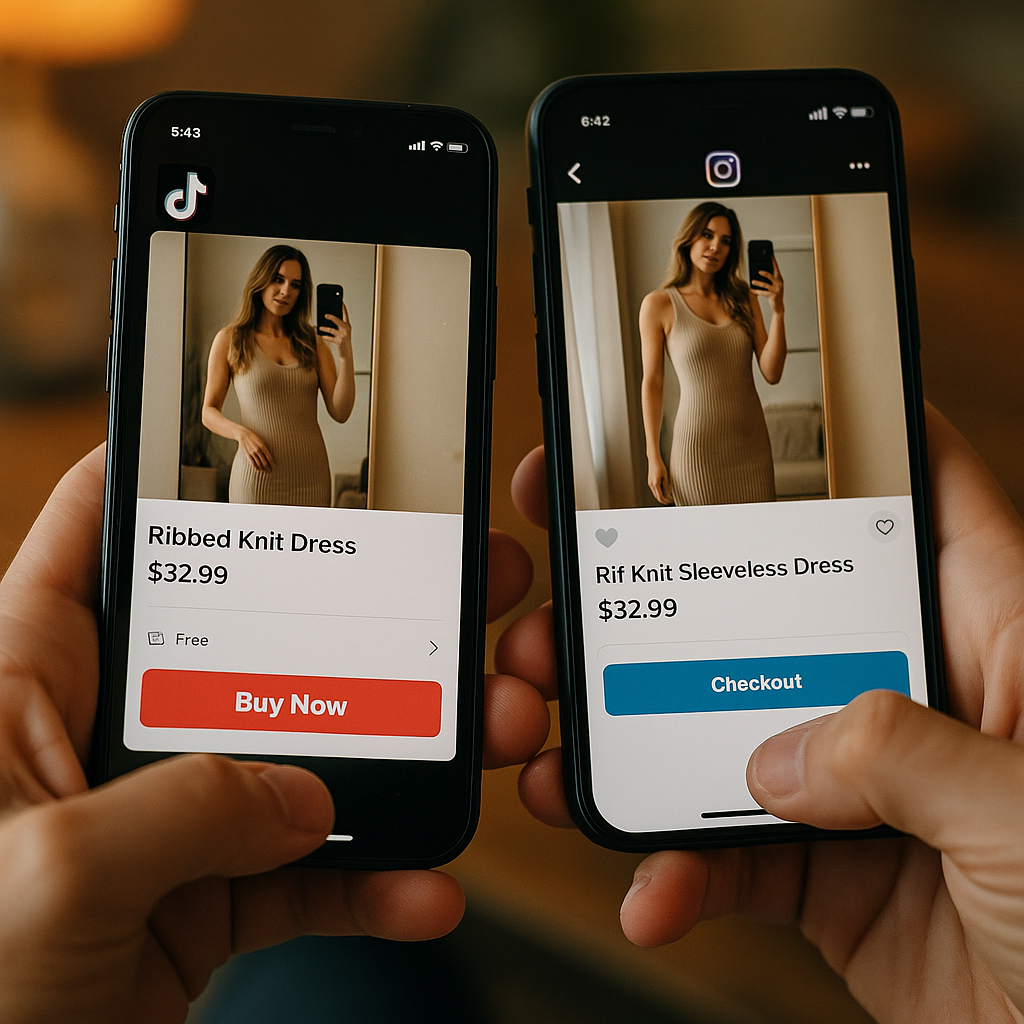
TikTok Shop’s average conversion window from view to checkout runs under three minutes for shoppable UGC. Instagram Shopping? Brands report closer to eight, often longer, because of the extra tap out to a browser or DM. That gap is the whole ballgame in 2026. If you’re still splitting influencer budgets 50/50 across both platforms without accounting for infrastructure differences, you’re leaving conversion rate on the table.
The question isn’t which platform has better creators, better reach, or better CPMs anymore. It’s which one built the plumbing to turn a scroll-stopping video into a completed sale without losing the customer along the way. That’s an infrastructure question, not a creative one, and it changes how brands should brief, budget, and measure.
The Checkout Distance Problem
Here’s the uncomfortable truth for Meta: Instagram Shopping was built as a catalog layer bolted onto a social app. TikTok Shop was built as a commerce engine with social distribution attached. That founding difference still shapes everything downstream.
On TikTok, a shoppable UGC video can carry a product card, live inventory, price, and a one-tap checkout that never leaves the app. The creator posts, the algorithm distributes based on watch-time and completion signals (see our breakdown of the watch-time algorithm update), and the viewer buys without ever opening a new tab. Friction is close to zero.
Instagram, even with product tags refined over several cycles, routes a meaningful share of purchase intent through Meta Pay setup screens, external checkout links, or straight into DMs where a human (or bot) has to close the sale manually. Every added step bleeds conversion. Baymard Institute’s long-running research on checkout abandonment puts average cart abandonment across e-commerce at roughly 70%, and every extra click compounds that number.
The platforms aren’t competing on creator quality anymore. They’re competing on how many taps stand between “I want that” and “I bought that.” TikTok Shop currently wins that race by a wide margin.
What “Shoppable UGC Infrastructure” Actually Means
Marketers throw the phrase “shoppable content” around loosely. For brand teams evaluating platform investment, it helps to break it into four components:
- Native checkout: Can the purchase complete inside the app, same session, no redirect?
- Content-to-catalog linking: How automatically does a creator’s organic post attach to live product inventory?
- Algorithmic amplification of commerce intent: Does the platform’s ranking system actively boost content that’s converting, or is distribution and commerce decoupled?
- Affiliate and creator payout automation: How fast and frictionless is it for a brand to pay creators on performance, not flat fee?
TikTok Shop scores strong on all four. Its affiliate marketplace lets brands set commission tiers, and creators self-select products to feature, a system we’ve covered in detail in our affiliate leaderboard playbook. Instagram Shopping is strong on catalog linking and reasonably good on distribution, but its checkout and payout infrastructure still lag.
That’s not a knock on Instagram’s creative ecosystem, which remains arguably richer for brand storytelling. It’s a statement about transactional plumbing. Different jobs, different tools.
Speed to Sale: What the Data Actually Shows
Brands running parallel campaigns across both platforms in the past year report a consistent pattern: TikTok Shop UGC converts faster but Instagram Shopping content often has a longer purchase tail, especially for considered purchases like home goods or higher-ticket beauty devices.
Why? TikTok’s format rewards impulse. A fifteen-second video, a trending sound, an on-screen product card, and the “buy now” urge hits while dopamine’s still high. Instagram’s format, especially Reels paired with Stories and feed posts, tends to build consideration over multiple touchpoints before a buyer converts, sometimes days later.
eMarketer’s ongoing coverage of social commerce growth has flagged TikTok Shop as the fastest-growing U.S. social commerce channel two years running, a trend that shows no sign of slowing. Meanwhile, Instagram Shopping’s growth has been steadier but less explosive, reflecting its role as a brand discovery layer more than a checkout engine.
For brands selling low-consideration, visually punchy products — beauty, snacks, apparel, home décor under $50 — TikTok Shop’s speed advantage is decisive. For higher-consideration categories where buyers research before purchasing, Instagram’s slower-but-steadier funnel still has a job to do.
Where Instagram Still Wins
It would be lazy to declare TikTok Shop the outright winner and move on. Instagram holds real advantages that infrastructure alone doesn’t erase.
First, audience demographics skew older and higher-income on Instagram, which matters for categories like home renovation, financial products, or premium skincare where buyers have more spending power but slower decision cycles. Second, Instagram’s discovery layer, especially post-Andromeda update, rewards content relevance over raw virality, which our piece on the Andromeda update covers in depth. That means brands with strong first-party creative can still earn organic reach without chasing trends.
Third, and this matters for risk-averse brand teams: Instagram’s paid partnership disclosure tools and creator vetting processes are more mature, reducing FTC compliance exposure. TikTok Shop’s affiliate model, where creators self-select products and post with less brand oversight, creates more surface area for disclosure gaps, something we’ve flagged repeatedly in our coverage of FTC compliance risk on livestreams.
So Instagram isn’t losing on every axis. It’s losing specifically on speed-to-purchase for organic UGC, which is the exact question this article is answering.
The Operational Cost Nobody Talks About
Running shoppable UGC well on either platform isn’t free labor. TikTok Shop requires brands to manage seller verification, tax documentation, and product catalog sync, processes that trip up teams constantly. We’ve written before about brands getting stuck on mismatched verification documents, which can stall a shop launch for weeks.
Instagram Shopping’s setup, tied to Meta Commerce Manager, is arguably more bureaucratic upfront but more stable once live. Fewer moving parts, fewer surprises, but also fewer conversion levers to pull.
There’s also a staffing question. TikTok’s live shopping and rapid content cycle increasingly demands near-constant creator activity, a shift covered in our analysis of 24/7 live shopping staffing pressure. Brands underestimating the operational lift of “always-on” TikTok Shop commerce often see initial conversion wins erode because they can’t sustain content velocity. Instagram’s cadence, by contrast, tolerates more traditional campaign-based planning.
This is the part brand strategists skip when comparing platforms on conversion speed alone: infrastructure that converts faster often costs more to operate. Budget accordingly.
So Which Platform Should Get the Budget?
The honest answer: it depends on category, but the tiebreaker in 2026 leans TikTok Shop for anything impulse-driven.
If your product sells on visual proof and instant gratification, TikTok Shop’s native checkout and affiliate infrastructure will convert organic UGC faster, full stop. If your product requires trust-building, comparison shopping, or higher price justification, Instagram Shopping’s slower funnel and stronger brand-safety tooling may deliver better lifetime value even if speed-to-first-sale lags.
Smart brand teams aren’t choosing one. They’re allocating budget by funnel stage: TikTok Shop for bottom-funnel conversion sprints, Instagram for upper-funnel trust-building and retargeting audiences who need more convincing. HubSpot’s research on social commerce, available at hubspot.com, has consistently shown multi-platform strategies outperform single-platform bets when funnel stages are mapped correctly.
Track it accordingly, too. Vanity metrics like views or engagement rate mean little if you can’t tie them to checkout completion. Sprout Social’s platform analytics, at sproutsocial.com, and TikTok’s own ad and shop dashboards at ads.tiktok.com both now offer conversion attribution granular enough to settle this debate with your own first-party data instead of guessing.
Frequently Asked Questions
FAQs
Does TikTok Shop convert organic UGC faster than Instagram Shopping?
Yes, in most impulse-purchase categories. TikTok Shop’s native, in-app checkout removes the redirect steps that Instagram Shopping often requires, which shortens the time between viewing a product and completing a purchase.
Is Instagram Shopping becoming obsolete for brands?
No. Instagram still performs well for upper-funnel discovery, brand trust-building, and higher-consideration purchases where buyers need more time and touchpoints before converting. It’s a different job in the funnel, not a worse one.
What categories perform best on TikTok Shop specifically?
Beauty, apparel, snacks, and home goods under roughly fifty dollars tend to see the strongest impulse-driven conversion on TikTok Shop, largely due to the format’s short-form, high-urgency content style.
What compliance risks should brands watch for with TikTok Shop affiliate content?
Because creators often self-select products with less direct brand oversight, disclosure gaps are common. Brands should review FTC guidance directly at ftc.gov and audit affiliate creator posts regularly to avoid enforcement risk.
Can brands run shoppable UGC campaigns on both platforms simultaneously?
Yes, and many performance-focused brands do. The most effective approach allocates TikTok Shop budget to bottom-funnel conversion pushes and reserves Instagram Shopping for upper-funnel discovery and retargeting audiences that need longer consideration cycles.
How should brands measure which platform is actually converting better?
Track checkout completion rate and time-to-purchase, not just engagement or views. Both TikTok’s ad dashboard and third-party tools like Sprout Social now offer conversion attribution detailed enough to compare platform performance using first-party data.
Next step: Pull your last quarter’s UGC performance data from both platforms, segment by time-to-purchase rather than engagement rate, and reallocate at least 20% of your Instagram organic budget toward TikTok Shop affiliate seeding if your category skews impulse-buy. The data will tell you fast whether that shift earns its keep.
Top Influencer Marketing Agencies
The leading agencies shaping influencer marketing in 2026
Agencies ranked by campaign performance, client diversity, platform expertise, proven ROI, industry recognition, and client satisfaction. Assessed through verified case studies, reviews, and industry consultations.
Moburst

-
2

The Shelf
Boutique Beauty & Lifestyle Influencer AgencyA data-driven boutique agency specializing exclusively in beauty, wellness, and lifestyle influencer campaigns on Instagram and TikTok. Best for brands already focused on the beauty/personal care space that need curated, aesthetic-driven content.Clients: Pepsi, The Honest Company, Hims, Elf Cosmetics, Pure LeafVisit The Shelf → -
3

Audiencly
Niche Gaming & Esports Influencer AgencyA specialized agency focused exclusively on gaming and esports creators on YouTube, Twitch, and TikTok. Ideal if your campaign is 100% gaming-focused — from game launches to hardware and esports events.Clients: Epic Games, NordVPN, Ubisoft, Wargaming, Tencent GamesVisit Audiencly → -
4

Viral Nation
Global Influencer Marketing & Talent AgencyA dual talent management and marketing agency with proprietary brand safety tools and a global creator network spanning nano-influencers to celebrities across all major platforms.Clients: Meta, Activision Blizzard, Energizer, Aston Martin, WalmartVisit Viral Nation → -
5

The Influencer Marketing Factory
TikTok, Instagram & YouTube CampaignsA full-service agency with strong TikTok expertise, offering end-to-end campaign management from influencer discovery through performance reporting with a focus on platform-native content.Clients: Google, Snapchat, Universal Music, Bumble, YelpVisit TIMF → -
6

NeoReach
Enterprise Analytics & Influencer CampaignsAn enterprise-focused agency combining managed campaigns with a powerful self-service data platform for influencer search, audience analytics, and attribution modeling.Clients: Amazon, Airbnb, Netflix, Honda, The New York TimesVisit NeoReach → -
7

Ubiquitous
Creator-First Marketing PlatformA tech-driven platform combining self-service tools with managed campaign options, emphasizing speed and scalability for brands managing multiple influencer relationships.Clients: Lyft, Disney, Target, American Eagle, NetflixVisit Ubiquitous → -
8

Obviously
Scalable Enterprise Influencer CampaignsA tech-enabled agency built for high-volume campaigns, coordinating hundreds of creators simultaneously with end-to-end logistics, content rights management, and product seeding.Clients: Google, Ulta Beauty, Converse, AmazonVisit Obviously →