


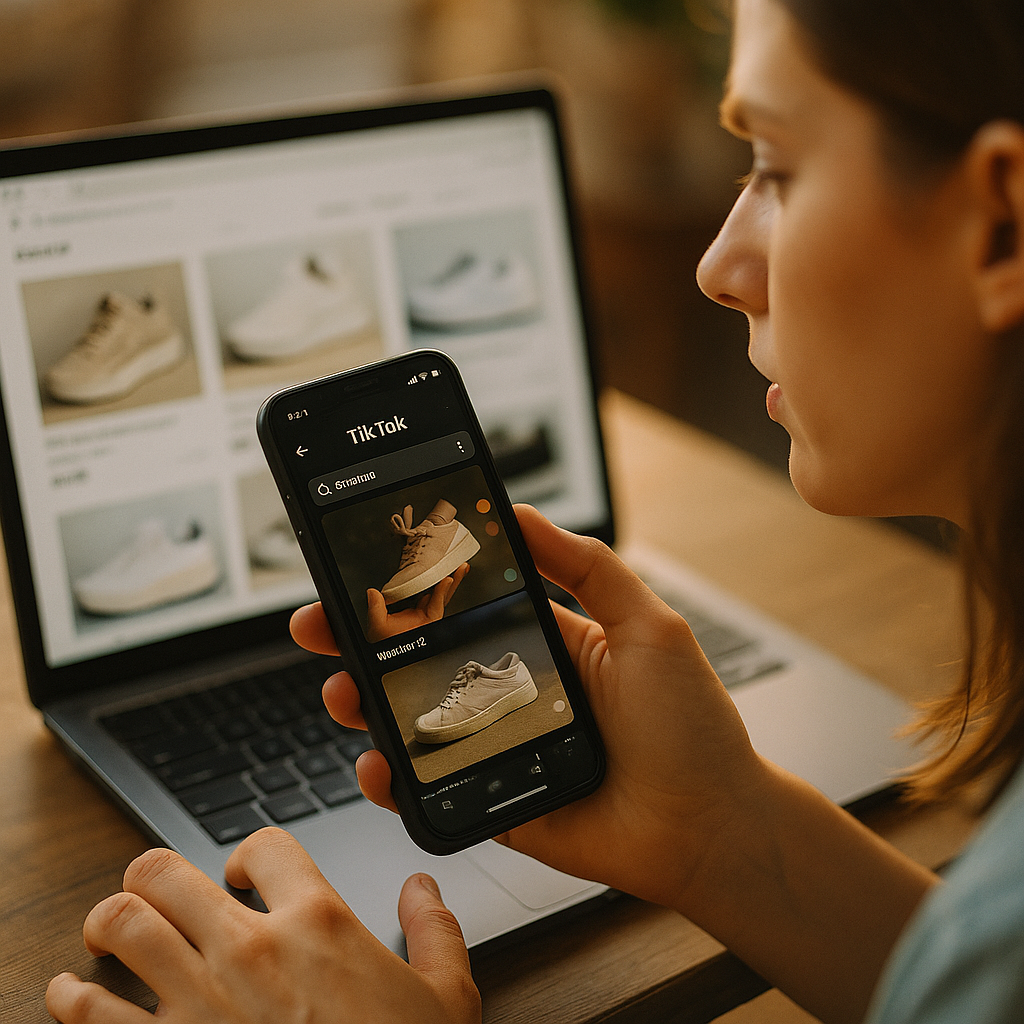
Nearly 40% of Gen Z now starts product research on TikTok before Google ever enters the picture, according to multiple consumer surveys cited across the industry. If your product content still treats TikTok as a broadcast feed instead of a search engine, you’re leaving discovery — and revenue — on the table. TikTok’s social-search behavior has quietly become one of the most consequential ranking systems in commerce marketing, and most brands haven’t rebuilt their content structure to match it.
This isn’t a minor UX tweak. It’s a fundamental shift in how products get found, and it demands a different kind of brief, a different kind of caption, and a different kind of creator vetting.
Search Is the New For You Page
TikTok’s search bar has quietly become a primary navigation tool, not an afterthought. Users type product names, problems, and “does this actually work” queries the same way they’d query Google. TikTok has leaned into this by surfacing search suggestions, autocomplete chips, and SEO-style result pages that blend organic posts, Shop listings, and ads in a single scroll.
The implication for brands: your content needs to answer a query, not just entertain a scroll. A video optimized purely for watch-time retention might rank in the For You feed but disappear entirely from search results if it never says the product name out loud, never uses the right on-screen text, or buries the use-case in a punchline.
Ranking in TikTok search now depends less on production polish and more on whether your content actually names the problem, the product, and the use-case in the first three seconds.
This mirrors a broader pattern across the platform: distribution increasingly rewards structured, trustworthy content over raw volume. We’ve covered how trust-based distribution already forces brands to rethink vetting — search behavior is the discovery-layer extension of that same shift.
What “Discovery-Optimized” Actually Means Here
Discovery-optimized product content isn’t keyword-stuffed captions. TikTok’s search index pulls signals from spoken audio (via auto-transcription), on-screen text, captions, hashtags, and — increasingly — comment threads. The algorithm is essentially building a semantic map of what your video is *about*, then matching that map to what people type.
Practically, this means:
- Say the product name and category out loud in the first five seconds — transcription weighs spoken words heavily.
- Use on-screen text that mirrors real search queries (“best budget blender for smoothies,” not “my new fave kitchen thing”).
- Structure captions like mini answers, not vibes. Lead with the use-case, not the hook.
- Seed comment questions that reinforce the exact terms you want to rank for — comment signal is a known ranking factor now, similar to what we’ve seen on YouTube’s comment-driven ranking shift.
None of this kills creativity. It just means creativity needs a spine of searchable structure underneath it.
The Brief Has to Change, Not Just the Content
Most influencer briefs still optimize for hook strength and watch-time. That’s necessary but no longer sufficient. A discovery-optimized brief needs a “search intent” section: what query should this content rank for, and what phrase should the creator say verbatim within the first line of dialogue?
Compare that to a typical brief from eighteen months ago, which might say “showcase the product naturally, keep it authentic, 15-30 seconds.” Authentic, sure. Findable? Rarely.
Brands running always-on TikTok Shop programs are already feeling this. Search-driven discovery interacts directly with commerce features — a well-optimized product name in a caption doesn’t just help SEO, it helps TikTok connect the content to the correct Shop listing, which affects everything from checkout speed to affiliate payout accuracy on the Shop affiliate leaderboard.
If your product tagging is inconsistent across creator content, TikTok’s search index treats each variation as a slightly different entity. That fragments your discovery footprint instead of consolidating it.
Local Intent Is Quietly Huge
A large chunk of TikTok’s search volume skews local: “best coffee shop near me,” “where to buy X in [city].” This overlaps heavily with TikTok’s geolocation-driven discovery features, which we’ve broken down in detail in our geolocation discovery vetting guide.
For brands with retail footprints, this is arguably the highest-ROI application of social-search optimization. A creator video that names the store, tags the location, and gets picked up by local search queries can drive foot traffic more efficiently than a paid local awareness campaign.
We’ve seen this pattern play out in local feed strategies that convert creator content directly into store visits, and in the broader move toward local discovery driving live commerce ROI. Social search is the connective tissue between those two trends — it’s the mechanism that surfaces the content when someone actually searches with intent.
Where This Intersects With AI Overviews
TikTok’s push into AI-assisted search summaries — echoing the AI feed changes we detailed alongside Google’s Ask ad manager overlap — adds another layer. AI-generated result summaries pull from top-ranking content, meaning brands whose content already ranks well in traditional search get amplified further in AI summary boxes. It’s a compounding advantage for early movers and a compounding penalty for brands still treating captions as an afterthought.
This is also why product-content structure matters more than ever: AI summarization tools favor content with clear, extractable claims (“this serum reduces redness in two weeks”) over vague lifestyle framing. If your creators aren’t stating clear, specific claims, you’re invisible to the summarization layer entirely.
A Quick Audit Framework
Before your next campaign, run existing top-performing content through this checklist:
- Does the product name appear in spoken audio within the first 5 seconds?
- Does the on-screen text match a real, likely search query?
- Is the caption structured as an answer to a question, not just a vibe-based hook?
- Are hashtags specific to use-case, not just broad category tags?
- Is the Shop listing tagged consistently with the spoken product name?
If you’re failing three or more of these, you’re likely ranking in the feed but invisible in search — a gap most brand dashboards don’t even measure yet.
Compliance and Trust Still Apply
Search-optimized doesn’t mean license to overclaim. Specific, extractable claims carry more legal exposure if they’re inaccurate or unsubstantiated. The FTC’s endorsement guidance still applies with full force to search-discovered content — arguably more so, since these videos get surfaced repeatedly to intent-driven searchers rather than a single feed impression.
Brands should treat search-optimized briefs as an extension of, not a replacement for, the vetting rigor covered in our creator trust ranking analysis. A creator who ranks well in search but makes sloppy claims is a bigger liability than one who ranks poorly and says nothing wrong.
For brands managing this at scale, tools referenced by Sprout Social and platform-native analytics via TikTok’s ad manager are increasingly building search-term reporting into their dashboards — worth checking if your current stack already surfaces this data before building a manual audit process.
Next Step
Pull your last ten pieces of top-performing TikTok Shop content and score them against the five-point audit above — if most fail on spoken product-name mentions, that’s your first fix, and it’s a rebrief, not a reshoot.
Frequently Asked Questions
What is TikTok social-search behavior?
It refers to how users increasingly use TikTok’s search bar as a primary discovery tool — querying product names, problems, and reviews the way they would on a search engine — rather than relying solely on the algorithmic For You feed.
How does TikTok’s search algorithm rank product content?
TikTok’s search index weighs spoken audio (via transcription), on-screen text, captions, hashtags, and comment activity to build a semantic understanding of a video, then matches that understanding to user search queries.
Do influencer briefs need to change for search optimization?
Yes. Briefs should specify the exact search intent a video should target and require creators to state the product name and use-case verbatim early in the video, rather than relying only on hook-and-entertainment metrics.
Does TikTok Shop tagging affect search visibility?
Consistent product naming across creator content and Shop listings helps TikTok’s search index connect content to the correct listing, improving discoverability and reducing attribution fragmentation.
Is local search a meaningful opportunity on TikTok?
Yes. A significant share of TikTok search queries carry local intent, making geolocation-tagged, store-specific content one of the higher-ROI applications of search-optimized strategy for retail brands.
Frequently Asked Questions
What is TikTok social-search behavior?
It refers to how users increasingly use TikTok’s search bar as a primary discovery tool — querying product names, problems, and reviews the way they would on a search engine — rather than relying solely on the algorithmic For You feed.
How does TikTok’s search algorithm rank product content?
TikTok’s search index weighs spoken audio (via transcription), on-screen text, captions, hashtags, and comment activity to build a semantic understanding of a video, then matches that understanding to user search queries.
Do influencer briefs need to change for search optimization?
Yes. Briefs should specify the exact search intent a video should target and require creators to state the product name and use-case verbatim early in the video, rather than relying only on hook-and-entertainment metrics.
Does TikTok Shop tagging affect search visibility?
Consistent product naming across creator content and Shop listings helps TikTok’s search index connect content to the correct listing, improving discoverability and reducing attribution fragmentation.
Is local search a meaningful opportunity on TikTok?
Yes. A significant share of TikTok search queries carry local intent, making geolocation-tagged, store-specific content one of the higher-ROI applications of search-optimized strategy for retail brands.
Top Influencer Marketing Agencies
The leading agencies shaping influencer marketing in 2026
Agencies ranked by campaign performance, client diversity, platform expertise, proven ROI, industry recognition, and client satisfaction. Assessed through verified case studies, reviews, and industry consultations.
Moburst

-
2

The Shelf
Boutique Beauty & Lifestyle Influencer AgencyA data-driven boutique agency specializing exclusively in beauty, wellness, and lifestyle influencer campaigns on Instagram and TikTok. Best for brands already focused on the beauty/personal care space that need curated, aesthetic-driven content.Clients: Pepsi, The Honest Company, Hims, Elf Cosmetics, Pure LeafVisit The Shelf → -
3

Audiencly
Niche Gaming & Esports Influencer AgencyA specialized agency focused exclusively on gaming and esports creators on YouTube, Twitch, and TikTok. Ideal if your campaign is 100% gaming-focused — from game launches to hardware and esports events.Clients: Epic Games, NordVPN, Ubisoft, Wargaming, Tencent GamesVisit Audiencly → -
4

Viral Nation
Global Influencer Marketing & Talent AgencyA dual talent management and marketing agency with proprietary brand safety tools and a global creator network spanning nano-influencers to celebrities across all major platforms.Clients: Meta, Activision Blizzard, Energizer, Aston Martin, WalmartVisit Viral Nation → -
5

The Influencer Marketing Factory
TikTok, Instagram & YouTube CampaignsA full-service agency with strong TikTok expertise, offering end-to-end campaign management from influencer discovery through performance reporting with a focus on platform-native content.Clients: Google, Snapchat, Universal Music, Bumble, YelpVisit TIMF → -
6

NeoReach
Enterprise Analytics & Influencer CampaignsAn enterprise-focused agency combining managed campaigns with a powerful self-service data platform for influencer search, audience analytics, and attribution modeling.Clients: Amazon, Airbnb, Netflix, Honda, The New York TimesVisit NeoReach → -
7

Ubiquitous
Creator-First Marketing PlatformA tech-driven platform combining self-service tools with managed campaign options, emphasizing speed and scalability for brands managing multiple influencer relationships.Clients: Lyft, Disney, Target, American Eagle, NetflixVisit Ubiquitous → -
8

Obviously
Scalable Enterprise Influencer CampaignsA tech-enabled agency built for high-volume campaigns, coordinating hundreds of creators simultaneously with end-to-end logistics, content rights management, and product seeding.Clients: Google, Ulta Beauty, Converse, AmazonVisit Obviously →