


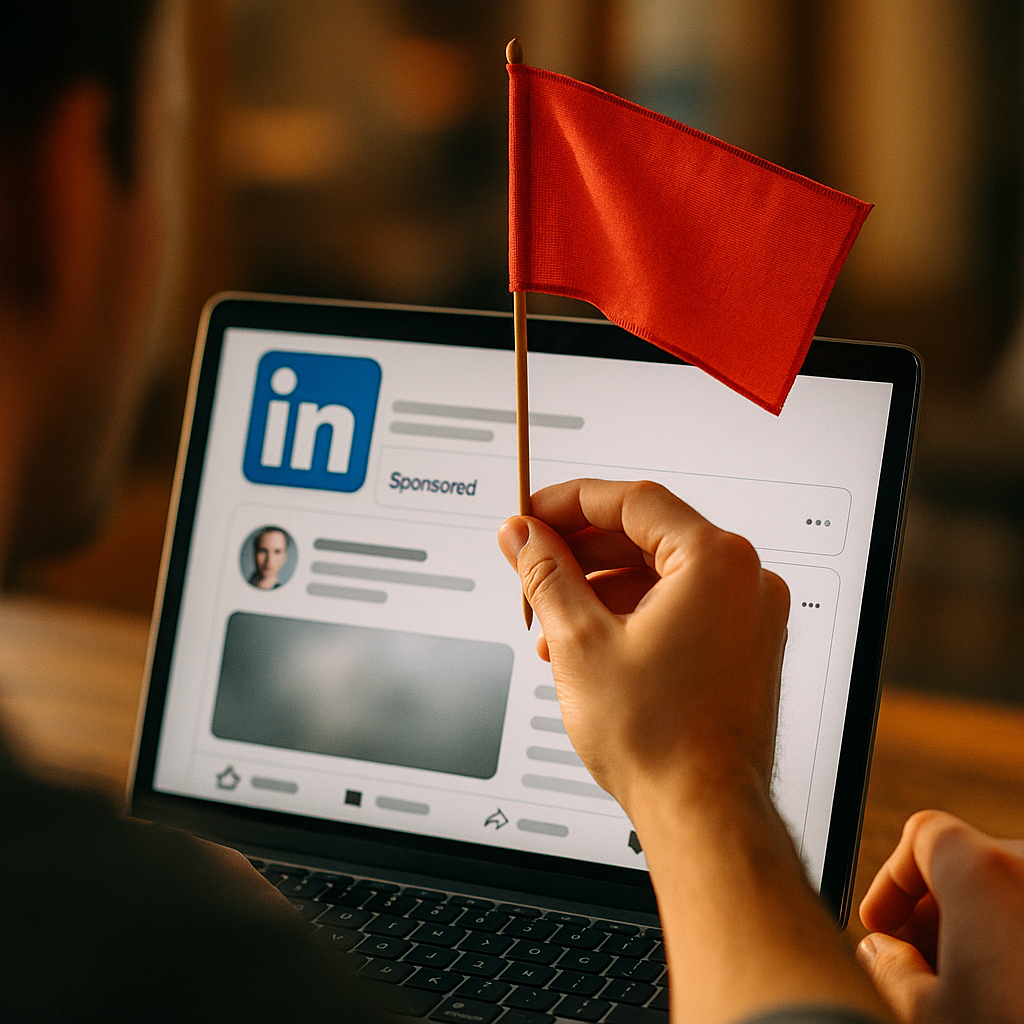
A LinkedIn post gets flagged as “seems like AI” and reach drops before your campaign even gets a fair shot. That’s the new reality: LinkedIn is quietly scoring content for synthetic patterns, and sponsored posts are getting caught in the net far more than organic ones. If you’re running influencer or executive thought-leadership programs on the platform, the LinkedIn seems like AI slop flag is now a variable you have to design around, not react to.
What This Flag Actually Is
LinkedIn hasn’t published a detailed technical spec, but the pattern is clear from creator reports and agency testing: the platform is applying a content-quality classifier that downranks posts exhibiting telltale signs of AI generation or low-effort automation. Think uniform paragraph cadence, generic hook formulas (“I used to think X, but then Y happened”), overused em-dashes, and emoji-bullet listicles that read like they came from the same prompt template. Once a post trips that classifier, distribution craters, sometimes before a human ever sees it.
This isn’t unique to LinkedIn. Reddit built something similar to cut fake engagement using AI trust scores, and platforms across the board are racing to protect feed quality as generative tools flood every channel with sameness. LinkedIn’s version matters more for B2B marketers because the platform’s entire value proposition is professional credibility. If your sponsored executive post reads like slop, it damages the brand and the exec’s personal authority in one shot.
The irony: brands are using AI to scale content production at the exact moment the platform is penalizing anything that reads as AI-produced. You can’t out-automate a system built to detect automation.
Why Sponsored Content Gets Flagged More Than Organic Posts
Sponsored and ghostwritten content tends to share structural DNA. Agencies use templates for efficiency. Ghostwriters reuse hook formulas because they convert. Creators paid per post lean on AI drafting tools to hit volume quotas. All of that creates pattern repetition, exactly what a slop detector is trained to catch.
There’s also a volume problem. A single creator posting three sponsored pieces a week, all structured the same way, all polished to the same gloss, builds a fingerprint. LinkedIn’s algorithm increasingly rewards accounts that show relevance over raw follower count, and relevance is measured partly by whether the content feels like it came from a person with actual opinions, not a content factory.
Consider the compounding effect. A flagged post doesn’t just underperform once. It can suppress future reach for the same account, similar to a shadow-ban mechanic. Brands running always-on ambassador programs risk an entire roster’s visibility if the content style is too uniform across creators.
The Telltale Signs LinkedIn’s Classifier Seems to Catch
- Overly symmetrical paragraph lengths, every sentence roughly the same size
- Hook openers that mimic viral templates without a genuine personal detail
- Excessive use of bolded phrases or emoji bullets that mimic AI-formatted output
- Zero typos, zero tangents, zero personality quirks, a post that reads too clean
- Generic CTAs (“Thoughts? Drop them below”) with no specificity to the actual audience
None of these signals alone is fatal. It’s the combination and the frequency that trips the system.
The Playbook: Keeping Sponsored Content Authentic-Looking
Here’s where brand and agency teams need to get tactical. Authenticity signals aren’t a vibe, they’re specific, testable inputs you can brief for.
1. Brief for voice, not just message
Most influencer briefs specify talking points and hashtags but skip voice entirely. That’s backwards now. Give creators 2-3 real anecdotes to pull from, not just product facts. A sponsored post that references a specific meeting, a specific client name (with permission), or a specific failure reads as human because it is specific. Generic claims read as generated because they could apply to anyone.
2. Ban the AI tells in your style guide
Add a short list to every creator brief: no rhetorical-question openers, no “let’s dive in,” no perfectly symmetrical bullet lists, vary sentence length deliberately. This is the same discipline good editors already apply, it just needs to be explicit now because AI drafting tools default to the opposite.
3. Let creators keep their imperfections
Resist the urge to over-polish. A slightly messy sentence structure, a mid-post tangent, an opinion that isn’t fully hedged, these are authenticity markers. Brands used to edit these out for “professionalism.” Now they may be the exact signals that keep a post out of the slop bucket.
Perfection is starting to look suspicious. Editors optimizing for polish may be accidentally optimizing for suppression.
4. Diversify format across a program, not just across creators
If ten creators in your ambassador program all post text-only, three-paragraph updates on the same day of the week, that’s a pattern too. Mix native video, document carousels, and long-form text. LinkedIn’s video ranking system already rewards format diversity independent of the slop issue, so this is a two-for-one fix.
5. Slow down your AI-assisted workflow
Using AI to draft is fine. Publishing the first draft is the problem. Build a mandatory human-edit pass into every workflow: add a real detail, cut a generic sentence, break up uniform paragraph rhythm. Treat the AI draft as a skeleton, not a finished asset.
What This Means for Executive Ghostwriting Programs
Executive thought-leadership content is arguably the highest-risk category here. Most CEO and CMO LinkedIn presences are ghostwritten at scale, often by agencies managing dozens of executive voices simultaneously with shared templates for efficiency. That’s precisely the production model most likely to trip a pattern-detection system.
The fix isn’t abandoning ghostwriting, it’s building distinct voice profiles per executive and refusing to let templates leak across accounts. If your agency uses the same hook structure for a fintech CEO and a logistics COO, LinkedIn’s classifier may eventually notice, even if human readers don’t. This connects directly to broader shifts in how the platform allocates reach: it’s the same underlying push toward rewarding relevance and specificity over generic professional content.
Brands running exec programs should also lean on formats that are structurally harder to template: live roundtables and native video clips carry inherent unpredictability that text posts don’t. An executive fumbling a word or reacting live to a question is, ironically, exactly the kind of imperfection that reads as human.
Measuring the Real Impact on Sponsored Reach
Brands should treat this like any other algorithm shift: measure before assuming. Pull reach and impression data for flagged versus unflagged posts across your last quarter of sponsored content. Look specifically at:
- Reach decay in the first two hours post-publish (a common slop-suppression signature)
- Comment-to-impression ratio, since suppressed posts often show comments from a narrow audience only
- Performance variance between creators who write their own posts versus those using heavy AI drafting
According to eMarketer, B2B brands are increasing LinkedIn ad and creator spend faster than any other platform this year, which raises the stakes for getting this right. Wasted spend on suppressed sponsored posts is a measurable line item, not an abstract risk. Tools like Sprout Social and native LinkedIn analytics can help isolate the pattern if you segment by content structure rather than just by creator or campaign.
This also has FTC disclosure implications worth flagging. Overly polished, template-driven sponsored content sometimes blurs the disclosure line further because it reads as editorial rather than promotional. Keeping content structurally varied and personally voiced tends to make sponsorship disclosures land more naturally too, a side benefit worth mentioning to legal and compliance teams reviewing FTC endorsement guidelines.
Where This Is Headed
Expect LinkedIn to keep tightening this, not loosening it. LinkedIn’s own marketing solutions team has signaled ongoing investment in content-quality signals as generative AI adoption climbs across every content category on the platform. Brands that build authentic, specific, structurally varied content into their operating model now will have a durable advantage over competitors still running templated creator content at scale.
The parallel worth watching: platforms like TikTok have gone the opposite direction in some ways, actively rewarding casual, lower-production content over polished brand work. The through-line across every platform in this cycle is the same: algorithms are getting better at detecting effort-mismatch between what a post claims to be (a genuine professional opinion) and what it actually is (a scaled content operation). Brands that close that gap win. Brands that don’t will keep losing reach to a filter they can’t see.
Next Step
Audit your last 20 sponsored LinkedIn posts against the five telltale signs above before your next campaign brief goes out. If more than a third trip two or more flags, fix the brief, not just the copy.
FAQs
What triggers LinkedIn’s AI slop flag on sponsored posts?
Uniform sentence structure, generic hook formulas, templated bullet formatting, and an absence of specific personal detail are the most commonly cited triggers. LinkedIn hasn’t released an official list, but creator and agency testing points to these patterns consistently.
Does using AI to draft content automatically get a post flagged?
No. AI-assisted drafting is common and not inherently penalized. The risk comes from publishing unedited AI output that retains templated structure and generic phrasing. A human edit pass that adds specificity and varies rhythm significantly reduces risk.
How does this affect executive ghostwriting programs specifically?
Ghostwriting at scale often relies on shared templates across multiple executive accounts, which creates the exact repetition patterns the classifier seems to catch. Programs need distinct voice profiles per executive and should avoid reusing hook structures across clients.
Can a flagged post recover its reach later?
There’s no confirmed recovery mechanism from LinkedIn, but anecdotal evidence suggests engagement from real users (comments, shares) can help offset initial suppression. Prevention through better content design remains the more reliable strategy.
Should brands stop using influencer or ghostwriting agencies because of this?
No. The fix is operational, not structural. Agencies need to update briefs and editing workflows to prioritize specificity, format diversity, and natural imperfection rather than abandoning the creator or ghostwriting model altogether.
FAQs
What triggers LinkedIn’s AI slop flag on sponsored posts?
Uniform sentence structure, generic hook formulas, templated bullet formatting, and an absence of specific personal detail are the most commonly cited triggers. LinkedIn hasn’t released an official list, but creator and agency testing points to these patterns consistently.
Does using AI to draft content automatically get a post flagged?
No. AI-assisted drafting is common and not inherently penalized. The risk comes from publishing unedited AI output that retains templated structure and generic phrasing. A human edit pass that adds specificity and varies rhythm significantly reduces risk.
How does this affect executive ghostwriting programs specifically?
Ghostwriting at scale often relies on shared templates across multiple executive accounts, which creates the exact repetition patterns the classifier seems to catch. Programs need distinct voice profiles per executive and should avoid reusing hook structures across clients.
Can a flagged post recover its reach later?
There’s no confirmed recovery mechanism from LinkedIn, but anecdotal evidence suggests engagement from real users (comments, shares) can help offset initial suppression. Prevention through better content design remains the more reliable strategy.
Should brands stop using influencer or ghostwriting agencies because of this?
No. The fix is operational, not structural. Agencies need to update briefs and editing workflows to prioritize specificity, format diversity, and natural imperfection rather than abandoning the creator or ghostwriting model altogether.
Top Influencer Marketing Agencies
The leading agencies shaping influencer marketing in 2026
Agencies ranked by campaign performance, client diversity, platform expertise, proven ROI, industry recognition, and client satisfaction. Assessed through verified case studies, reviews, and industry consultations.
Moburst

-
2

The Shelf
Boutique Beauty & Lifestyle Influencer AgencyA data-driven boutique agency specializing exclusively in beauty, wellness, and lifestyle influencer campaigns on Instagram and TikTok. Best for brands already focused on the beauty/personal care space that need curated, aesthetic-driven content.Clients: Pepsi, The Honest Company, Hims, Elf Cosmetics, Pure LeafVisit The Shelf → -
3

Audiencly
Niche Gaming & Esports Influencer AgencyA specialized agency focused exclusively on gaming and esports creators on YouTube, Twitch, and TikTok. Ideal if your campaign is 100% gaming-focused — from game launches to hardware and esports events.Clients: Epic Games, NordVPN, Ubisoft, Wargaming, Tencent GamesVisit Audiencly → -
4

Viral Nation
Global Influencer Marketing & Talent AgencyA dual talent management and marketing agency with proprietary brand safety tools and a global creator network spanning nano-influencers to celebrities across all major platforms.Clients: Meta, Activision Blizzard, Energizer, Aston Martin, WalmartVisit Viral Nation → -
5

The Influencer Marketing Factory
TikTok, Instagram & YouTube CampaignsA full-service agency with strong TikTok expertise, offering end-to-end campaign management from influencer discovery through performance reporting with a focus on platform-native content.Clients: Google, Snapchat, Universal Music, Bumble, YelpVisit TIMF → -
6

NeoReach
Enterprise Analytics & Influencer CampaignsAn enterprise-focused agency combining managed campaigns with a powerful self-service data platform for influencer search, audience analytics, and attribution modeling.Clients: Amazon, Airbnb, Netflix, Honda, The New York TimesVisit NeoReach → -
7

Ubiquitous
Creator-First Marketing PlatformA tech-driven platform combining self-service tools with managed campaign options, emphasizing speed and scalability for brands managing multiple influencer relationships.Clients: Lyft, Disney, Target, American Eagle, NetflixVisit Ubiquitous → -
8

Obviously
Scalable Enterprise Influencer CampaignsA tech-enabled agency built for high-volume campaigns, coordinating hundreds of creators simultaneously with end-to-end logistics, content rights management, and product seeding.Clients: Google, Ulta Beauty, Converse, AmazonVisit Obviously →