


63% of marketers plan to increase TikTok spend this year, while YouTube quietly captures more watch time than any other platform in the US. So which one deserves your next dollar? Wrong question. The real challenge of TikTok and YouTube budget allocation isn’t picking a winner — it’s building a system where both platforms do the job they’re actually good at.
Most brands still treat this as an either/or decision. Pick TikTok because it’s “where culture happens.” Pick YouTube because it’s “where performance lives.” Both framings are lazy, and both leave money on the table.
Two Platforms, Two Jobs
TikTok is a discovery engine. Its recommendation algorithm doesn’t care about your follower count or your posting history — it cares about watch-through and engagement velocity in the first few hours. That makes it exceptional at introducing new products, new categories, and new brands to audiences who weren’t looking for you. Our earlier coverage of how the TikTok algorithm rewards engagement over followers explains why even small accounts can outperform mega-influencers on reach.
YouTube is a consideration engine. People search it like a search engine (because it is one — owned by Google, indexed accordingly), and they watch longer-form content when they’re actively evaluating a purchase. Review videos, comparison content, tutorials — this is where someone who saw your product on TikTok goes to decide if it’s actually worth buying.
TikTok starts the conversation. YouTube closes the loop. Budgeting for one without the other is like paying for billboards but skipping the sales page.
What the Data Actually Shows
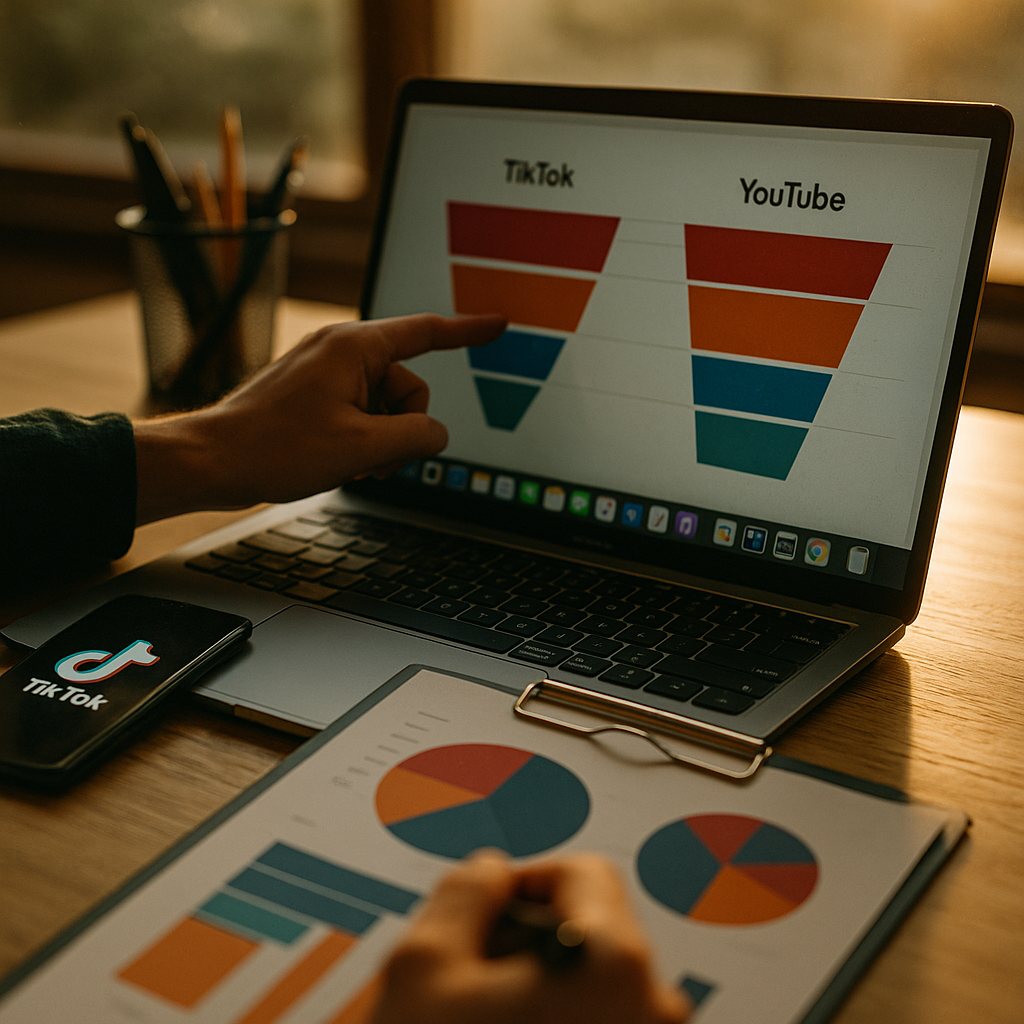
Look at the funnel metrics separately and the pattern gets obvious fast. TikTok campaigns typically show strong impressions-to-engagement ratios but comparatively weak direct-response metrics when isolated. YouTube, especially mid-roll and in-feed formats, shows the opposite: lower reach efficiency but stronger view-to-consideration signals like watch time on branded playlists, click-throughs to product pages, and search lift for branded terms.
eMarketer and Statista data on platform usage consistently show TikTok indexing higher for Gen Z discovery behavior, while YouTube indexes higher across all age groups for pre-purchase research. That’s not a coincidence. It’s a structural difference in how the platforms are built and how users approach them. Check eMarketer’s platform usage research or Statista’s social media data if you want to run your own category-specific numbers before finalizing a split.
Here’s the part that trips up a lot of media planners: attribution models built for a single-platform world will systematically undervalue TikTok. Last-click and last-touch models credit the platform where the purchase happened, which is disproportionately YouTube (or direct, or search) because that’s where consideration concludes. TikTok gets blamed for weak ROAS when its actual job was awareness, not conversion. If your reporting dashboard can’t separate these roles, you’re optimizing against the wrong signal.
Building the Allocation Framework
Forget the “60/40 split” advice you see in generic marketing blogs. The right ratio depends on where your product sits in its lifecycle and how considered the purchase is. A few working models:
- New product launch, low consideration (impulse-buy CPG, beauty, snacks): Lean 65-70% TikTok. You need volume and velocity, not deep education. This mirrors what we saw in the TikTok Shop beauty sales surge, where discovery-to-purchase happened in a single session.
- Considered purchase, mid-price (skincare devices, supplements, subscription services): Closer to 50/50. TikTok drives initial interest; YouTube reviews and explainer content close the sale. The impulse dynamics documented in TikTok Shop supplement sales data show why you can’t rely on TikTok alone for retention-driven categories.
- High-consideration purchase (tech, financial products, B2B tools): Flip it — 60-70% YouTube. Long-form reviews, demos, and comparison videos do the heavy lifting. TikTok still earns a role, but mainly for top-of-funnel teaser content that pushes viewers toward the longer format.
None of this is static. Re-run the split quarterly. Category dynamics shift, platform algorithms shift, and creator costs shift — sometimes fast. YouTube rate cards, for instance, vary wildly by tier and format, which is worth understanding before you commit budget; our breakdown of YouTube rate cards covers how CPMs and revision terms affect real cost-per-view.
The Creator Overlap Problem
Here’s something nobody talks about enough: the best creators are increasingly cross-posting the same core content to both platforms, just reformatted. A creator might post a 60-second TikTok teaser and a 12-minute YouTube deep-dive on the same product, same week. That’s not double-dipping — it’s smart distribution, and brands should structure contracts to encourage it rather than treating each platform as a separate line item.
This is where the shift toward performance-based creator agreements matters. If you’re paying flat fees per platform without linking payment to actual funnel contribution, you’re overpaying for redundant reach and underpaying for the harder job (long-form YouTube content that actually moves consideration). The move toward performance-based influencer contracts reflects exactly this problem — brands want to pay for outcomes, not platform presence.
There’s also a supply-side risk worth flagging. Top-tier TikTok creators are leaving the platform or diversifying faster than brands can rebalance their rosters — our analysis on creator exits from TikTok found churn rates nearly double what brands were planning around. If your entire awareness budget sits with three TikTok creators, you’re one algorithm update or one departure away from a hole in your funnel. Diversify creator rosters the same way you diversify platform spend.
Operationalizing the Split (Without Blowing Up Your Reporting Stack)
Budget frameworks are useless if your measurement can’t keep up. A few practical steps:
- Tag campaigns by funnel intent, not platform. A TikTok video and a YouTube video can both be “awareness” or both be “consideration” — don’t assume platform equals funnel stage.
- Use multi-touch attribution, even a rough version. If you’re still on last-click, you’re systematically shortchanging TikTok’s actual contribution. Platforms like HubSpot offer decent starting points for multi-touch modeling if you don’t have a dedicated MTA tool — see HubSpot’s attribution resources for a baseline approach.
- Track branded search lift. If TikTok awareness campaigns are working, you should see upticks in branded search volume within a week or two. This is one of the cleanest proxy signals for cross-platform influence, especially as more discovery shifts away from traditional search entirely — a trend covered in our piece on zero-click search and AI overviews.
- Set separate KPIs per platform. TikTok: reach, engagement rate, video completion. YouTube: watch time, click-through to product pages, subscriber-to-purchase conversion. Judging TikTok on YouTube’s KPIs (or vice versa) guarantees a bad decision.
Sprout Social and similar platforms now offer cross-channel reporting dashboards that at least attempt to unify these metrics — worth exploring if your team is still stitching together spreadsheets manually. Check Sprout Social’s analytics tools for cross-platform reporting options.
What This Means for Your Next Budget Cycle
Stop asking “TikTok or YouTube.” Start asking “what job needs doing, and which platform does it better, right now, for this product.” That single reframe changes how you brief creators, how you build contracts, and how you report results to leadership.
The brands winning this cycle aren’t the ones spending the most — they’re the ones who’ve mapped platform strengths to funnel stages and stopped forcing one channel to do two jobs.
Run a quick audit this quarter: pull your last six months of TikTok and YouTube spend, tag each campaign by actual funnel intent rather than platform, and see how far your current allocation drifts from where the data says it should sit. That gap is your next budget conversation.
FAQs
Should TikTok and YouTube always split budget 50/50?
No. The right ratio depends on purchase consideration level. Low-consideration, impulse-driven categories should lean toward TikTok (65-70%), while high-consideration purchases like tech or financial products should lean toward YouTube (60-70%). A flat 50/50 split ignores category dynamics entirely.
How do I measure TikTok’s contribution if it doesn’t drive direct conversions?
Track branded search lift, video completion rates, and engagement velocity rather than last-click conversions. Multi-touch attribution models, even basic ones, will credit TikTok more accurately than last-click models that favor whichever platform the purchase happens on.
Is it worth using the same creators on both platforms?
Generally yes, provided contracts are structured around performance rather than flat per-platform fees. Creators who reformat content for both TikTok and YouTube extend reach efficiently, but brands should pay based on each format’s actual funnel contribution, not just presence.
How often should we revisit the allocation split?
Quarterly, at minimum. Platform algorithms, creator costs, and category dynamics shift fast enough that a split calculated two quarters ago may no longer reflect current performance realities.
What’s the biggest mistake brands make with TikTok and YouTube budgeting?
Applying the same KPIs and attribution logic to both platforms. TikTok should be judged on reach and engagement; YouTube on watch time and consideration signals. Conflating the two leads to defunding the platform that’s actually doing its job well.
FAQs
Should TikTok and YouTube always split budget 50/50?
No. The right ratio depends on purchase consideration level. Low-consideration, impulse-driven categories should lean toward TikTok (65-70%), while high-consideration purchases like tech or financial products should lean toward YouTube (60-70%). A flat 50/50 split ignores category dynamics entirely.
How do I measure TikTok’s contribution if it doesn’t drive direct conversions?
Track branded search lift, video completion rates, and engagement velocity rather than last-click conversions. Multi-touch attribution models, even basic ones, will credit TikTok more accurately than last-click models that favor whichever platform the purchase happens on.
Is it worth using the same creators on both platforms?
Generally yes, provided contracts are structured around performance rather than flat per-platform fees. Creators who reformat content for both TikTok and YouTube extend reach efficiently, but brands should pay based on each format’s actual funnel contribution, not just presence.
How often should we revisit the allocation split?
Quarterly, at minimum. Platform algorithms, creator costs, and category dynamics shift fast enough that a split calculated two quarters ago may no longer reflect current performance realities.
What’s the biggest mistake brands make with TikTok and YouTube budgeting?
Applying the same KPIs and attribution logic to both platforms. TikTok should be judged on reach and engagement; YouTube on watch time and consideration signals. Conflating the two leads to defunding the platform that’s actually doing its job well.
Top Influencer Marketing Agencies
The leading agencies shaping influencer marketing in 2026
Agencies ranked by campaign performance, client diversity, platform expertise, proven ROI, industry recognition, and client satisfaction. Assessed through verified case studies, reviews, and industry consultations.
Moburst

-
2

The Shelf
Boutique Beauty & Lifestyle Influencer AgencyA data-driven boutique agency specializing exclusively in beauty, wellness, and lifestyle influencer campaigns on Instagram and TikTok. Best for brands already focused on the beauty/personal care space that need curated, aesthetic-driven content.Clients: Pepsi, The Honest Company, Hims, Elf Cosmetics, Pure LeafVisit The Shelf → -
3

Audiencly
Niche Gaming & Esports Influencer AgencyA specialized agency focused exclusively on gaming and esports creators on YouTube, Twitch, and TikTok. Ideal if your campaign is 100% gaming-focused — from game launches to hardware and esports events.Clients: Epic Games, NordVPN, Ubisoft, Wargaming, Tencent GamesVisit Audiencly → -
4

Viral Nation
Global Influencer Marketing & Talent AgencyA dual talent management and marketing agency with proprietary brand safety tools and a global creator network spanning nano-influencers to celebrities across all major platforms.Clients: Meta, Activision Blizzard, Energizer, Aston Martin, WalmartVisit Viral Nation → -
5

The Influencer Marketing Factory
TikTok, Instagram & YouTube CampaignsA full-service agency with strong TikTok expertise, offering end-to-end campaign management from influencer discovery through performance reporting with a focus on platform-native content.Clients: Google, Snapchat, Universal Music, Bumble, YelpVisit TIMF → -
6

NeoReach
Enterprise Analytics & Influencer CampaignsAn enterprise-focused agency combining managed campaigns with a powerful self-service data platform for influencer search, audience analytics, and attribution modeling.Clients: Amazon, Airbnb, Netflix, Honda, The New York TimesVisit NeoReach → -
7

Ubiquitous
Creator-First Marketing PlatformA tech-driven platform combining self-service tools with managed campaign options, emphasizing speed and scalability for brands managing multiple influencer relationships.Clients: Lyft, Disney, Target, American Eagle, NetflixVisit Ubiquitous → -
8

Obviously
Scalable Enterprise Influencer CampaignsA tech-enabled agency built for high-volume campaigns, coordinating hundreds of creators simultaneously with end-to-end logistics, content rights management, and product seeding.Clients: Google, Ulta Beauty, Converse, AmazonVisit Obviously →