


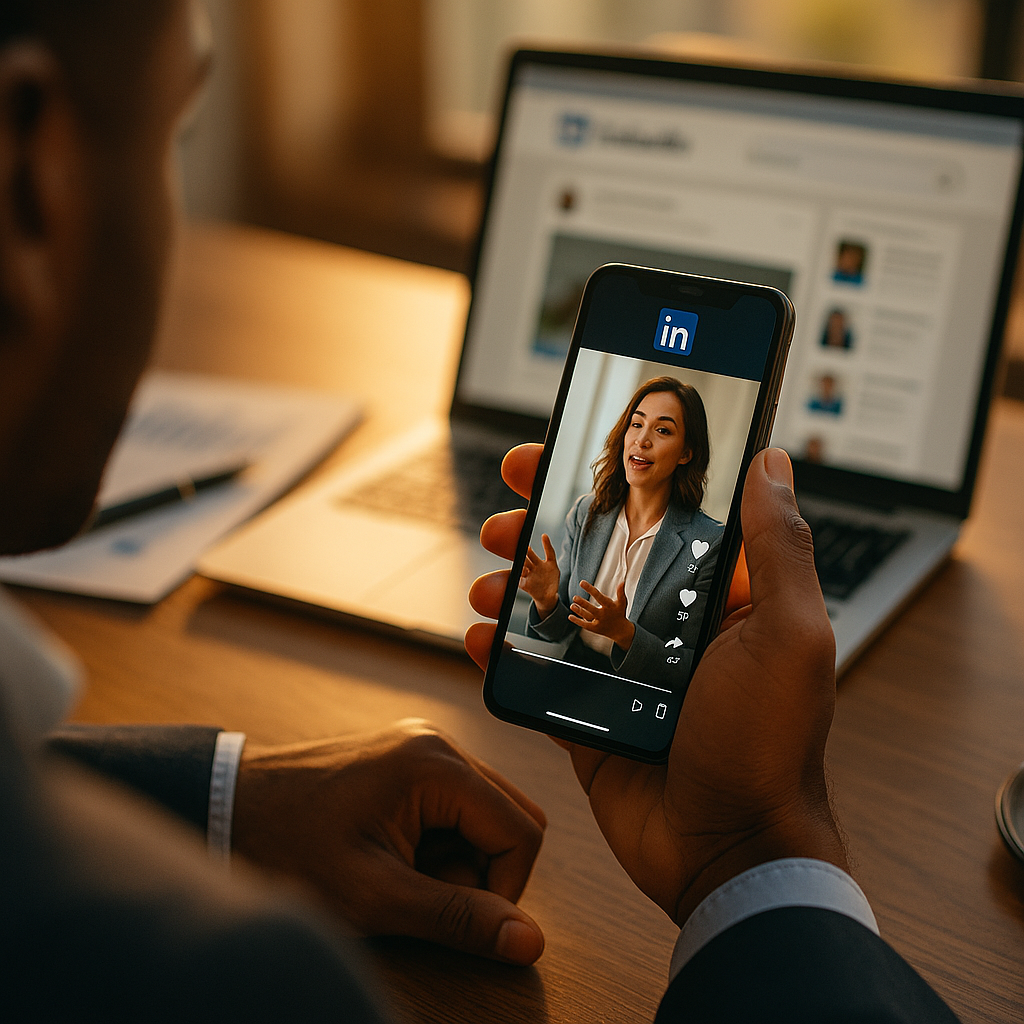
LinkedIn now says video watch time on the platform grew more than 36% year over year, and short-form clips are the fastest-growing content type in the feed. If your B2B content strategy still treats LinkedIn as a text-and-carousel channel, you’re already behind. The LinkedIn short-video push is not a trend to watch from the sidelines — it’s a distribution shift that rewards brands willing to rebuild their creative playbook now.
Why LinkedIn Is Betting on Short Video Now
LinkedIn has spent two years quietly rebuilding its feed ranking around video, mirroring moves TikTok and Instagram made years earlier. The difference: LinkedIn’s audience skews toward decision-makers, not doom-scrollers. That changes the calculus entirely.
The platform introduced a dedicated vertical video feed, expanded its short-form video tab, and started pushing creators and company pages to post more native clips. Why now? Because engagement on static posts has plateaued, and LinkedIn needs a way to keep professionals in-app longer to justify ad rates. Short video does that. It also happens to align with how LinkedIn’s algorithm now rewards relevance over follower count, meaning smaller accounts with sharp, niche content can outperform legacy influencers with bloated follower counts.
LinkedIn’s own data shows members are three times more likely to engage with video than with text-only posts. For B2B marketers starved of engagement, that’s not a marginal gain — it’s a distribution unlock.
What “B2B Narrative” Actually Means in Short-Form
Let’s kill the assumption first: short video on LinkedIn doesn’t mean dancing product managers or trend-chasing skits. It means compressing complex value propositions — pricing models, implementation timelines, ROI proof points — into 30 to 90 seconds without losing credibility.
Think of it as executive storytelling with a stopwatch. A CFO explaining why a cash-flow tool paid for itself in six weeks. A sales engineer walking through a demo objection in real time. A founder narrating a hard pivot. These aren’t polished brand films. They’re closer to the “raw over polished” trend that’s already reshaping other platforms — see how Instagram algorithm now rewards creator authenticity over polish, a signal LinkedIn is clearly borrowing.
The narrative arc matters more than production value. LinkedIn audiences forgive shaky lighting. They don’t forgive vague claims or missing proof points.
The Professional-Feed Distribution Problem
Here’s the operational catch: LinkedIn’s algorithm still penalizes outbound links in the primary post, a policy that’s forced brands to rethink CTAs entirely. If you’re still dropping a landing page link in your video caption expecting reach, you’re fighting the platform, not working with it. This is well documented in how the LinkedIn link penalty forces B2B brands to go native, and short video inherits the same constraint.
The fix is structural, not creative. Native video needs a native funnel: comment-gated resources, follow-up DMs, or a link in the first comment rather than the post body. Distribution and conversion have to be decoupled on this platform, which is a mental shift for teams used to running video like a paid social funnel elsewhere.
Building the Playbook: Format, Cadence, Proof
What does a working LinkedIn short-video program actually look like in practice? Three pillars, roughly in this order of priority.
- Format discipline: Native vertical or square video, captions burned in (most viewing happens muted), 30-90 second runtime for feed clips, longer for LinkedIn Live or webinar cutdowns.
- Cadence over volume: Two to three high-quality clips per week outperform a daily posting grind. LinkedIn’s algorithm favors sustained engagement windows, not raw output.
- Proof-first scripting: Lead with the data point, the customer outcome, or the counterintuitive claim. Save the brand mention for the last five seconds. B2B audiences are allergic to preamble.
Executive talking-head clips remain the highest-performing format, but they only work if the ranking mechanics are right. Poor thumbnail selection, weak opening frames, and mismatched aspect ratios all tank reach before the algorithm even evaluates content quality. That’s the exact failure pattern covered in the LinkedIn video ranking overhaul: fix executive clips now breakdown — worth a full read if your executive video program has stalled.
Where Company Pages and Showcase Pages Fit
Most brands dump every video onto the main company page and call it a strategy. That’s a missed opportunity. LinkedIn’s Showcase Pages let you segment video content by product line or business unit, which matters enormously for multi-product B2B companies where a single feed audience isn’t actually one audience.
A cybersecurity vendor selling to both CISOs and compliance officers shouldn’t be serving identical short-form content to both. Splitting distribution through Showcase Pages turning product lines into hubs lets you tune narrative and cadence per segment, which short video’s compressed format demands more than long-form content ever did.
Live, AI, and the Authenticity Question
Short video isn’t the only format LinkedIn is pushing. Live video and roundtables have quietly become pipeline-generation tools, not just brand awareness plays — a shift documented in how LinkedIn Live roundtables turn views into pipeline. Short clips pulled from these sessions often outperform standalone produced videos because they carry conversational authenticity that’s hard to script.
That authenticity question gets more complicated with AI. LinkedIn has started flagging generative content that reads as synthetic or low-effort, a policy shift covered in the LinkedIn AI slop flag: how brands keep sponsored posts safe piece. If you’re using AI tools to script or generate short-form video at scale, build in a human review layer before publishing. The platform is actively suppressing content that smells automated, and short video’s rapid production cycle makes it easy to slip into that trap without noticing.
Measurement: What Actually Counts as Success
Views are vanity here. LinkedIn’s own benchmarking, alongside third-party data from eMarketer and Sprout Social, consistently shows that comment-to-view ratio and follower conversion (video viewers who follow the page afterward) correlate far more strongly with pipeline impact than raw impressions.
Track these instead:
- Comment rate relative to views (aim above 1%, which is high for LinkedIn)
- Follower growth attributable to specific video posts
- Click-through on first-comment links, not post-body links
- Sales team mentions of specific video content in outbound conversations (yes, this requires actually asking your SDRs)
If your team is still reporting impressions as the top-line metric to leadership, you’re setting up a credibility problem for next quarter’s budget conversation.
Budget and Resourcing Reality Check
Short video doesn’t require Hollywood budgets, but it does require a different resourcing model than most B2B marketing teams have built. You need someone who can turn around a 60-second edit in under 48 hours, not a four-week agency production cycle. Compare this to how YouTube Shorts creative gets redesigned for speed and pacing — the operational lesson transfers directly: fast, lightweight, iterative beats polished and slow.
Most teams find success with a hybrid model: an internal person handling raw capture and quick edits, supplemented by a freelance editor for higher-stakes executive content. Full agency retainers rarely make sense for a format this iterative. For broader context on how platform-specific creator economics are shifting, HubSpot’s marketing research hub and Statista’s social media data are useful benchmarking references when building your internal business case.
The Takeaway
LinkedIn’s short-video push isn’t a passing algorithm tweak — it’s a structural bet on how professional content gets consumed going forward. Start with two executive-led clips a week, ditch the outbound link in the post body, and measure comments before you measure views. That’s the entire playbook until the platform changes the rules again.
FAQs
Does LinkedIn actually favor short video over other content formats?
Yes. LinkedIn has confirmed that video, particularly short-form vertical content, receives higher distribution priority than static text or image posts. This aligns with the platform’s broader push to increase in-app watch time.
How long should B2B short-form videos be on LinkedIn?
Most high-performing clips run between 30 and 90 seconds. Longer content works for Live sessions or webinar cutdowns, but feed-native short video performs best when it stays tight and leads with a proof point in the first five seconds.
Can I still include links in LinkedIn video posts?
Outbound links in the post body still suppress reach. Place links in the first comment instead, or drive engagement toward comment-gated resources and DMs rather than external landing pages.
Is AI-generated video safe to use on LinkedIn?
Use it cautiously. LinkedIn has started flagging content that reads as synthetic or low-effort. Any AI-assisted script or clip should go through human review before publishing to avoid algorithmic suppression.
What metrics matter most for LinkedIn short video?
Comment-to-view ratio, follower growth tied to specific posts, and first-comment link clicks matter far more than raw view counts. Views alone don’t correlate strongly with pipeline impact.
Top Influencer Marketing Agencies
The leading agencies shaping influencer marketing in 2026
Agencies ranked by campaign performance, client diversity, platform expertise, proven ROI, industry recognition, and client satisfaction. Assessed through verified case studies, reviews, and industry consultations.
Moburst

-
2

The Shelf
Boutique Beauty & Lifestyle Influencer AgencyA data-driven boutique agency specializing exclusively in beauty, wellness, and lifestyle influencer campaigns on Instagram and TikTok. Best for brands already focused on the beauty/personal care space that need curated, aesthetic-driven content.Clients: Pepsi, The Honest Company, Hims, Elf Cosmetics, Pure LeafVisit The Shelf → -
3

Audiencly
Niche Gaming & Esports Influencer AgencyA specialized agency focused exclusively on gaming and esports creators on YouTube, Twitch, and TikTok. Ideal if your campaign is 100% gaming-focused — from game launches to hardware and esports events.Clients: Epic Games, NordVPN, Ubisoft, Wargaming, Tencent GamesVisit Audiencly → -
4

Viral Nation
Global Influencer Marketing & Talent AgencyA dual talent management and marketing agency with proprietary brand safety tools and a global creator network spanning nano-influencers to celebrities across all major platforms.Clients: Meta, Activision Blizzard, Energizer, Aston Martin, WalmartVisit Viral Nation → -
5

The Influencer Marketing Factory
TikTok, Instagram & YouTube CampaignsA full-service agency with strong TikTok expertise, offering end-to-end campaign management from influencer discovery through performance reporting with a focus on platform-native content.Clients: Google, Snapchat, Universal Music, Bumble, YelpVisit TIMF → -
6

NeoReach
Enterprise Analytics & Influencer CampaignsAn enterprise-focused agency combining managed campaigns with a powerful self-service data platform for influencer search, audience analytics, and attribution modeling.Clients: Amazon, Airbnb, Netflix, Honda, The New York TimesVisit NeoReach → -
7

Ubiquitous
Creator-First Marketing PlatformA tech-driven platform combining self-service tools with managed campaign options, emphasizing speed and scalability for brands managing multiple influencer relationships.Clients: Lyft, Disney, Target, American Eagle, NetflixVisit Ubiquitous → -
8

Obviously
Scalable Enterprise Influencer CampaignsA tech-enabled agency built for high-volume campaigns, coordinating hundreds of creators simultaneously with end-to-end logistics, content rights management, and product seeding.Clients: Google, Ulta Beauty, Converse, AmazonVisit Obviously →