


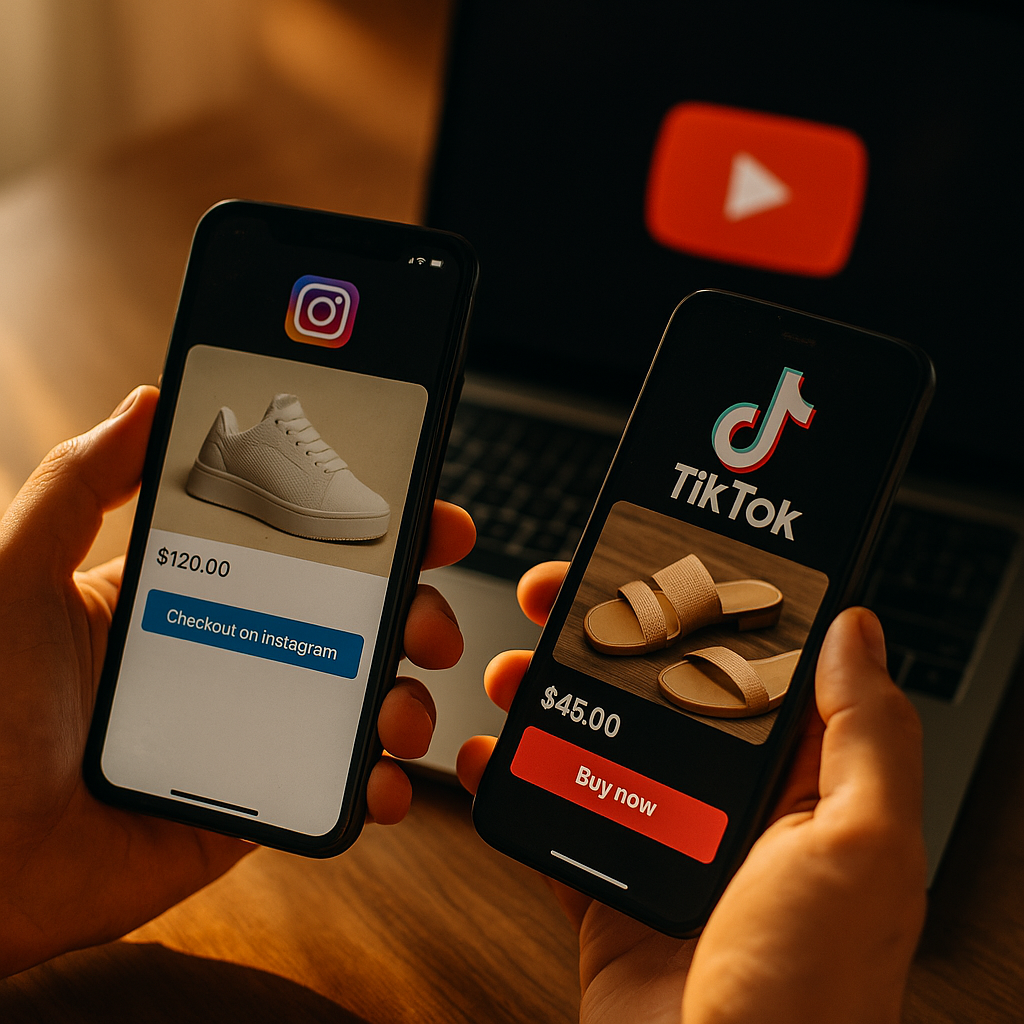
Seventy-eight percent of shoppers who abandon a native checkout blame the number of taps, not the price tag. That single stat explains why Instagram checkout has quietly become the platform brands lean on hardest for in-app conversion. TikTok built the hype around shoppable video. YouTube brought scale. But Instagram built the flow that actually closes.
This isn’t a loyalty argument. It’s an operational one. If you’re allocating budget across three platforms with three very different purchase mechanics, you need to know which one reduces friction, which one reduces risk, and which one just reduces your patience.
Why In-App Checkout Became the Metric That Matters
Two years ago, “shoppable content” mostly meant a swipe-up link and a prayer. Now it means a transaction completed without ever leaving the app: saved payment credentials, native order tracking, in-platform returns. The difference matters because every redirect to a mobile web browser costs conversion. HubSpot’s commerce research has repeatedly shown that added checkout steps correlate directly with cart abandonment, and social platforms have absorbed that lesson aggressively.
Brands running performance campaigns don’t care which platform has the coolest live-shopping format. They care about completed purchase rate per impression. That’s the lens for this comparison.
Instagram’s checkout advantage isn’t about flashier features — it’s about fewer decisions required from the shopper between “I want this” and “I bought this.”
Instagram Checkout: The Quiet Category Leader
Instagram Checkout has had years to mature, and it shows. Saved card details persist across Reels, Stories, and product tags. Meta’s unified commerce backend means a purchase started from an influencer’s Reel and a purchase started from a static feed post both route through the same infrastructure, with the same saved credentials, the same order history, the same return flow.
That consistency is the real differentiator. Brands don’t have to design separate purchase journeys for separate content formats. A tagged product in a Reel, a swipe-up in Stories, a shop tab listing — they all deposit shoppers into the identical checkout experience. Fewer format-specific bugs. Fewer QA cycles. Less engineering overhead for the brand’s commerce team.
This matters more than it sounds. Teams running influencer programs across multiple content types often discover, painfully, that one format’s purchase flow breaks while another’s works fine. Instagram has largely engineered that risk away. For brands optimizing Reels specifically, understanding how tagged Reels get algorithmic favor is now inseparable from understanding how those same tags drive checkout completion.
Where Instagram Still Has Gaps
It’s not flawless. Checkout availability still varies by region and merchant category, and Meta’s commerce policies around health, supplement, and financial products remain stricter than TikTok’s, which frustrates brands in regulated verticals. Live shopping on Instagram also lags behind TikTok’s livestream commerce — the format exists, but the audience habit isn’t there yet. If your strategy leans on livestream impulse buying, Instagram is not currently the stronger bet.
TikTok Shop: Fast, Volatile, Still Evolving
TikTok Shop remains the most aggressive experiment in native commerce. Product tags, affiliate links, livestream carts, and the For You feed’s shopping surfaces all funnel into one checkout, and TikTok has clearly prioritized speed of iteration over stability. New sellers report changes to commission structures, tagging rules, and fee tiers with little warning.
That volatility is the tradeoff for TikTok’s genuinely impressive discovery mechanics. Its algorithm surfaces product-tagged content to intent-rich audiences in a way Instagram still can’t fully replicate — see how product tags boost organic reach on TikTok specifically. But discovery isn’t the same as checkout reliability. Brands running TikTok Shop still report higher rates of cart drop-off during payment authorization compared to Instagram, particularly for shoppers without TikTok’s stored payment method already set up.
TikTok’s real strength is impulse-driven livestream commerce. Segmented livestream scripts built around scarcity and urgency convert well, provided brands stay inside FTC guardrails. If you’re building live-selling scripts, the guidance on structuring livestream segments for impulse buys and on avoiding FTC scarcity risk with countdown timers should be required reading before your next livestream calendar goes out.
The Affiliate Layer Complicates Things
TikTok’s affiliate infrastructure — creators tagging products and earning commission on resulting sales — adds a genuinely useful acquisition channel. But it also adds checkout complexity. Commission tracking has to reconcile in real time or brands end up disputing payouts with creators, which damages relationships fast. Anyone running affiliate programs at scale should be watching how real-time commission tracking is evolving, because attribution errors here directly undermine trust with your creator roster.
YouTube: Commerce as an Afterthought, Still
YouTube’s native checkout is the least mature of the three, and it’s not particularly close. Shopping features exist — product shelves under videos, live shopping during streams, affiliate tagging through the YouTube Shopping program — but adoption among viewers remains lower. Most YouTube-driven purchases still happen through an external link click that lands on a brand’s own site, not through an in-app transaction.
Is that necessarily a weakness? Depends on your goal. YouTube’s strength has always been consideration and trust-building rather than impulse conversion. Long-form video builds the kind of product understanding that a six-second TikTok clip simply can’t. Brands in high-consideration categories — supplements, financial products, electronics — often see better full-funnel results from YouTube precisely because it doesn’t rush the shopper toward checkout. The reasoning behind why long-form wins trust for supplement brands applies directly here: a slower funnel isn’t a broken funnel.
That said, YouTube is investing. Shopping affiliate tools have expanded, and Shorts now support product tagging similar to Reels and TikTok clips. If you’re deciding where to put production budget, the tradeoffs outlined in a Shorts vs. long-form budget framework are worth revisiting with commerce, not just watch time, as the success metric.
YouTube converts on trust over weeks. TikTok converts on impulse in seconds. Instagram is the only one of the three built to convert reliably on both timelines.
A Practical Side-by-Side
- Checkout consistency: Instagram wins. Same flow across Reels, Stories, and Shop tab.
- Discovery-to-cart speed: TikTok wins. Algorithm surfaces intent faster than either competitor.
- High-consideration purchases: YouTube wins, though mostly via external redirect rather than native checkout.
- Regulated categories (supplements, finance): TikTok is currently more permissive; Instagram is stricter but more stable long-term.
- Livestream commerce: TikTok is dominant; Instagram is playing catch-up; YouTube is experimental.
- Affiliate/creator commission tracking: TikTok has the most mature tooling, though reliability varies by market.
None of this means brands should pick one platform and abandon the others. It means budget allocation should map to funnel stage, not platform preference. Use TikTok for volume and impulse. Use Instagram for reliable, repeatable conversion across content formats. Use YouTube where the purchase decision needs more runway.
What This Means for Creator Briefs
Checkout mechanics should shape creator briefs, not just content strategy. A creator brief for Instagram should assume the shopper can complete a purchase without leaving the Reel. A TikTok brief should build urgency into the script because impulse is the mechanism, not an accident. And format decisions matter too — brands still debating Reels versus TikTok brief strategy should treat checkout capability as a primary input, not an afterthought bolted on after the creative is locked.
It’s also worth remembering that Instagram’s algorithm changes affect checkout indirectly. When Meta adjusts how it distributes Reels across feeds, it changes how many shoppers ever see the tagged product in the first place. Distribution and checkout are two ends of the same pipe. Brands that optimize one without watching the other tend to see conversion numbers that don’t make sense until they trace the full funnel.
Platform commerce data is still catching up to reality, too. eMarketer’s social commerce forecasts and Statista’s platform usage figures are useful directional benchmarks, but they lag actual in-platform behavior by a quarter or more, largely because Meta, TikTok, and Google don’t release granular checkout completion rates publicly. Treat published estimates as a floor, not gospel, and validate against your own pixel and platform-reported conversion data before reallocating spend.
The Compliance Layer Nobody Wants to Talk About
In-app checkout also concentrates risk. When a purchase happens entirely inside a platform, disclosure and advertising compliance get harder to audit externally. The FTC’s endorsement guidelines still apply regardless of where the transaction closes, and regulators have shown increasing interest in scarcity messaging, countdown timers, and livestream sales tactics that pressure impulse purchases. Brands running TikTok Shop livestreams in particular should treat the guidance on countdown timer scripts that avoid FTC risk as non-negotiable, not optional reading. A checkout that converts brilliantly but invites regulatory scrutiny isn’t actually a win.
Next step: Audit your current in-app checkout performance by platform this quarter, not by vanity conversion rate but by completed-purchase-per-impression, then reallocate creator brief structure and ad spend to match each platform’s actual strength: Instagram for consistency, TikTok for impulse, YouTube for consideration.
FAQs
Which platform currently has the most reliable native checkout for brands?
Instagram, largely because its commerce backend is unified across Reels, Stories, and the Shop tab, giving shoppers a consistent experience regardless of content format.
Is TikTok Shop still worth the investment despite its volatility?
Yes, particularly for impulse-driven categories and livestream commerce. TikTok’s discovery algorithm surfaces purchase intent faster than competitors, but brands should expect ongoing changes to fees, tagging rules, and commission structures.
Does YouTube have native checkout at all?
YouTube offers product shelves, live shopping, and affiliate tagging through its Shopping program, but most purchases still route through external links to a brand’s own site rather than completing natively in-app.
How should brands split budget across these three platforms?
Map spend to funnel stage rather than platform preference: TikTok for volume and impulse purchases, Instagram for consistent cross-format conversion, and YouTube for high-consideration categories that need longer decision windows.
What compliance risks come with in-app checkout specifically?
Scarcity messaging, countdown timers, and livestream sales tactics face increasing regulatory scrutiny under FTC endorsement and advertising guidelines, regardless of which platform hosts the transaction.
Visible FAQ
Which platform currently has the most reliable native checkout for brands?
Instagram, largely because its commerce backend is unified across Reels, Stories, and the Shop tab, giving shoppers a consistent experience regardless of content format.
Is TikTok Shop still worth the investment despite its volatility?
Yes, particularly for impulse-driven categories and livestream commerce. TikTok’s discovery algorithm surfaces purchase intent faster than competitors, but brands should expect ongoing changes to fees, tagging rules, and commission structures.
Does YouTube have native checkout at all?
YouTube offers product shelves, live shopping, and affiliate tagging through its Shopping program, but most purchases still route through external links to a brand’s own site rather than completing natively in-app.
How should brands split budget across these three platforms?
Map spend to funnel stage rather than platform preference: TikTok for volume and impulse purchases, Instagram for consistent cross-format conversion, and YouTube for high-consideration categories that need longer decision windows.
What compliance risks come with in-app checkout specifically?
Scarcity messaging, countdown timers, and livestream sales tactics face increasing regulatory scrutiny under FTC endorsement and advertising guidelines, regardless of which platform hosts the transaction.
Top Influencer Marketing Agencies
The leading agencies shaping influencer marketing in 2026
Agencies ranked by campaign performance, client diversity, platform expertise, proven ROI, industry recognition, and client satisfaction. Assessed through verified case studies, reviews, and industry consultations.
Moburst

-
2

The Shelf
Boutique Beauty & Lifestyle Influencer AgencyA data-driven boutique agency specializing exclusively in beauty, wellness, and lifestyle influencer campaigns on Instagram and TikTok. Best for brands already focused on the beauty/personal care space that need curated, aesthetic-driven content.Clients: Pepsi, The Honest Company, Hims, Elf Cosmetics, Pure LeafVisit The Shelf → -
3

Audiencly
Niche Gaming & Esports Influencer AgencyA specialized agency focused exclusively on gaming and esports creators on YouTube, Twitch, and TikTok. Ideal if your campaign is 100% gaming-focused — from game launches to hardware and esports events.Clients: Epic Games, NordVPN, Ubisoft, Wargaming, Tencent GamesVisit Audiencly → -
4

Viral Nation
Global Influencer Marketing & Talent AgencyA dual talent management and marketing agency with proprietary brand safety tools and a global creator network spanning nano-influencers to celebrities across all major platforms.Clients: Meta, Activision Blizzard, Energizer, Aston Martin, WalmartVisit Viral Nation → -
5

The Influencer Marketing Factory
TikTok, Instagram & YouTube CampaignsA full-service agency with strong TikTok expertise, offering end-to-end campaign management from influencer discovery through performance reporting with a focus on platform-native content.Clients: Google, Snapchat, Universal Music, Bumble, YelpVisit TIMF → -
6

NeoReach
Enterprise Analytics & Influencer CampaignsAn enterprise-focused agency combining managed campaigns with a powerful self-service data platform for influencer search, audience analytics, and attribution modeling.Clients: Amazon, Airbnb, Netflix, Honda, The New York TimesVisit NeoReach → -
7

Ubiquitous
Creator-First Marketing PlatformA tech-driven platform combining self-service tools with managed campaign options, emphasizing speed and scalability for brands managing multiple influencer relationships.Clients: Lyft, Disney, Target, American Eagle, NetflixVisit Ubiquitous → -
8

Obviously
Scalable Enterprise Influencer CampaignsA tech-enabled agency built for high-volume campaigns, coordinating hundreds of creators simultaneously with end-to-end logistics, content rights management, and product seeding.Clients: Google, Ulta Beauty, Converse, AmazonVisit Obviously →