


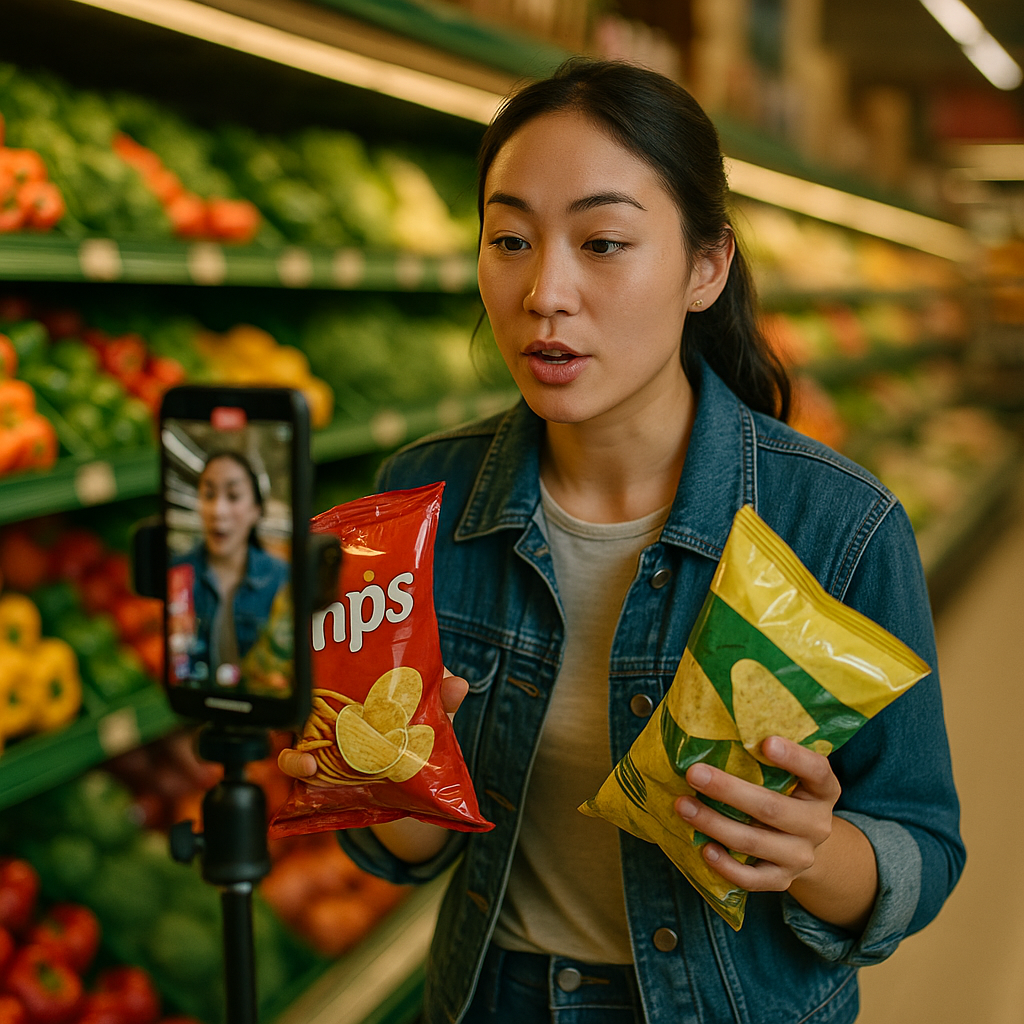
Grocery shoppers scroll fast. You have roughly 60 seconds to stop a thumb, prove value, and drop a link before they’re gone. Brands running TikTok Shop grocery livestreams that ignore this window are wasting inventory on empty carts. The ones winning right now have turned the humble side-by-side aisle comparison into a conversion machine, and the structure behind it is more deliberate than it looks.
Why Grocery Livestreams Behave Differently Than Beauty or Fashion
Grocery is a low-consideration category dressed up as a high-frequency one. Nobody agonizes over a $6 bag of snack chips the way they do over a $60 serum. That changes everything about pacing. Beauty livestreams can spend three minutes building a narrative around ingredients and skin type. Grocery buyers want the punchline first: is this cheaper, better, or more convenient than what’s already in their cart? Beauty’s livestream growth came from trust-building over longer arcs. Grocery growth comes from speed and proof, compressed into a format closer to a game show round than a tutorial.
TikTok’s own commerce data has repeatedly shown that shopping intent spikes in the platform’s food and beverage tags, but conversion still lags unless the content answers a comparison question almost instantly. That’s the gap most merchants leave open.
The 60-Second Aisle Comparison Format, Broken Down
Think of the segment as four beats, not a script. Rigid scripts read as ads, and ads get scrolled past. The beats:
- Second 0-8: Hold up two products side by side. Name the comparison out loud (“store brand vs. this new snack” or “$5 versus $12 for the same protein count”).
- Second 8-25: Show the differentiator visually. Pour it, taste it, weigh it, read the label. Grocery buyers trust what they can see more than what they’re told.
- Second 25-45: Deliver the verdict fast and opinionated. “This one wins on price per ounce, that one wins on protein.” Neutral hosts lose viewers. Opinionated hosts keep them.
- Second 45-60: Push the cart link with urgency tied to stock or bundle, not just a generic “link in cart” mention.
Notice what’s missing: no brand history, no ingredient deep dive, no multi-slide comparison chart. Save that for a landing page or a longer-form comparison video on YouTube where viewers arrive with more patience.
A grocery livestream segment that runs past 75 seconds without a verdict is a segment losing viewers to the next creator in their feed.
Casting the Right Host for Impulse Categories
Grocery comparisons live or die on host credibility, and that credibility looks different than in other verticals. You don’t need a nutritionist. You need someone who shops for their own household and reacts like a real person tasting or testing something for the first time. Overly polished delivery reads as scripted, and scripted reads as an ad you can skip.
This is one reason TikTok Shop’s algorithm now weighs trust signals over raw posting frequency. A host who has done twenty honest comparisons, including ones where the competitor won, earns more algorithmic distribution than one who churns out five hyped-up promos a day with no critical takes. Let your creators say a competing product is better on price. It costs you one segment and buys you a season of credibility.
Structuring the Livestream Around Aisle Logic, Not Product Logic
Most brands structure their livestream around their own SKUs: product one, then product two, then product three. Viewers don’t shop that way. They shop by aisle logic, snacks versus snacks, drinks versus drinks, breakfast versus breakfast. Rebuild your rundown around categories a shopper already has in mind, and slot your product into that frame as the challenger or the incumbent.
A practical rundown for a one-hour grocery livestream might look like this:
- Open with a trending comparison (protein bars, energy drinks, whatever’s hot in the FYP food tags that week).
- Rotate through five to seven aisle-comparison segments, each under 90 seconds.
- Insert one longer “deep dive” segment around minute 25 for viewers who stuck around, this is where you can slow down and build narrative.
- Close the final ten minutes with a rapid-fire recap of every winner, stacked with countdown urgency for bundle pricing.
That closing rapid-fire block deserves its own attention. It’s where a lot of the incremental cart adds happen, because viewers who watched earlier segments passively often convert only once they see a compressed recap with a clear deadline.
Urgency Without an FTC Headache
Countdown timers and “only X left” messaging drive real lift in grocery livestreams, but grocery is also a category where regulators pay attention to inflated scarcity claims. If you tell viewers only 40 units remain and you actually have 4,000, that’s not a growth hack, that’s a liability. Review the mechanics carefully, TikTok Shop’s own guidance and the FTC’s endorsement and disclosure rules both apply here, and the same logic covered in structuring countdown timers without FTC risk applies directly to grocery drops. Real-time inventory syncing between your TikTok Shop backend and your actual warehouse counts isn’t optional anymore, it’s the difference between a compliant urgency tactic and a deceptive one.
For a full regulatory refresher, the FTC’s guidance on endorsements and advertising claims is the baseline every brand legal team should keep bookmarked before a livestream calendar gets locked.
Picking Comparison Products That Actually Convert
Not every comparison is worth airtime. The strongest performers share three traits: a clear price gap, a visible physical difference, and a category the viewer already buys weekly. Toilet paper, snack bars, coffee pods, and bottled drinks outperform niche specialty items precisely because the audience doesn’t need to be educated on why the category matters. They already buy it. You’re just proving your version is the smarter buy this week.
Avoid comparisons where the difference is purely subjective, like flavor preference with no measurable edge. Those segments tend to stall out because viewers can’t verify the claim visually, and grocery audiences are unusually skeptical of taste claims they can’t see or hear confirmed on screen (a crunch, a pour consistency, a fizz).
Categories with weekly repurchase habits convert at a different rate than novelty items, because the viewer isn’t being asked to try something new, only to switch what they already buy.
Where AI Tools Help, and Where They Get You Flagged
A lot of merchants are experimenting with AI-generated voiceovers and avatars to scale grocery livestream production across time zones. TikTok has drawn a clear line here for Shop livestreams specifically. Synthetic voices reading product claims in a live selling environment are treated differently than a pre-recorded ad, largely because live commerce carries an implicit “this is a real person vouching for this” signal. If you’re testing AI in your production pipeline, read where TikTok bans AI voices on Shop lives but allows it elsewhere before you build a workflow around it, and cross-check against the merchant compliance playbook for the Shop AI toggle. AI can still help off-stream: generating comparison scripts, pulling price data across competitors, or drafting the rapid-fire recap copy your host reads live.
Measuring What Actually Matters in a 60-Second Segment
Total watch time on a livestream is a vanity number if you’re not segmenting it by comparison block. Pull your analytics down to the segment level: which aisle comparison had the highest add-to-cart rate relative to its viewer count, not just in absolute units sold. A segment that ran during peak viewership will always show more raw sales than one that ran at minute 50 to a shrinking audience, even if the minute-50 segment converted a higher percentage of the people who actually watched it.
Track these four metrics per segment, every stream, without exception:
- Viewer count at segment start versus segment end (drop-off rate)
- Add-to-cart clicks per 100 viewers during that segment window
- Comment sentiment (agree/disagree ratio on the verdict) as a leading indicator for future comparisons
- Return viewer rate for that specific host across multiple streams
Benchmarking data from eMarketer’s retail media and social commerce coverage continues to show live shopping engagement concentrated in short, high-frequency bursts rather than long single sessions, which reinforces why the segment-level view matters more than the full-stream average.
Format Fit: Where This Sits Against Other Channels
Grocery aisle comparisons are a TikTok Shop native format, but that doesn’t mean every grocery brand should abandon other channels. Longer comparison content still has a home on YouTube for shoppers doing pre-purchase research, and Pinterest continues to work well for grocery brands feeding into meal-planning searches, a pattern covered in the shopping list guide for home and kitchen brands. If you’re deciding how to split a limited content budget across formats, the framework in matching format to funnel stage is a useful starting filter: put impulse comparisons on TikTok Shop, put research-driven comparisons on YouTube, and use Pinterest for the planning stage that happens days before either purchase.
For brands still deciding whether livestream commerce belongs on TikTok or Instagram at all, the deeper structural argument is in why vertical commerce wins on TikTok Shop, and it comes down to exactly the mechanic described above: vertical, sound-on, thumb-stopping comparisons simply outperform grid-based shopping tags for low-consideration categories like grocery.
FAQs
How long should a single aisle-comparison segment run on a grocery livestream?
Aim for 60 to 90 seconds per segment. Anything longer risks losing viewers who came in for a quick verdict, not a product story. If a segment naturally needs more time, save the extended version for one designated “deep dive” slot mid-stream rather than stretching every comparison.
What products convert best in TikTok Shop grocery livestreams?
Weekly-repurchase items with a clear, visible price or quality difference tend to convert best: snack bars, drinks, coffee pods, paper goods. Novelty items or purely flavor-based claims underperform because viewers can’t verify the difference on screen.
Are countdown timers and stock scarcity claims allowed on grocery livestreams?
Yes, but only if the numbers reflect real inventory. TikTok Shop and the FTC both treat inflated scarcity claims as deceptive advertising, so sync your countdown mechanics to actual warehouse stock levels before going live.
Can I use an AI voiceover to scale grocery livestream production?
Not for the live selling portion itself. TikTok currently restricts synthetic AI voices specifically within Shop livestreams, though AI-assisted scripting and off-stream production tools are still fair game.
How is grocery livestream success measured differently from other categories?
Segment-level add-to-cart rate matters more than total stream watch time. Because grocery is impulse-driven, a short comparison segment can outperform a longer narrative segment even with fewer total viewers, so measurement needs to happen block by block.
Build your next grocery livestream rundown around aisle categories instead of your own SKU list, cap each comparison at 90 seconds with a clear verdict, and audit your countdown mechanics against real inventory before you go live.
FAQs
How long should a single aisle-comparison segment run on a grocery livestream?
Aim for 60 to 90 seconds per segment. Anything longer risks losing viewers who came in for a quick verdict, not a product story. If a segment naturally needs more time, save the extended version for one designated “deep dive” slot mid-stream rather than stretching every comparison.
What products convert best in TikTok Shop grocery livestreams?
Weekly-repurchase items with a clear, visible price or quality difference tend to convert best: snack bars, drinks, coffee pods, paper goods. Novelty items or purely flavor-based claims underperform because viewers can’t verify the difference on screen.
Are countdown timers and stock scarcity claims allowed on grocery livestreams?
Yes, but only if the numbers reflect real inventory. TikTok Shop and the FTC both treat inflated scarcity claims as deceptive advertising, so sync your countdown mechanics to actual warehouse stock levels before going live.
Can I use an AI voiceover to scale grocery livestream production?
Not for the live selling portion itself. TikTok currently restricts synthetic AI voices specifically within Shop livestreams, though AI-assisted scripting and off-stream production tools are still fair game.
How is grocery livestream success measured differently from other categories?
Segment-level add-to-cart rate matters more than total stream watch time. Because grocery is impulse-driven, a short comparison segment can outperform a longer narrative segment even with fewer total viewers, so measurement needs to happen block by block.
Top Influencer Marketing Agencies
The leading agencies shaping influencer marketing in 2026
Agencies ranked by campaign performance, client diversity, platform expertise, proven ROI, industry recognition, and client satisfaction. Assessed through verified case studies, reviews, and industry consultations.
Moburst

-
2

The Shelf
Boutique Beauty & Lifestyle Influencer AgencyA data-driven boutique agency specializing exclusively in beauty, wellness, and lifestyle influencer campaigns on Instagram and TikTok. Best for brands already focused on the beauty/personal care space that need curated, aesthetic-driven content.Clients: Pepsi, The Honest Company, Hims, Elf Cosmetics, Pure LeafVisit The Shelf → -
3

Audiencly
Niche Gaming & Esports Influencer AgencyA specialized agency focused exclusively on gaming and esports creators on YouTube, Twitch, and TikTok. Ideal if your campaign is 100% gaming-focused — from game launches to hardware and esports events.Clients: Epic Games, NordVPN, Ubisoft, Wargaming, Tencent GamesVisit Audiencly → -
4

Viral Nation
Global Influencer Marketing & Talent AgencyA dual talent management and marketing agency with proprietary brand safety tools and a global creator network spanning nano-influencers to celebrities across all major platforms.Clients: Meta, Activision Blizzard, Energizer, Aston Martin, WalmartVisit Viral Nation → -
5

The Influencer Marketing Factory
TikTok, Instagram & YouTube CampaignsA full-service agency with strong TikTok expertise, offering end-to-end campaign management from influencer discovery through performance reporting with a focus on platform-native content.Clients: Google, Snapchat, Universal Music, Bumble, YelpVisit TIMF → -
6

NeoReach
Enterprise Analytics & Influencer CampaignsAn enterprise-focused agency combining managed campaigns with a powerful self-service data platform for influencer search, audience analytics, and attribution modeling.Clients: Amazon, Airbnb, Netflix, Honda, The New York TimesVisit NeoReach → -
7

Ubiquitous
Creator-First Marketing PlatformA tech-driven platform combining self-service tools with managed campaign options, emphasizing speed and scalability for brands managing multiple influencer relationships.Clients: Lyft, Disney, Target, American Eagle, NetflixVisit Ubiquitous → -
8

Obviously
Scalable Enterprise Influencer CampaignsA tech-enabled agency built for high-volume campaigns, coordinating hundreds of creators simultaneously with end-to-end logistics, content rights management, and product seeding.Clients: Google, Ulta Beauty, Converse, AmazonVisit Obviously →