


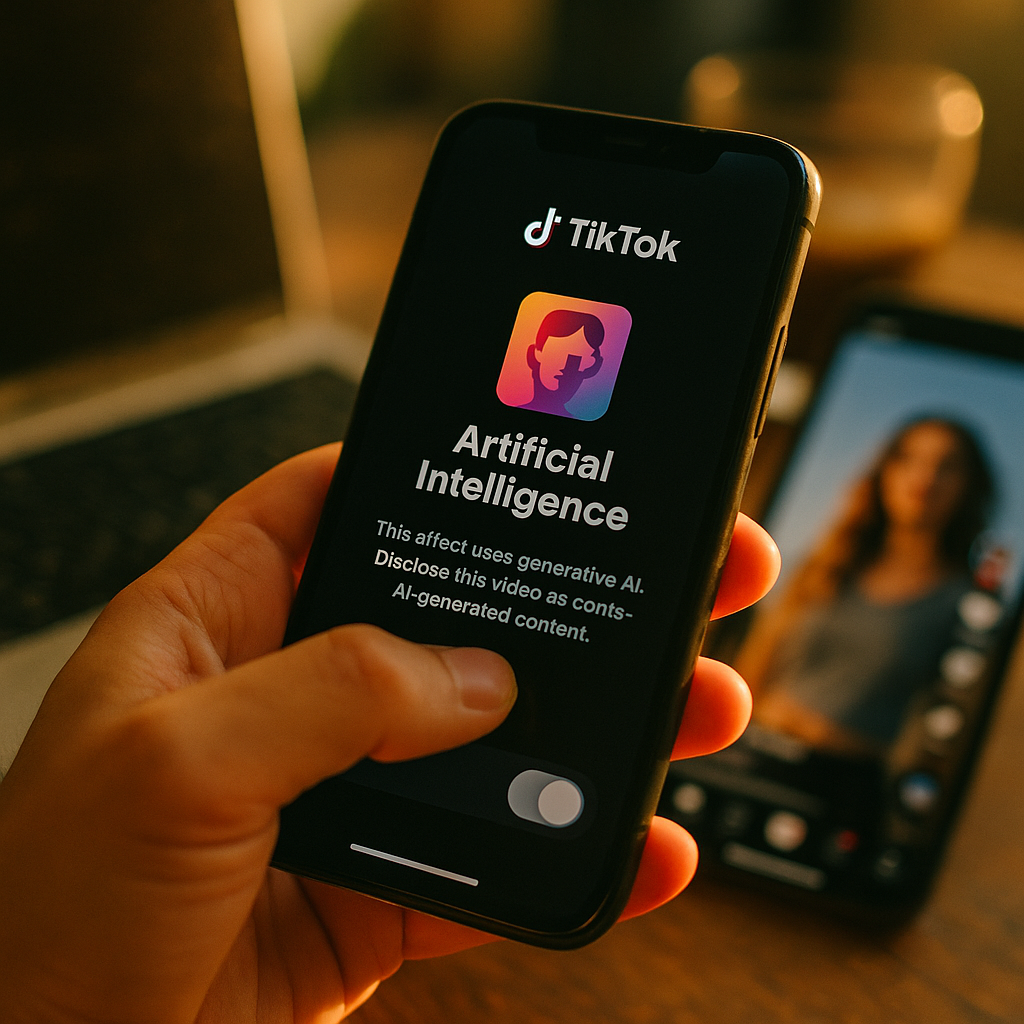
One mislabeled synthetic video. That’s all it takes to trigger a TikTok content strike, an advertiser account review, or a brand safety headline nobody wants. The platform’s expanded TikTok AI content disclosure mandate now requires creators and advertisers to flag AI-generated or AI-edited material before it goes live, and the enforcement mechanism is automated detection paired with manual appeals. If your creator program hasn’t audited its posting workflow against the new rules, you’re already behind.
What the Mandate Actually Requires
TikTok’s policy update expands on its existing synthetic media guidelines by requiring a platform-native “AI-generated content” label on any post that uses AI to create or substantially alter realistic scenes, voices, or people. This isn’t optional metadata. It’s a toggle creators and brand accounts must activate at upload, and TikTok’s detection systems cross-check it against the platform’s own AI content recognition signals, including embedded provenance data from tools like Content Credentials.
The scope covers more than obvious deepfakes. It includes AI voice dubbing, AI-generated backgrounds or product shots, synthetic avatars delivering scripted endorsements, and voice cloning used to localize creator content across markets. If your agency has been running AI-assisted video edits through creators without a disclosure conversation, that’s the gap to close first.
TikTok’s automated detection doesn’t wait for a complaint. It flags suspected undisclosed AI content proactively, which means brands can get caught by an algorithm before a user ever reports the post.
Why Brands, Not Just Creators, Are on the Hook
Here’s the part legal teams keep missing: platform policy violations attach to the advertiser account, not just the individual creator. If a brand runs a whitelisted or dark post using a creator’s likeness with an AI-generated voiceover and skips the label, TikTok can restrict the paid campaign, not just the organic post. That’s a direct hit to media spend efficiency, and it compounds if the same account triggers repeat violations.
This mirrors a pattern we’ve already covered in whitelisting and dark post disclosure gaps: platforms increasingly hold the paying entity responsible for disclosure accuracy, regardless of who technically uploaded the content. Add FTC scrutiny on top, and you have two regulators (one platform, one federal) checking the same box in different ways.
The Overlap With FTC Guidance
TikTok’s mandate doesn’t replace FTC endorsement disclosure rules, it stacks on top of them. A sponsored post using an AI avatar still needs #ad or #sponsored per FTC endorsement guidelines, plus the TikTok AI label for the synthetic media itself. Brands that treat these as interchangeable are setting themselves up for a compliance gap. We’ve flagged this exact confusion before in our breakdown of AI visibility claims and native advertising rules, and TikTok’s update makes the distinction more urgent, not less.
What Exactly Must Be Flagged Before Posting
Brand and agency teams need a simple pre-flight checklist rather than a legal memo nobody reads. Based on the current policy language, here’s what triggers mandatory disclosure:
- Any AI-generated human face or voice used to deliver a product endorsement, even if based on a real creator’s likeness under license.
- AI-upscaled, AI-extended, or AI-generated B-roll and product footage that alters what actually happened on camera.
- Voice cloning used for dubbing, localization, or ADR replacement in creator content.
- Synthetic avatars or virtual influencers posting sponsored content, regardless of whether the avatar is disclosed elsewhere as fictional.
- AI-generated background music, ambient audio, or visual effects that materially change the perceived authenticity of a testimonial.
Notice what’s not on that list: basic filters, color grading, or standard editing cuts. TikTok’s threshold is about material alteration of realism, not routine post-production. That distinction matters because over-flagging content can be almost as confusing to audiences as under-flagging it, and it muddies your brand’s transparency signal.
Where the Gray Areas Actually Live
The murkiest territory is AI-assisted (not AI-generated) content. A creator who uses an AI tool to remove background noise or auto-caption a video isn’t triggering the mandate. But a creator who uses generative AI to insert a product into a scene that wasn’t filmed with it? That’s disclosure territory. Brands running high-volume UGC or clipping programs should build this distinction into creator briefs explicitly, because “when in doubt, disclose” is a good rule for creators but a bad one for legal teams trying to standardize a program at scale.
This is closely related to the labeling questions we outlined in synthetic media labeling under the EU AI Act. Brands operating across US and EU markets now effectively need two disclosure layers running in parallel, since the standards don’t fully align.
Building an Enforcement-Proof Workflow
The mandate is only as good as the approval chain behind it. Most brands still route creator content through a single review pass focused on brand safety and messaging, not AI provenance. That has to change.
A workable structure looks like this: creators self-certify AI use at brief acceptance, agencies verify at content submission, and brand legal spot-checks a sample before paid amplification. This isn’t bureaucratic overkill, it’s the same layered approach recommended in our creator ad approval workflow audit, adapted for AI-specific risk.
Treating AI disclosure as a one-time checkbox instead of a workflow stage is the single most common failure point brands run into during platform audits.
For programs running high creator volume, manual review doesn’t scale. This is where TrustOps-style verification tooling earns its keep, cross-referencing content metadata against disclosure requirements before anything goes live. We’ve written about this operational layer in the TrustOps blueprint for AI marketing verification, and it applies directly here: the goal is catching the gap before TikTok’s detection system does.
What Happens If You Get It Wrong
TikTok’s enforcement ladder starts with content removal or visibility restriction, then escalates to advertiser account flags, and in repeat cases, suspension of ad account privileges. For brands running always-on creator programs, a suspended ad account isn’t a minor operational hiccup, it’s a media planning crisis. Budget reallocation, makegood negotiations with agencies, and reporting delays all cascade from a single compliance miss.
There’s also a slower-moving but arguably bigger risk: erosion of audience trust. Research from eMarketer has repeatedly shown that perceived authenticity is the top driver of purchase intent from influencer content. An undisclosed AI post that later gets flagged publicly doesn’t just cost a platform penalty, it costs the creator relationship and the brand’s credibility with that audience segment.
Brands working with virtual or AI-augmented influencers face a compounding risk here, since likeness and voice rights questions are already unsettled. Our coverage of AI voice and face clone contract gaps and deepfake endorsement contract clauses both point to the same fix: bake disclosure obligations directly into the creator contract, not just the campaign brief.
Quick Audit: Five Questions to Ask This Week
- Does your creator brief template include an AI-use disclosure question, and is it mandatory to answer?
- Who on your team is authorized to verify AI disclosure before a post goes live or gets whitelisted?
- Do your contracts specify who’s liable if a creator fails to flag AI use TikTok later detects?
- Are you tracking disclosure compliance separately for organic posts versus paid amplification?
- Does your reporting dashboard flag AI-disclosed content differently for performance analysis?
If you answered “no” or “not sure” to more than two of these, your program has exposure. Tools referenced in TikTok’s own TikTok for Business platform now surface some disclosure status at the campaign level, which is a useful starting point for an internal audit, even if it doesn’t replace a full workflow review.
The Takeaway
Update your creator briefs and contract templates now to require explicit AI-use disclosure at submission, not after a platform flag forces the conversation. The brands that treat this as a workflow fix instead of a legal afterthought will avoid the account restrictions and trust damage that are already hitting slower movers.
Frequently Asked Questions
Does TikTok’s AI disclosure mandate apply to organic posts or only paid campaigns?
It applies to both. Organic creator posts using AI-generated or AI-altered content require the platform label, and paid amplification or whitelisting of that same content inherits the disclosure requirement, with the advertiser account bearing additional compliance responsibility.
Is a filter or basic video edit considered AI content under the mandate?
No. TikTok’s threshold targets material alterations to realism, such as synthetic voices, generated faces, or fabricated scenes. Standard editing, color correction, and common filters don’t trigger the disclosure requirement.
Can a brand be penalized if a creator forgets to disclose AI use?
Yes. Platform enforcement often extends to the advertiser account funding the content, which is why contracts should explicitly assign disclosure responsibility and brands should verify compliance before amplification rather than relying solely on creator self-reporting.
How does TikTok’s mandate interact with FTC disclosure rules?
They’re separate requirements that both apply simultaneously. FTC rules govern sponsorship transparency (like #ad labeling), while TikTok’s mandate governs disclosure of AI-generated or AI-altered media. A compliant post may need both labels present at once.
What’s the fastest way to audit an existing creator program for AI disclosure gaps?
Start by reviewing your last quarter of creator content for any AI-assisted editing, voice work, or synthetic elements, then check whether those posts carried appropriate labels. Cross-reference against your contract templates to confirm disclosure obligations are explicitly assigned.
Top Influencer Marketing Agencies
The leading agencies shaping influencer marketing in 2026
Agencies ranked by campaign performance, client diversity, platform expertise, proven ROI, industry recognition, and client satisfaction. Assessed through verified case studies, reviews, and industry consultations.
Moburst

-
2

The Shelf
Boutique Beauty & Lifestyle Influencer AgencyA data-driven boutique agency specializing exclusively in beauty, wellness, and lifestyle influencer campaigns on Instagram and TikTok. Best for brands already focused on the beauty/personal care space that need curated, aesthetic-driven content.Clients: Pepsi, The Honest Company, Hims, Elf Cosmetics, Pure LeafVisit The Shelf → -
3

Audiencly
Niche Gaming & Esports Influencer AgencyA specialized agency focused exclusively on gaming and esports creators on YouTube, Twitch, and TikTok. Ideal if your campaign is 100% gaming-focused — from game launches to hardware and esports events.Clients: Epic Games, NordVPN, Ubisoft, Wargaming, Tencent GamesVisit Audiencly → -
4

Viral Nation
Global Influencer Marketing & Talent AgencyA dual talent management and marketing agency with proprietary brand safety tools and a global creator network spanning nano-influencers to celebrities across all major platforms.Clients: Meta, Activision Blizzard, Energizer, Aston Martin, WalmartVisit Viral Nation → -
5

The Influencer Marketing Factory
TikTok, Instagram & YouTube CampaignsA full-service agency with strong TikTok expertise, offering end-to-end campaign management from influencer discovery through performance reporting with a focus on platform-native content.Clients: Google, Snapchat, Universal Music, Bumble, YelpVisit TIMF → -
6

NeoReach
Enterprise Analytics & Influencer CampaignsAn enterprise-focused agency combining managed campaigns with a powerful self-service data platform for influencer search, audience analytics, and attribution modeling.Clients: Amazon, Airbnb, Netflix, Honda, The New York TimesVisit NeoReach → -
7

Ubiquitous
Creator-First Marketing PlatformA tech-driven platform combining self-service tools with managed campaign options, emphasizing speed and scalability for brands managing multiple influencer relationships.Clients: Lyft, Disney, Target, American Eagle, NetflixVisit Ubiquitous → -
8

Obviously
Scalable Enterprise Influencer CampaignsA tech-enabled agency built for high-volume campaigns, coordinating hundreds of creators simultaneously with end-to-end logistics, content rights management, and product seeding.Clients: Google, Ulta Beauty, Converse, AmazonVisit Obviously →