


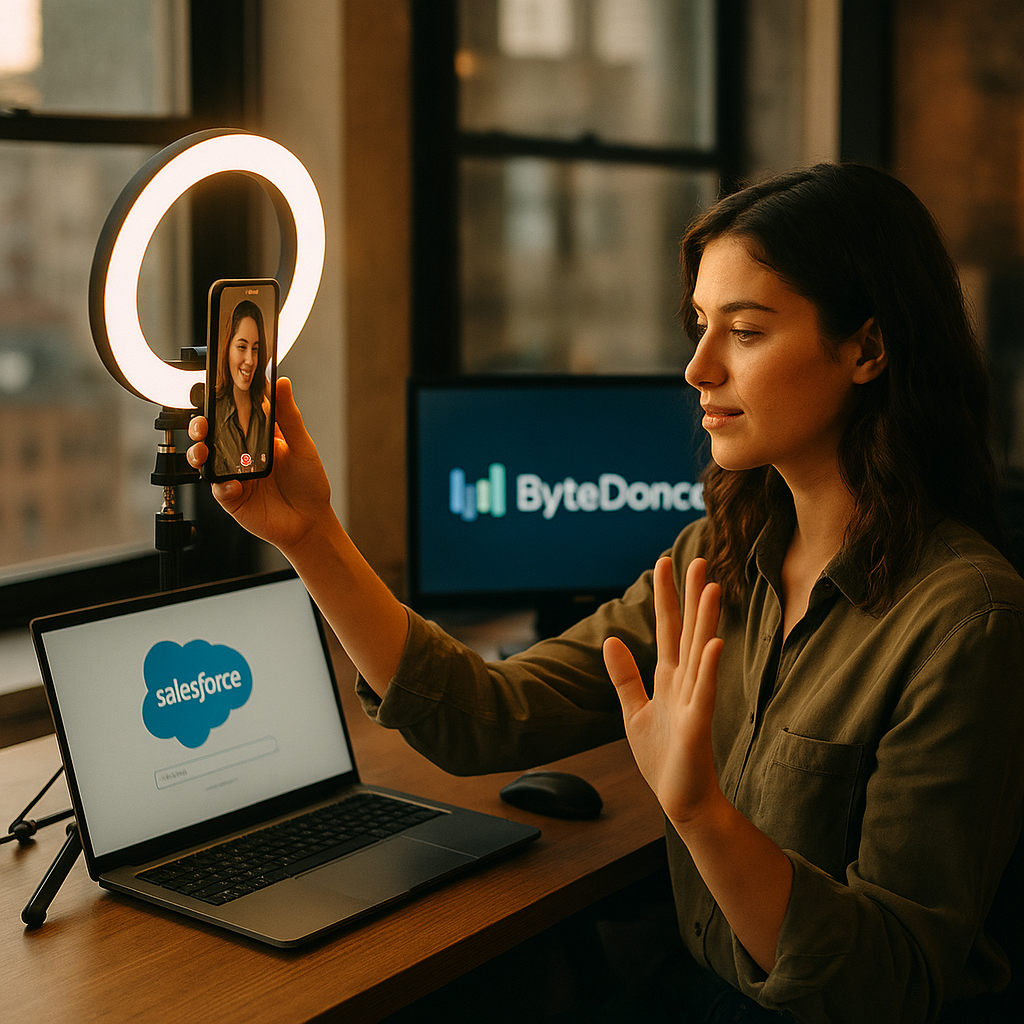
Two of the world’s biggest tech companies just posted job listings for in house creators, and almost nobody in the trade press blinked. That’s a mistake. When Salesforce and ByteDance hiring for creator roles shows up in the same quarter, it’s not a coincidence, it’s a signal. Both companies are telling you, in plain job description language, that the agency-first influencer model is losing ground to something leaner and harder to outsource.
The Job Postings Nobody’s Talking About
Scroll through LinkedIn job boards and you’ll find Salesforce recruiting for “creator strategist” and “social content producer” roles that read less like marketing support and more like media operations. ByteDance, meanwhile, has been staffing internal creator teams for TikTok Shop and its broader commerce push, building a bench of talent that produces content natively rather than briefing it out.
These aren’t vanity hires. They come with reporting lines into growth, commerce, or product marketing teams, not brand or comms. That detail matters more than the job title.
Why? Because it tells you where the budget actually sits. When a creator role reports into growth or commerce, the expectation is measurable output: conversion, GMV, pipeline. Not brand lift surveys six months later.
A creator hire that reports into growth, not brand, is a company telling you influencer content has graduated from awareness tactic to revenue lever.
Why Salesforce Wants Creators on Payroll
Salesforce isn’t a consumer brand in the traditional sense. It sells to CMOs, IT directors, and revenue operations leaders, a B2B audience that supposedly doesn’t care about creator content. Except it does. LinkedIn’s own data has repeatedly shown that B2B buyers trust peer voices and practitioner content far more than polished corporate decks, and Salesforce’s creator hires look like a direct response to that shift.
Bringing creator production in house lets Salesforce move at the speed of a product launch instead of the speed of an agency SOW. It also keeps brand voice consistent across Dreamforce content, product demos, and the kind of fast-turnaround LinkedIn video that’s reshaping B2B distribution, a trend we covered in detail in our piece on the LinkedIn algorithm refresh and its effect on creator briefs.
There’s a cost angle too. Agency retainers for always-on content production aren’t cheap, and the math changes fast once you’re producing dozens of assets a month. An in house creator who understands your product roadmap can outproduce an external team that has to be re-briefed every cycle.
ByteDance’s Play Is Different, and More Telling
ByteDance isn’t hiring creators to talk about itself. It’s hiring creators to prove its own commerce infrastructure works, essentially acting as its own best customer. That’s a subtle but important distinction from Salesforce’s approach.
TikTok Shop’s GMV numbers have been climbing fast, and we broke down the scale of that shift in our coverage of the platform’s 50 billion GMV milestone. ByteDance staffing internal creators who sell live, test features, and generate case-study-worthy content isn’t just marketing, it’s product validation. If ByteDance’s own people can’t move product on TikTok Shop, that’s a credibility problem for the entire platform.
This is also a hedge against a licensing economy that ByteDance itself is shaping. Our reporting on the marketplace push turning creator content into bulk licenses shows a company that wants to control both the supply and the proof of concept for creator commerce. Owning in house talent gives ByteDance a controlled variable it can point to when brands ask, “does this actually work?”
What This Means for Your Org Chart
If you’re still routing every piece of creator content through an agency, you’re operating on a model these two companies have already started to move past. That doesn’t mean agencies disappear. It means their role shifts toward strategy, casting, and specialized production, while always-on, lower-cost content gets pulled in house.
We’ve tracked this exact pattern across other categories. Camera brands are doing it, as we detailed in Canon EMEA’s creator hires, which signaled camera manufacturers stepping directly into the content supply chain rather than waiting for creators to come to them. UGC production is following the same trajectory, something we unpacked in the piece on the UGC hiring surge pushing brands to build editing pods.
The pattern across industries is consistent: companies that treat creator content as a core operating function hire for it directly. Companies that treat it as a campaign line item keep outsourcing, and keep paying premium rates for speed they could build internally.
Every brand that has built an internal creator function in the last two years cites the same driver: agency turnaround times can’t match the velocity of platform algorithm changes.
Is This Just Big-Budget Theater?
Fair question. Salesforce and ByteDance have resources most brands don’t. A 12-person in house creator team isn’t realistic for a mid-market retailer or a regional bank.
But the underlying lesson scales down even when the headcount doesn’t. You don’t need twelve creators on payroll to benefit from the model; you need one or two people who understand production, platform mechanics, and brand voice well enough to brief faster and iterate without waiting on external approval chains. Several brands outside the beauty and fashion categories have already made this move, a shift we covered in non-endemic brands building creator ops once reserved for lifestyle categories.
The real signal from Salesforce and ByteceDance isn’t “hire a creator team.” It’s “stop treating creator production as something that happens exclusively outside your walls.”
The Risk Nobody’s Pricing In
In house creator teams come with their own exposure. Disclosure compliance doesn’t disappear just because the creator is on payroll instead of under contract; the FTC’s endorsement guidance still applies, arguably with sharper scrutiny, since regulators tend to assume employees have less editorial independence than external creators. Brands operating in the UK face a parallel compliance layer through the ICO’s data and advertising rules, which is worth reviewing before scaling any internal content operation that touches personal data or targeted ads.
There’s also a retention risk most companies underestimate. In house creators build personal followings on company time, and when they leave, some of that audience equity walks out the door with them. That tension doesn’t show up in a job posting, but it shows up fast in exit interviews. Brands weighing this tradeoff should look at how program design affects retention; our analysis of creator retention as a program health metric applies just as much to internal hires as it does to external roster talent.
Budget owners should also expect pushback from finance. An in house creator role is a fixed headcount cost, not a flexible line item you can pause between quarters. That’s a real tradeoff against the “93 percent budget surge” pressure many teams are already navigating, something we explored in our piece on justifying creator spend internally.
Where Mid-Size Brands Should Actually Start
You don’t need to copy Salesforce’s org chart. Start smaller and more deliberate.
- Audit how much of your current creator content is repeatable, low-risk, and high-frequency. That’s the content worth bringing in house first.
- Keep high-concept, high-reach campaigns with external talent and agencies. That’s where outside creativity still earns its premium.
- Build one internal role focused on speed: rapid-response content, trend reaction, platform testing. Pair it with a rapid response roster model instead of a monthly calendar.
- Track performance data the way platforms do. Tools like Sprout Social or HubSpot can help bridge the attribution gap between in house content and pipeline impact.
None of this requires a Salesforce-sized budget. It requires admitting that the fastest, cheapest content in your program might already belong inside your building.
Frequently Asked Questions
Why are Salesforce and ByteDance hiring in house creators instead of using agencies?
Both companies want faster production cycles and tighter control over brand voice. In house creators can respond to platform changes and product launches without the delay of agency briefing and approval chains, which matters most for always-on content rather than big campaign moments.
Does hiring in house creators mean brands should drop their agencies?
No. Most brands adopting this model keep agencies for high-concept campaigns, casting, and specialized production, while shifting repeatable, high-frequency content to internal teams. It’s a rebalancing, not a replacement.
What compliance risks come with in house creator hires?
Disclosure rules still apply even when a creator is an employee. The FTC’s endorsement guidelines and, for UK operations, ICO advertising rules remain relevant, and regulators often scrutinize employee-created content more closely because of assumed reduced editorial independence.
Is building an in house creator team realistic for smaller or mid-size brands?
Yes, at a smaller scale. One or two internal hires focused on fast-turnaround content can capture most of the speed advantage without the headcount investment of a company like Salesforce or ByteDance.
What happens to brand equity if an in house creator leaves?
Some audience equity tends to follow the individual creator, especially if their personal brand grew alongside company content. Brands should plan for this risk the same way they plan for retention in external creator rosters.
If you take one thing from Salesforce and ByteDance’s hiring patterns, make it this: audit your current creator spend for repeatable, high-frequency content, and price out what one internal hire would cost against a year of agency retainers for that same work. The math will tell you faster than any trend piece can.
Top Influencer Marketing Agencies
The leading agencies shaping influencer marketing in 2026
Agencies ranked by campaign performance, client diversity, platform expertise, proven ROI, industry recognition, and client satisfaction. Assessed through verified case studies, reviews, and industry consultations.
Moburst

-
2

The Shelf
Boutique Beauty & Lifestyle Influencer AgencyA data-driven boutique agency specializing exclusively in beauty, wellness, and lifestyle influencer campaigns on Instagram and TikTok. Best for brands already focused on the beauty/personal care space that need curated, aesthetic-driven content.Clients: Pepsi, The Honest Company, Hims, Elf Cosmetics, Pure LeafVisit The Shelf → -
3

Audiencly
Niche Gaming & Esports Influencer AgencyA specialized agency focused exclusively on gaming and esports creators on YouTube, Twitch, and TikTok. Ideal if your campaign is 100% gaming-focused — from game launches to hardware and esports events.Clients: Epic Games, NordVPN, Ubisoft, Wargaming, Tencent GamesVisit Audiencly → -
4

Viral Nation
Global Influencer Marketing & Talent AgencyA dual talent management and marketing agency with proprietary brand safety tools and a global creator network spanning nano-influencers to celebrities across all major platforms.Clients: Meta, Activision Blizzard, Energizer, Aston Martin, WalmartVisit Viral Nation → -
5

The Influencer Marketing Factory
TikTok, Instagram & YouTube CampaignsA full-service agency with strong TikTok expertise, offering end-to-end campaign management from influencer discovery through performance reporting with a focus on platform-native content.Clients: Google, Snapchat, Universal Music, Bumble, YelpVisit TIMF → -
6

NeoReach
Enterprise Analytics & Influencer CampaignsAn enterprise-focused agency combining managed campaigns with a powerful self-service data platform for influencer search, audience analytics, and attribution modeling.Clients: Amazon, Airbnb, Netflix, Honda, The New York TimesVisit NeoReach → -
7

Ubiquitous
Creator-First Marketing PlatformA tech-driven platform combining self-service tools with managed campaign options, emphasizing speed and scalability for brands managing multiple influencer relationships.Clients: Lyft, Disney, Target, American Eagle, NetflixVisit Ubiquitous → -
8

Obviously
Scalable Enterprise Influencer CampaignsA tech-enabled agency built for high-volume campaigns, coordinating hundreds of creators simultaneously with end-to-end logistics, content rights management, and product seeding.Clients: Google, Ulta Beauty, Converse, AmazonVisit Obviously →