


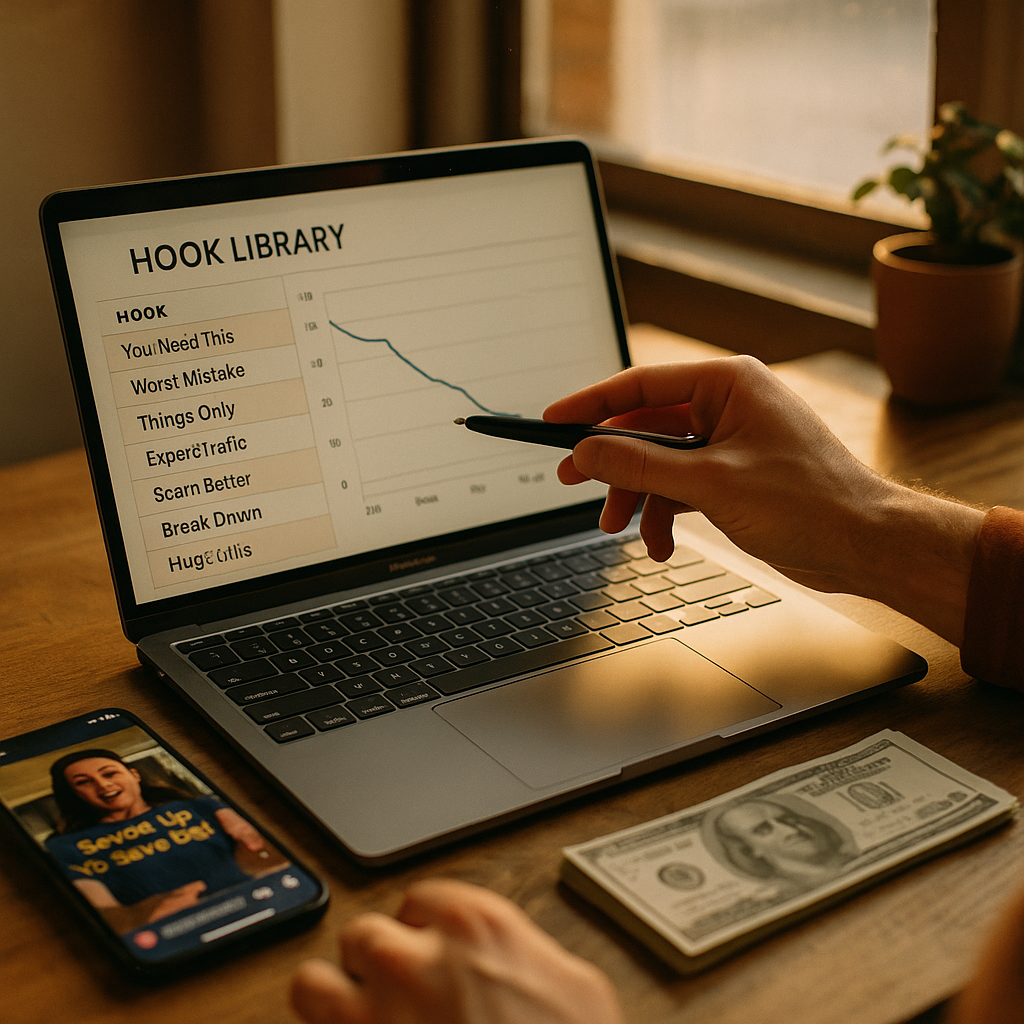
Most brands burn 70% of their creative budget producing hooks they will use exactly once. Meta’s own research has repeatedly flagged creative fatigue as the top driver of rising CPMs, yet marketing teams keep treating every creator asset as disposable. A hook library flips that model: instead of shooting once and discarding, you build a reusable bank of opening frames, lines, and visual patterns that your paid social team can remix indefinitely.
What Is a Hook Library, Actually?
Strip away the jargon and a hook library is just a tagged, searchable archive of the first three seconds of every creator video you’ve ever run. Not the full ad. Just the hook: the line, the visual gag, the pattern interrupt that stops a scroll. You store it alongside performance data (hook rate, thumb-stop ratio, CPA) so your media buyers can pull winning openers and pair them with new bodies, new offers, or new creators without starting from zero.
Think of it as the inverse of a stock footage library. Stock footage gives you generic b-roll. A hook library gives you proven, brand-specific openers that already have a performance track record attached.
A hook that converted at a 2.1x higher thumb-stop rate for one SKU will often transfer that lift to an adjacent SKU, because the pattern interrupt is doing the work, not the product itself.
Why Paid Social Testing Breaks Without One
Here’s the operational problem nobody talks about enough. Paid social testing requires volume. You need dozens of variants running simultaneously to find statistically meaningful winners, especially on platforms like TikTok Ads and Meta Advantage+ where the algorithm rewards creative diversity. But most brands commission creators for finished, polished ads, not raw components. That means every test cycle starts a new production sprint.
The result? Testing velocity collapses. Teams test five variants a month instead of fifty. Creative fatigue sets in faster than the pipeline can refresh it. And because nobody is tracking which specific hook drove performance (as opposed to the whole ad), institutional knowledge evaporates every time a media buyer leaves or an agency relationship ends.
A hook library solves this by decoupling the hook from the ad. You test hooks independently, identify winners fast, then attach winning hooks to new bodies and CTAs. This is the same logic behind job-specific creative briefs, where format is matched to funnel stage rather than treated as one-size-fits-all.
Building the Taxonomy: How to Tag Hooks So They’re Actually Reusable
A hook library without a taxonomy is just a cluttered folder. The tagging structure is where most teams get lazy, and it’s exactly where the ROI lives. Here’s a workable framework:
- Hook type: question hook, shock stat, pattern interrupt, POV, text-on-screen callout, sound-first (ASMR-style), problem/agitation opener.
- Delivery mode: talking head, voiceover, on-screen text only, silent visual gag (critical for silent-first video design since most feed views happen on mute).
- Funnel stage: cold awareness, retargeting, conversion-stage.
- Emotional register: humor, urgency, trust-building, curiosity gap.
- Performance tier: based on hook rate and 3-second view percentage, not just final CTR.
- Creator archetype: founder, micro-creator, UGC actor, employee. This matters because founder-led video hooks often outperform hired-creator hooks on trust signals but underperform on reach.
Store this in a simple spreadsheet, Airtable base, or a DAM (digital asset management) tool. The sophistication of the tool matters far less than the discipline of tagging every single asset the moment it comes in, not three months later when you’ve forgotten the context.
The Metadata Most Teams Skip
Two fields get overlooked constantly: usage rights expiration and original performance context. If a hook was licensed for 90 days of paid use, you need that flagged before legal finds out the hard way. And if a hook performed well in a holiday campaign, that context matters when you’re deciding whether to redeploy it in a different season. A hook library without rights metadata is a compliance incident waiting to happen, not an asset bank.
Sourcing Hooks at Scale Without Blowing the Budget
You don’t need a bigger production budget to build a deep library. You need a wider sourcing funnel. A few proven channels:
- Whitelisted creator content: Every piece of organic creator content you have usage rights to is a potential hook source, even if the full video never ran as a paid ad.
- Employee-generated content: Internal teams often produce rougher but highly authentic hooks at near-zero cost, a tactic brands are increasingly piloting before scaling creator spend, as covered in our piece on employee-generated content pilots.
- Repurposed long-form content: Mine mini-documentaries and brand films for hook-worthy moments. A single long-form brand film can yield six or seven distinct hook candidates.
- Street interview and vox pop formats: These generate dozens of short, punchy reaction clips in a single shoot day, ideal for stocking a library fast. See how brands structure these in vox pop street interview campaigns.
- Batch creator briefs: Brief creators to deliver three to five hook variations per shoot instead of one finished ad. This single change can triple your library’s input rate without adding a dollar to the production line.
How Do You Test Hooks Without Wasting Media Spend?
Run hook tests as a distinct campaign objective, separate from full-funnel optimization. The cheapest, fastest method is a three-second video view or thumb-stop ratio test with a small, controlled budget, often $20 to $50 per variant per day across a handful of platforms. You’re not optimizing for conversions yet. You’re isolating which opening three seconds earns attention.
Once you’ve identified a top-tier hook (generally one sitting in the top quartile of hook rate within its tagged category), pair it with two or three different bodies and CTAs. This is where comparison video formats and split-screen comparison ads become useful bodies to test against a winning hook, since they give you a consistent structural frame to slot creative into.
Treat the hook and the body as two separate testing variables. Brands that test them together conflate two different performance signals and end up with noisy, hard-to-act-on data.
Platforms like Meta’s Advantage+ creative tools increasingly support dynamic creative testing that can mix and match hooks against bodies automatically, which makes a tagged hook library a direct input into the ad platform rather than a side reference document.
Vertical Format Discipline: Don’t Let Your Library Become Dead Weight
A hook library stocked with horizontally shot footage is a library you’ll quietly stop using. Cropping a horizontal hook to fit a 9:16 feed costs you framing, costs you facial expression clarity, and according to platform benchmarks reported by eMarketer, costs you measurable CPM efficiency too. Our deep dive on why cropped ads pay a cost penalty lays out the mechanics, but the operational takeaway for a hook library is simple: tag every asset by native aspect ratio at ingestion, and refuse horizontal-only submissions from creators going forward.
Format Variety Inside the Library
Diversify beyond standard talking-head hooks. ASMR-style sound-first openers, text-message mockup formats, and recipe-style demonstration hooks each pull different attention triggers. Our coverage of ASMR product content and iMessage mockup ads both show how niche formats consistently punch above their production cost when used as hook sources, specifically because they interrupt pattern expectations that standard UGC has trained audiences to scroll past.
Governance: Who Owns the Library?
Assign a single owner, usually a creative operations lead or performance marketing manager, responsible for tagging standards, rights tracking, and quarterly pruning. Hooks decay. A hook that crushed it eighteen months ago may now read as dated or, worse, associated with a discontinued promotion. Build a quarterly audit into the calendar: archive underperformers, flag expiring usage rights, and refresh tags based on new platform format shifts.
Compliance deserves a specific mention here. The FTC’s endorsement guidelines apply to repurposed creator content just as much as original placements. If a hook library asset gets redeployed in a new campaign context, confirm the original disclosure and consent terms still cover that use. This is a small operational check that prevents a much larger legal headache.
Measuring Whether the Library Is Paying Off
Track three numbers quarter over quarter: average time-to-launch for a new test batch, cost per validated hook (total sourcing cost divided by hooks that hit your performance threshold), and creative fatigue rate (how fast CPA climbs on your top ad). Teams that build disciplined libraries typically see testing velocity double within two quarters, simply because they’re no longer starting from a blank page every sprint. For a sense of how structured creative briefs compound this effect, our piece on turning creator posts into owned IP covers the adjacent discipline of building compounding creative assets rather than one-off spend.
Benchmarking tools from Sprout Social and HubSpot can help contextualize your hook rate and CPA figures against broader industry averages, though your own historical data will always be the more actionable comparison point.
Next step: audit your last six months of creator content, pull every three-second opener into a single tagged sheet, and run one hook-only test batch before your next full creative sprint. The library builds itself one tagged asset at a time, but only if you start now instead of waiting for a “perfect” system.
FAQs
What’s the difference between a hook library and a standard content library?
A standard content library stores finished assets for reuse as-is. A hook library isolates just the opening three to five seconds, tags it by type and performance, and treats it as a modular component you can pair with different bodies, offers, and CTAs.
How many hooks do I need before testing becomes meaningful?
Most teams see useful signal once they have 15 to 20 tagged hooks per audience segment. Below that, sample sizes are too thin to separate real winners from statistical noise.
Can I reuse a hook across different products?
Often yes, especially pattern-interrupt or question-based hooks that aren’t product-specific. Problem/agitation hooks tied closely to a single product’s pain point transfer less reliably.
Do hook libraries work for B2B brands, not just DTC?
Yes, though B2B hooks tend to lean on credibility and specificity (stats, founder commentary, customer proof) rather than humor or shock value. The tagging taxonomy still applies.
How often should a hook library be audited?
Quarterly at minimum. Platform format trends shift fast, usage rights expire, and hooks tied to discontinued promotions or seasonal moments need to be archived before they’re accidentally redeployed.
Top Influencer Marketing Agencies
The leading agencies shaping influencer marketing in 2026
Agencies ranked by campaign performance, client diversity, platform expertise, proven ROI, industry recognition, and client satisfaction. Assessed through verified case studies, reviews, and industry consultations.
Moburst

-
2

The Shelf
Boutique Beauty & Lifestyle Influencer AgencyA data-driven boutique agency specializing exclusively in beauty, wellness, and lifestyle influencer campaigns on Instagram and TikTok. Best for brands already focused on the beauty/personal care space that need curated, aesthetic-driven content.Clients: Pepsi, The Honest Company, Hims, Elf Cosmetics, Pure LeafVisit The Shelf → -
3

Audiencly
Niche Gaming & Esports Influencer AgencyA specialized agency focused exclusively on gaming and esports creators on YouTube, Twitch, and TikTok. Ideal if your campaign is 100% gaming-focused — from game launches to hardware and esports events.Clients: Epic Games, NordVPN, Ubisoft, Wargaming, Tencent GamesVisit Audiencly → -
4

Viral Nation
Global Influencer Marketing & Talent AgencyA dual talent management and marketing agency with proprietary brand safety tools and a global creator network spanning nano-influencers to celebrities across all major platforms.Clients: Meta, Activision Blizzard, Energizer, Aston Martin, WalmartVisit Viral Nation → -
5

The Influencer Marketing Factory
TikTok, Instagram & YouTube CampaignsA full-service agency with strong TikTok expertise, offering end-to-end campaign management from influencer discovery through performance reporting with a focus on platform-native content.Clients: Google, Snapchat, Universal Music, Bumble, YelpVisit TIMF → -
6

NeoReach
Enterprise Analytics & Influencer CampaignsAn enterprise-focused agency combining managed campaigns with a powerful self-service data platform for influencer search, audience analytics, and attribution modeling.Clients: Amazon, Airbnb, Netflix, Honda, The New York TimesVisit NeoReach → -
7

Ubiquitous
Creator-First Marketing PlatformA tech-driven platform combining self-service tools with managed campaign options, emphasizing speed and scalability for brands managing multiple influencer relationships.Clients: Lyft, Disney, Target, American Eagle, NetflixVisit Ubiquitous → -
8

Obviously
Scalable Enterprise Influencer CampaignsA tech-enabled agency built for high-volume campaigns, coordinating hundreds of creators simultaneously with end-to-end logistics, content rights management, and product seeding.Clients: Google, Ulta Beauty, Converse, AmazonVisit Obviously →