


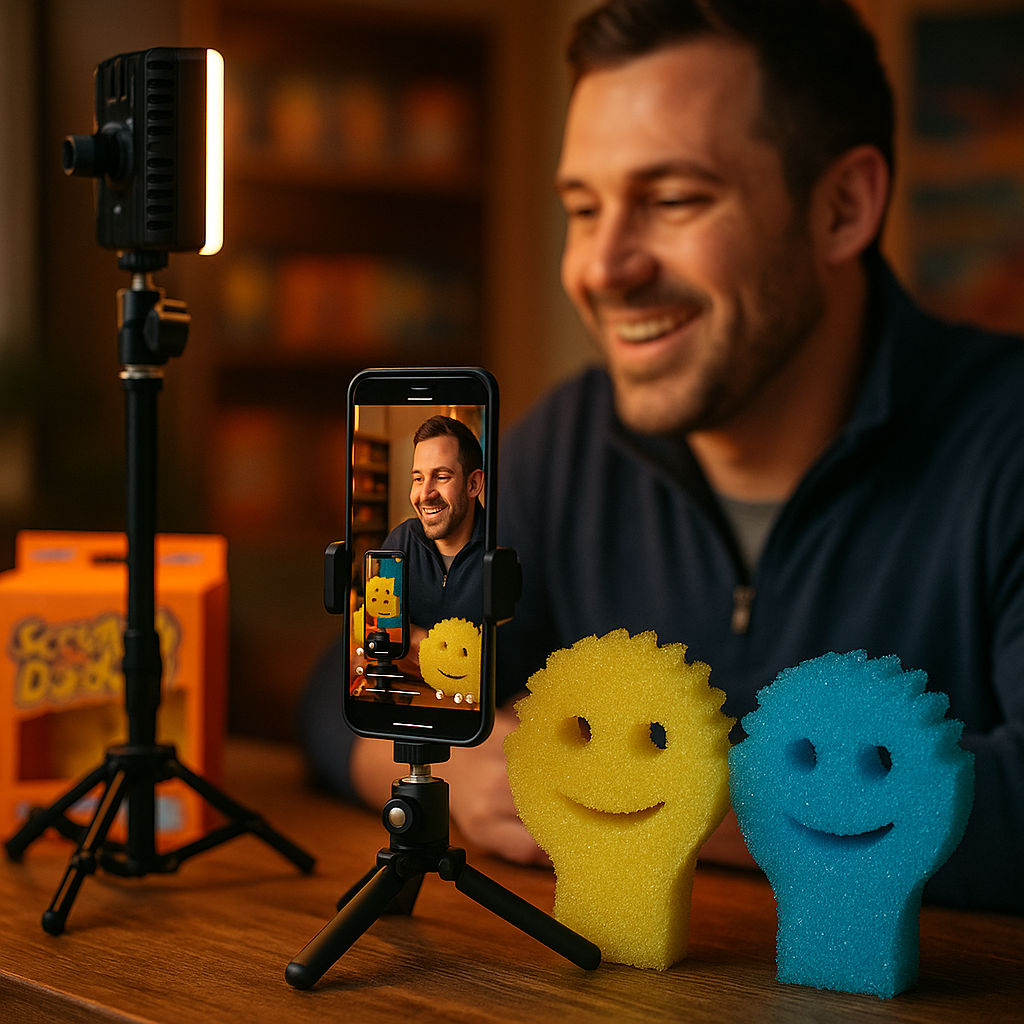
Scrub Daddy does a live shopping event on TikTok almost every week. Not once a quarter. Not for a holiday push. Every single week, rain or shine, and the brand has quietly turned that cadence into one of the most dependable revenue lines in its entire direct-to-consumer stack. If your idea of a TikTok Shop livestream is a one-off stunt tied to a product drop, Scrub Daddy’s playbook should make you rethink the whole model.
The Problem With Treating Livestreams as Campaigns
Most brands approach live shopping the way they approach a product launch event: big push, lots of prep, then silence until the next “moment.” That approach burns out internal teams and trains your audience to expect novelty instead of habit. Scrub Daddy flipped that logic. The company, known for its smiley-face sponges and a founder (Aaron Krause) who’s become something of a TikTok personality in his own right, treats livestreams less like campaigns and more like a retail channel with its own P&L.
That shift in framing matters more than it sounds. A campaign has a start and end date. A channel has a run rate, a cost structure, and a renewal cycle. Once Scrub Daddy started measuring livestreams against channel benchmarks (cost per acquisition, repeat purchase rate, average order value) instead of campaign metrics like reach or one-time GMV, the whole operation got more disciplined.
Scrub Daddy’s livestream cadence isn’t about chasing virality. It’s about building a predictable shelf that happens to be hosted by a human instead of a retailer.
Why Weekly Cadence Beats Big Moments
Here’s the uncomfortable truth a lot of brand strategists don’t want to hear: consistency beats spectacle on TikTok Shop. The platform’s algorithm rewards accounts that show up predictably because it can learn viewer behavior and re-serve content to warm audiences. A brand that livestreams four times a year is starting from zero every time. A brand that livestreams weekly builds a return audience that the algorithm already knows how to find.
Scrub Daddy’s team runs livestreams with a mix of the founder, in-house staff, and affiliate creators rotating through hosting duties. That rotation keeps the format fresh without sacrificing the muscle memory that comes from doing the same basic show structure over and over: product demo, limited-time bundle, flash discount, Q&A, repeat. According to eMarketer, live shopping in the U.S. is still a fraction of the GMV seen in markets like China, but the format’s growth rate on TikTok Shop specifically has outpaced nearly every other commerce channel brands track.
The lesson for mid-market and enterprise brands alike: stop treating livestream as a launch tactic. Treat it as a standing retail shift that needs a schedule, a host rotation, and a content calendar just like any other channel.
The Affiliate Layer Does the Heavy Lifting
Livestreams alone don’t build a recurring revenue channel. What makes Scrub Daddy’s model durable is the affiliate layer underneath it, something the brand has been refining for longer than most. We covered the mechanics of that open affiliate structure in depth in Scrub Daddy’s open affiliate model, and it’s worth understanding how that foundation feeds directly into livestream performance.
Scrub Daddy keeps commission rates open to a wide pool of creators rather than locking in a small group of exclusive partners. That openness means more creators are incentivized to drive traffic into livestreams, not just post standalone videos. A creator with 40,000 followers who earns a healthy commission on every sale has real reason to tell their audience “go watch the live right now, there’s a bundle deal.” That’s a very different incentive structure than a flat sponsorship fee, where the creator gets paid whether the livestream converts or not.
This is the part brands underestimate. Affiliate commission structures aren’t just a payment mechanism, they’re a distribution engine for your livestream schedule. Compare this to Myntra’s commission strategy during festive season, where tripling payouts during peak windows pulled in dramatically more creator-driven traffic. Scrub Daddy runs a quieter, always-on version of the same idea.
What the Data Actually Shows
Recurring revenue claims are easy to make and hard to prove. So what does “recurring” actually mean in Scrub Daddy’s case? A few patterns stand out from how the brand operates its program:
- Repeat buyer rate inside livestream sessions. A meaningful share of livestream purchasers come back for a second or third livestream purchase within a 90-day window, a far higher repeat rate than the brand sees from standard product page conversions.
- Stacked bundle economics. Livestream-exclusive bundles (multi-pack sponges, seasonal colorways, limited scent drops) carry higher average order values than the brand’s standard catalog listings, because urgency and scarcity are baked into the live format itself.
- Affiliate-sourced traffic compounding over time. Because commissions are open and ongoing, the same creators keep sending traffic to subsequent livestreams rather than one-and-done promotions, which smooths out week-to-week volatility.
None of this works without disciplined measurement. If your team is still evaluating livestream success by peak concurrent viewers alone, you’re measuring the wrong thing. Peak viewers is a vanity number. Repeat purchase rate and affiliate-driven traffic share are the numbers that tell you whether you’ve built a channel or just thrown a party.
Operational Reality Check
None of this is free labor. Running a credible weekly livestream requires a host (ideally one who doesn’t sound like they’re reading a script), a production setup that’s good enough to not look amateurish but doesn’t need to be a full studio, and someone dedicated to managing the affiliate creator pipeline feeding traffic into each session. Smaller brands often underestimate the staffing commitment and burn out after a few weeks of inconsistent hosting. Sprout Social’s research on content consistency backs this up broadly: audiences disengage fast when a brand’s publishing or appearance cadence becomes unpredictable.
Scrub Daddy’s answer has been to spread hosting duties across multiple people so no single person becomes a bottleneck. That’s an operational insight that applies well beyond sponges. Brands like Ryanair’s lean social team have proven a similar point in a totally different category: small, consistent, in-house operations often beat bloated agency structures when speed and cadence matter more than production polish.
Risk and Compliance Don’t Disappear Because It’s “Just” a Livestream
Here’s where a lot of brand legal and compliance teams get nervous, and rightly so. Live, unscripted commerce content moving in real time is harder to review than a pre-approved video ad. Claims made verbally during a demo (durability promises, health or safety claims, exaggerated discount framing) can create FTC exposure just as easily as a written ad can. The FTC’s endorsement guidance applies to livestream commerce the same way it applies to any other paid or affiliate relationship, and brands running high-frequency livestreams need a clear protocol for what hosts can and can’t say on the fly.
Scrub Daddy mitigates this by keeping its core demo script tight and consistent across sessions, even when hosts rotate. The product does the convincing, there’s less room for a host to improvise claims that wander into risky territory. That’s a simple but effective compliance control that any brand scaling livestream frequency should borrow.
It’s worth comparing this to brands navigating livestream and reveal risk in other categories. CeraVe’s Super Bowl stunt showed how quickly a public reveal can go sideways without tight message control, a lesson that applies just as much to a weekly livestream as it does to a once-a-year broadcast moment.
Could This Model Work Outside CPG?
Scrub Daddy sells a low-cost, high-frequency household item, which is arguably an ideal fit for livestream commerce: cheap enough for impulse buys, visual enough for a demo to land, and consumable enough that repeat purchase makes sense. Not every category maps cleanly onto that. Electronics retailers, for instance, face a trust gap that live demo alone can’t fully solve, something explored in Best Buy’s TikTok Shop launch, where higher price points and longer consideration cycles change the math entirely.
That said, the underlying structure, weekly cadence, open affiliate incentives, tight compliance scripting, is portable across categories even if the specific tactics need adjusting. A beauty brand might run livestreams biweekly instead of weekly. A supplement brand might lean harder on retention-focused creator partnerships, similar to what Ryse Supplements has done with longer-term creator retention rather than one-off posts. The channel-not-campaign mindset is the transferable part.
Building Your Own Recurring Livestream Channel
If you’re a brand strategist looking at this and wondering where to start, a few practical steps stand out from Scrub Daddy’s approach:
- Commit to a fixed cadence before you worry about production value. Weekly or biweekly, same day, same time, every time.
- Open your affiliate commission structure wide enough that creators have real financial incentive to drive live traffic, not just post content.
- Rotate hosts to avoid burnout and single points of failure, but keep core product claims scripted and consistent for compliance.
- Measure channel health metrics (repeat purchase rate, affiliate-sourced traffic share) instead of vanity metrics like peak concurrent viewers.
- Build a review process for live claims the same way you’d review a written ad, because TikTok’s commerce policies and FTC rules both apply in real time, not just in post-production.
The brands winning at TikTok Shop long term aren’t the ones with the flashiest one-off livestream. They’re the ones who showed up again this week, and will show up again next week, until the audience stops thinking of it as a show and starts thinking of it as a habit.
FAQs
What makes a TikTok Shop livestream a recurring revenue channel instead of a one-time campaign?
Consistency and measurement. A recurring channel runs on a fixed schedule, is staffed like a standing operation rather than a one-off event, and gets measured against channel metrics like repeat purchase rate and affiliate-driven traffic share instead of single-event GMV.
How often should a brand run TikTok Shop livestreams to build momentum?
Scrub Daddy runs livestreams nearly every week, which has helped the brand build return audiences the algorithm can reliably re-serve. Brands with smaller teams can start biweekly, but inconsistent, sporadic scheduling tends to underperform regardless of production quality.
Do affiliate creators actually move the needle on livestream sales?
Yes. Open commission structures give creators direct financial incentive to drive their audience into live sessions rather than just posting standalone content, which creates a steady stream of warm traffic into each livestream rather than relying solely on organic discovery.
What compliance risks come with frequent livestream commerce?
Unscripted, real-time claims about product performance, safety, or discounts can create FTC exposure the same way written ad claims can. Brands should script core product claims consistently across hosts and treat live content with the same review rigor as pre-approved ads.
Is the livestream-plus-affiliate model only effective for low-cost products?
Low-cost, high-frequency products are an easier fit because impulse buying and repeat purchase cycles align naturally with live demo formats. Higher-priced categories like electronics can still benefit, but they typically need a longer trust-building strategy alongside the livestream cadence.
Top Influencer Marketing Agencies
The leading agencies shaping influencer marketing in 2026
Agencies ranked by campaign performance, client diversity, platform expertise, proven ROI, industry recognition, and client satisfaction. Assessed through verified case studies, reviews, and industry consultations.
Moburst

-
2

The Shelf
Boutique Beauty & Lifestyle Influencer AgencyA data-driven boutique agency specializing exclusively in beauty, wellness, and lifestyle influencer campaigns on Instagram and TikTok. Best for brands already focused on the beauty/personal care space that need curated, aesthetic-driven content.Clients: Pepsi, The Honest Company, Hims, Elf Cosmetics, Pure LeafVisit The Shelf → -
3

Audiencly
Niche Gaming & Esports Influencer AgencyA specialized agency focused exclusively on gaming and esports creators on YouTube, Twitch, and TikTok. Ideal if your campaign is 100% gaming-focused — from game launches to hardware and esports events.Clients: Epic Games, NordVPN, Ubisoft, Wargaming, Tencent GamesVisit Audiencly → -
4

Viral Nation
Global Influencer Marketing & Talent AgencyA dual talent management and marketing agency with proprietary brand safety tools and a global creator network spanning nano-influencers to celebrities across all major platforms.Clients: Meta, Activision Blizzard, Energizer, Aston Martin, WalmartVisit Viral Nation → -
5

The Influencer Marketing Factory
TikTok, Instagram & YouTube CampaignsA full-service agency with strong TikTok expertise, offering end-to-end campaign management from influencer discovery through performance reporting with a focus on platform-native content.Clients: Google, Snapchat, Universal Music, Bumble, YelpVisit TIMF → -
6

NeoReach
Enterprise Analytics & Influencer CampaignsAn enterprise-focused agency combining managed campaigns with a powerful self-service data platform for influencer search, audience analytics, and attribution modeling.Clients: Amazon, Airbnb, Netflix, Honda, The New York TimesVisit NeoReach → -
7

Ubiquitous
Creator-First Marketing PlatformA tech-driven platform combining self-service tools with managed campaign options, emphasizing speed and scalability for brands managing multiple influencer relationships.Clients: Lyft, Disney, Target, American Eagle, NetflixVisit Ubiquitous → -
8

Obviously
Scalable Enterprise Influencer CampaignsA tech-enabled agency built for high-volume campaigns, coordinating hundreds of creators simultaneously with end-to-end logistics, content rights management, and product seeding.Clients: Google, Ulta Beauty, Converse, AmazonVisit Obviously →