


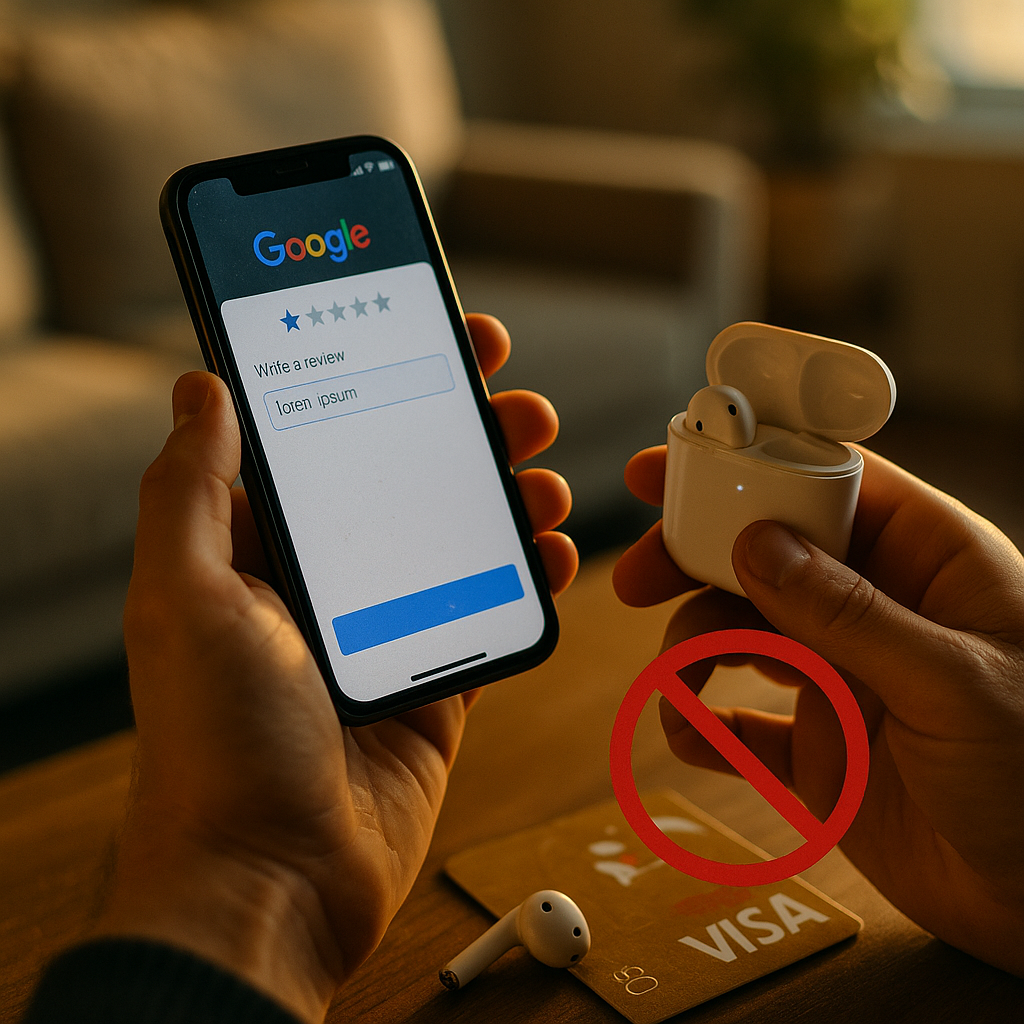
Google now suspends merchant accounts for undisclosed incentivized reviews, and the policy quietly reaches into how brands run gifting and seeding campaigns. If your influencer program still treats “send product, hope for a mention” as a strategy, you’re sitting on compliance debt. The Google ban on undisclosed incentivized reviews isn’t a search algorithm footnote. It’s a direct challenge to how seeding programs operate at scale.
What Google Actually Changed
Google’s updated review policies tighten enforcement against reviews generated through incentives, free products, or compensation that aren’t clearly flagged to the reader. This isn’t new language exactly, but Google has moved from passive policy to active enforcement, pulling product listings, suspending Google Business Profile accounts, and stripping review visibility when disclosure is missing or buried.
The mechanism matters here. Google’s systems increasingly cross-reference review patterns, timing clusters, and language similarity to flag incentivized activity, even when a brand never explicitly asked for a “positive” review. Sent a hundred units to creators the same week and got forty five-star reviews within 72 hours? That pattern reads as incentivized activity whether or not cash changed hands. For background on how Google closed a related loophole, see our breakdown of gifted review disclosure rules.
A free product is compensation in the eyes of both Google and the FTC. If your seeding program hasn’t updated its disclosure language to reflect that, you’re exposed on two regulatory fronts at once.
Why Seeding Programs Are Ground Zero
Seeding, sending free products to creators with no formal contract, is the most common and least documented tactic in influencer marketing. It’s cheap, it’s fast, and it scales. According to Statista, product gifting remains one of the top three influencer engagement tactics brands use globally, precisely because it avoids the overhead of paid contracts.
That lack of formal structure is exactly the problem. Most seeding programs never specify how a creator should disclose the gift, whether in-platform tags are sufficient, or what happens if the creator posts a glowing review without mentioning it was free. Brands assumed Google’s enforcement focused on paid search ads and sponsored listings. The incentivized review crackdown says otherwise: organic-looking content tied to free product now carries the same disclosure burden as a paid placement.
Agencies running seeding at volume for e-commerce clients face the sharpest exposure. A beauty brand sending 200 PR boxes a month, expecting a chunk to land on Google-indexed blogs or YouTube reviews, is running what Google now classifies as incentivized review generation at scale.
The Disclosure Gap Brands Keep Missing
Here’s the uncomfortable part: most brands think “FTC compliant” and “Google compliant” are the same checkbox. They’re not. The FTC cares about consumer deception in advertising. Google cares about the integrity of its review and search ecosystem. A creator can satisfy FTC disclosure rules with a hashtag and still trigger Google’s incentivized review flags if the review appears on a third-party site, blog, or embedded widget that Google indexes.
This dual-compliance reality means brands need disclosure language built for both systems simultaneously. We’ve covered the FTC side extensively, including the recent FTC endorsement sweep enforcement actions, but Google’s parallel track is newer and less understood by most marketing teams.
Consider AI-written or AI-assisted testimonials too. If a creator uses generative tools to draft a review based on a seeded product, both platforms now expect disclosure of that fact. We broke down the mechanics in our piece on AI-generated testimonial disclosure requirements, and the overlap with Google’s incentivized review policy is significant: AI-assisted content plus free product equals two disclosure obligations stacked on one post.
Where Agencies Carry Risk They Didn’t Sign Up For
Brands often assume the creator bears sole responsibility for disclosure. Google and the FTC don’t see it that way, and increasingly neither do courts. Agencies that manage seeding logistics, select creators, or approve content before it publishes can be treated as a party to the violation. Our analysis of agency liability for creator disclosures walks through how this plays out contractually, and it’s worth reading before your next seeding wave goes out.
Building a Compliant Seeding Workflow
Fixing this doesn’t require abandoning seeding. It requires treating it like the regulated activity it now is.
- Standardize disclosure templates. Give creators exact language options, not vague instructions like “please disclose if relevant.” Specify platform-native disclosure tools (Instagram’s paid partnership tag, YouTube’s “includes paid promotion” label) and require them for any gifted product, not just paid placements.
- Track seeding at the same rigor as paid media. Log every product sent, every creator who received it, and every piece of resulting content. If Google or the FTC ever audits a campaign, “we don’t have records” is not a defense, it’s an admission.
- Audit third-party review surfaces. Check whether seeded content is landing on blogs, review aggregators, or embedded widgets your brand controls or syndicates. If you’re pulling creator reviews into product pages, you inherit the disclosure obligation.
- Build kill switches into contracts. Reserve the right to require takedowns or edits if a creator’s post violates disclosure standards after publishing.
- Train procurement and PR teams, not just influencer marketing staff. Seeding often happens outside the core influencer team, through PR mailers or product sampling programs that never touch a compliance checklist.
For reference on structuring disclosure around platform-specific requirements, Google’s own guidance is a useful starting point: see Google’s support documentation on review policies.
What Happens If You Ignore This?
Penalties aren’t theoretical. Google can deindex product listings, suspend Merchant Center accounts, and strip review rich snippets from search results, all of which directly tank conversion rates and paid search quality scores. Sprout Social’s research on consumer trust consistently shows that review authenticity signals directly influence purchase decisions, so losing review visibility isn’t just a technical penalty, it’s a revenue hit.
Layer on FTC exposure, and the math gets worse. Civil penalties for deceptive endorsement practices can run into the tens of thousands of dollars per violation, and that’s before accounting for legal fees, PR cleanup, and lost retailer trust. Brands running uninsured seeding programs should also look at how creator marketing insurance can offset some of this exposure, particularly for high-volume gifting operations where one bad actor among hundreds of creators can trigger a cascading compliance review.
The cost of fixing seeding disclosure now is a line item. The cost of fixing it after a Google suspension or FTC inquiry is a crisis communications budget.
None of this means seeding is dead as a tactic. HubSpot’s marketing benchmarks still show gifting campaigns delivering strong engagement-to-cost ratios compared to paid sponsorships. What’s dead is the assumption that free product sits outside disclosure rules. It never did, Google just wasn’t enforcing it with this much teeth before.
Next Step for Brand Teams
Audit your current seeding program this quarter: pull every gifted-product post from the last 90 days and check disclosure language against both FTC and Google standards. If more than a handful fail, your seeding workflow needs a rebuild before your next product drop, not after Google notices.
FAQs
Does Google’s incentivized review policy apply to social media posts, or just written reviews on review sites?
It applies most directly to content Google indexes or surfaces in search and shopping results, including blog reviews, YouTube videos with transcripts, and embedded review widgets. Social posts on closed platforms face less direct Google exposure but still carry FTC disclosure obligations.
What counts as an “incentive” under Google’s rules?
Free products, discounts, payment, affiliate commissions, and even early access to unreleased products can all qualify as incentives. The value of the item doesn’t need to be large for disclosure rules to apply.
Can a brand be penalized if a creator fails to disclose, even without the brand’s knowledge?
Yes. Both Google and the FTC have held brands and their agencies responsible for creator non-disclosure, particularly when the brand controlled the gifting relationship or approved the content before publication.
Is a hashtag like #gifted sufficient disclosure for Google’s standards?
It often satisfies FTC requirements if placed prominently, but Google’s policy focuses more on whether the review’s context clearly communicates incentivization to a reader scanning search results or a review snippet. Platform-native disclosure tags paired with clear language in the content itself offer stronger protection.
How does this affect UGC repurposed in paid ads?
If seeded content gets repurposed into paid ads or on-site testimonials, disclosure obligations carry over and can intensify, since paid media triggers additional FTC scrutiny. Brands should review usage rights and disclosure consistency before repurposing any gifted-product content.
Top Influencer Marketing Agencies
The leading agencies shaping influencer marketing in 2026
Agencies ranked by campaign performance, client diversity, platform expertise, proven ROI, industry recognition, and client satisfaction. Assessed through verified case studies, reviews, and industry consultations.
Moburst

-
2

The Shelf
Boutique Beauty & Lifestyle Influencer AgencyA data-driven boutique agency specializing exclusively in beauty, wellness, and lifestyle influencer campaigns on Instagram and TikTok. Best for brands already focused on the beauty/personal care space that need curated, aesthetic-driven content.Clients: Pepsi, The Honest Company, Hims, Elf Cosmetics, Pure LeafVisit The Shelf → -
3

Audiencly
Niche Gaming & Esports Influencer AgencyA specialized agency focused exclusively on gaming and esports creators on YouTube, Twitch, and TikTok. Ideal if your campaign is 100% gaming-focused — from game launches to hardware and esports events.Clients: Epic Games, NordVPN, Ubisoft, Wargaming, Tencent GamesVisit Audiencly → -
4

Viral Nation
Global Influencer Marketing & Talent AgencyA dual talent management and marketing agency with proprietary brand safety tools and a global creator network spanning nano-influencers to celebrities across all major platforms.Clients: Meta, Activision Blizzard, Energizer, Aston Martin, WalmartVisit Viral Nation → -
5

The Influencer Marketing Factory
TikTok, Instagram & YouTube CampaignsA full-service agency with strong TikTok expertise, offering end-to-end campaign management from influencer discovery through performance reporting with a focus on platform-native content.Clients: Google, Snapchat, Universal Music, Bumble, YelpVisit TIMF → -
6

NeoReach
Enterprise Analytics & Influencer CampaignsAn enterprise-focused agency combining managed campaigns with a powerful self-service data platform for influencer search, audience analytics, and attribution modeling.Clients: Amazon, Airbnb, Netflix, Honda, The New York TimesVisit NeoReach → -
7

Ubiquitous
Creator-First Marketing PlatformA tech-driven platform combining self-service tools with managed campaign options, emphasizing speed and scalability for brands managing multiple influencer relationships.Clients: Lyft, Disney, Target, American Eagle, NetflixVisit Ubiquitous → -
8

Obviously
Scalable Enterprise Influencer CampaignsA tech-enabled agency built for high-volume campaigns, coordinating hundreds of creators simultaneously with end-to-end logistics, content rights management, and product seeding.Clients: Google, Ulta Beauty, Converse, AmazonVisit Obviously →