


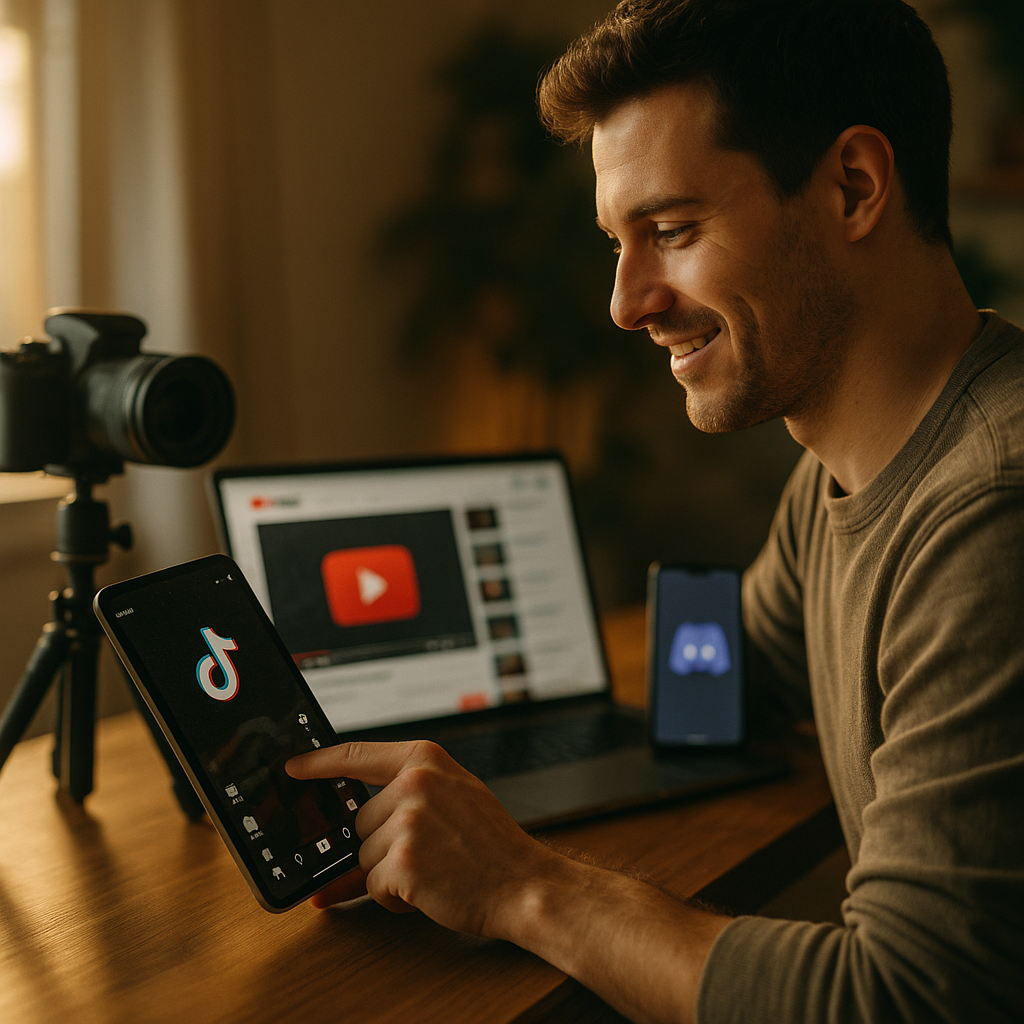
Your Audience Is Never Just Watching One Thing
During last year’s Super Bowl, over 40% of viewers were simultaneously active on a second screen, and a significant share were inside Discord servers, TikTok LIVE streams, and YouTube reaction videos. Multi-surface creator activations aren’t a nice-to-have. They are the new baseline for brands serious about capturing distributed attention in the creator economy.
The Fragmentation Problem Is Structural, Not Cyclical
Attention has always been competitive. What’s different now is the architecture. Audiences aren’t just choosing between two shows on competing networks. They are splitting their presence across fundamentally different content formats, community types, and social contracts at the same moment.
A 22-year-old watching an NBA game in 2026 might have the broadcast on one screen, a Kick streamer reacting to it on another, a Discord channel of 4,000 co-fans running live commentary, and TikTok auto-playing in portrait mode during commercial breaks. Each surface has a different creator, different tone, different engagement expectation. And crucially: different advertising receptivity.
For brand strategists, this creates an operational problem that media buying alone cannot solve. You can’t buy your way into cultural relevance when the conversation is happening inside a private Discord server or a creator’s members-only community on YouTube.
Brands that treat multi-platform activation as a distribution problem will lose. It’s actually a cultural fluency problem — and creators are the translators.
Where Attention Actually Lives Right Now
Let’s be specific, because vague platform generalizations waste budget.
YouTube remains the dominant long-form and VOD habitat. According to Statista, YouTube reaches over 2.7 billion logged-in users monthly, and its connected TV viewership continues to accelerate. The implication for brands: YouTube is where considered purchase decisions get researched, where creator authority compounds over time, and where video podcast CPMs are increasingly competitive with traditional broadcast.
TikTok is the impulse layer. Short-form, trend-reactive, and socially contagious. It functions less like a media channel and more like a cultural mood board that refreshes in real time. Brands trying to activate around live sports moments or cultural drops need a TikTok strategy that operates in hours, not weeks.
Discord is the underground that most brand playbooks still ignore. With over 200 million monthly active users, Discord hosts communities around gaming, sports franchises, music artists, crypto projects, and niche fandoms. It’s where taste is formed before it surfaces on mainstream platforms. Brands that have figured out Discord aren’t advertising inside it — they’re partnering with community owners and creators who already have trust equity with the group.
Emerging surfaces worth watching: Substack’s audio and video expansion, Beehiiv newsletters with embedded creator content, and LinkedIn’s growing short-video feed (relevant especially for B2B pipeline strategy). These aren’t niche experiments — they’re where specific high-value audience segments are concentrating.
Why Single-Platform Briefs Are a Liability
Here’s a scenario that plays out constantly: a brand signs a creator for a TikTok sponsorship tied to a product launch. The creator also has 800,000 YouTube subscribers, a weekly newsletter, and an active Discord community where their most engaged fans live. The brand brief covers one platform. The creator’s actual influence operates across four.
That misalignment is a strategic and contractual failure. The brand is paying for a fraction of the creator’s reach and zero of the cultural amplification that happens in community spaces. Worse, if the brief is too restrictive, the creator’s content feels off-brand for their audience and underperforms across every surface.
This is why creator contracts need to evolve to reflect multi-surface realities — specifying platform deliverables, community engagement expectations, and cross-posting rights rather than locking everything into a single format.
The operational fix isn’t complicated, but it requires discipline: build your creator brief around the audience’s content journey, not your media plan’s column headings. What does a fan of this creator encounter from first discovery to community participation? Design for that path.
Designing Multi-Surface Activations That Actually Convert
Multi-surface doesn’t mean spray-and-pray. It means sequenced, intentional presence across the surfaces where your target audience has different modes of attention and engagement.
A framework that works:
- Anchor content: A longer-form YouTube video or podcast episode where the creator establishes the brand narrative with depth. This is the SEO-durable asset. It answers questions, builds consideration, and ranks.
- Reactive content: TikTok and Instagram Reels built around the same campaign moment but adapted to the format’s native culture — shorter, faster, trend-adjacent. Creators with genuine platform fluency know how to do this without it feeling like a TV ad cut down to 30 seconds.
- Community amplification: Discord, Telegram, or the creator’s Substack/newsletter — wherever their highest-trust audience congregates. This isn’t ad placement; it’s community integration. A creator mentioning a brand in a Discord Q&A or including it in their weekly newsletter recommendation carries disproportionate weight.
- Live moments: Streaming activations on YouTube Live, TikTok LIVE, or Twitch tied to sports events, product drops, or cultural moments. These create urgency and shared experience — two things that advertising alone struggles to manufacture.
For brands investing in sports and entertainment moments, this architecture is particularly powerful. Consider how World Cup-style activations generate layered creator content: pre-match analysis on YouTube, live reaction on TikTok, real-time community conversation on Discord, and post-match creator roundups that drive VOD traffic for weeks.
The Measurement Problem No One Wants to Talk About
Multi-surface activations expose the inadequacy of last-click attribution. A consumer who discovered a brand through a creator’s Discord mention, watched the YouTube review, and converted via a TikTok link three weeks later will show up in your analytics as a TikTok conversion. You’ll pull budget from YouTube. You’ll ignore Discord entirely. And your optimization model will be wrong.
The brands navigating this well are investing in first-party data capture (email sign-ups, community joins, loyalty program enrollments) at every surface touchpoint, then building cohort models that track time-to-conversion across the full journey. eMarketer consistently reports that multi-touch attribution models outperform last-click by significant margins for creator-driven campaigns, particularly in categories with longer consideration cycles.
Budget sequencing matters here too. Flat sponsorship fees distributed evenly across platforms misallocate spend. Paid amplification layered strategically on top of organic creator content tends to compound returns rather than simply adding reach.
The multi-surface measurement gap isn’t a data problem — it’s a model problem. Brands still optimizing for platform-level ROAS will systematically undervalue the surfaces where purchase intent is actually built.
Roster Architecture for a Fragmented World
Not every creator is multi-surface fluent. Some are YouTube natives who produce weak TikTok content. Others are TikTok-native creators whose long-form attempts feel awkward. The correct response isn’t to demand that every creator perform on every platform — it’s to build rosters intentionally.
The participatory fandom economy rewards brands that think in ecosystems rather than individual creators. That means mapping your creator roster to the attention surfaces where your audience lives: a YouTube authority for consideration-stage content, a TikTok creator for trend amplification, a Discord community manager or micro-creator for trust-layer community engagement, and a newsletter creator for the high-intent segment that’s opted into long-form consumption.
This is also where niche creators outperform macro influencers in measurable ways. A niche creator who runs a tight Discord community of 6,000 passionate sneaker enthusiasts delivers a different (often superior) CPA than a macro creator posting to millions of passive followers across a single platform.
Evaluate your current creator roster against this lens: which platforms does each creator genuinely command? Where is their engaged community, not just their follower count? Use tools like Sprout Social or HubSpot’s social listening integrations to track where audience conversation actually surfaces after a creator activation — you’ll often find that the ROI is flowing from a platform you weren’t measuring.
For brands managing complex rosters across multiple agencies, the AOR versus hybrid agency debate becomes directly relevant. Multi-surface activations require coordination that a single-platform specialist shop often can’t provide, but consolidated AOR arrangements can introduce bottlenecks in reactive, moment-driven content. The answer is usually a hybrid model with clear platform lane ownership and fast-approval protocols built into the creator agreement from day one.
Start here: audit your last three creator campaigns and map every piece of content, organic and paid, to the platform where it was consumed. Then overlay your conversion data. The gap between where you invested and where impact was generated will tell you exactly where your multi-surface strategy needs to be rebuilt.
Frequently Asked Questions
What is a multi-surface creator activation?
A multi-surface creator activation is a brand campaign designed to engage audiences across multiple platforms simultaneously, such as YouTube, TikTok, Discord, and newsletters. Rather than briefing a single creator for one platform, brands design content journeys that follow audience attention across different surfaces, formats, and community types. Each surface serves a specific role: awareness, consideration, community trust, or conversion.
Why is attention fragmentation a problem for influencer marketing budgets?
Attention fragmentation means that no single platform captures a complete audience. When consumers split their time across YouTube, TikTok, Discord, and live streaming simultaneously, brands that concentrate their influencer spend on one platform miss significant portions of the target audience’s engagement journey. This leads to underperformance, inaccurate attribution, and missed opportunities to influence purchase decisions at the community level.
How should brands measure ROI across multiple creator platforms?
Brands should move beyond last-click attribution and invest in multi-touch models that track the full consumer journey from discovery to conversion. First-party data capture at every touchpoint (email sign-ups, community joins, loyalty enrollments) is essential. Cohort analysis that measures time-to-conversion across surfaces provides a more accurate picture of which platforms and creator types are driving genuine business outcomes versus surface-level engagement metrics.
Which platforms should brands prioritize for multi-surface creator campaigns?
Platform prioritization should follow your audience’s attention patterns, not industry defaults. YouTube is critical for long-form authority content and SEO-durable assets. TikTok serves trend-reactive, impulse-layer engagement. Discord and community platforms are where high-trust, purchase-influencing conversations happen at the fandom level. Emerging surfaces like Substack, Beehiiv, and LinkedIn video are increasingly relevant for specific high-value audience segments. The right mix depends on your category, audience demographics, and campaign objectives.
How does creator roster architecture change for multi-surface strategies?
Rather than selecting creators based on total follower count, brands need to map roster selection to platform fluency and community ownership. A multi-surface roster typically includes a YouTube authority creator for consideration-stage content, a TikTok-native creator for trend amplification, a Discord or community-native micro-creator for trust-layer engagement, and a newsletter creator for high-intent audiences. Niche creators often outperform macro influencers on cost-per-acquisition metrics in this model because their community engagement is deeper and more intentional.
Top Influencer Marketing Agencies
The leading agencies shaping influencer marketing in 2026
Agencies ranked by campaign performance, client diversity, platform expertise, proven ROI, industry recognition, and client satisfaction. Assessed through verified case studies, reviews, and industry consultations.
Moburst

-
2

The Shelf
Boutique Beauty & Lifestyle Influencer AgencyA data-driven boutique agency specializing exclusively in beauty, wellness, and lifestyle influencer campaigns on Instagram and TikTok. Best for brands already focused on the beauty/personal care space that need curated, aesthetic-driven content.Clients: Pepsi, The Honest Company, Hims, Elf Cosmetics, Pure LeafVisit The Shelf → -
3

Audiencly
Niche Gaming & Esports Influencer AgencyA specialized agency focused exclusively on gaming and esports creators on YouTube, Twitch, and TikTok. Ideal if your campaign is 100% gaming-focused — from game launches to hardware and esports events.Clients: Epic Games, NordVPN, Ubisoft, Wargaming, Tencent GamesVisit Audiencly → -
4

Viral Nation
Global Influencer Marketing & Talent AgencyA dual talent management and marketing agency with proprietary brand safety tools and a global creator network spanning nano-influencers to celebrities across all major platforms.Clients: Meta, Activision Blizzard, Energizer, Aston Martin, WalmartVisit Viral Nation → -
5

The Influencer Marketing Factory
TikTok, Instagram & YouTube CampaignsA full-service agency with strong TikTok expertise, offering end-to-end campaign management from influencer discovery through performance reporting with a focus on platform-native content.Clients: Google, Snapchat, Universal Music, Bumble, YelpVisit TIMF → -
6

NeoReach
Enterprise Analytics & Influencer CampaignsAn enterprise-focused agency combining managed campaigns with a powerful self-service data platform for influencer search, audience analytics, and attribution modeling.Clients: Amazon, Airbnb, Netflix, Honda, The New York TimesVisit NeoReach → -
7

Ubiquitous
Creator-First Marketing PlatformA tech-driven platform combining self-service tools with managed campaign options, emphasizing speed and scalability for brands managing multiple influencer relationships.Clients: Lyft, Disney, Target, American Eagle, NetflixVisit Ubiquitous → -
8

Obviously
Scalable Enterprise Influencer CampaignsA tech-enabled agency built for high-volume campaigns, coordinating hundreds of creators simultaneously with end-to-end logistics, content rights management, and product seeding.Clients: Google, Ulta Beauty, Converse, AmazonVisit Obviously →