


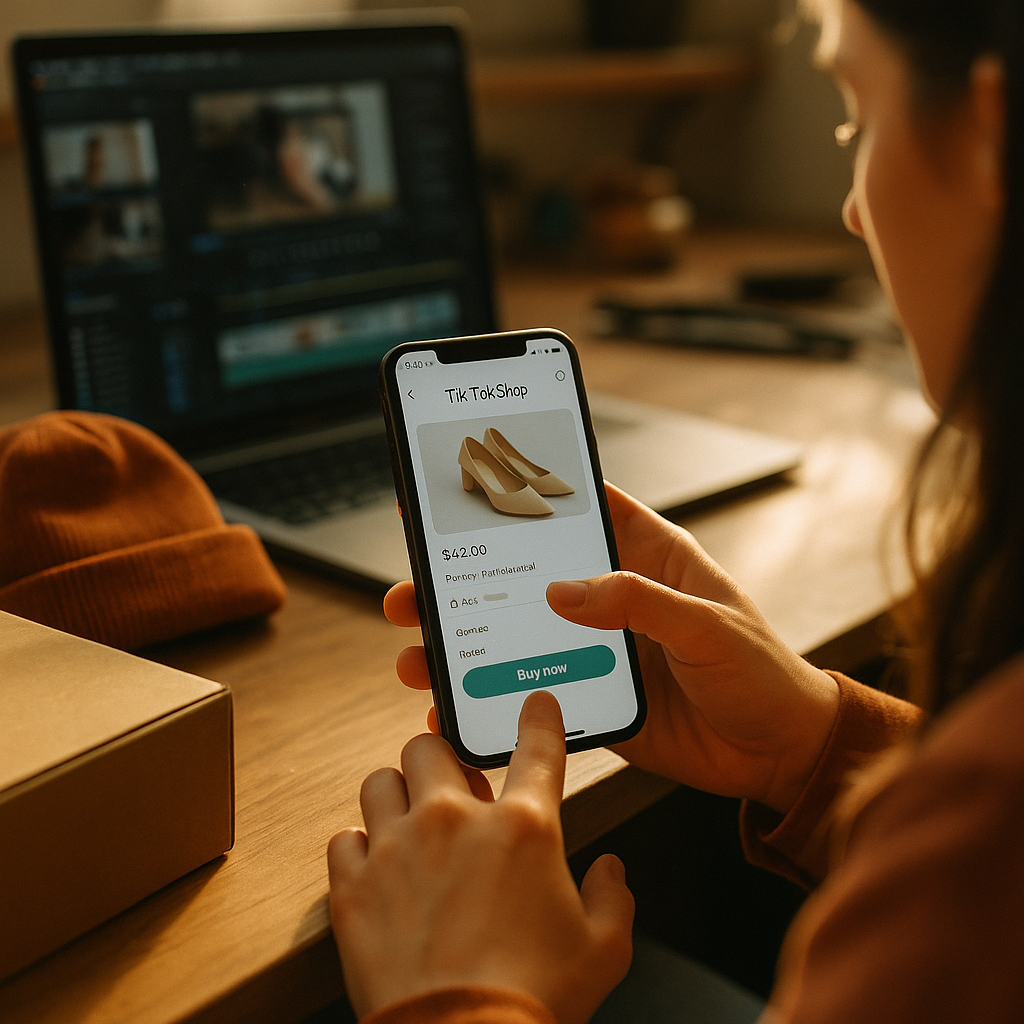
Three seconds. That’s roughly how long a TikTok Shop viewer takes to decide whether a product is worth a tap. No redirect, no cart abandonment on a slow-loading landing page, no second thoughts while a payment gateway loads. TikTok Shop’s in-app checkout has collapsed the funnel into a single scroll-stop moment, and most brand creative simply wasn’t built for that kind of pressure.
If your production pipeline still treats TikTok content like a top-of-funnel awareness play, you’re leaving commission on the table. The platform has quietly rewired the relationship between content and conversion, and the brands winning right now are the ones that rebuilt their creative process around it.
The Checkout Moved Inside the Content
For most of digital marketing history, creative and commerce lived in separate systems. A video earned attention, a landing page closed the sale. TikTok Shop erased that boundary. Product cards, live shopping carts, and affiliate links now sit directly inside the video experience, meaning the creative itself has to carry the entire purchase decision, not just spark interest in one.
That’s a fundamentally different creative brief. A traditional ad can afford a slow build, a clever twist at the end, a brand-first narrative arc. In-app checkout content can’t. Every second of hesitation is a second closer to a scroll-away. Speed to checkout has become its own competitive metric, and creative teams are being measured against it whether they realize it or not.
When checkout lives inside the content, the content stops being marketing and starts being the storefront. Treat it accordingly.
Why Old Creative Playbooks Are Losing Money
Here’s the uncomfortable truth: a lot of brand creative is still optimized for brand recall, not purchase intent. Beautiful cinematography, slow reveals, brand-logo-at-the-end structures — all of it performs fine on awareness metrics and terribly on Shop conversion rates.
Consider what actually happens in a frictionless checkout environment. A viewer sees a product demo, taps the shopping bag icon, and completes a purchase without leaving the app. If the video hasn’t already answered “what is this, why do I need it, and how much does it cost” within the first five seconds, that tap never happens. According to eMarketer, social commerce continues to grow faster than overall e-commerce, and TikTok Shop is a major driver of that gap. Brands that don’t adapt creative pacing are effectively subsidizing competitors who do.
This isn’t just a TikTok problem, either. It echoes shifts happening across the platform’s ranking systems more broadly. The same logic that pushed TikTok to prioritize creator trust over post volume is now pushing commerce content toward instant clarity over polish.
What Frictionless Creative Actually Looks Like
So what changes in the production process? A few things, and none of them are subtle.
- Product visibility in frame one. No slow pans, no mystery-box intros. The item needs to be identifiable before the viewer’s thumb even considers moving.
- Price and value stated out loud or on-screen early. Ambiguity kills conversion. Viewers want to know if this is a $12 impulse buy or a $150 consideration purchase before they invest attention.
- Native, UGC-style production. Overly polished ads read as “ad” and trigger skip behavior. Creators shooting on phones, in real environments, consistently outperform studio shoots on Shop conversion.
- Built-in urgency cues. Limited stock callouts, live-only discounts, and affiliate leaderboard mentions all nudge the viewer toward immediate action rather than “I’ll come back later.”
- Caption and on-screen text as a second sales channel. Many viewers watch muted. If your value proposition only lives in voiceover, you’ve lost half your audience.
None of this is about lowering production value for its own sake. It’s about recognizing that the creative’s job description changed. It’s not a trailer for the product anymore. It’s the point of sale.
Briefing Creators for Conversion, Not Just Reach
This shift hits brief-writing hardest. A brief built for awareness content usually leans on brand tone, key messaging pillars, and “creative freedom within guardrails.” A brief built for checkout-embedded content needs to be far more tactical.
Smart brands are now specifying exact timing for product reveal, mandating on-screen price callouts, and requiring a clear call-to-action gesture (tapping the yellow cart icon, saying “link in cart”) within the first ten seconds. It sounds rigid. It is rigid. But rigidity in service of conversion is a fair trade when the alternative is a beautifully shot video that nobody buys from.
This mirrors what’s already happening across other platforms as algorithms reward specificity over generic reach. Brands that failed to update briefs for watch-time signals saw performance collapse almost overnight. Checkout-optimized creative is the commerce-side version of the same lesson: the platform tells you what it rewards, and your brief either reflects that or it doesn’t.
There’s also a compliance layer brands can’t ignore. Faster checkout means faster claims, faster disclosures, faster everything, and the FTC hasn’t relaxed its expectations just because the sales cycle sped up. Influencer content promoting products with in-app purchase links still needs clear, conspicuous disclosure per FTC guidelines, and that requirement doesn’t disappear just because the creative is a fifteen-second clip optimized for speed.
Live Shopping Raises the Stakes Further
If static Shop videos demand fast creative, live shopping demands something closer to real-time production discipline. TikTok’s push toward 24/7 livestream infrastructure means brands are now staffing and scripting content that never technically stops airing.
That has real operational consequences. Brands used to producing a handful of polished monthly campaigns are now being asked to support hosts who need constantly refreshed talking points, updated pricing, and live-reactive product demos. It’s less “shoot and wrap” and more “always-on retail broadcast.” Teams that haven’t rethought staffing around live shopping are discovering the hard way that creative production and commerce operations can no longer sit in separate departments.
The brands treating TikTok Shop as a broadcast retail channel, not a marketing placement, are the ones seeing sustainable commission growth.
Affiliate Creators Need a Different Kind of Creative Support
Most TikTok Shop volume doesn’t come from brand-owned accounts. It comes from affiliate creators pulling products from the Shop catalog and building their own content around them. That means brand influence over “the creative” is often indirect, exercised through sample kits, commission structures, and creator education rather than direct scripts.
This is where a lot of brands underinvest. If you’re not actively coaching your affiliate base on what converts, they’ll default to whatever content style got them views last month, which isn’t always what drives checkout completions. Brands seeing the strongest affiliate performance are the ones running structured onboarding: sample product decks with suggested hooks, price transparency guidelines, and examples of high-converting formats pulled from their own affiliate leaderboard data.
Commission structure matters here too. Tiered incentives that reward creators for actual completed checkouts, not just link clicks, push the whole affiliate ecosystem toward frictionless-sale thinking naturally. Brands running category-specific programs, like the tiered models seen in home goods commission tiers, are effectively training their creator base to self-optimize for speed to purchase, without micromanaging every video.
The Verification and Compliance Layer Nobody Talks About
There’s an operational wrinkle that rarely makes it into creative strategy conversations: none of this frictionless-checkout content matters if the Shop account behind it isn’t properly verified and compliant. Brands rushing to scale affiliate programs have run into real delays over mismatched business documentation, which stalls payouts and creator trust simultaneously.
Category-specific rules add another layer. Beauty brands running live shopping need to navigate FTC disclosure requirements alongside platform-specific restrictions, particularly around livestream compliance risk and, in some markets, age-gating for alcohol-adjacent formulations. Speed-to-checkout creative is worthless if the underlying commerce infrastructure gets flagged or frozen mid-campaign.
Data hygiene deserves a mention too, especially for brands operating in the UK or EU. Faster checkout means faster data collection at scale, and regulators are paying attention. The Information Commissioner’s Office has been increasingly vocal about consumer data handling in social commerce contexts, which is one more reason legal and creative teams need to be talking to each other more than they currently are.
Building an Actual Production Workflow for This
Theory is easy. Operationalizing it is where most teams stall. A workable production model for frictionless Shop creative usually includes:
- A shortened creative brief template specifically for Shop-linked content, distinct from brand awareness briefs.
- A rapid-turnaround shoot cadence, weekly or biweekly rather than monthly, matched to product drops and trending sounds.
- A shared calendar between commerce, legal, and creative teams so compliance review doesn’t become the bottleneck that kills speed-to-post advantage.
- Creator scorecards tracking checkout completion rate, not just views or engagement, as the primary success metric.
- A feedback loop where top-converting affiliate content gets reverse-engineered into brand guidance for future creators.
None of this requires a massive budget increase. It requires reallocating existing production hours away from polish and toward volume, speed, and clarity. That’s an uncomfortable trade for teams used to being judged on brand aesthetics. But aesthetics don’t pay commission. Completed checkouts do.
For a broader view of how discovery and distribution logic is shifting across platforms, it’s worth comparing this to how discovery-over-reach ranking has changed creator vetting elsewhere. The throughline is the same: platforms are rewarding relevance and immediacy over broad, generic reach, and creative production has to catch up or keep losing efficiency.
Tools like those referenced in Sprout Social’s social commerce research, and benchmarking data from Statista, can help brands quantify exactly how much conversion lift comes from restructuring creative pacing versus simply increasing ad spend. Worth running that analysis before the next planning cycle, not after.
Next step: Audit your last ten Shop-linked videos against a single question: does the product, price, and call-to-action appear within the first five seconds? If the answer is no more than half the time, that’s your production bottleneck, not your media budget.
FAQs
What makes TikTok Shop’s in-app checkout different from standard social commerce?
It removes the redirect to an external website entirely. Viewers can browse, add to cart, and complete payment without ever leaving the TikTok app, which shortens the decision window dramatically compared to link-in-bio or landing-page-based social commerce.
How long should Shop-linked TikTok videos be to maximize conversion?
Most high-converting Shop content runs between fifteen and thirty seconds, with the product and price identified in the first five seconds. Longer format works for live shopping, but standard feed content performs best when it gets to the point fast.
Do brands need separate creative briefs for TikTok Shop versus brand awareness content?
Yes. Awareness content can afford narrative build and brand-first pacing. Shop-linked content needs immediate product visibility, clear pricing, and an explicit call-to-action gesture, since the creative itself functions as the point of sale rather than a precursor to one.
How does FTC disclosure apply to TikTok Shop affiliate content?
Affiliate creators promoting products through TikTok Shop links must still follow standard FTC disclosure guidelines, meaning paid partnerships or commission-based promotions require clear, conspicuous disclosure regardless of how short or fast-paced the content is.
What metric should replace views as the primary KPI for Shop creative?
Checkout completion rate. Views and engagement still matter for discovery, but they’re vanity metrics if they don’t translate into completed in-app purchases. Brands should track conversion rate per video and per creator to identify what production style actually drives revenue.
FAQs
Top Influencer Marketing Agencies
The leading agencies shaping influencer marketing in 2026
Agencies ranked by campaign performance, client diversity, platform expertise, proven ROI, industry recognition, and client satisfaction. Assessed through verified case studies, reviews, and industry consultations.
Moburst

-
2

The Shelf
Boutique Beauty & Lifestyle Influencer AgencyA data-driven boutique agency specializing exclusively in beauty, wellness, and lifestyle influencer campaigns on Instagram and TikTok. Best for brands already focused on the beauty/personal care space that need curated, aesthetic-driven content.Clients: Pepsi, The Honest Company, Hims, Elf Cosmetics, Pure LeafVisit The Shelf → -
3

Audiencly
Niche Gaming & Esports Influencer AgencyA specialized agency focused exclusively on gaming and esports creators on YouTube, Twitch, and TikTok. Ideal if your campaign is 100% gaming-focused — from game launches to hardware and esports events.Clients: Epic Games, NordVPN, Ubisoft, Wargaming, Tencent GamesVisit Audiencly → -
4

Viral Nation
Global Influencer Marketing & Talent AgencyA dual talent management and marketing agency with proprietary brand safety tools and a global creator network spanning nano-influencers to celebrities across all major platforms.Clients: Meta, Activision Blizzard, Energizer, Aston Martin, WalmartVisit Viral Nation → -
5

The Influencer Marketing Factory
TikTok, Instagram & YouTube CampaignsA full-service agency with strong TikTok expertise, offering end-to-end campaign management from influencer discovery through performance reporting with a focus on platform-native content.Clients: Google, Snapchat, Universal Music, Bumble, YelpVisit TIMF → -
6

NeoReach
Enterprise Analytics & Influencer CampaignsAn enterprise-focused agency combining managed campaigns with a powerful self-service data platform for influencer search, audience analytics, and attribution modeling.Clients: Amazon, Airbnb, Netflix, Honda, The New York TimesVisit NeoReach → -
7

Ubiquitous
Creator-First Marketing PlatformA tech-driven platform combining self-service tools with managed campaign options, emphasizing speed and scalability for brands managing multiple influencer relationships.Clients: Lyft, Disney, Target, American Eagle, NetflixVisit Ubiquitous → -
8

Obviously
Scalable Enterprise Influencer CampaignsA tech-enabled agency built for high-volume campaigns, coordinating hundreds of creators simultaneously with end-to-end logistics, content rights management, and product seeding.Clients: Google, Ulta Beauty, Converse, AmazonVisit Obviously →